创新药

Search documents
机构研判港股2026年前景: 基本面“接棒”驱动行情 看好四类资产配置价值
Zhong Guo Zheng Quan Bao· 2025-11-04 20:37
Core Viewpoint - The outlook for the Hong Kong stock market in 2026 is optimistic, driven by fundamental improvements and the potential for AI industry catalysis, which may enhance the net asset return (ROE) of related sectors, particularly the Hang Seng Technology Index [1][2][3]. Market Performance - The Hong Kong stock market rebounded significantly since early 2024, with major indices reaching new highs in 2025. As of November 4, 2023, the Hang Seng Index, Hang Seng Technology Index, and Hang Seng China Enterprises Index have increased by 29.37%, 30.22%, and 25.83% respectively this year [1][2]. Market Adjustments - The market experienced notable adjustments in April and October 2023, leading to a high-level consolidation phase. Investors are particularly focused on whether the market can maintain its upward momentum and set new highs in 2026 [2][3]. Earnings Growth - It is predicted that the revenue growth rate for non-financial overseas Chinese companies will reach 4% in 2026, with operating profit growth expected to be 13%. This profit growth is attributed to cost reduction, efficiency improvements, and advancements in AI applications [2][3]. Valuation Insights - Current valuations of the Hong Kong stock market are considered low, especially in the technology sector, providing ample room for further upward movement. Historical comparisons indicate that the market is undervalued, suggesting significant potential for valuation recovery [3][4]. Capital Inflows - There is a high certainty of incremental capital inflows into the Hong Kong market in 2026, with net inflows from southbound funds exceeding 1.27 trillion HKD since 2025, marking a historical high. The inflow structure is expected to become more balanced [4][5]. Domestic and Foreign Investment - Domestic institutional investors, including public funds and insurance companies, are increasingly influencing the pricing power in the Hong Kong market. It is anticipated that net inflows from southbound funds could exceed 1.5 trillion RMB in 2026 [5][6]. Sector Focus - The technology sector, particularly driven by AI advancements, is expected to be the main focus for the Hong Kong market in 2026. Additionally, there is a recommendation to pay attention to innovative pharmaceuticals and brokerage firms, which are anticipated to perform well due to favorable market conditions [6].
基本面“接棒”驱动行情 看好四类资产配置价值
Zhong Guo Zheng Quan Bao· 2025-11-04 20:17
Core Viewpoint - The outlook for the Hong Kong stock market in 2026 is optimistic, driven by fundamental improvements and the potential for AI industry catalysis, which may enhance the net asset return (ROE) of related sectors, particularly the Hang Seng Technology Index [1][2][3] Market Performance - The Hong Kong stock market rebounded significantly since early 2024, with major indices reaching new highs in 2025. As of November 4, 2023, the Hang Seng Index, Hang Seng Technology Index, and Hang Seng China Enterprises Index have increased by 29.37%, 30.22%, and 25.83% respectively this year [1][2] Market Adjustments - The market experienced notable adjustments in April and October 2023, leading to a high-level consolidation phase. Investors are particularly focused on whether the market can maintain its upward momentum and set new highs in 2026 [2][3] Earnings Growth - Predictions indicate that the revenue growth for non-financial overseas Chinese companies could reach 4% in 2026, with operating profit growth expected to be 13%. This improvement is attributed to cost reduction, efficiency gains, and advancements in AI applications [2][3] Valuation Insights - Current valuations of the Hong Kong stock market are considered low, especially in the technology sector, providing ample room for further upward movement. Historical comparisons suggest significant potential for valuation recovery [3][4] Capital Inflows - There is a high certainty of incremental capital inflows into the Hong Kong market in 2026, with net inflows from southbound funds exceeding 1.27 trillion HKD since 2025, marking a historical high [3][4] Foreign and Domestic Investment - Foreign investment is expected to improve as it is currently underweight in Chinese equity assets. Additionally, domestic institutional investors are increasingly influencing the pricing power in the Hong Kong market, with expectations of continued strong inflows [4][5] Sector Focus - The technology sector, particularly driven by AI advancements, is anticipated to be the main focus for 2026. Other sectors such as innovative pharmaceuticals and brokerage firms are also recommended for investment consideration [5][6] Policy Support - The government is expected to enhance support for the technology sector, particularly in areas like computing infrastructure and AI application development, which may accelerate the growth of the AI industry [6] Investment Strategy - Investors are advised to maintain a focus on growth-oriented technology stocks while also considering value-oriented assets as the market evolves. The potential for a shift towards cyclical stocks is also highlighted as the economic recovery progresses [6]
4000点成为过不去的坎,起点还是终点?
Ge Long Hui· 2025-11-04 19:31
Market Performance - The three major indices collectively declined, with the Shanghai Composite Index down 0.19%, the Shenzhen Component down 1.27%, and the ChiNext down 1.51% [1] - Over 3,400 stocks fell across the two markets, with a total trading volume of 1.216 trillion [1] Sector Performance - Robotics concept stocks experienced a collective decline, with significant drops in companies like Ampere and Top Group [3] - The innovative drug sector saw fluctuations, with Changshan Pharmaceutical nearing a limit down [3] - Gold concept stocks also faced declines, particularly Chao Hong Ji [3] - Nearly 20 industry sectors, including energy metals, precious metals, and lithium mining, saw declines exceeding 2% [3] - Banking stocks opened high and rose by 1.83%, with Xiamen Bank increasing by 6.48% [3] - The Fujian sector performed well, with Pingtan Development achieving 10 consecutive trading limits [3] - Semiconductor equipment stocks rebounded, with Zhongwei Company rising over 7% [3] - The coal sector remained active, with Antai Group achieving 8 limits in 14 days [3] News and Announcements - Ant Group and others established an innovative venture capital partnership with an investment of 600 million [3] - The Federal Reserve announced a 25 basis point reduction in the federal funds rate target range to between 3.75% and 4%, marking the second rate cut this year [3] - The London Metal Exchange will suspend all non-USD denominated metal options trading starting November 10, 2025 [3]

超半数投资者盈利 权益配置意愿持续升温——上海证券报·个人投资者2025年第四季度调查报告
Shang Hai Zheng Quan Bao· 2025-11-04 19:09
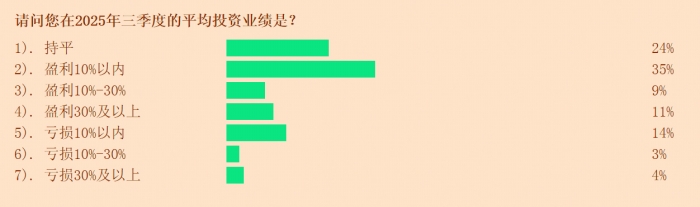
Core Viewpoint - The A-share market experienced a strong rebound in the third quarter, leading to improved investor sentiment and profitability, with over 55% of surveyed investors reporting gains [6][7][24] Market Performance - The Shanghai Composite Index rose from below 3500 points to close at 3882.78 points by September 30, marking a cumulative increase of 12.73% for the quarter [7] - The Shenzhen Component Index and the ChiNext Index saw even larger gains, increasing by 29.25% and 50.4% respectively [7] Investor Sentiment - 55% of investors reported profitability in Q3, an increase of 7 percentage points from Q2 and 13 percentage points from Q1 [7][8] - Over 70% of surveyed investors are optimistic about the A-share market in Q4, with many expecting the Shanghai Composite Index to reach around 3900 points [19][20] Asset Allocation Trends - The proportion of personal financial assets allocated to securities increased to 42.2%, up from 40.87% in Q1 [10] - 38% of investors increased their stock market investments in Q3, while 41% reduced their holdings [9] Sector Focus - The technology sector remains a focal point for investors, with nearly half expecting a style shift in Q4, while 30% believe technology stocks will continue to perform strongly [14][16][18] - The average holding in technology growth stocks rose to 26.64%, significantly higher than other sectors [15] Gold Investment - 67% of investors anticipate further increases in gold prices, with many viewing it as a hedge against geopolitical risks and inflation [12] - The average gold price rose from $3300 to $3800 per ounce during the quarter [12] Hong Kong Market Interest - 24% of investors increased their Hong Kong stock investments in Q3, with a profitability rate of 40% [22] - Investors are optimistic about the long-term potential of the Hong Kong market, with many viewing it as a value opportunity [22][24]
成长VS价值!基金三季报“暗战”
Guo Ji Jin Rong Bao· 2025-11-04 14:12
Core Insights - The A-share market is experiencing fluctuations below the 4000-point mark, with a focus on whether traditional value sectors like dividends and consumption can lead the market upward [1] - The divergence in performance between growth and value sectors is becoming more pronounced, with institutional investors showing differing views on popular sectors [1][2] - The third-quarter reports indicate that some popular sectors are showing signs of valuation bubbles, and the pace of new fund investments is slowing down, which could impact future market dynamics [1][2] Growth Sector Performance - The Ruiyuan Growth Value Fund has surpassed 20 billion yuan in size, with a net value increase of over 50% in Q3, focusing on high-growth sectors like internet technology and semiconductors [2] - The Xingquan Helun Fund, with nearly 25 billion yuan, reported a 36.16% net value increase, emphasizing the importance of overseas computing power sectors [2] - The Galaxy Innovation Growth Fund, exceeding 16 billion yuan, also saw a net value increase of over 50%, primarily driven by the technology sector [3] Value Sector Challenges - The consumer sector, particularly food and beverage, has underperformed, with the sector index rising only 2.44% in Q3, ranking 27th among 31 industry indices [5][6] - The E-Fonda Consumer Fund, the largest active stock fund, reported an 8.83% net value increase in Q3 but a year-to-date decline of 1.2% [6] - Fund managers are adjusting their portfolios to focus on companies that can adapt to industry changes and are increasing exposure to undervalued sectors [6][7] Market Sentiment and Strategy - Fund managers express caution regarding the rapid market gains in Q3, with some indicating that the current market environment may not be sustainable [9][10] - The sentiment among value fund managers remains optimistic about traditional sectors, anticipating a recovery in domestic demand and asset prices [7][8] - The market's high activity level in Q3 is noted, but the concentration of gains in specific sectors raises concerns about long-term sustainability [9][10] Investment Outlook - The AI sector is highlighted as a key area for investment, but concerns about high valuations and the need for performance to meet optimistic expectations are prevalent [11] - Fund managers emphasize the importance of maintaining a long-term investment perspective amidst market volatility and the challenges of adjusting large portfolios [10][11]
ETF龙虎榜 | 提前埋伏 收获逆势上涨!
Zhong Guo Zheng Quan Bao· 2025-11-04 14:01
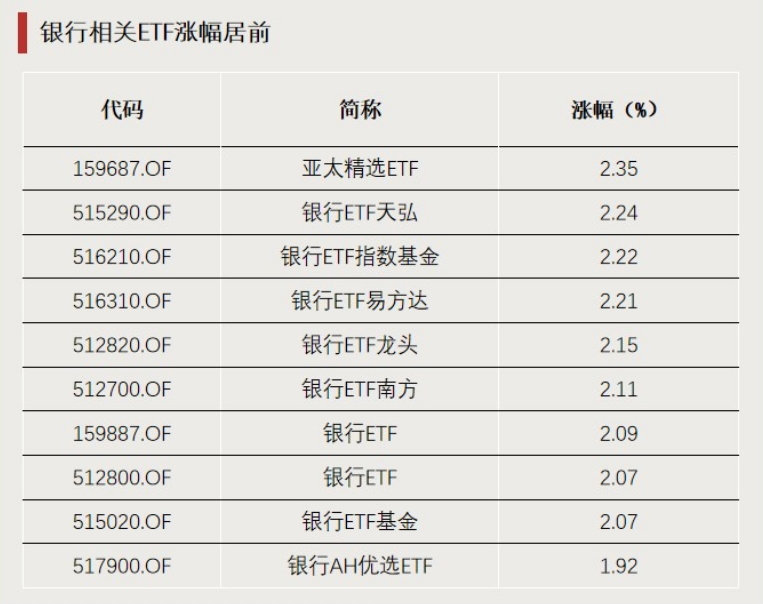
Group 1: Market Overview - On November 4, A-shares experienced a volume contraction adjustment, while bank stocks rose against the trend, leading to significant gains in related ETFs, with 9 out of the top 10 ETFs being bank-related [1][4] - The rise in bank stocks is attributed to a "defensive switch" in capital, as investors seek safer investments amid increased market volatility in the fourth quarter [6][11] Group 2: ETF Performance - The top-performing ETFs on November 4 included bank-related ETFs, with notable gains such as Xiamen Bank rising nearly 6% and the Tianhong Bank ETF increasing by 2.24% [4][5] - The total trading volume of ETFs on November 4 was approximately 500.5 billion yuan, with a decrease of nearly 60 billion yuan from the previous day [8] Group 3: Bond ETFs - The trading activity of Sci-Tech bond ETFs remained robust, with 5 such ETFs exceeding 9 billion yuan in trading volume on November 4, and the total scale of bond ETFs surpassing 700 billion yuan [2][8] - The newly issued 24 Sci-Tech bond ETFs this year have collectively reached a scale of 252.34 billion yuan, indicating strong market interest in this segment [2] Group 4: Sector Rotation - There has been a noticeable shift in capital towards defensive sectors, with significant net inflows into ETFs related to securities, banks, liquor, and innovative pharmaceuticals, reflecting a strategy to mitigate risks [3][11] - The banking sector, having previously underperformed, is now attracting attention due to its perceived investment value after recent adjustments [6][11]
金工ETF点评:跨境ETF单日净流入32.12亿元,煤炭、环保、石化拥挤变幅较大
Tai Ping Yang Zheng Quan· 2025-11-04 13:14
- The industry crowding monitoring model was constructed to monitor the crowding level of Shenwan primary industry indices daily. The model identifies industries with high crowding levels, such as electric power equipment and environmental protection, while industries like non-bank financials exhibit lower crowding levels. The model also tracks significant changes in crowding levels for industries like environmental protection, coal, and petrochemicals[3] - The Z-score model for premium rate was developed to screen ETF products with potential arbitrage opportunities. The model uses rolling calculations to identify ETFs with significant deviations from their fair value, providing signals for potential trades while warning of possible price corrections[4] - The Z-score model for premium rate was applied to ETF products, including broad-based ETFs, industry-themed ETFs, style-strategy ETFs, and cross-border ETFs. The model identified top funds with net inflows and outflows, such as the A500ETF fund (+9.14 billion yuan) and the Shanghai 50ETF (-11.95 billion yuan), respectively[5][6] - The industry crowding monitoring model and Z-score model for premium rate provide valuable insights into market dynamics and potential trading opportunities. However, the models require continuous updates and validation to ensure accuracy and reliability in changing market conditions[3][4]
市场下行,红利支撑
Tebon Securities· 2025-11-04 12:14
Market Analysis - The A-share market experienced a volume contraction and a downward adjustment, with the Shanghai Composite Index closing down 0.41% at 3960.19 points, and the ChiNext Index down nearly 2% [3][6] - Despite the overall decline, dividend and micro-cap indices showed relative resilience, with the Wind Micro-Cap Index up 0.48% and the CSI Dividend Index up 0.37% [3][6] - The trading volume for A-shares was 1.94 trillion, down from 2.13 trillion the previous day, indicating a shrinking market activity [3][8] Sector Performance - The market rotation intensified, with sectors such as lithium batteries, gold, innovative pharmaceuticals, and consumer electronics experiencing significant declines, while banking stocks performed relatively well [6][12] - The ice and snow tourism sector saw some strength, with stocks like Jingxue Energy rising over 10% following a promotional event in Harbin [6][12] Policy and Economic Outlook - The market is entering a policy and earnings vacuum period, with a lack of driving factors for a mainline trend, but there are optimistic signs as external uncertainties are gradually alleviating [6][7] - The report suggests maintaining a balanced allocation strategy, focusing on dividend and micro-cap stocks while also paying attention to emerging technology sectors highlighted in the 14th Five-Year Plan [7][13] Bond Market - The bond market showed a weak oscillation, with most government bond futures closing down, reflecting a stable performance in the face of a declining stock market [11][12] - The central bank's recent operations indicated a net withdrawal of 357.8 billion, with short-term interest rates mostly rising [11][12] Commodity Market - The commodity market saw widespread declines, particularly in agricultural products, with red dates dropping 5.55% due to high inventory levels and lower-than-expected production cuts [10][12] - The price of polysilicon also decreased significantly, with a month-on-month production drop of approximately 10.4%, indicating a tightening supply situation [12][13] Investment Strategy - The report recommends a balanced investment approach, emphasizing the importance of dividend and small-cap stock rotations while also considering opportunities in technology sectors and the effects of monetary policy on the bond market [13][15] - The potential for gold and other precious metals to become more attractive for investment is highlighted, especially following anticipated interest rate cuts by the Federal Reserve [13][15]
创新药修复行情现波折,520880收跌2.61%止步两连阳!A股最大医疗ETF(512170)靠近半年线,低吸资金狂涌
Xin Lang Ji Jin· 2025-11-04 11:36
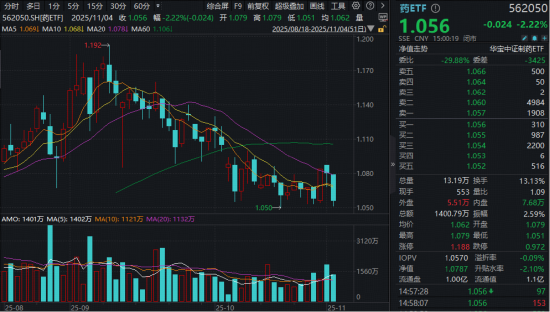
Core Viewpoint - The A-share and Hong Kong stock markets experienced a pullback, particularly in the pharmaceutical sector, with innovative drugs, medical devices, and CXO concepts facing significant declines. However, several representative ETFs showed premium, indicating some capital may be moving against the trend [1][3][5]. Group 1: Market Performance - The A-share innovative drug sector saw a notable decline, with Kanghong Pharmaceutical dropping 6.79%, and other companies like ShenZhou Cell and BaiLi TianHeng falling over 5%. The only drug ETF (562050) closed down 2.22%, marking a new low in this adjustment phase [1]. - The medical sector also declined, with CXO concepts collectively falling. Notable drops included Zhaoyan New Drug at 4.81% and WuXi AppTec at 2.7%. The largest medical ETF (512170) fell 1.63% [3]. - The Hong Kong innovative drug ETF (520880) experienced a 2.61% drop after two consecutive days of gains, with a total transaction volume of 347 million yuan. Only one of the 37 covered innovative drug companies, Hengrui Medicine, saw a gain, while major stocks like Kangfang Biotech and 3SBio fell by 6% and 5.85%, respectively [5]. Group 2: Policy and Future Outlook - The recent conclusion of the five-day medical insurance negotiations and the pricing discussions for innovative drug catalogs has drawn attention, with a focus on high-value innovative drugs and CAR-T therapies. The final results of the 2025 medical insurance catalog adjustments are expected in early December [7]. - According to Open Source Securities, the current innovative drugs included in the medical insurance and commercial insurance are mostly in the early stages of volume expansion. The ongoing policy support for innovative drugs is expected to lead to rapid revenue growth for these drugs, benefiting patients and driving growth for related companies [7]. - Zhongtai Securities views the recent adjustments in the innovative drug sector as relatively benign, with no negative changes in the industry fundamentals. The pharmaceutical sector is believed to be at a relatively low point, with strong safety margins and potential for upward movement as market dynamics shift [7]. Group 3: Investment Strategies - The current market conditions are seen as a favorable time for medium to long-term investments in the biopharmaceutical sector, with recommendations for balanced allocations within the sector. This includes a rotation towards large-cap blue-chip companies and balancing investments in underperforming segments like medical devices and services [7]. - The investment strategies suggest focusing on specific ETFs: the Hong Kong innovative drug ETF (520880) for pure innovative drug exposure, the drug ETF (562050) as the only one tracking the pharmaceutical index, and the medical ETF (512170) as the largest in the market [8][9].
医药BD旺季来临,机构资金或悄然布局,医药相关ETF值得关注
Zhi Tong Cai Jing· 2025-11-04 10:48
Core Insights - The pharmaceutical sector has been experiencing fluctuations since September, following a strong rally, and is currently undergoing a rotation adjustment. The question arises whether the sector is worth attention after a valuation decline and if there is still growth logic in the pharmaceutical sector [1] Group 1: Policy Environment - The policy environment for the pharmaceutical industry is improving, with the National Healthcare Security Administration and the National Health Commission jointly releasing measures to support high-quality development of innovative drugs, providing comprehensive support across five key areas [2][4] - The implementation of ICH guidelines in China is promoting more efficient and scientific drug evaluation processes, enhancing regulatory frameworks [2] Group 2: Market Activity - October and November are traditionally high-frequency periods for business development (BD) transactions, with significant activity expected as companies aim to finalize annual procurement plans before the Christmas holidays. Notable transactions include a $100 million upfront deal by Innovent Biologics [5] - A record-breaking global strategic collaboration worth up to $11.4 billion was established between Innovent Biologics and Takeda Pharmaceutical, reflecting a robust trend in BD transactions for Chinese innovative drugs [6] Group 3: Valuation and Investment Opportunities - The Shenyin Wanguo Pharmaceutical Index is approximately 50% below its recent five-year price peak, indicating potential for valuation recovery [9] - The proportion of stock-type public funds heavily invested in the pharmaceutical sector has increased to 12.2%, showing a recovery trend, yet still below the historical average of 13.7%, suggesting room for further capital inflow [9][14] - For ordinary investors, investing in individual innovative drug stocks poses challenges due to the need for specialized tracking capabilities. Therefore, considering ETFs that cover industry leaders may be a more viable investment strategy [12] Group 4: Summary of Insights - The pharmaceutical industry is experiencing a favorable policy environment, with increasing BD transaction activity and potential for valuation recovery, indicating a supportive backdrop for future growth [14]