
玩具

Search documents
奥飞娱乐(002292) - 2026年1月22日投资者关系活动记录表
2026-01-22 12:00
Group 1: Company Strategy and IP Management - The company focuses on a "youth-oriented" strategy to enhance the commercial value of its IPs by engaging younger audiences through targeted content and operations [2] - Establishment of dedicated studios like the Young Studio and Hero Special Effects Studio to manage youth-oriented content and operations [2] - Implementation of both online and offline strategies to boost IP popularity, including social media engagement and pop-up events in major cities [2] Group 2: AI Technology Applications - The company is advancing AI technology in three key areas: empowering digital IP assets, developing smart products, and optimizing content creation processes [3] - Development of interactive digital personas for core IPs like "Pleasant Goat" and "Super Wings" by integrating with AI platforms [3] - Launch of smart plush products since early 2025, aiming to create a matrix of smart home products [3] Group 3: New Product Launch - "Hurricane Battle Soul" - The new "Hurricane Battle Soul" spinning top project targets the youth market, enhancing product value with added content and emotional engagement [4] - Introduction of immersive product experiences with various weapon designs to enhance user participation [4] - Establishment of a complete competitive system with strict scoring and competition rules, leveraging past experience in toy industry events [4] Group 4: Marketing and Promotion Strategies - The project employs a "content matrix + competition system + multi-channel communication" strategy for promotion [5] - Content promotion includes a mix of main animation, side stories, and live-action web series to support product sales [6] - Ongoing competitions in 15 cities with plans for a national championship and biannual world championship [7] Group 5: Core Strategy for "Infinite Play" - The core strategy for the "Infinite Play" brand focuses on niche market targeting, precise IP partnerships, and multi-channel engagement [7] - The brand has gained significant recognition in the niche category of stacking toys [7] - Successful collaborations with popular game IPs like "Honkai: Star Rail" and "Love and Deep Space" to develop related toy products [7]

港股收盘 | 恒指收涨0.17% 商业航天概念走强 泡泡玛特午后升近6%
Zhi Tong Cai Jing· 2026-01-22 09:05
Market Overview - The Hong Kong stock market showed mixed performance, with the Hang Seng Index rising by 0.17% to close at 26,629.96 points, while the Hang Seng China Enterprises Index fell by 0.09% to 9,114.3 points, and the Hang Seng Tech Index increased by 0.28% to 5,762.44 points. The total trading volume was HKD 234.86 billion [1] Blue Chip Performance - Pop Mart (09992) led the blue-chip stocks, rising by 5.97% to HKD 206, contributing 13.8 points to the Hang Seng Index. The company has been in the spotlight due to its new product launch and share buybacks totaling nearly HKD 350 million [2] - Other notable blue-chip performers included Wharf Real Estate (01997) up 4.81%, Li Auto-W (02015) up 4.13%, while China Life (02628) fell by 3.82%, dragging the index down by 15.13 points [2] Sector Highlights - Large tech stocks had mixed results, with Baidu rising over 4% and Alibaba nearly 1%, while Tencent fell by 0.83%. The construction and cement sectors performed well, with China Liansu up over 8% and China National Building Material up nearly 7% [3] - Oil and gas stocks were active, with Shanghai Petrochemical (00338) up 3.45% and Sinopec (00386) up 3.41%. The International Energy Agency (IEA) raised its global oil demand growth forecast for 2026 to 930,000 barrels per day, up from a previous estimate of 860,000 barrels per day [3][4] Commercial Aerospace - The commercial aerospace sector saw renewed interest, with JunDa Co. (02865) rising nearly 16% and other related companies also showing significant gains. Reports indicate that Elon Musk is pushing for a SpaceX IPO, which could further stimulate the sector [4] Real Estate Sector - Hong Kong real estate stocks showed positive performance, with Wharf Real Estate (01997) and Sun Hung Kai Properties (00016) both rising significantly. Analysts predict a continued upward trend in property prices, although the growth rate may moderate due to resilient mortgage rates [5][6] Gold Stocks - Gold stocks experienced a decline, with Lingbao Gold (03330) down 3.16% and Zijin Mining (02899) down 2.3%. This drop is attributed to easing risk aversion, leading to a decrease in gold prices from historical highs [6] Notable Stock Movements - Minth Group (00425) saw a significant increase of 13.94% following a positive report from Citigroup, which initiated a 90-day upward catalyst observation [7] - ASMPT (00522) continued its upward trend, rising 6.29% as it evaluates options for its surface mount technology business [8] - Baidu (09888) was active, rising 4.1% after the release of its new AI model, which supports various forms of information processing [9] - Longqi Technology (09611) debuted with a 3.55% increase, raising approximately HKD 1.52 billion from its IPO [10] - Nanshan Aluminum (02610) faced a decline of 6.89% after announcing a share placement at a discount to its previous closing price [11]

港股收评:恒指涨0.17%、科指涨0.28%,新消费概念股及军工股走高,有色金属概念股调整,半导体芯片股走低
Jin Rong Jie· 2026-01-22 08:22
Market Overview - The Hong Kong stock index opened high but closed lower, with the Hang Seng Index up 0.17% at 26,629.96 points, the Hang Seng Tech Index up 0.28% at 5,762.44 points, the National Enterprises Index down 0.09% at 9,114.3 points, and the Red Chip Index up 0.48% at 4,223.84 points [1] Company News - Shanghai Electric (02727.HK) expects a net profit of RMB 1.1 billion to RMB 1.32 billion for 2025, an increase of approximately 47% to 76% year-on-year [2] - Kingdee International (00268.HK) anticipates total revenue of RMB 6.95 billion to RMB 7.05 billion for 2025, a year-on-year growth of about 11.1% to 12.7%, with net profit expected between RMB 60 million and RMB 100 million [2] - JD Health saw a significant decline, with shares dropping over 2% [1] - Xiaomi Group (01810.HK) repurchased 7 million shares for HKD 248 million at prices between HKD 35.22 and HKD 35.48 [3] - Bubble Mart (09992.HK) repurchased 500,000 shares for HKD 96.49 million at prices between HKD 191.1 and HKD 194.9 [3] Sector Performance - Major tech stocks showed mixed performance, with Alibaba up 0.98% and Tencent down 0.83% [1] - Semiconductor stocks faced declines, with Zhaoyi Innovation down over 8% [1] - Military stocks strengthened, with China Shipbuilding Defense up over 3% [1] - Internet healthcare stocks were among the biggest losers, with JD Health down over 2% [1] Analyst Insights - Dongwu Securities noted that the Hong Kong market is in a long-term upward trend but faces short-term challenges, with strong consensus on domestic fundamentals but mixed views on overseas factors [5] - Guolian Minsheng Securities expressed optimism about the revaluation of Chinese AI, citing a solid industry catalyst timeline [6] - Morgan Stanley predicted that the upward trend in A-shares and Hong Kong stocks will continue until the Lunar New Year, with earnings expectations being revised upward, particularly in materials and communication services [6] - Guojin Securities highlighted that the valuation advantages of the Hong Kong market will become more pronounced as the domestic economy recovers and overseas monetary policies turn accommodative [7]
以爱之名,AI玩具的竞合博弈
Bei Jing Shang Bao· 2026-01-21 11:52
Core Insights - The AI toy market in China is rapidly growing, with projections indicating a market size of 246 billion yuan in 2024 and an expected increase to 290 billion yuan in 2025, which is double the growth rate of traditional toys [3][8] - Major tech companies and IP giants are entering the AI toy sector, creating a multi-dimensional competitive landscape, while traditional toy manufacturers and startups are adapting by leveraging their strengths [3][8] - The emotional connection and understanding of user needs are becoming the core value propositions of AI toys, shifting the focus from mere functionality to companionship [11][12] Market Dynamics - The AI toy market is characterized by significant participation from internet giants and leading consumer electronics companies, indicating a shift towards AI toys as the next generation of human-computer interaction and family data gateways [8][9] - Sales data shows a booming market, with products like "显眼包" achieving over 1.2 billion yuan in GMV within 48 hours of launch, and AI toys integrated with JoyInside seeing a 20-fold increase in sales during the "双11" shopping festival compared to earlier periods [14][16] - The market is still in its early stages, with a projected compound annual growth rate of 14%-16% over the next decade, potentially exceeding 60 billion USD by 2034 [13][22] Competitive Landscape - The entry of major players has created a protective barrier in the AI toy market, compelling traditional manufacturers and startups to innovate and differentiate themselves [9][18] - Different companies are focusing on various aspects of the market: internet giants on data and AI capabilities, consumer electronics firms on supply chain management, and IP companies on emotional connections and content creation [18][21] - The competition is expected to evolve into a differentiation strategy rather than a price war, with companies focusing on unique emotional and technological offerings [21][22] Consumer Trends - The AI toy market caters to a wide range of age groups, with children aged 3-12 making up 62% of the market, while the Z generation (ages 18-35) shows a 45% repurchase rate driven by emotional needs [22] - The demand for AI toys is fueled by the increasing need for companionship among various demographics, including children, young adults, and the elderly [22][25] - The emotional value of AI toys is becoming a key selling point, with consumers seeking products that provide companionship rather than just functionality [12][22] Ethical and Safety Concerns - The rapid growth of the AI toy market raises concerns about data privacy, as these toys collect sensitive information from users, particularly children [23][27] - There are worries about the potential negative impact of AI toys on children's social skills and emotional development, as reliance on these products may hinder real-life interactions [25][27] - Industry experts emphasize the need for strict content filtering and data protection measures to ensure the safety and ethical use of AI toys [27][28]


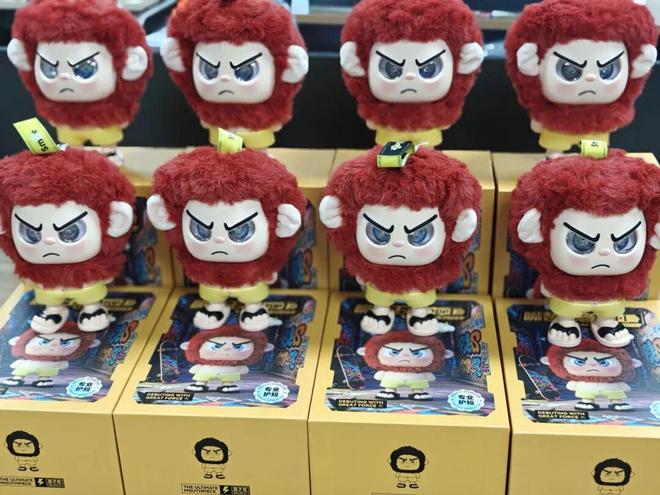
富瑞:降布鲁可目标价至97港元 维持“买入”评级
Zhi Tong Cai Jing· 2026-01-21 09:22
该行成,布鲁可2025年下半年的复苏势头似乎较预期疲弱,由于公司产品推出步伐放缓及低价商品占比 上升,因此下调其销售与盈利预测,惟销量增长料将保持强劲。富瑞预期布鲁可旗下车辆玩具产品的进 一步发展将带动增量销售,料公司毛利率将于2026年下半年回升。随着公司采取更聚焦的招聘策略及签 约新IP,预料销售、一般及行政开支比率将温和改善。 富瑞发布研报称,将布鲁可(00325)2025至2027年的盈测分别下调14%、23%及26%,收入预测降14%、 18%及21%,目标价由128港元下调至97港元,维持"买入"评级。该行相信公司的销售动力持续改善, 且2022至2027年间的净利润复合年增长率达22%,估值吸引。 ...
平安证券(香港)港股晨报-20260121
Ping An Securities Hongkong· 2026-01-21 02:19
Market Overview - The Hong Kong stock market experienced a downward trend, with the Hang Seng Index closing at 23,831 points, down 145 points or 0.61% [1][5] - The market turnover decreased to 82.799 billion, with net inflows of 484 million from the Stock Connect [1][5] - The technology sector led the decline, with notable drops in stocks like SMIC and Sunny Optical, while real estate stocks showed resilience [1][5] US Market Performance - The US stock market saw significant declines, with the Dow Jones falling 1.8% and the S&P 500 down 2.1%, marking the worst single-day performance since October of the previous year [2] - The technology sector was particularly affected, with Nvidia and Tesla experiencing drops of 4.4% and 4.2% respectively [2] Market Outlook - The report highlights that both Hong Kong and A-shares achieved a positive start in 2026, with net inflows of 45.1 billion HKD from southbound funds [3] - Key investment themes include "technological self-reliance" and AI applications, with leading companies in these sectors expected to benefit in the medium to long term [3] - Recommendations for investment focus on sectors supported by policies for "expanding domestic demand," including sports apparel and non-essential services [3] Company Spotlight: Li Ning - Li Ning, a leading sports brand in China, reported a revenue of 14.817 billion for the first half of 2025, reflecting a year-on-year growth of 3.3% [10] - The company's gross margin was 50%, a slight decrease of 0.4 percentage points, attributed to increased promotional competition [10] - Li Ning's net profit was 1.737 billion, down 11% year-on-year, with a net profit margin of 11.7% [10] - The company is expected to enhance its brand presence in professional sports through a partnership with the Chinese Olympic Committee [10]
北水动向|北水成交净买入36.63亿 泡泡玛特时隔两年回购 北水抢筹超3亿港元
智通财经网· 2026-01-20 11:07
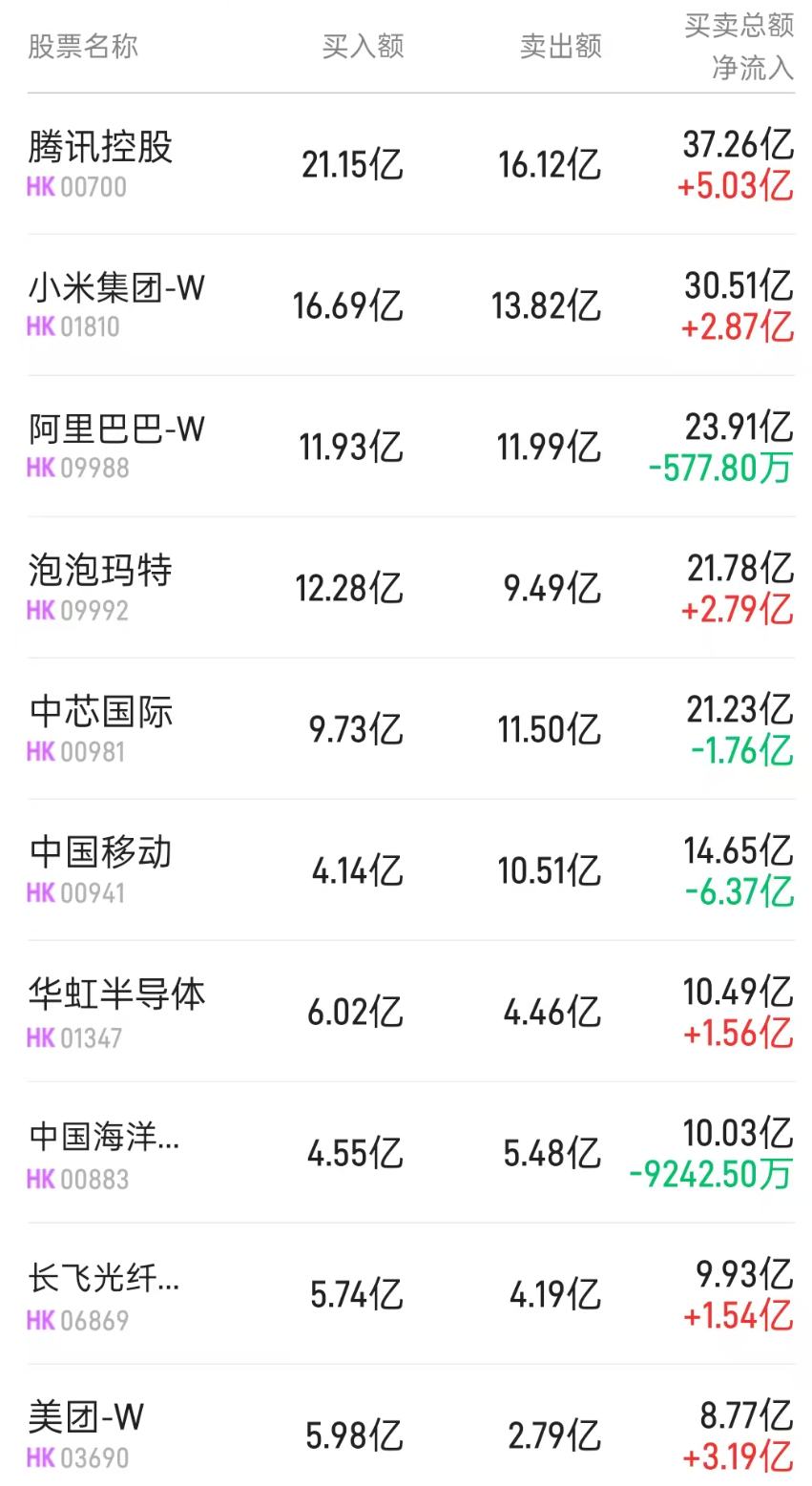
Group 1 - The core point of the news is that the Hong Kong stock market saw significant net buying from northbound capital, totaling HKD 36.63 billion, with Tencent, Meituan, and Xiaomi being the most purchased stocks [2][6] - Tencent Holdings (00700) had a net inflow of HKD 5.03 billion, with total buy and sell amounts of HKD 21.15 billion and HKD 16.12 billion respectively [3][5] - Meituan (03690) recorded a net inflow of HKD 3.19 billion, with total buy and sell amounts of HKD 5.98 billion and HKD 2.79 billion respectively [3][6] Group 2 - Semiconductor stocks showed divergence, with Hua Hong Semiconductor (01347) receiving a net inflow of HKD 2.45 billion, while SMIC (00981) faced a net outflow of HKD 7.17 billion [7] - The report from Open Source Securities indicated that TSMC raised its capital expenditure forecast significantly, reflecting strong long-term demand driven by AI [7] - Long-distance fiber optic cable stocks like Changfei Optical Fiber (06869) saw a net inflow of HKD 1.54 billion, supported by rising prices in the G.652.D fiber market [7] Group 3 - Xiaomi Group-W (01810) received a net inflow of HKD 3.95 billion, while China Mobile (00941) faced a net outflow of HKD 6.37 billion [8] - The report from Bank of America noted that the growth in metal demand is no longer cyclical, as economies are restructuring their energy infrastructure [8] - The sentiment around resource competition is affecting copper prices, which may remain volatile in the short term [8]




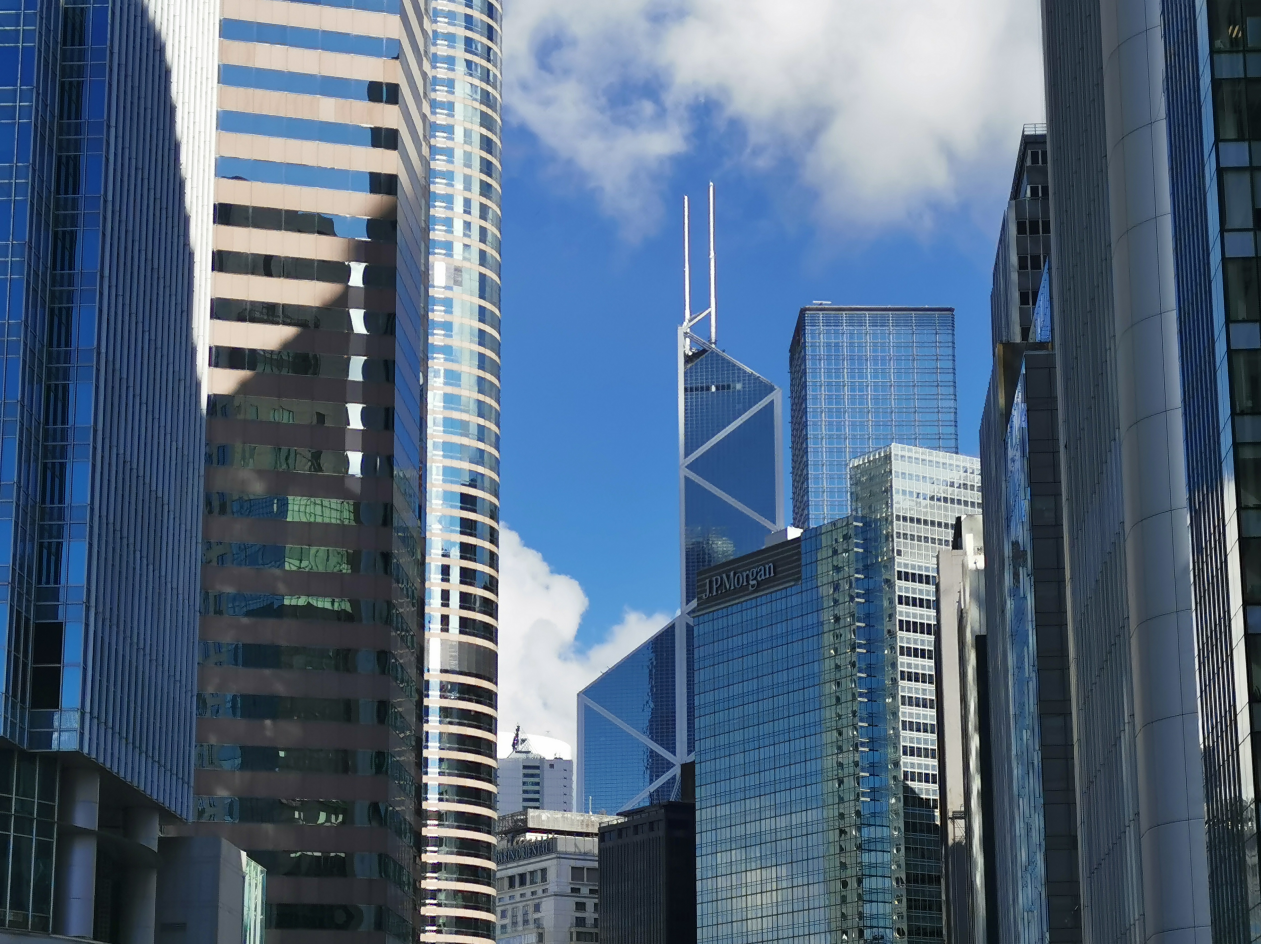
北水动向|北水成交净买入36.63亿 泡泡玛特(09992)时隔两年回购 北水抢筹超3亿港元
智通财经网· 2026-01-20 10:01
Core Viewpoint - The Hong Kong stock market experienced significant net inflows from northbound trading, with a total net buy of HKD 36.63 billion on January 20, 2023, indicating strong investor interest in certain stocks [1]. Group 1: Net Buying and Selling Activities - Tencent (00700) received the highest net buy of HKD 21.15 billion, with a total trading volume of HKD 37.26 billion, reflecting a net inflow of HKD 5.03 billion [2]. - Meituan-W (03690) saw a net buy of HKD 16.69 billion, with a total trading volume of HKD 30.51 billion, resulting in a net inflow of HKD 2.87 billion [2]. - Xiaomi Group-W (01810) had a net buy of HKD 3.95 billion, contributing to the overall positive sentiment in the tech sector [7]. - Conversely, SMIC (00981) faced the largest net sell of HKD 9.73 billion, with a total trading volume of HKD 21.23 billion, indicating a net outflow of HKD 1.76 billion [2]. - China Mobile (00941) also experienced significant net selling, with a net outflow of HKD 6.37 billion [7]. Group 2: Sector Insights and Market Trends - The technology sector, particularly companies like Tencent, Meituan, and Alibaba, is seeing increased investment interest, driven by expectations of growth in AI and cloud computing [4]. - The semiconductor sector showed divergence, with Hua Hong Semiconductor (01347) receiving a net buy of HKD 2.45 billion, while SMIC faced a net sell of HKD 7.17 billion, reflecting varying investor confidence [5]. - The optical fiber and cable industry is experiencing a price recovery, with Longi Optical Fiber (06869) receiving a net buy of HKD 1.54 billion, supported by rising market prices for G.652.D optical fibers [5]. - The mining sector, particularly Zijin Mining (02899) and Luoyang Molybdenum (03993), faced net selling pressures, attributed to changing market sentiments regarding metal demand and supply dynamics [6].
港股收盘 | 恒指收跌0.29% 黄金、消费股走高 泡泡玛特劲升9%领跑蓝筹
Zhi Tong Cai Jing· 2026-01-20 08:37
Market Overview - The Hong Kong stock market experienced fluctuations today, with all three major indices closing lower. The Hang Seng Index fell by 0.29% or 76.39 points to 26,487.51 points, with a total turnover of HKD 2,377.66 million. The Hang Seng China Enterprises Index decreased by 0.43% to 9,094.76 points, and the Hang Seng Tech Index dropped by 1.16% to 5,683.44 points [1] Blue Chip Performance - Pop Mart (09992) led the blue-chip stocks, rising by 9.07% to HKD 197.2, contributing 19.52 points to the Hang Seng Index. The company announced a share buyback of 1.4 million shares for HKD 2.51 million at prices between HKD 177.7 and HKD 181.2. Morgan Stanley noted that this buyback could attract more investors [2] - Other notable blue-chip performances included China Life (601628) (02628) up 4.31% to HKD 33.4, contributing 16.6 points, and China Resources Land (01109) up 3.71% to HKD 29.64, contributing 5.52 points. Conversely, WuXi AppTec (603259) (02359) fell by 4.13% to HKD 113.7, detracting 3.73 points, and SMIC (00981) dropped by 3.25% to HKD 74.5, detracting 18.11 points [2] Sector Highlights - The technology sector showed mixed results, with Baidu rising by 0.95% while Tencent fell over 1%. Gold stocks rebounded, with spot gold surpassing USD 4,700 for the first time, and consumer stocks gained traction due to favorable consumption policies. Notably, Pop Mart's buyback led to a price increase of over 10% [3] - Gold stocks saw a recovery, with Zijin Mining International (02259) up 5.47% to HKD 179.4, Chifeng Jilong Gold Mining (600988) (06693) up 3.6% to HKD 33.94, Shandong Gold Mining (600547) (01787) up 2.73% to HKD 43.7, and China National Gold International (600916) (02099) up 2.04% to HKD 195 [3] Real Estate Sector - The National Bureau of Statistics reported a 0.3% month-on-month decline in new residential sales prices in first-tier cities for December 2025, with the decline narrowing by 0.1 percentage points from the previous month. Shenwan Hongyuan believes that the real estate sector has undergone deep adjustments, and recent central government directives to stabilize the market may lead to positive policy changes [5] - The real estate sector showed positive performance, with China Overseas Land & Investment (00081) up 4.93% to HKD 2.13, and China Resources Land (01109) up 3.71% to HKD 29.64 [4][5] Insurance Sector - The insurance sector performed well, with China Pacific Insurance (00966) up 4.39% to HKD 23.8, China Life (02628) up 4.31% to HKD 33.4, and New China Life Insurance (601336) (01336) up 2.72% to HKD 62.35. Reports indicated that major insurance companies saw significant growth in premium income through bancassurance channels [4][5] Aviation Sector - The aviation sector continued its upward trend, with China Southern Airlines (600029) (01055) up 4.57% to HKD 6.18, China National Aviation (601111) (00753) up 3.91% to HKD 7.45, and Cathay Pacific (00293) up 1.63% to HKD 12.49. Analysts expect strong demand during the upcoming Spring Festival travel season, with improved ticket pricing and revenue management driving profitability [6] Notable Stock Movements - Youjia Innovation (02431) saw a significant increase of 7.21% to HKD 15.77 after signing a memorandum of understanding with India's Sterling Tools Ltd. to focus on the automotive market [7] - Nanshan Aluminum International (02610) reached a new high, rising 6.04% to HKD 71.95, as the company plans to initiate a 250,000-ton electrolytic aluminum project with an estimated investment of USD 436.6 million [8] - GigaDevice Semiconductor (603986) (03986) continued to rise by 5.52% to HKD 306, benefiting from a tight supply of memory chips [9] - Shanghai Petrochemical (600688) (00338) issued a profit warning, expecting a net loss of approximately RMB 1.289 billion to RMB 1.576 billion for the year ending December 31, 2025 [10]



港股收盘(01.20) | 恒指收跌0.29% 黄金、消费股走高 泡泡玛特(09992)劲升9%领跑蓝筹
智通财经网· 2026-01-20 08:34
Market Overview - The Hong Kong stock market experienced fluctuations, with all three major indices closing lower. The Hang Seng Index fell by 0.29% to 26,487.51 points, with a total trading volume of HKD 2,377.66 million [1] - Dongwu Securities believes that the Hong Kong stock market is still in a long-term upward trend but faces short-term challenges. There is a strong consensus on domestic fundamentals, but significant divergence regarding overseas factors, leading to an underestimation of overseas risks [1] Blue-Chip Stocks Performance - Pop Mart (09992) led the blue-chip stocks, rising by 9.07% to HKD 197.2, contributing 19.52 points to the Hang Seng Index. The company announced a share buyback of HKD 251 million for 1.4 million shares at prices between HKD 177.7 and HKD 181.2 [2] - Other notable blue-chip performances include China Life (02628) up 4.31% to HKD 33.4, and China Resources Land (01109) up 3.71% to HKD 29.64. Conversely, WuXi AppTec (02359) fell by 4.13% to HKD 113.7, and SMIC (00981) dropped by 3.25% to HKD 74.5 [2] Sector Highlights - Technology stocks showed mixed results, with Baidu rising by 0.95% while Tencent fell over 1%. Gold stocks rebounded, with spot gold surpassing USD 4,700 for the first time [3] - Consumer concept stocks gained traction, particularly Pop Mart, which saw a significant increase following its buyback announcement. Insurance stocks performed well, with China Pacific Insurance rising over 4% [3] Gold and Real Estate Sector - Gold stocks rebounded, with Zijin Mining (02259) up 5.47% to HKD 179.4, and Chifeng Jilong Gold Mining (06693) up 3.6% to HKD 33.94 [3] - The real estate sector showed signs of recovery, with several stocks like Jianfa International Group (01908) rising by 6.22% to HKD 15.21 [4] Insurance Sector Performance - The insurance sector saw strong performance, with China Pacific (00966) up 4.39% to HKD 23.8, and China Life (02628) up 4.31% to HKD 33.4. The sector's growth is attributed to a significant increase in premium income from bancassurance channels [5][6] Aviation Sector Trends - The aviation sector continued its upward trend, with China Southern Airlines (01055) rising by 4.57% to HKD 6.18. Analysts expect strong demand during the upcoming Spring Festival travel season [7] Notable Stock Movements - Youjia Innovation (02431) surged by 7.21% to HKD 15.77 after signing a memorandum with an Indian automotive parts supplier [8] - Nanshan Aluminum International (02610) reached a new high, rising by 6.04% to HKD 71.95, with plans to invest approximately USD 436.6 million in a new aluminum project [9] - Zhaoyi Innovation (03986) increased by 5.52% to HKD 306, benefiting from a global memory chip shortage [10] - Shanghai Petrochemical (00338) issued a profit warning, expecting a net loss of approximately RMB 1.289 billion to RMB 1.576 billion for the fiscal year [11]