建材

Search documents
基建ETF(159619)昨日净流入超1.5亿,建筑行业景气改善预期升温
Mei Ri Jing Ji Xin Wen· 2025-07-22 02:27
Group 1 - The construction and infrastructure sectors are expected to improve in terms of market sentiment, with a notable increase in orders from state-owned construction enterprises in the second quarter [1] - The issuance of new local government special bonds reached 54.29% of the total planned for 2025, representing a year-on-year increase of 13.94 percentage points, with a month-on-month increase of 490.45% in July [1] - The Ministry of Industry and Information Technology is set to release a work plan to stabilize growth in the building materials sector, which is anticipated to alleviate supply-demand conflicts in the cement industry under the anti-involution policy [1] Group 2 - The current price-to-earnings ratio for the construction sector is at a historical low of 8.53 times, while the infrastructure sub-sector has a valuation of 7.58 times, indicating potential for recovery [1] - The China Infrastructure ETF (159619) tracks the CSI Infrastructure Index (930608), which includes listed companies involved in construction, building materials, and engineering machinery, reflecting the overall performance of the infrastructure sector [1] - Investors without stock accounts can consider the Guotai CSI Infrastructure ETF Initiated Link C (016837) and Guotai CSI Infrastructure ETF Initiated Link A (016836) [1]
杨德龙:低利率环境有利于权益投资
Xin Lang Ji Jin· 2025-07-22 02:01
Group 1: Monetary Policy and Economic Impact - The People's Bank of China (PBOC) maintained the Loan Prime Rate (LPR) at 3.05% for one year and 3.5% for five years, aligning with market expectations due to the current low interest rate environment [1] - The low interest rate policy aims to stimulate economic growth and stabilize the real estate and stock markets, with adjustments made to mortgage rates to support the housing market [1] - There is limited potential for significant increases in housing prices, as expectations have fundamentally changed, and the low interest rate policy primarily seeks to prevent a sharp decline in property values [1] Group 2: Industrial Growth and Economic Recovery - The Ministry of Industry and Information Technology (MIIT) proposed a new round of growth stabilization plans for key industries such as steel, non-ferrous metals, petrochemicals, and building materials, indicating more policies will be implemented in the second half of the year [3] - China's GDP grew by 5.3% in the first half of the year, and further stabilization policies are needed to achieve the annual growth target of around 5% [3] - The stock market is expected to benefit from the economic recovery, with the Shanghai Composite Index surpassing 3500 points and the Hang Seng Index exceeding 25000 points, indicating potential for increased investment opportunities [3] Group 3: Trade and Inflation Concerns - The trade war initiated by President Trump has led to rising costs for American businesses, with the Federal Reserve reporting price increases across all regions, particularly affecting manufacturing and construction sectors [4] - The increase in tariffs has pressured profit margins for companies, leading some to pass costs onto consumers, which may contribute to inflationary pressures [4] - Despite the challenges posed by tariffs, China's economy showed resilience with a 5.3% GDP growth, driven by strong consumer spending, which accounted for 52% of GDP growth [4]
海螺水泥涨超9%,建材ETF(516750)持有该股票15.18%
news flash· 2025-07-22 01:57
海螺水泥(600585)涨幅扩大至9.11%,建材ETF(516750)持有该股票15.18%,当前涨幅为2.39%,最新 价创120日新高,溢价率为1.78%,成交额4.45亿元,较昨日此时放量884.90%,近1月份额增加 544.01%,增加4.47亿份。 ...
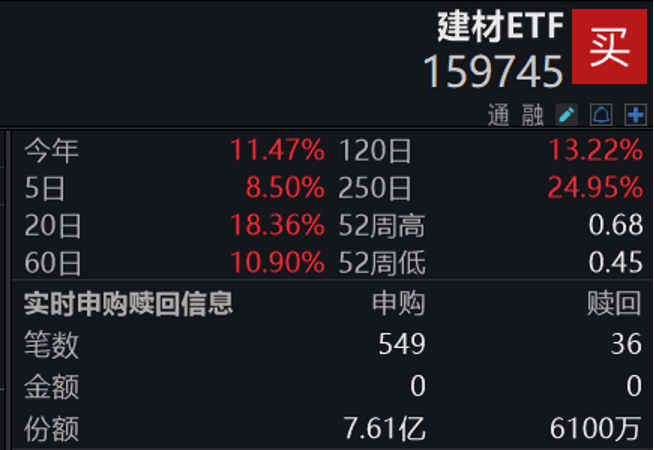
超级工程开工,建材ETF(159745)涨停,基建ETF(159619)收涨超6%
Sou Hu Cai Jing· 2025-07-22 01:16
Core Viewpoint - The launch of the Yarlung Tsangpo River downstream hydropower project and the announcement of ten key industries' growth stabilization plans have positively impacted cyclical sectors such as building materials, infrastructure, steel, and coal, leading to significant market gains [1][3]. Group 1: Market Performance - The Building Materials ETF (159745) experienced a strong performance, closing at the daily limit with a net subscription of nearly 700 million shares [1]. - The Infrastructure ETF (159619) also performed well, ultimately rising over 6% [1]. - The overall market sentiment has shifted from "weak expectations - weak reality" to "strong expectations - weak reality," indicating a clearer bottoming out in cyclical sectors [7]. Group 2: Project Impact - The Yarlung Tsangpo River downstream hydropower project, with a total investment of approximately 1.2 trillion yuan, is expected to create significant demand for upstream and downstream industries, particularly in steel, cement, and other construction materials [2]. - The project will involve the construction of five tiered power stations over a ten-year period, which is anticipated to act as a stabilizer against short-term demand fluctuations [2]. Group 3: Policy Support - The Ministry of Industry and Information Technology announced that growth stabilization plans for ten key industries, including steel and building materials, are forthcoming, which is expected to enhance market confidence [3]. - The ongoing "anti-involution" policies and the introduction of detailed supportive measures are seen as crucial for breaking the negative feedback loop between PPI and CPI, thereby fostering a healthier economic outlook [3]. Group 4: Investment Opportunities - The cyclical sectors, particularly building materials, infrastructure, and steel, are poised to benefit directly from the implementation of the "super project," with substantial room for earnings and valuation expansion [7]. - The coal sector, previously underperforming, also shows potential for valuation recovery, with dividend yields exceeding 5%, providing a significant safety margin for investors [7].

金融工程日报:市场放量上涨,沪指4连阳创年内新高-20250721
Guoxin Securities· 2025-07-21 14:55
- The report does not contain any quantitative models or factors for analysis[1][2][3][4][5][6][7][8][9][10][11][12][13][14][15][16][17][18][19][20][21][22][23][24][25][26][27][28][30][31][32][33][34][35][36][37][38][39][40][41]
每日复盘-20250721
Guoyuan Securities· 2025-07-21 14:45
Market Performance - On July 21, 2025, the Shanghai Composite Index rose by 0.72%, closing at 3,559.79, marking a three-and-a-half-year high with a total market turnover of 16,996.87 billion yuan, an increase of 1,288.31 billion yuan from the previous trading day[2][15] - The Shenzhen Component Index increased by 0.86% to 11,007.49, while the ChiNext Index rose by 0.87% to 2,296.88[2][15] - A total of 4,056 stocks rose, while 1,310 stocks fell across the market[2][15] Sector Performance - The best-performing sectors included building materials (up 5.64%), construction (up 3.73%), and steel (up 3.46%)[2][21] - The banking sector saw a decline of 0.77%, while comprehensive finance and computing sectors fell by 0.39% and 0.37%, respectively[2][21] Capital Flow - On July 21, 2025, the net outflow of main funds was 93.04 billion yuan, with large orders seeing a net outflow of 116.24 billion yuan, while small orders had a net inflow of 168.90 billion yuan[3][25] - Southbound funds recorded a net inflow of 70.52 billion HKD, with the Shanghai-Hong Kong Stock Connect contributing 39.00 billion HKD and the Shenzhen-Hong Kong Stock Connect contributing 31.52 billion HKD[4][27] ETF Trading - Major ETFs such as the Huaxia SSE 50 ETF and the Huatai-PB CSI 300 ETF saw changes in trading volume, with the former at 16.57 billion yuan (down 2.91 billion yuan) and the latter at 31.84 billion yuan (up 2.43 billion yuan)[3][30] - The net inflow for the CSI 1000 ETF was 2.65 billion yuan on July 18, indicating a strong interest in this fund[3][30] Global Market Overview - On July 21, 2025, the Hang Seng Index rose by 0.68% to 24,994.14, while the Australian S&P 200 Index fell by 1.02% to 8,668.20[4][34] - The U.S. stock market showed mixed results, with the Dow Jones Industrial Average down 0.32% and the Nasdaq Composite up 0.05%[5][34]
周期视角如何看反内卷?
2025-07-21 14:26
Summary of Conference Call Records Industry Overview - The records discuss the industrial sector, particularly focusing on industries such as steel, coal mining, construction materials, chemicals, and agriculture chemicals, highlighting the current economic conditions and challenges faced by these sectors [1][2][3][4]. Key Points and Arguments 1. **Current Economic Conditions**: Industrial product prices and overall price levels are declining, with capacity utilization rates in the first two quarters below the historical 10th percentile over the past five years, indicating a severe oversupply situation [1][2]. 2. **Supply-Side Reform**: Short-term supply contraction is critical to address the oversupply and low price environment. Industries with high concentration and state-owned enterprise (SOE) involvement are more likely to implement production cuts [1][5]. 3. **Cyclical Price Increases**: The recent price increases in cyclical products are primarily driven by policy catalysts and a bottoming out of supply-demand dynamics. Industries like steel, electrolytic aluminum, and rare earths show significant profit release potential [1][6]. 4. **Long-Term Investment Opportunities**: Agriculture chemicals and fine chemicals have reached a supply-demand bottom, making them suitable for long-term investment. Stocks in upstream sectors like steel and rare earths exhibit high price elasticity [7][8]. 5. **Specific Industry Potential**: Industries such as organic silicon and glyphosate are expected to see price increases due to supply disruptions and seasonal demand peaks [1][10]. 6. **Steel Industry Performance**: The steel industry is highlighted as a core sector with strong price elasticity and improved profitability, with over 60% of companies reporting profits in the first half of the year, a significant increase from below 20% in the previous year [11][12]. 7. **Globalization of Steel Industry**: The steel sector is becoming less constrained by domestic demand, with a shift towards becoming a global manufacturing representative. The implementation of supply-side reforms is expected to enhance industry conditions [13]. 8. **Impact of Anti-Internal Competition Policies**: Policies aimed at reducing internal competition are expected to significantly impact the construction materials sector, with specific measures to stabilize growth and eliminate outdated capacity [14][15]. 9. **Investment Focus in Construction Materials**: Investment opportunities should focus on traditional cyclical materials like cement, which may benefit from infrastructure demand, and growth sectors like photovoltaic glass [16][17]. 10. **Coal Industry Dynamics**: The coal sector faces significant challenges due to oversupply and the need for effective supply-side policies. Recommendations include focusing on stocks with high elasticity potential [31]. Other Important Insights - The records emphasize the importance of monitoring policy developments and their implications for various sectors, particularly in the context of supply-side reforms and anti-internal competition measures [6][14]. - The potential for price recovery in the steel and construction materials sectors is linked to broader economic recovery and demand stabilization [30]. - The records also highlight the need for companies to adapt to changing market conditions and regulatory environments to maintain competitiveness and profitability [20][21][24].
广发研究:周观点
2025-07-21 14:26
Summary of Key Points from Conference Call Records Industry Overview - **Macro Environment**: The focus is shifting from actual growth to nominal growth, with an emphasis on "anti-involution" policies. Government investment is expected to effectively drive social investment, with significant projects like the Yarlung Tsangpo River hydropower project commencing, involving a total investment of 1.2 trillion yuan [3][18]. - **Non-Banking Sector**: Incremental capital is entering the market, with a strong recommendation for the non-banking sector, particularly brokerage firms and insurance companies, as they are expected to benefit from improved market conditions and regulatory support [6][7]. - **Electronics**: The penetration of DDR5 technology is accelerating, driven by the AI industry, with expectations for significant growth in AI PCB manufacturers due to rising demand for computing power [8]. - **Media**: The gaming industry remains optimistic despite recent adjustments, with opportunities in IP and advanced technology applications [9]. - **Food and Beverage**: The industry is entering a golden period for brand upgrades, particularly in the liquor sector, which is expected to recover from previous downturns [10]. - **Agriculture**: The price of yellow chickens may be nearing a bottom, while the pig farming sector is expected to stabilize under "anti-involution" policies [11]. - **Home Appliances**: The "trade-in" policy has significantly boosted domestic sales, with a reported 32% year-on-year increase in retail sales from January to June 2025 [12]. - **Textiles and Light Industry**: The textile manufacturing sector is recovering, with opportunities in high-performance materials and traditional clothing businesses [14]. - **Environmental Protection**: The exploration of RWA (Risk-Weighted Assets) in environmental assets is expected to enhance financing efficiency and optimize cash flow for companies in the sector [15]. - **New Energy**: Solid-state batteries are projected to achieve commercial application by 2027, with significant growth expected in the coming years [16][17]. - **Construction**: The construction sector is poised for growth with the launch of major projects and upcoming policies aimed at stabilizing the industry [19][21]. - **Coal**: Coal prices are on the rise due to favorable supply-demand dynamics, with expectations for continued price increases in the second half of the year [20]. - **Building Materials**: A growth plan for the building materials sector is anticipated, with the Yarlung Tsangpo River project expected to drive demand for related materials [21]. - **Metals**: The implementation of a new growth plan is expected to support metal prices, particularly in the aluminum and steel sectors [22]. - **Public Utilities**: New pricing policies in Gansu are expected to enhance profitability for power generation companies [23]. Core Insights and Arguments - **Investment Strategies**: The report suggests a three-pronged investment strategy focusing on economic cycle assets, growth sectors, and stable value assets, with a recommendation to increase exposure to sectors benefiting from long-term improvements [4][6]. - **Market Dynamics**: The report highlights the asymmetry between downside risks and upside potential in the current market environment, emphasizing the need for strategic asset allocation [4][5]. - **Sector-Specific Recommendations**: - Non-banking financials are recommended due to expected recovery in performance and valuation [6][7]. - The electronics sector is advised for investment due to the growth in AI-related technologies [8]. - The media sector is seen as a stable investment due to ongoing demand for gaming and IP products [9]. - The food and beverage sector is highlighted for its potential recovery and brand upgrades [10]. - The agriculture sector is recommended for its stabilization under new policies [11]. - Home appliances are expected to benefit from government policies and consumer demand [12]. Important but Potentially Overlooked Content - **Risk Factors**: The reports consistently mention various risk factors, including geopolitical tensions, regulatory changes, and economic uncertainties that could impact market performance across sectors [4][5][20][22]. - **Technological Advancements**: The rapid development of solid-state battery technology and its implications for the automotive and energy sectors are emphasized, indicating a significant shift in energy storage solutions [16][17]. - **Regulatory Environment**: The impact of government policies on various sectors, particularly in terms of investment and operational efficiency, is a recurring theme, suggesting that regulatory changes could significantly influence market dynamics [3][4][5][19][23].
周期论剑 重启重大工程,重视周期机会
2025-07-21 14:26
Summary of Conference Call Records Industry Overview - The conference call primarily discusses the **construction materials** and **engineering machinery** industries, with a focus on the impact of major infrastructure projects on these sectors [1][5][25]. Key Points and Arguments Economic and Policy Outlook - The second half of the year is expected to focus on addressing structural issues while stabilizing overall demand, particularly in real estate and consumption [1][3]. - Monetary policy is anticipated to remain loose, with potential interest rate cuts and reserve requirement ratio reductions [1][3]. - Fiscal policy is unlikely to see significant short-term increases, but data from July and August will be crucial for potential support measures in September and October [1][3]. Major Infrastructure Projects - The restart of major projects, such as the Yarlung Tsangpo River hydropower project and the China-Kyrgyzstan-Uzbekistan railway, signals a significant opportunity for cyclical stocks, particularly in the construction materials sector [1][5]. - The Yarlung Tsangpo project has a total investment of **1.2 trillion** yuan, with a capacity of **60 million kilowatts**, indicating a strong push for stable economic growth over the next five years [1][9]. Construction Materials Sector - The construction materials industry is currently at a low point, with leading companies like Conch Cement, Oriental Yuhong, and China Jushi showing substantial profits but relatively low market valuations [1][7]. - Investors are advised to adjust their portfolios to include construction materials stocks, particularly focusing on leading companies to capitalize on potential demand changes [1][7][8]. - Recent performance of leading cyclical stocks, such as Conch Cement hitting its upper limit, indicates a positive trend [1][8]. Steel Industry Insights - The steel sector has seen significant price increases due to expectations of major infrastructure projects and supportive government policies [14][16]. - Recommendations for leading steel companies include Baosteel, CITIC Special Steel, and Hualing Steel, as they are expected to benefit from increased demand and reduced supply pressures [15][17]. Engineering Machinery Sector - The engineering machinery industry is experiencing positive growth, with July data showing stable domestic sales and an expected **10%** increase in exports [26]. - The Yarlung Tsangpo project is projected to drive significant demand for construction machinery, with total equipment investment estimated at **200 billion** yuan [25][26]. Market Reactions - The market has reacted positively to the announcement of major projects, with significant stock price increases for companies involved in hydropower and construction [11][12]. - The Yarlung Tsangpo project has garnered attention due to its high investment amount and the involvement of high-ranking officials, indicating strong governmental support [12][13]. Additional Considerations - The construction materials sector is advised to focus on high dividend yield stocks as a safety margin, with specific recommendations including Conch Cement and Taipai Group [8]. - The engineering machinery sector should consider companies like SANY, XCMG, and major suppliers of construction equipment, as they are expected to benefit from increased project activity [25][26]. Conclusion - The conference call highlights a cautiously optimistic outlook for the construction materials and engineering machinery sectors, driven by government support for major infrastructure projects and a stabilizing economic environment. Investors are encouraged to focus on leading companies within these industries to capitalize on emerging opportunities.
国家队一分钱都没卖
表舅是养基大户· 2025-07-21 13:30
Group 1 - The article highlights the recent surge in A-share market sentiment, particularly driven by the announcement of the "super hydropower project" and the Ministry of Industry and Information Technology's ten industry growth stabilization plans [1][2][3] - A significant increase in trading activity is noted, with major industry ETFs, especially in the construction materials sector, experiencing substantial gains, including three construction material ETFs hitting the daily limit [1][2][3] - The overall market sentiment is described as highly optimistic, with a tendency for rapid price increases in response to positive news [3][4] Group 2 - The article discusses the recent performance of the A-share market, noting that the Shanghai Composite Index has surpassed 5500 points, indicating a strong upward trend [6][8] - It emphasizes that while the market is experiencing a bullish phase, it does not advocate for a full-blown bull market, instead suggesting a focus on structural opportunities in a low-interest-rate environment [8][9] - The article mentions that the national team (state-owned investment entities) did not sell any of their holdings during the second quarter, indicating confidence in the market [12][14] Group 3 - The article points out that the AH premium has reached a five-year low, suggesting a potential shift in market dynamics between mainland and Hong Kong stocks [17][18] - It connects the outflow from broad-based ETFs to increased net buying in Hong Kong stocks, indicating a strategic shift among institutional investors [21][22] - The article reiterates that low interest rates are a fundamental driver of both stock market performance and bond market stability [23]