
电子制造

Search documents
从卖产品到卖方案!七部门力推服务型制造业价值跃升
券商中国· 2025-10-11 23:31
Core Viewpoint - The article emphasizes the critical transformation of the manufacturing industry from "selling products" to "selling solutions," supported by national policies aimed at enhancing service-oriented manufacturing [1][2]. Summary by Sections National Policy Framework - On October 11, the Ministry of Industry and Information Technology and six other departments issued the "Implementation Plan for Promoting Service-Oriented Manufacturing Innovation Development (2025-2028)," outlining three core goals by 2028: establishing 20 service-oriented manufacturing standards, creating 50 leading brands, and building 100 innovation development hubs [2]. Current State and Challenges - Service-oriented manufacturing has shown initial advantages in China, with a continuous increase in development levels from 2018 to 2023. Provinces like Zhejiang and Guangdong are leading, with Zhejiang alone having established 73 national-level service-oriented manufacturing demonstration enterprises [2]. - However, challenges such as weak key technology supply, an incomplete standard system, uneven application of typical models across industries, and difficulties in statistical monitoring hinder the large-scale advancement of service-oriented manufacturing [3]. Strategic Framework for Implementation - The plan proposes a systematic approach to promote service-oriented manufacturing through seven core tasks, focusing on key common technology breakthroughs and model innovations. It encourages enterprises to increase innovation investments and enhance collaboration with industrial intelligence technologies [4]. - The plan also aims to strengthen the technology service industry, improve digital capabilities of testing and certification institutions, and develop financial services that support manufacturing enterprises [4]. Industry-Specific Strategies - The plan emphasizes "classified policies" to promote service-oriented manufacturing across various sectors, including raw materials, equipment manufacturing, electronics, and consumer goods. It aims to enhance the competitive position of industries like new energy vehicles and machinery [5]. - A significant focus is placed on strengthening the digital infrastructure, promoting the integration of 5G and industrial internet, and enhancing data resource management [5]. Practical Implementation Actions - The plan outlines three major special actions to facilitate policy implementation, with a priority on developing shared manufacturing platforms that enable collaborative production and resource sharing among enterprises [6]. - It aims to cultivate 100 leading service-oriented manufacturing enterprises and 50 brands, establishing a brand evaluation system to promote exemplary cases [6]. - The plan also focuses on creating innovative application scenarios driven by demand, targeting production, consumption, and national strategic needs [7].


七部门发文推动服务深度嵌入制造业,涉及装备制造、消费品等行业
2 1 Shi Ji Jing Ji Bao Dao· 2025-10-11 12:14
Core Viewpoint - The joint implementation plan by seven government departments aims to promote service-oriented manufacturing, integrating services deeply into the manufacturing sector to enhance the industry's quality and efficiency by 2028 [2][3]. Group 1: Implementation Goals - By 2028, the role of service-oriented manufacturing in high-quality development will be significantly enhanced, with the establishment of 20 standards, creation of 50 leading brands, and development of 100 innovation hubs [2]. - The plan emphasizes the widespread adoption of typical service-oriented manufacturing models and the emergence of new models, optimizing the industrial ecosystem [2]. Group 2: Key Tasks - The plan outlines seven main tasks, including strengthening key common technology research, fostering key productive service industries, and promoting the application of service-oriented manufacturing models [3][4]. - It encourages enterprises to increase innovation investment and focuses on upgrading typical models such as shared manufacturing and personalized customization [3]. Group 3: Development of Productive Services - Productive service industries are crucial for supporting service-oriented manufacturing through technology research, design, and financial services [4]. - The plan aims to enhance policy support and optimize the industrial development ecosystem for various productive service sectors, including technology services and logistics [4]. Group 4: Infrastructure and Innovation - The plan emphasizes the need for new information infrastructure, promoting the integration of 5G and industrial internet, and enhancing data resource management [5]. - It includes actions to cultivate shared manufacturing, enhance service-oriented manufacturing brands, and innovate application scenarios [5][6]. Group 5: Application Scenarios - The plan encourages the creation of integrated application scenarios that cater to production needs, consumer demands, and national strategic requirements [6]. - It aims to establish a platform for promoting new models and scenarios, facilitating cooperation between supply and demand sides [6].
全球市场惊现拐点!美联储鸽声嘹亮,A股牛市能走多远?
Sou Hu Cai Jing· 2025-10-11 09:46
Group 1: Federal Reserve's Dovish Shift - Federal Reserve Chairman Powell's recent speech indicated a dovish shift, suggesting that interest rate cuts could begin as early as September 2025 [3] - In the September meeting, nearly all members agreed to lower the federal funds rate target range by 25 basis points to between 4% and 4.25% [3][4] Group 2: A-share Market's Structural Bull Market - The A-share market has entered a structural bull market, with the Shanghai Composite Index rising 39% and the CSI 300 Index rising 41% over the past year [1] - The market has experienced two significant upward trends, with a total trading volume reaching 410.99 trillion yuan, a 117% increase from the previous year [5] Group 3: Technology Sector Leadership - The most notable feature of the current bull market is the leadership of technology stocks, with communication, electronics, and composite indices rising over 100% [6] - Companies with a market capitalization exceeding 1 trillion yuan have increased, reflecting market recognition of technology and new economy enterprises [8] Group 4: Global Market Interconnectivity - The dovish stance of the Federal Reserve has had a profound impact on global markets, leading to a decline in the dollar and treasury yields, while stocks have risen [9][10] - Emerging market currencies, including the Indian rupee and Chinese yuan, have strengthened, indicating a positive sentiment in the cryptocurrency market as well [10] Group 5: Market Outlook and Investment Strategies - Despite strong market performance, there are concerns about high inflation, with the latest consumer price index showing an inflation rate close to 3% [11] - Investment strategies should focus on undervalued quality companies, particularly in sectors like semiconductors, artificial intelligence, and high-end manufacturing, while avoiding overheated sectors [15]

首批19家公司三季度业绩预告出炉,广东明珠归母净利润增幅上限预计超1000%
3 6 Ke· 2025-10-11 09:28
Core Viewpoint - The A-share market has seen a series of positive earnings forecasts from listed companies for the first three quarters of 2025, with all 19 companies reporting expected profit increases, indicating a strong market sentiment and potential investment opportunities [1][3]. Group 1: Earnings Forecasts - As of October 10, 2025, 19 listed companies in the Shanghai and Shenzhen markets have released earnings forecasts, all of which are optimistic [1]. - Among these, 11 companies expect a year-on-year increase in net profit exceeding 100%, with some companies like Yinglian Co. and Guangdong Mingzhu projecting increases over 1000% [3][4]. - Lixun Precision (立讯精密) is expected to have the highest absolute net profit, estimated between 10.89 billion to 11.344 billion yuan, with a year-on-year growth of 20% to 25% [4][6]. Group 2: Stock Performance - Companies with positive earnings forecasts have seen strong stock performance, with Lixun Precision's stock price reaching a historical high of 72.20 yuan per share, reflecting a 143.43% increase from April 9 to September 24 [5]. - Guangdong Mingzhu achieved a "limit-up" on October 10, indicating strong investor confidence despite a broader market pullback [7]. Group 3: Company-Specific Insights - Lixun Precision is focusing on "smart manufacturing upgrades" and "underlying technology innovation" to enhance operational efficiency and cost control across its supply chain [6]. - Shandong Steel has turned a profit, expecting a net profit of approximately 140 million yuan, a significant turnaround from a loss of 1.451 billion yuan in the same period last year [6]. - Yinglian Co. anticipates a staggering increase in net profit, projecting a growth of 1531.13% to 1672.97% year-on-year, with a turnaround in its non-recurring profit [6].


大家有没有发现?深圳和上海悄悄爆发4大怪象,背后原因值得深思
Sou Hu Cai Jing· 2025-10-11 06:43
Core Insights - The article discusses the paradoxical economic phenomena observed in Shenzhen and Shanghai, highlighting the disconnect between rising rents and increasing vacancy rates in commercial properties, as well as the contrasting performance of high-end and budget consumer sectors [1][8]. Group 1: Commercial Real Estate Trends - In Shenzhen, the vacancy rate for brand stores reached 18.7% in the first half of 2025, up 5.3 percentage points from the same period in 2024, while Shanghai's core areas reported a vacancy rate of 16.5% [2]. - Despite high vacancy rates, rental prices remain elevated, with Shenzhen's core areas maintaining rents between 800-1500 RMB per square meter, and Shanghai's rents even higher [2]. - Approximately 65% of property owners in both cities prefer to keep their properties vacant rather than significantly reduce rents, indicating a strong holding capacity among landlords [2]. Group 2: Consumer Behavior Shifts - High-end dining and shopping have seen a decline, with high-end restaurant revenues dropping by 15.3% and foot traffic in upscale shopping centers down by 12.7% in the first half of 2025 [4]. - Conversely, budget dining options and street food have thrived, reflecting a shift in consumer preferences towards more affordable dining experiences [4]. - The increase in essential expenditures, such as housing and education, has led to a reduction in discretionary spending, with real disposable income growth in Shenzhen at 2.1% and 2.8% in Shanghai for the first quarter of 2025 [4]. Group 3: Labor Market Dynamics - Shenzhen experienced a net outflow of 37,000 talents in the first half of 2025, with over 60% holding a bachelor's degree or higher, while Shanghai saw a net outflow of 25,000 [5]. - Despite the talent outflow, there is a simultaneous "labor shortage" in manufacturing and service sectors, with recruitment demand rising by 18.3% while job applications fell by 12.5% [5]. - The mismatch in labor supply and demand highlights structural issues, with high-skilled positions being oversupplied while basic labor roles remain unfilled due to low social recognition and high work intensity [6]. Group 4: Real Estate Market Observations - Both cities maintain high property prices, with average new home prices at 68,500 RMB per square meter in Shenzhen and 73,200 RMB in Shanghai, reflecting year-on-year increases of 2.3% and 1.8% respectively [7]. - New home sales have significantly declined, with transaction volumes down by 35.7% in Shenzhen and 28.5% in Shanghai [7]. - The real estate market is characterized by a "volume shrinkage, price stability" phenomenon, as developers prefer to hold onto properties rather than reduce prices, supported by financial institutions' policies [7]. Group 5: Economic Structural Issues - The article identifies these phenomena as indicative of a transitional economic phase, where traditional high-investment growth models are becoming unsustainable, leading to structural contradictions in the economy [8]. - The persistent high property prices and low transaction volumes suggest a "bubble" in the real estate market, where asset values are increasingly detached from actual market demand [8]. - Consumer confidence remains low, with consumer confidence indices for Shenzhen and Shanghai at 92.5 and 94.8, respectively, indicating concerns about future income growth and economic prospects [8].

今日看点|国新办将举行介绍“十四五”时期住房城乡建设高质量发展成就新闻发布会
Jing Ji Guan Cha Bao· 2025-10-11 01:05
(原标题:今日看点|国新办将举行介绍"十四五"时期住房城乡建设高质量发展成就新闻发布会) 10月11日重点关注的财经要闻与资本市场大事: 1、国新办将举行介绍"十四五"时期住房城乡建设高质量发展成就新闻发布会 10月11日,国新办将举行两场"高质量完成'十四五'规划"系列主题新闻发布会。上午10时,住房城乡建 设部部长倪虹介绍"十四五"时期住房城乡建设高质量发展成就,并答记者问。 下午3时,中国气象局局长陈振林介绍"十四五"时期气象高质量发展情况,并答记者问。 3、51家公司披露回购进展 10月11日,51家公司共发布51个股票回购相关进展。其中,4家公司首次披露股票回购预案,5家公司回 购方案获股东大会通过,35家公司披露股票回购实施进展,7家公司回购方案已实施完毕。 从首次披露回购预案来看,当日共1家公司股票回购预案金额超千万。康强电子、海通发展、井松智能 回购预案金额最高,分别拟回购不超1.0亿元、180.02万元、78.89万元。从股东大会通过回购预案来 看,当日共3家公司回购预案超千万。健盛集团、神马股份、锐科激光回购金额最高,分别拟回购不超 3.0亿元、2.0亿元、8065.09万元。 4、6家公 ...
生益电子股份有限公司关于股份回购进展暨2025年半年度权益分派实施后调整回购股份价格上限的公告
Shang Hai Zheng Quan Bao· 2025-10-10 18:39
Core Viewpoint - The company has adjusted the maximum repurchase price of its shares following the implementation of its 2025 semi-annual profit distribution plan, reducing it from RMB 42.77 per share to RMB 42.47 per share, effective from September 25, 2025 [1][5]. Summary by Sections 1. Basic Information on Share Repurchase - The company approved a share repurchase plan on April 18, 2025, allowing for the repurchase of shares using its own funds, with a total repurchase amount between RMB 50 million and RMB 100 million, and a maximum price of RMB 43.02 per share [2]. 2. Progress of Share Repurchase - As of September 30, 2025, the company has not yet implemented the share repurchase plan and will proceed based on market conditions [3]. 3. Reason for Adjusting the Maximum Repurchase Price - The adjustment in the maximum repurchase price is due to the company's decision to distribute a cash dividend of RMB 3.00 per 10 shares, effective from the record date of September 24, 2025 [4][3]. 4. Specifics of the Price Adjustment - The new maximum repurchase price is calculated as RMB 42.47 per share, derived from the previous maximum price minus the cash dividend per share, which is approximately RMB 0.2970 [5]. 5. Other Matters - Other aspects of the share repurchase plan remain unchanged, and the company will adhere to relevant regulations while making repurchase decisions based on market conditions [6].

丘钛科技9月摄像头模组销售数量合计4665.4万件,环比减少7.6%,同比增长45.1%
Zhi Tong Cai Jing· 2025-10-10 12:12
Core Insights - The company reported a total sales volume of 46.654 million camera modules in September 2025, representing a quarter-over-quarter decrease of 7.6% but a year-over-year increase of 45.1% [1] - The sales volume of fingerprint recognition modules reached 19.034 million units, showing a quarter-over-quarter increase of 0.6% and a year-over-year increase of 42.3% [1] Camera Module Sales - The significant year-over-year growth in camera module sales is attributed to the company's increased market share in mobile camera modules and substantial growth in sales for IoT and smart automotive applications [1] Fingerprint Recognition Module Sales - The year-over-year increase in fingerprint recognition module sales is primarily due to the company's enhanced market share in this segment, with a notable rise in sales of ultrasonic fingerprint recognition modules [1]
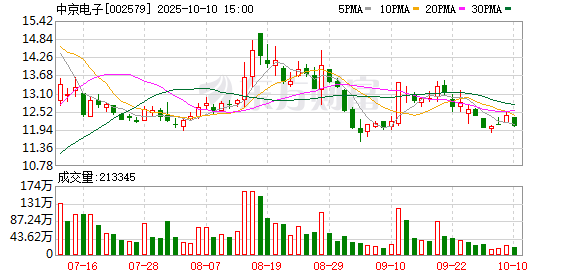
中京电子:公司为华为的二级供应商
Zheng Quan Ri Bao· 2025-10-10 11:12
Group 1 - The company, Zhongjing Electronics, stated on October 10 that it is a secondary supplier for Huawei, primarily involved in products such as mobile phones, tablets, and consumer electronics [2]

丘钛科技(01478)9月摄像头模组销售数量合计4665.4万件,环比减少7.6%,同比增长45.1%
智通财经网· 2025-10-10 11:03
Core Insights - The company reported a total sales volume of camera modules reaching 46.654 million units in September 2025, reflecting a quarter-over-quarter decrease of 7.6% but a year-over-year increase of 45.1% [1] - The sales volume of fingerprint recognition modules totaled 19.034 million units, showing a quarter-over-quarter increase of 0.6% and a year-over-year increase of 42.3% [1] Camera Modules - The significant year-over-year growth in camera module sales is attributed to the company's increased market share in mobile camera modules and substantial growth in sales for IoT and smart automotive applications [1] Fingerprint Recognition Modules - The year-over-year increase in fingerprint recognition module sales is primarily due to the company's enhanced market share in this segment, with a notable rise in sales of ultrasonic fingerprint recognition modules [1]