家电

Search documents
2025年GDP20强城市大预测:深圳约4万亿,武汉远超南京,青岛增速7%!
Sou Hu Cai Jing· 2025-12-08 06:15
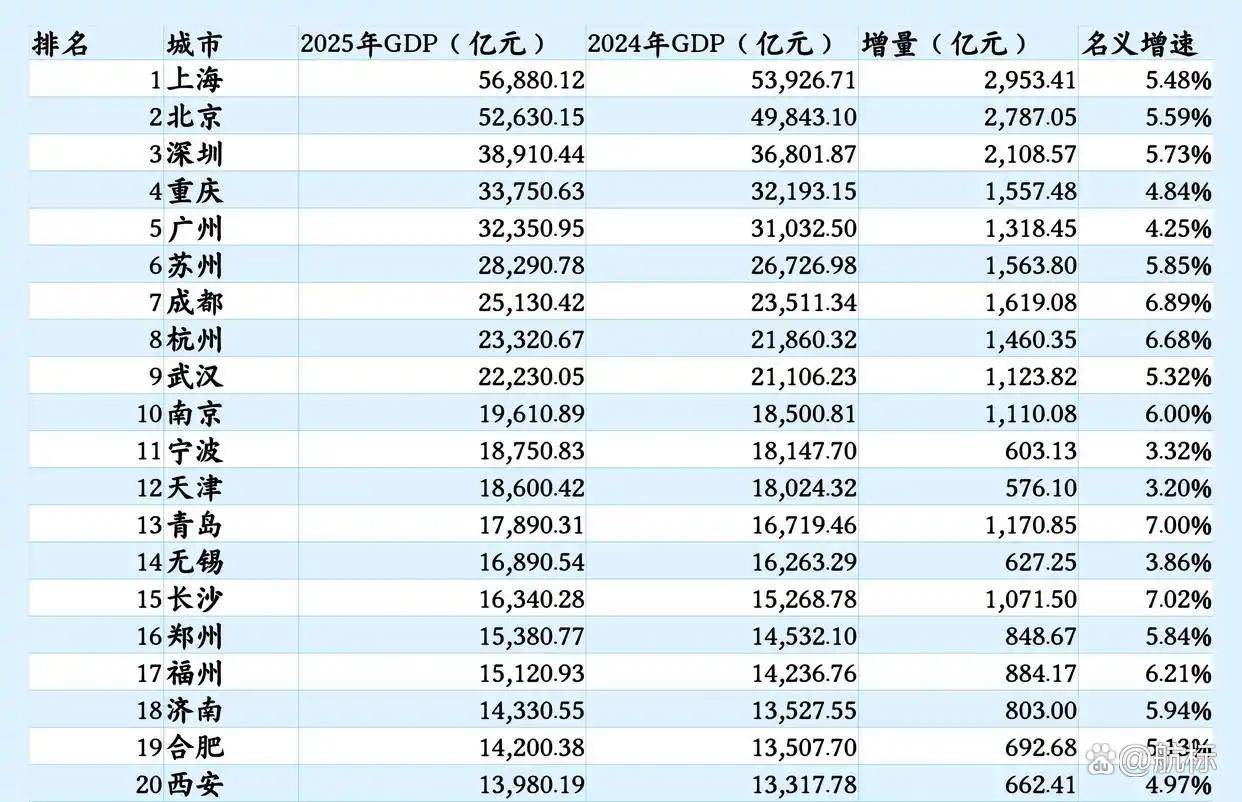
Core Insights - The competition among China's leading cities has entered a new phase characterized by refined and differentiated comparisons, with Shanghai and Beijing leading with GDPs exceeding 5.5 trillion yuan, while cities like Shenzhen, Wuhan, and Qingdao show significant growth potential [1][2] Group 1: Economic Growth and Projections - Shanghai's projected GDP for 2025 is 56,880.12 billion yuan, with an increase of 2,953.41 billion yuan from 2024 [2] - Beijing's projected GDP for 2025 is 52,630.15 billion yuan, reflecting an increase of 2,787.05 billion yuan from 2024 [2] - Shenzhen is approaching the 4 trillion yuan mark with a projected GDP of 38,910.44 billion yuan, marking a nominal growth rate of 5.73% [2][3] - Wuhan's GDP is projected to reach 22,230.05 billion yuan, expanding its lead over Nanjing to approximately 2,620 billion yuan [5] - Qingdao is expected to have a GDP growth rate of 7.00%, making it one of the fastest-growing economies among the top 20 cities [7] Group 2: Strategic Development and Innovation - Shenzhen's growth is driven by a robust innovation ecosystem, with strategic emerging industries accounting for over 40% of its GDP [2][3] - Major companies like Huawei, BYD, and Tencent are not only revenue contributors but also serve as innovation hubs within the industrial chain [3] - Wuhan is leveraging its geographical advantages to become a center for market and supply chain nodes, supported by significant projects in new energy and intelligent vehicles [5] - Qingdao is focusing on marine economy and innovation, with initiatives like the "Blue Granary" strategy targeting advanced fields such as marine pharmaceuticals [7] Group 3: Competitive Landscape and Future Outlook - The competition among cities is intensifying, with cities like Changsha and Chengdu showing remarkable growth rates of 7.02% and 6.89%, respectively [9] - The shift from mere scale expansion to developing core competencies in unique sectors is becoming crucial for future success [9] - The next five years will reveal which cities can leverage their unique industrial characteristics to achieve significant advancements in their economic standings [9]

AI赋能数智转型四川长虹锚定全域智联新蓝图
Zheng Quan Shi Bao Wang· 2025-12-08 05:47
Core Viewpoint - Sichuan Changhong is leveraging digital transformation to redefine its position in the traditional manufacturing sector, achieving significant revenue growth and aiming to become a leader in global consumer electronics and smart manufacturing during the "14th Five-Year Plan" and beyond [1][2]. Group 1: Financial Performance - Sichuan Changhong's revenue surpassed 100 billion yuan, with a net profit of 5.01 billion yuan in the first half of 2025, marking a year-on-year increase of 78.6%, the highest in nearly four years [2]. - The company has achieved a commercial inventory turnover rate improvement of 145%, saving nearly 100 million yuan in annual inventory costs [2]. Group 2: Technological Advancements - The company has integrated AI technology across its entire value chain, establishing a comprehensive innovation system that includes R&D, production, and products [1]. - The "Changhong Yunfan AI Model Platform" became the first AI model platform in Sichuan Province to be registered with the National Cyberspace Administration, enhancing the AI capabilities of its home appliances [1]. Group 3: Smart Manufacturing - Sichuan Changhong's smart display factory was selected as one of the first batch of excellent smart factories in the country, featuring 18 smart production lines that fully automate key processes [2]. - The factory can handle 6 million personalized orders annually, showcasing its advanced manufacturing capabilities [2]. Group 4: Global Expansion - The company has adopted a localization strategy for its products, focusing on high-end design and energy efficiency for the European market, while emphasizing cost-effectiveness in Southeast Asia [2]. - Sichuan Changhong's products are now available in over 160 countries and regions, reflecting its successful internationalization efforts [2]. Group 5: Future Outlook - For the "15th Five-Year Plan," Sichuan Changhong aims to achieve an 80% coverage rate of advanced smart factories and enhance its integrated manufacturing capabilities [3]. - The company plans to deepen its presence in key international markets, including Europe, Australia, and Indonesia, to increase market share [3].

大消费行业周报:关注具有边际改善的细分赛道-20251208
Ping An Securities· 2025-12-08 05:34
Investment Rating - The industry investment rating is "stronger than the market," indicating that the industry index is expected to outperform the market by more than 5% over the next six months [29]. Core Insights - The report highlights the importance of focusing on segments with marginal improvements and stable growth within the consumer sector, particularly in the home appliance and beauty industries [3][4]. - The tourism sector is showing potential for recovery, with leading companies like Ctrip and Huazhu Hotels responding quickly to changing consumer demands [3]. - The beauty industry is experiencing steady growth, with a recommendation to monitor leading brands that adapt swiftly to market dynamics [3]. - The liquor industry is facing challenges, with a notable decline in net profits for many companies in Q3 2025 compared to Q2 2025, but leading firms are expected to gain market share [4][20]. - The snack segment is showing a divergence in performance, with certain products like konjac continuing to thrive, while dairy companies are entering a recovery phase [4][25]. Summary by Sections Home Appliances - The home appliance sector is experiencing a downturn, with air conditioning production down 27.9% year-on-year in October 2025, and sales down 20.1% [27]. - Central air conditioning sales reached 11.2 billion yuan in October 2025, facing downward pressure [27]. - Refrigerator production decreased by 9.8% year-on-year, while washing machine production saw a slight decline of 0.2% [27]. Social Services - The report emphasizes the need to focus on leading companies that can adapt to changing consumer demands in the social services sector, particularly in tourism and beauty [3][4]. Food and Beverage - Alcohol - The report notes a significant decline in net profits for many liquor companies in Q3 2025, with a focus on high-end and mid-range liquor brands expected to perform better [4][20]. - The average price of pork in the wholesale market increased by 0.2% to 17.68 yuan per kilogram as of December 5, 2025 [25]. Food and Beverage - General - The snack segment is experiencing a mixed performance, with konjac products showing strong growth potential [4][25]. - Dairy companies are expected to enter a recovery phase as supply and demand dynamics improve [4][25]. Cultural Communication - The report suggests that media companies should focus on segments related to spiritual needs and consumer sentiment to capture opportunities [4][17].
从“税”数据透视今年以来我国经济稳中向好 制造业“压舱石”作用持续稳固
Yang Shi Wang· 2025-12-08 04:36
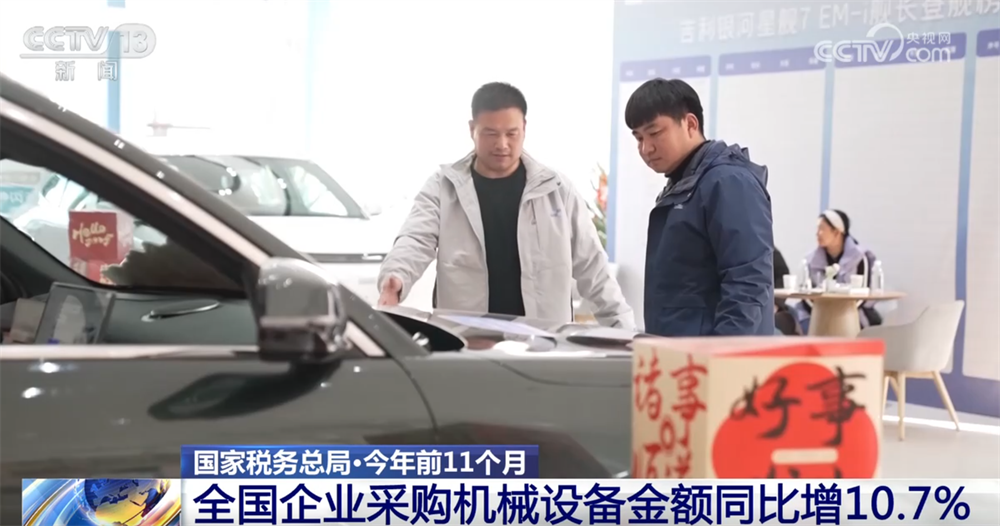
Group 1 - The core viewpoint of the article highlights that China's economy is showing steady improvement, with an optimized economic structure and enhanced development momentum [1] Group 2 - National enterprises' procurement of machinery and equipment increased by 10.7% year-on-year in the first 11 months, indicating a stronger investment in equipment [2] - Sales revenue in the retail sectors of communication and home appliances, supported by the old-for-new consumption policy, grew by 20.3% and 26.5% respectively, reflecting the ongoing effects of consumption promotion policies [2] - The manufacturing sector's tax revenue remains stable at around 30%, underscoring its role as an economic stabilizer [2] Group 3 - Export tax refunds processed by national tax authorities increased by 6.8% year-on-year, demonstrating the resilience of Chinese enterprises in maintaining good growth amid complex international trade conditions [4] Group 4 - The sales revenue of clean energy sectors, including wind, solar, and hydropower, grew by 14.9% year-on-year, accounting for 38% of total electricity industry sales revenue, which is an increase of 4.3 percentage points compared to the same period last year [6] - Sales revenue from wind power and solar power increased by 16.8% and 35.7% year-on-year, respectively, indicating a rapid advancement in the green transition of China's energy structure [8] Group 5 - In the first 10 months, tax reductions and refunds supporting technological innovation and manufacturing amounted to 23,725 billion, driving rapid growth in innovative industries [10]
大力提振消费!清理汽车、住房等消费不合理限制性措施……广东重磅发布
证券时报· 2025-12-08 04:20
Core Viewpoint - The article emphasizes the importance of Guangdong's role in advancing China's modernization and outlines the strategic goals and guiding principles for the province's economic and social development during the "15th Five-Year Plan" period. Group 1: Achievements and Historical Context - Guangdong has achieved significant development during the "14th Five-Year Plan" period, with a GDP surpassing 14 trillion yuan, showcasing rapid economic growth and social stability despite challenges such as the pandemic and global changes [3][4]. - The "15th Five-Year Plan" period is seen as a critical time for consolidating achievements and creating new advantages for Guangdong, focusing on overcoming bottlenecks and enhancing development capabilities [4][5]. Group 2: Development Environment - The province faces both strategic opportunities and challenges, including global shifts in power dynamics, technological revolutions, and the need for sustainable development [5][6]. - Guangdong's economic foundation remains strong, with advantages such as proximity to Hong Kong and Macau, a robust industrial base, and a large population, but issues like unbalanced development and the need for innovation persist [5][6]. Group 3: Guiding Principles and Goals - The guiding principles for the "15th Five-Year Plan" include upholding the leadership of the Communist Party, prioritizing people's needs, promoting high-quality development, and deepening reforms [7][8]. - Key goals include achieving significant progress in high-quality development, enhancing technological self-reliance, improving urban-rural coordination, and advancing social civilization [10][11][12]. Group 4: Economic Development Strategies - The plan emphasizes building a modern industrial system centered on advanced manufacturing, optimizing traditional industries, and fostering emerging sectors [19][20][23]. - There is a focus on enhancing service industries, improving infrastructure, and leveraging digital technologies to drive economic growth [23][24][30]. Group 5: Innovation and Technology - Strengthening original innovation and key technology breakthroughs is a priority, with an emphasis on integrating technology with industry to enhance productivity [25][26][27]. - The development of a comprehensive innovation ecosystem is essential, involving collaboration between education, technology, and talent development [29][28]. Group 6: Domestic Market and Consumption - The strategy includes boosting domestic consumption and investment, enhancing the consumer environment, and promoting new consumption patterns [32][33]. - Efforts will be made to integrate domestic and international markets, facilitating trade and economic cooperation [34][35][41]. Group 7: Reform and Opening Up - The article highlights the need for deepening reforms and expanding openness to enhance economic vitality and competitiveness [36][37][38]. - Creating a market-oriented, law-based, and international business environment is crucial for attracting investment and fostering economic growth [38][39].

金鹰基金:春节躁动增量资金加持相对明确 关注科技+制造主线双轮动
Xin Lang Cai Jing· 2025-12-08 04:05
Group 1 - The A-share market saw a general increase in major indices last week, but trading volume was insufficient, with the average daily turnover dropping to 1.70 trillion yuan [1][5] - The cyclical sector performed well due to supply tightening and rising expectations of interest rate cuts by the Federal Reserve, with precious metals leading the gains [1][5] - The market style was characterized by cyclical > financial > growth > consumption [1][5] Group 2 - Domestic news indicates that the capital space and leverage limits for quality brokerages are expected to open up, which will facilitate the entry of significant incremental capital into the market [1][5] - The upcoming Central Economic Work Conference in December is anticipated to set a relatively positive fiscal policy for next year, particularly in new areas of fiscal support that will directly impact the recovery of certain sectors [1][5] Group 3 - The spring market focus is on technology and manufacturing, with an emphasis on domestic policy direction [2][6] - The technology sector is believed to be in the later stages of adjustment, with historical data suggesting limited further downside potential after a 40-day correction and a 25% drop in the industry index [2][6] - Concerns regarding AI investment returns need to be alleviated for the technology sector to regain strength, with advancements in large model capabilities and AI commercialization being key catalysts [2][6] Group 4 - The global manufacturing sector is expected to experience a synchronized recovery, benefiting from both fiscal and monetary easing [2][6] - There is a focus on manufacturing within the export chain (non-ferrous metals, power grid equipment, engineering machinery) and related sectors in emerging markets (home appliances, automotive) [2][6] - Non-bank sectors (insurance, brokerages, financial IT) and high-dividend stocks (banks, coal, white goods) are also expected to benefit from liquidity-driven opportunities [2][6]
前11个月消费需求持续释放,日用家电销售增长超20%
Bei Jing Ri Bao Ke Hu Duan· 2025-12-08 04:03
Group 1 - The core viewpoint of the articles highlights the sustained growth in consumer demand driven by policies such as the trade-in program for consumer goods, with significant sales increases in home appliances and new energy vehicles [1][2] - In the first 11 months of the year, retail sales in the telecommunications equipment sector, including mobile phones, grew by 20.3%, while daily household appliances like refrigerators saw a 26.5% increase in sales revenue [1] - The sales revenue from new energy passenger vehicles also showed positive momentum, with a year-on-year growth of 19.1% [1] Group 2 - The sports and health sectors exhibited high consumer enthusiasm, with sports exhibition services and retail of sports goods and equipment increasing by 29.7% and 6.6% respectively in the first 11 months [2] - Health-related consumption has emerged as a new hotspot, with sales of health auxiliary treatment equipment and health consulting services maintaining double-digit growth [2]
前11个月消费需求持续释放 日用家电销售增长超20%
Yang Shi Xin Wen· 2025-12-08 03:50
Group 1 - The core viewpoint of the articles highlights the sustained growth in consumer demand driven by policies such as the trade-in program for consumer goods, with significant sales increases in home appliances and new energy vehicles [1][2] - In the retail sector, sales revenue for communication devices like mobile phones increased by 20.3%, while daily household appliances such as refrigerators saw a 26.5% rise in sales revenue year-on-year [1] - The sales revenue for new energy passenger vehicles also showed positive growth, with a year-on-year increase of 19.1% [1] Group 2 - The sports and health sectors are experiencing high consumer enthusiasm, with sports exhibition services and retail of sports goods and equipment growing by 29.7% and 6.6% respectively year-on-year [2] - Health-related consumption is emerging as a new hotspot, with sales of health auxiliary treatment equipment and health consulting services maintaining double-digit growth [2]
斐雪派克亮相2025 Dreamforce大会
Jin Tou Wang· 2025-12-08 03:46
Group 1 - The 2025 Dreamforce conference showcased the digital transformation achievements of Fisher & Paykel, highlighting its role as a benchmark in digital marketing, IT infrastructure, and customer service [1] - In marketing, Fisher & Paykel utilized AI technology to enhance personalized experiences, resulting in a 33% increase in order conversion rates and a 75% efficiency improvement through internalized advertising content and automated operations [1] - In customer service, the company reduced user inquiries by half and shortened service wait times by nearly one-third through AI and automation technologies [1] - Fisher & Paykel's IT platform underwent significant digital transformation, enabling seamless data flow from order to service, which is essential for providing a high-end customer experience [1] - The company's digital practices reflect its commitment to designing for a changing world and responding to the demands of the digital age, offering valuable insights for the industry [1] Group 2 - Digital transformation has effectively driven market growth, with Fisher & Paykel and Haier holding the top sales share in the Australia-New Zealand market, achieving a 20% share in Australia and over 40% in the New Zealand white goods market [2]
现在的格力电器,到底是一只股票还是债券?
晚点LatePost· 2025-12-08 03:20
Core Viewpoint - Gree Electric Appliances is a leading company in the A-share market known for its substantial and consistent dividend payouts, which have become a core value label for the company. However, concerns about the sustainability of these dividends and the company's growth prospects are evident, as Gree faces challenges in revenue growth and strategic alignment [5][6][7]. Group 1: Dividend and Financial Performance - Gree's cumulative dividends have exceeded 170 billion yuan since its listing, while the company has only raised 5 billion yuan from the market, highlighting a significant disparity between dividends and capital raised [5]. - The company has maintained a high dividend payout ratio of over 50% in recent years, likening its dividends to a perpetual bond that provides fixed returns to shareholders [25][28]. - Despite a rolling PE ratio of approximately 7, significantly lower than competitors like Haier and Midea, Gree's stock price remains stable due to its consistent dividend policy [25][28]. Group 2: Revenue and Business Structure - Gree's revenue has stagnated around 200 billion yuan from 2018 to 2024, with a projected decline of about 7% year-on-year for 2025, indicating a passive development situation amid increasing market competition [7][22]. - The company's revenue is primarily derived from its manufacturing business, with a smaller portion from other business activities, which have fluctuated due to market conditions [10][11]. - The share of Gree's air conditioning business has decreased from 97.4% in 2011 to 86.6% in 2023, while the share of home appliances has seen minimal growth, reflecting challenges in diversifying its product offerings [13][15]. Group 3: Market Position and Competition - Gree's international business remains underdeveloped, with its market share not exceeding 20%, trailing behind competitors like Midea and Haier, primarily due to its conservative approach to overseas expansion [18][19]. - The company faces significant competition from both established players and emerging brands, complicating its efforts to regain market share and achieve growth in a challenging environment [50][51]. - Gree's channel reform efforts aim to streamline operations and improve profitability, but the effectiveness of these reforms in driving growth remains uncertain [51][60]. Group 4: Challenges and Strategic Outlook - Gree is currently navigating multiple internal and external challenges, including a prolonged inventory destocking cycle and declining demand in both domestic and international markets [22][48]. - The company's reliance on a high dividend payout may limit its ability to invest in growth initiatives, creating a paradox where maintaining dividends could hinder long-term strategic flexibility [60][61]. - The ongoing channel reforms are critical for Gree to adapt to market changes, but the complexity of its governance structure and the need for consensus among diverse stakeholders pose significant hurdles [59][61].