
医药生物

Search documents
63只科创板股票跻身百元股阵营
Zheng Quan Shi Bao Wang· 2025-09-03 09:20
以最新收盘价计算,科创板平均股价为39.44元,其中股价超100元的有63只,股价最高的是寒武纪。 证券时报·数据宝统计显示,科创板股今日上涨的有146只,下跌的有440只,以收盘价为基准测算,科 创板平均股价为39.44元,其中,收盘价超过100元的有63只,股价在50元至100元之间的有140只,股价 在30元至50元的有155只。 科创板股中,收盘价最高的是寒武纪,今日报收1405.00元,下跌5.07%,其次是茂莱光学、百利天恒 等,最新收盘价分别为422.02元、410.00元。 科创板百元股中,今日平均上涨0.65%,具体来看,今日上涨的有30只,涨幅居前的有海博思创、百利 天恒、源杰科技等。下跌的有31只,跌幅居前的有财富趋势、寒武纪、国盾量子等。 向前追溯发现,科创板百元股最新收盘价相对发行价平均溢价392.25%,溢价幅度居前的有寒武纪、百 利天恒、安集科技等,溢价幅度分别为2082.02%、1559.92%、1282.93%。 以申万一级行业分类,科创板百元股较为集中的行业有电子、医药生物、计算机等,分别有28只、11 只、9只股票上榜。 资金流向方面,科创板百元股今日主力资金合计净流出2 ...

京新药业(002020):2025年中报点评:盈利能力提升,地达西尼加速放量
Orient Securities· 2025-09-03 08:42
Investment Rating - The report maintains a "Buy" rating for the company [3][6]. Core Views - The company's profitability is improving, with significant growth expected from the product Didasyn [10]. - The revenue forecast for 2025 has been adjusted to 4.33 billion yuan, with EPS estimates revised to 0.95 yuan for 2025, 1.10 yuan for 2026, and 1.25 yuan for 2027 [3][5]. - The target price is set at 25.30 yuan based on a 23x PE ratio for 2026 [3]. Financial Performance Summary - Revenue for 2023 is projected at 3.999 billion yuan, with a growth rate of 5.8%. For 2024, revenue is expected to reach 4.159 billion yuan, growing at 4.0% [5][12]. - Operating profit is forecasted to be 714 million yuan in 2023, with a decline of 5.6%, but is expected to rise to 844 million yuan in 2024, reflecting an 18.1% increase [5][12]. - Net profit attributable to the parent company is estimated at 619 million yuan for 2023, with a decrease of 6.5%, and is projected to grow to 712 million yuan in 2024, a 15.0% increase [5][12]. - The gross margin is expected to improve from 50.6% in 2023 to 51.5% in 2025, while the net margin is projected to increase from 15.5% to 18.9% over the same period [5][12]. - The company’s return on equity (ROE) is expected to rise from 11.6% in 2023 to 12.8% in 2025 [5][12].

仙琚制药(002332):2025年中报点评:业绩短期承压,下半年有望改善
Orient Securities· 2025-09-03 08:42
Investment Rating - The report maintains a "Buy" rating for the company [5] Core Views - The company's performance is under short-term pressure, but improvement is expected in the second half of the year [1] - Revenue and profit forecasts have been adjusted, with earnings per share projected at 0.61, 0.70, and 0.86 yuan for 2025-2027, respectively [2] - The target price is set at 12.81 yuan based on a 17x P/E ratio for 2026 [2] Financial Performance Summary - The company reported a revenue of 4,123 million yuan in 2023, with a projected decline to 3,837 million yuan in 2025, followed by a recovery to 4,429 million yuan in 2026 and 5,181 million yuan in 2027 [4] - The gross margin is expected to improve from 52.9% in 2023 to 65.0% by 2027 [4] - The net profit attributable to the parent company is forecasted to increase from 563 million yuan in 2023 to 852 million yuan in 2027, with a significant jump of 51.9% in 2025 [4] - The company’s earnings per share are projected to rise from 0.57 yuan in 2023 to 0.86 yuan in 2027 [4] Market and Product Insights - The company is experiencing challenges in raw material and formulation sales, but there is potential for recovery as export prices stabilize and the impact of centralized procurement diminishes [8] - The overseas market is becoming a new growth driver, with a reported revenue of 5.41 billion yuan from international operations, reflecting a 5.1% year-on-year increase [8] - The company has a robust pipeline of new products, with several new drugs and complex formulations expected to receive approval soon, enhancing future growth prospects [8]

益方生物(688382):2025年中报点评:商业化加速,在研管线高效推进
Orient Securities· 2025-09-03 07:24
Investment Rating - The report maintains a "Buy" rating for the company with a target price of 47.30 CNY, reflecting a reasonable market value of 273.54 billion CNY [4][7]. Core Views - The company has shown a narrowing loss with a significant increase in commercial product sales, leading to a 29% year-on-year revenue growth in the first half of 2025, achieving 0.19 billion CNY. The net profit attributable to the parent company was -1.19 billion CNY, a 44% reduction in loss compared to the previous year [12]. - The company is actively expanding the indications for its approved products, with ongoing clinical trials for both Beifutini and Gesorex, which are expected to contribute positively to revenue in the coming years [12]. - The research pipeline is well-structured, with several promising candidates in advanced clinical stages, indicating strong potential for business development opportunities [12]. Financial Summary - The company's revenue is projected to decline from 186 million CNY in 2023 to 141 million CNY in 2025, before rebounding to 323 million CNY in 2026 and 525 million CNY in 2027, reflecting a growth rate of 129.3% and 62.6% respectively [6][15]. - The net profit attributable to the parent company is expected to improve from -284 million CNY in 2023 to -203 million CNY in 2025, with a further reduction to -94 million CNY by 2027 [6][15]. - The gross margin is forecasted to remain high, around 97.2% in 2025, while the net margin is expected to improve significantly from -144.0% in 2025 to -17.8% in 2027 [6][15].

【盘中播报】10只A股跌停 国防军工行业跌幅最大
Zheng Quan Shi Bao Wang· 2025-09-03 07:21
证券时报·数据宝统计,截至下午13:58,今日沪指跌1.15%,A股成交量1186.09亿股,成交金额18732.31 亿元,比上一个交易日减少23.96%。个股方面,967只个股上涨,其中涨停33只,4391只个股下跌,其 中跌停10只。从申万行业来看,综合、电力设备、医药生物等涨幅最大,涨幅分别为1.95%、0.79%、 0.33%;国防军工、非银金融、计算机等跌幅最大,跌幅分别为5.87%、3.02%、2.18%。(数据宝) 今日各行业表现(截至下午13:58) | 申万行业 | 行业涨跌(%) | 成交额(亿元) | 比上日(%) | 领涨(跌)股 | 涨跌幅(%) | | --- | --- | --- | --- | --- | --- | | 综合 | 1.95 | 48.75 | -18.17 | 东阳光 | 6.23 | | 电力设备 | 0.79 | 1948.04 | -8.54 | 海博思创 | 18.00 | | 医药生物 | 0.33 | 1257.92 | -22.73 | 成都先导 | 12.28 | | 传媒 | 0.21 | 491.42 | -17.34 | 金逸影视 | ...
主观多头管理人今年以来仓位及配置观点变化
私募排排网· 2025-09-03 07:00
点击↑↑上面卡片参考更多 2025年是中国资本市场直面外部冲击与内部转型的关键之年。在中美贸易摩擦升级、科技产业变革深化、政策托底信号强化的三重交织下,A 股市场经历了从指数下跌到修复再到快牛的剧烈波动。 在此环境中,主观多头策略管理人通过灵活调整仓位与主线布局,展现出对市场节奏的 敏锐把握。 年初国债利率在宽松货币政策表态下达到历史新低,A股核心指数价格震荡向下。在此背景下,主观多头私募管理人仍以中高仓位运作为主, 股票仓位分布于六成至满仓范围,多数基金维持八至九成仓位,现金仓位较低,大多低于5%,强调进攻性策略。其中A股仓位占股票总仓位的 50-90%,多数管理人超配,港股仓位占比为10-40%,聚焦互联网和消费板块,美股仅少数全球化基金配置。 行业配置高度集中于科技(AI、 半导体)、消费、周期品及高端制造等,其中科技占比整体约为20-40%,管理人普遍增持AI应用端和国产算力链,不同管理人持有子行业有所 不同, 例如信息技术、电子、计算机;消费(含互联网)占比15-30%,主要分为持电力设备、汽车为主和持医药生物为主的管理人,主要布局 内需复苏预期;周期板块(有色/能源)占比约10-20%,出于防御性 ...


创业板ETF(159915)半日成交额近50亿元,居深市股票型ETF第一
Mei Ri Jing Ji Xin Wen· 2025-09-03 05:20
Group 1 - The Sci-Tech Innovation Board 50 ETF tracks the Shanghai Stock Exchange Sci-Tech Innovation Board 50 Index, consisting of 50 large-cap, liquid stocks with a significant focus on "hard technology," particularly in the semiconductor sector, which accounts for over 60% of the index [2] - The rolling price-to-earnings (P/E) ratio of the Sci-Tech Innovation Board 50 Index is 183.7 times, indicating a high valuation level [2] - The index has shown a price change of 20% since its inception [2] Group 2 - The ChiNext ETF tracks the ChiNext Index, which includes 100 large-cap, liquid stocks from the ChiNext market, with a high proportion of strategic emerging industries, particularly in power equipment, pharmaceuticals, and electronics, which together account for over 55% of the index [3] - The rolling P/E ratio for the ChiNext Index is 40.7 times, reflecting a moderate valuation [3] - The index has not shown any price change since its inception [3] Group 3 - The Sci-Tech Innovation and ChiNext ETF tracks the CSI Sci-Tech Innovation and ChiNext 50 Index, comprising 50 large-cap stocks from both boards, with a high concentration in emerging industries, particularly in power equipment, electronics, and pharmaceuticals, which together account for nearly 75% of the index [4] - The rolling P/E ratio for this index is 57.1 times, indicating a relatively high valuation [4] - The index has experienced a price change of 0.6% since its inception [4] Group 4 - The data for the indices is sourced from Wind, with the price changes recorded as of September 3, 2025, and the rolling P/E ratios and valuation percentiles as of September 2, 2025 [5] - The Sci-Tech Innovation Board 50 Index was launched on July 23, 2020, the ChiNext Index on June 1, 2010, and the CSI Sci-Tech Innovation and ChiNext 50 Index on June 1, 2021 [5]

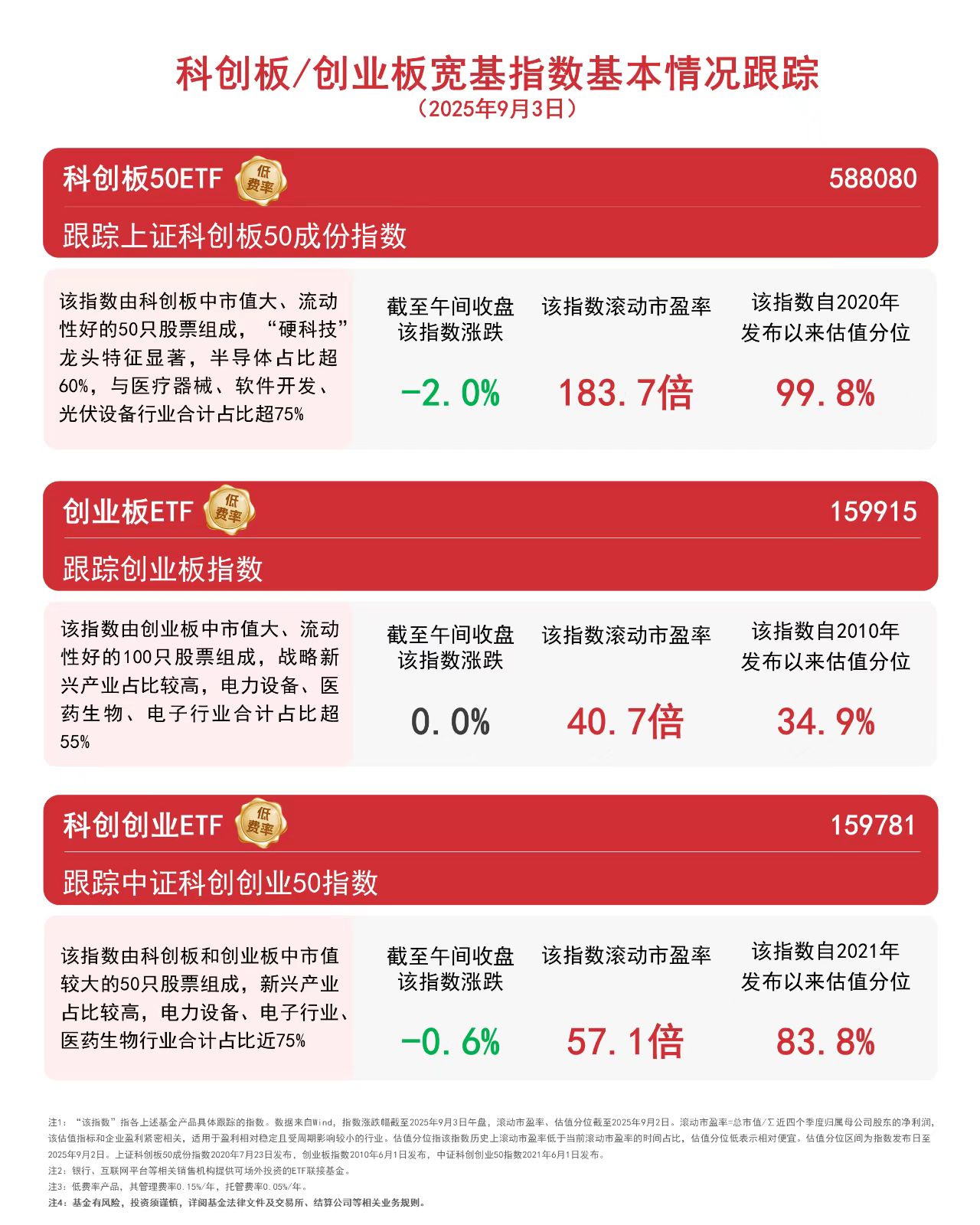
9.2犀牛财经晚报:8月A股新开户数同比增长165% 宇树科技将在四季度提交IPO申请
Xi Niu Cai Jing· 2025-09-03 05:04
Group 1: A-Share Market Activity - In August 2025, A-share new account openings reached 2.65 million, representing a year-on-year increase of 165% compared to 1 million in August 2024 [1] - Monthly comparisons show a significant rise from 1.57 million in January 2025 to 2.84 million in February, with a peak of over 3 million in March [1] - The new account openings in August 2025 exceeded the total for 10 months of the previous year [1] Group 2: Robotics Sector Developments - The robotics sector experienced a strong rebound on September 2, 2025, with Zhejiang Rongtai's stock hitting the limit up, attributed to a market rumor regarding a meeting with Tesla [2] - The rumor suggested that Tesla provided optimistic guidance for robot production capacity, expecting a weekly output of 10,000 units by Q3 2026 [2] - Zhejiang Rongtai confirmed awareness of the rumor but could not verify its accuracy, stating that no related meeting occurred on that day [2] Group 3: Fund Holdings and Industry Focus - The 2025 mid-year report from public funds indicated significant increases in holdings in the pharmaceutical, banking, and electronics sectors, while sectors like power equipment and food and beverage saw declines [3] - Notable individual stocks with increased fund holdings included Shutaishen, Anglikang, and Weichai Heavy Machinery, while Guotai Haitong, Shenghong Technology, and Zijin Mining led in fund holding value growth [3] Group 4: DRAM Industry Performance - The DRAM industry reported a total revenue of $31.63 billion in Q2 2025, marking a quarter-on-quarter increase of 17.1% due to rising contract prices and increased shipment volumes [3] - The average selling price (ASP) of DRAM products increased as demand from PC OEMs, smartphones, and CSP companies grew [3] Group 5: Corporate Announcements - Yushutech announced plans to submit an IPO application between October and December 2025, with sales from quadruped robots, humanoid robots, and components making up 65%, 30%, and 5% of revenue, respectively [5] - Huazhong Securities received approval to issue subordinate bonds totaling up to 10 billion yuan [6] - Lin Yang Energy was recommended as a candidate for a 2.44 billion yuan project with the Southern Power Grid [7] - Jinbei Automotive plans to invest 240 million yuan in establishing an automotive industry investment fund focusing on electrification and low-carbon initiatives [8] - Xiangxin Technology intends to apply for a total of 280 million yuan in bank credit [9] - Ningbo Construction's subsidiary won a construction project worth 729 million yuan [10] - Kuangda Technology announced a suspension of trading due to a planned change in control [12]
新质生产力成共识!公募、券商、社保集体加码
Huan Qiu Wang· 2025-09-03 04:21
Group 1 - Institutional investors are increasingly focusing on "new quality productivity" stocks, with 89 out of 145 stocks held by public funds, brokerages, and social security funds falling into this category, indicating a significant trend towards new developments [1] - As of the end of Q2, social security funds appeared among the top ten shareholders of 568 listed companies, with a total holding value of 165.07 billion yuan, and significant investments in companies like Sany Heavy Industry and Transsion Holdings [2] - Public funds held stocks in 5,205 A-share companies with a total market value of 6.03 trillion yuan, while brokerages held stocks in 820 companies valued at 85.02 billion yuan, showing a broad investment base across various sectors [2] Group 2 - The consensus among the three types of institutions regarding new quality productivity stocks stems from their shared investment focus, despite differing core objectives and operational styles [4] - New quality productivity aligns with national strategies for technological innovation and industrial upgrading, with sectors like high-end manufacturing and artificial intelligence receiving resource support [4][5] - The 89 new quality productivity stocks held by these institutions are primarily concentrated in high-growth industries such as hardware equipment, machinery, and biomedicine, reflecting a positive outlook on these sectors [6]

科创50ETF探底回升,跌幅收窄
Mei Ri Jing Ji Xin Wen· 2025-09-03 03:13
Group 1 - The core viewpoint of the article highlights the significant recovery of the ChiNext 50 ETF, driven by a positive outlook on China's economic development and improvements in the global macro environment [1] - The ChiNext 50 Index has seen a notable increase in its holdings, particularly in semiconductor and biotechnology sectors, with major stocks like Tianyue Advanced and Shengmei Shanghai leading the gains [1] - The recommendation from the securities firm is to increase allocation to technology growth assets, focusing on sectors with high or improving mid-year performance expectations [1] Group 2 - The ChiNext 50 ETF (588000) tracks the ChiNext 50 Index, which has a concentrated industry distribution with 63.74% in the electronics sector and 11.78% in the pharmaceutical and biotechnology sector, totaling 75.52% [1] - The index includes various sub-sectors such as semiconductors, medical devices, software development, and photovoltaic equipment, indicating a high content of hard technology [1] - The current position of the ChiNext 50 Index is near its baseline, and historical trends suggest potential for future growth, making it an attractive option for investors interested in China's hard technology development [1]
