基金

Search documents
2026年公募REITs市场3月半月报:回调加剧、换手探底,年报季聚焦分红窗口-20260318
Shenwan Hongyuan Securities· 2026-03-18 08:33
1. Report Industry Investment Rating No information about the industry investment rating is provided in the report. 2. Core Viewpoints of the Report - Multiple factors such as the diversion of commercial real - estate REITs, concerns about the accelerated pace of primary supply, and the rise in long - term bond interest rates have led to an intensified correction in the REITs market. The liquidity is running at a low level, but the decline has narrowed. The CSI REITs Total Return Index fell 1.7% in the first half of March 2026, with the decline widening compared to the same period last month [4]. - The dividend yield of REITs has caught up with that of dividend - paying stocks. The valuation of equity - type REITs has decreased, while that of concession - type REITs has increased. The internal rate of return (IRR) of both types has increased compared to the end of February [4]. - Two infrastructure REITs projects have been registered and are awaiting issuance. One new commercial real - estate REIT has been reported, and the fundraising scale of new projects has decreased. The market is expected to see an increase in the enthusiasm for offline subscriptions with the issuance of the first project of the year and the progress of commercial real - estate projects [4]. - Annual reports will be released one after another. It is recommended to pay attention to the dividend window in April. After the release of the annual reports, the concentrated dividend season of the year will follow [4]. 3. Summary According to the Directory 3.1 Market Correction Amplifies, Liquidity Decline at Low Level Narrows - **Market Performance**: In the first half of March 2026, the equity market was weak, with the 300 Return Index falling 0.8% and only the CSI Dividend Total Return Index rising 1.5%. The 10 - year Treasury yield continued to rise, reaching 1.83%. Affected by multiple factors, the CSI REITs Total Return Index fell 1.7%, with the decline widening compared to February [10]. - **Sector Performance**: In the first half of March 2026, various types of assets generally corrected, with only the energy sector rising slightly. Equity - type assets had a large decline, with the warehousing and logistics, IDC, and rental - housing sectors falling more than 3%. Concession - type sectors were relatively resistant to decline, and the energy sector rose 0.58% [11][16]. - **Individual Bond Performance**: The proportion of rising and falling individual REITs was 18% and 82% respectively. The National Electric Power Investment New Energy REIT led the rise (+2.58%), while the JD Warehouse REIT led the decline (-10.95%) [20]. - **Turnover Rate**: In the first half of March 2026, the average daily turnover rate of Shanghai and Shenzhen REITs was 0.37%, a slight narrowing of 0.01 percentage points compared to February. The selling pressure of rental - housing assets increased, the trading activity of industrial park and consumer assets continued to cool, and the turnover rate of IDC assets showed an upward trend [26]. 3.2 Dividend Yield Catches Up with Dividend - Paying Stocks, Equity Valuation Decreases while Concession Valuation Increases - **Dividend Yield**: As of March 16, 2026, the dividend yield (TTM) of equity - type REITs was 4.67% (at the 64th percentile), and that of concession - type REITs was 8.46% (at the 73rd percentile). The overall dividend yield of equity - type REITs increased by 0.08 percentage points compared to the end of February, and the dividend yield of consumer REITs reached the 90th percentile of the historical high [31]. - **Comparison with Other Assets**: The spread between the dividend yield of equity - type REITs and the 10 - year Treasury yield was 2.83% (at the 72nd percentile of history), widening by 0.07 percentage points compared to the end of February. The spread between the dividend yield of equity - type REITs and the CSI Dividend yield was 0.00% (at the 78th percentile of history), widening by 0.27 percentage points compared to the end of February, and the dividend yields of the two were equal [36]. - **Valuation**: The latest P/NAV of equity - type REITs was 1.23X, at the 66th percentile of history, and the valuation decreased compared to the end of February. The latest P/FFO of concession - type REITs was 13.45X, at the 55th percentile of history, and the valuation increased compared to the end of February [46]. - **IRR**: The latest IRR of equity - type REITs was 4.2%, at the 42nd percentile of history; the latest IRR of concession - type REITs was 5.2%, at the 32nd percentile of history. The IRRs of both types increased compared to the previous period [51]. 3.3 Two Projects Registered and Awaiting Issuance, New Commercial Fundraising Amount Decreases - **Market Status**: As of March 16, 2026, there were 79 listed REITs in Shanghai and Shenzhen, with a total market value of 222.9 billion yuan. There have been no new REITs issued in the market since 2026 [53]. - **Subscription Yield**: Only the Huaxia Zhonghe Clean Energy REIT was listed in 2026. The offline cash subscription yields for 10 million yuan, 30 million yuan, and 100 million yuan were 0.83 million yuan, 2.48 million yuan, and 8.27 million yuan respectively, and the cumulative offline subscription yield for cash below 100 million yuan was 0.08% [59]. - **Infrastructure REITs**: As of March 16, there were 15 infrastructure REITs projects that had been accepted but not issued. The Dongfanghong Tunnel Intelligent Operation and Maintenance Expressway REIT (initial offering) and the CICC Xiamen Anju REIT (expansion) had been registered and approved. Two projects, Guojin Jize New Energy REIT and Jianxin Tianjin Lingang Development REIT, were newly accepted [63]. - **Commercial Real - Estate REITs**: As of March 16, there were 15 commercial real - estate REITs projects under review. Three new projects were accepted, and five projects received inquiry letters from the exchange. The fundraising scale of newly accepted projects has decreased, concentrating in the range of 1 - 2 billion yuan [66]. - **Bidding**: In the first half of March 2026, there were updates on the bidding progress of 5 public REITs projects, covering multiple fields such as cultural tourism, hotels, and energy [80]. 3.4 Annual Reports to be Released, Recommend Paying Attention to the Dividend Window in April - **Annual Report Release**: As of now, the 2025 annual reports of China Merchants Shekou Rental Housing REIT and Boshi China Merchants Shekou Industrial Park REIT have been released. The Yinhuashangyuanshui Water Conservancy REIT has not lifted the primary - level emergency response for raw water supply, and the CITIC Construction Investment National Electric Power Investment New Energy REIT carried out factoring financing [88]. - **Performance in 2025**: From the perspective of distributable amount, the year - on - year growth rates of Huatai Jiangsu Jiaokong REIT (+21%) and Fuguo Shouchuang Water Service REIT (+27%) in 2025 were the highest. Attention should be paid to the differences between the annual report and the quarterly summary, such as the large impairment provisions for investment real estate of Jianxin Zhongguancun REIT every year [92]. - **Dividend Window**: After the release of the annual reports, April will be the concentrated window period for REITs dividend distribution. There are obvious differences in the distributable amount per unit among different asset categories and projects within the same asset [93]. - **Block Trades**: Since 2026, the activity of block trades in public REITs has cooled down. In the first half of March, there were 61 block trades in the public REITs market, with a total amount of 1.442 billion yuan. Ping An Ningbo Jiaotou REIT had the largest total block - trade amount, and CICC ProLogis REIT had the largest single - transaction amount [98].
麦高视野:ETF观察日志 (2026-03-17)
Mai Gao Zheng Quan· 2026-03-18 02:59
- The report introduces the RSI (Relative Strength Index) as a quantitative factor, calculated using the formula: $ RSI = 100 - 100 / (1 + RS) $, where RS represents the ratio of average gains to average losses over a 12-day period. RSI values above 70 indicate an overbought market, while values below 30 suggest an oversold market[2] - Another quantitative factor mentioned is the net subscription amount (NETBUY), calculated using the formula: $ NETBUY(T) = NAV(T) - NAV(T-1) * (1 + R(T)) $, where NETBUY(T) represents the net subscription amount, NAV(T) is the ETF's net asset value, and R(T) is the return on the current trading day[2] - The report tracks various ETFs based on their underlying indices, such as CSI 300, CSI 500, CSI A500, and thematic indices like non-bank financials, dividends, and China internet sectors. These indices serve as benchmarks for ETF performance analysis[2][4] - The report provides daily monitoring of ETF metrics, including RSI values, net subscription amounts, trading volumes, and institutional holdings, offering insights into market trends and investor behavior[2][4] - The RSI values for different ETFs range widely, with examples including 43.34 for Huatai-PineBridge CSI 300 ETF, 36.27 for Southern CSI 500 ETF, and 50.91 for Ping An CSI A50 ETF, reflecting varying market conditions across indices[4] - Net subscription amounts also vary significantly, such as 11.01 billion for Huatai-PineBridge CSI 300 ETF, -2.28 billion for China Asset Management CSI 500 ETF, and 1.88 billion for Guotai CSI A500 ETF, indicating diverse investor activity[4] - Institutional holdings percentages are highlighted, with examples like 87.11% for Huatai-PineBridge CSI 300 ETF, 93.09% for China Asset Management CSI 300 ETF, and 56.96% for E Fund CSI A500 ETF, showcasing the level of institutional participation in these funds[4]
绝对收益产品及策略周报(260309-260313)-20260318
GUOTAI HAITONG SECURITIES· 2026-03-18 02:52
Group 1: Core Insights - The report highlights that 98 fixed income + products reached historical net value highs last week, with a total market size of 23,805.16 billion yuan and 1,175 products as of March 13, 2026 [2][21] - The stock strategy employs a small-cap value portfolio combined with a non-timing stock-bond rebalancing strategy of 10/90 and 20/80, yielding cumulative returns of 1.66% and 2.93% respectively by 2026 [1][4] Group 2: Performance Tracking of Fixed Income + Products - The performance median of various fund types for the week of March 9-13, 2026, showed mixed results: mixed bond type I (-0.03%), mixed bond type II (-0.11%), and flexible allocation type (-0.13%) [2][14] - The conservative, balanced, and aggressive fund median returns were -0.03%, -0.13%, and -0.15% respectively, indicating a decline across risk categories [14][15] Group 3: Asset Allocation and Industry ETF Rotation - The macro environment forecast for Q1 2026 indicates a slowdown, with the CSI 300 index, China government bond total wealth index, and gold contract AU9999 showing returns of -0.79%, 0.03%, and -3.74% respectively [3] - Recommended industry ETFs for March 2026 include those focused on coal, petrochemical, infrastructure, communication equipment, and steel, with a combined return of 1.63%, outperforming the Wind All A index by 2.11% [3][4] Group 4: Absolute Return Strategy Performance - The stock-bond 20/80 rebalancing strategy yielded a return of -0.16% last week, while the stock-bond risk parity strategy returned -0.17% [4] - The small-cap value strategy within the stock-bond 20/80 portfolio showed the best performance with a year-to-date return of 2.93%, while the PB earnings and high dividend strategies returned 1.68% and 1.21% respectively [4][10]
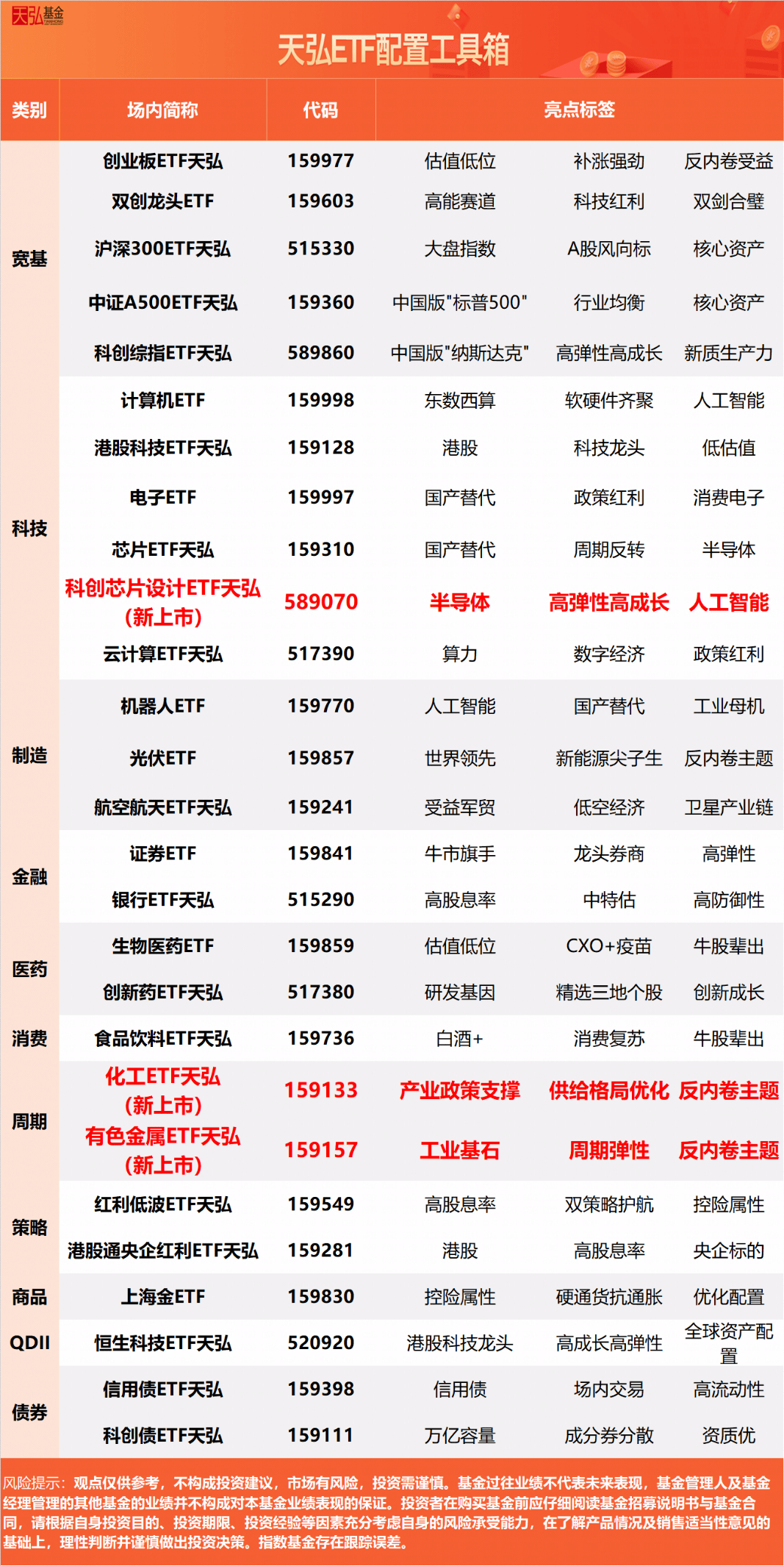
英伟达新机架或“光铜并举”!有色金属ETF天弘(159157)标的指数连续5日回调,估值低位布局价值凸显
Sou Hu Cai Jing· 2026-03-18 01:44
Core Viewpoint - The non-ferrous metal ETF Tianhong (159157) has shown significant trading activity and valuation metrics, indicating potential investment opportunities in the sector due to favorable market conditions and recent developments in copper demand [1][4]. Trading Activity - As of March 17, the non-ferrous metal ETF Tianhong (159157) had a turnover of 6.65% and a transaction volume of 321 million yuan [1]. - The ETF's latest scale reached 4.933 billion yuan, with a total of 5.392 billion shares, both marking all-time highs since its inception [2]. - Over the past 22 days, the ETF has experienced continuous net inflows, with a peak single-day net inflow of 329 million yuan, totaling 4.33 billion yuan in net inflows [3]. Market Performance - The tracked index, the CSI Industrial Non-Ferrous Metal Theme Index (H11059), declined by 2.37%, marking five consecutive days of losses [1]. - Key constituent stocks such as Shenhuo Co., Ltd. and Hailiang Co., Ltd. saw significant declines, with losses of 6.91% and 6.22%, respectively [1]. Valuation Metrics - The current price-to-earnings ratio (PE-TTM) of the CSI Industrial Non-Ferrous Metal Theme Index is 25.13, which is at the 40.4% percentile over the past decade, indicating that valuations are lower than 60% of the time historically [1]. Investment Outlook - The non-ferrous metal sector is highlighted as having significant allocation value due to multiple favorable factors, including supply-side contraction policies, new demand drivers, economic cycle resonance, global deflation expectations, and concerns over U.S. dollar credit [4]. - The copper market is expected to face a supply-demand gap widening to 450,000 tons by 2026, with average copper prices projected to rise to $12,000 per ton [7].


投资主动基金,会有哪些收益来源呢?|投资小知识
银行螺丝钉· 2026-03-17 14:05
Group 1 - The core viewpoint of the article emphasizes that the long-term average annual return of the A-share market is around 10%, and through stock fund selection, excess returns can be achieved [3] - The stock fund selection process involves choosing stocks with stronger profitability among thousands of listed companies, which can enhance overall returns [4] - The total index of stock funds reflects the overall performance of all stock funds in the A-share market, with a long-term average annual return of approximately 11%-13%, outperforming the overall market index by 1%-3% [5][6] Group 2 - Not all stock funds in the A-share market have strong long-term performance; however, those with stable investment styles tend to yield better results [7] - Selecting experienced and high-performing fund managers can lead to further excess returns, with some managers achieving long-term annualized returns exceeding 15% [7] - Building a diversified investment portfolio and rebalancing it can enhance returns based on the three sources of income mentioned [8]

ETF生态周报:ETF市场整体综合面板-20260317
HWABAO SECURITIES· 2026-03-17 11:03
1. Report Industry Investment Rating No relevant content provided. 2. Core Viewpoints of the Report - The overall trend in the ETF market last week was that domestic equities generally declined, with high - valuation broad - based indices under pressure. Bonds provided a hedge, and sectors with defensive or resource attributes such as electricity were relatively dominant. There was a clear migration of funds from equity broad - based ETFs to gold, fixed - income, and some thematic ETFs, showing an obvious defensive tendency [22][23][33]. 3. Summary According to the Directory 3.1 Scale: Total Expansion and Structural Stratification (Market/Product/Institution) 3.1.1 Product Scale - As of March 13, 2026, the total number of ETFs in the whole market was 1,456, with a total scale of 52,528.30 billion yuan and 33,707.47 billion shares. Stock - type ETFs were the main force in terms of scale, with 1,131 funds, a scale of 30,551.01 billion yuan, and 21,147.17 billion shares. Compared with the previous week, the overall share increased by 400 million, but the scale decreased by 50.2 billion yuan. The number of stock - type ETFs remained unchanged, the share increased by 1.6 billion, but the scale decreased by 33.1 billion yuan [15][16]. 3.1.2 Institution Scale - Last week, the top 20 fund companies managed a total net asset value of 23 trillion yuan, accounting for 62% of the whole market, indicating significant industry concentration. E Fund and China Asset Management led in total scale with a more balanced structure. Tianhong was more focused on the money - market type. The scale fluctuations last week mainly came from the stock - type and ETF segments, with a "reduction" trend in the equity and ETF segments of the market, and more incremental funds concentrated in a few medium - sized institutions [18][19][20]. 3.2 Performance: Differentiated Gains and Losses and Valuation Positions 3.2.1 Major ETFs - Last week, the domestic equity market was generally weak, with broad - based indices generally retreating. The valuation quantiles of medium - and small - cap indices were at relatively high levels, indicating weakening market risk appetite. Structurally, there were obvious differences. The power ETF rose by 3.88%, showing defensive attributes, while the securities ETF fell by 1.68% due to systematic market adjustments rather than high valuations. Bonds strengthened slightly, and cross - border (QDII) ETFs were also weak, with the Hang Seng Tech Index ETF relatively resistant to decline and at a low historical valuation quantile [22][23]. 3.2.2 CITIC First - level Industry Index - Last week, industry performance showed obvious differentiation. Most industries had relatively high valuation quantiles but different trends. Strong industries were concentrated in the high - valuation range, while low - valuation sectors were generally weak [28]. 3.2.3 Representative ETF Products - As of March 13, 2026, in terms of scale, the Huatai - Peregrine SSE 300 ETF ranked first with 205.803 billion yuan. In terms of trading activity, bond - type ETFs were prominent, and in terms of valuation, some ETFs such as the military - leading ETF and the dividend ETF were at historical high levels, while the Hang Seng Tech ETF and the pharmaceutical ETF were at historical low levels, which were attractive for long - term investors [29]. 3.3 Funds: Sector Liquidity and Net Inflow Structure 3.3.1 Overall Market Overview: Scale and Net Redemption - As of March 13, 2026, the total scale of the whole - market ETFs reached 5.25 trillion yuan, slightly shrinking by 0.77 trillion yuan compared with the beginning of the year. The number of listed ETFs increased to 1,452, an increase of 52 compared with the beginning of the year. Stock - type ETFs were still the main force in scale, but their scale decreased by 0.78 trillion yuan compared with the beginning of the year. Commodity - type ETFs performed the best, with a significant increase of 109.841 billion yuan compared with the beginning of the year [36]. 3.3.2 Major Category of Funds: Stocks/Bonds/Commodities/Cross - border - Last week, funds generally showed a defensive tendency. Broad - based ETFs continued to have net outflows, while industry - thematic ETFs and commodity ETFs had net inflows. The SGE Gold 9999 had the largest net inflow, indicating a strong demand for hedging [4][32]. 3.3.3 Internal Equity: Broad - based vs. Industry/Theme vs. Strategy - As of March 13, 2026, the funds of major broad - based ETFs were generally weak, with continuous net outflows. Thematic ETFs and cyclical manufacturing ETFs were the main directions of fund inflows, while broad - based ETFs continued to be under pressure, indicating an obvious migration of existing funds from broad - based to thematic and cyclical directions [49]. 3.3.4 Top 20 Stock - type ETF Redemption Net Inflows - Last week, power and hedging assets were the main directions pursued by funds. The Grid Equipment ETF had the largest net inflow, followed by the Haifutong Short - term Financing ETF and the Free Cash Flow ETF. The Hang Seng Tech ETF did not appear in the top 10 list, indicating a weakening of short - term capital momentum for Hong Kong technology stocks [53]. 3.3.5 Leveraged Funds: Top 20 Net Margin Purchases and the Relationship with Redemption - Last week, the Bosera Convertible Bond ETF had the largest net margin purchase, followed by the Science and Technology Innovation 50 ETF and the E Fund Hong Kong Securities ETF. There were four typical relationships between margin trading and redemption, and the overall resonance of redemption and margin trading in the market was weak last week [55][56]. 3.4 ETF Trading Congestion 3.4.1 Changes in Trading Volume and Top 10 Turnover ETFs - As of March 13, 2026, the total trading volume of the ETF market was about 2.7 trillion yuan, with the increase mainly coming from bond - type ETFs, followed by stock - type ETFs. The trading volume of bond - type ETFs showed high turnover and high trading volume, and the trading congestion of bond - type ETFs was significantly differentiated. In stock - type ETFs, A500 - related ETFs were the most active in trading, and the trading of large - cap styles still dominated the market [60][63][66]. 3.5 Issuance Dynamics - Last week, the ETF issuance market declined. There were 66 funds being issued, a decrease of 14.29% compared with the previous week. 30 funds were established, an increase of 328.57% compared with the previous week, and 0 funds were listed, a decrease of 100% compared with the previous week. It is expected that 10 ETFs will be listed in the next two weeks, mainly stock - type, covering multiple themes. New products in some directions may be able to承接 existing capital enthusiasm, while the short - term trading activity of new products in some directions may be limited [76][78].
铁打的宝武,流水的华宝
虎嗅APP· 2026-03-17 09:37
Core Viewpoint - The article discusses the recent talent exodus at Huabao Fund, highlighting the challenges the company faces in maintaining its competitive edge in the ETF and active equity investment sectors, as well as the implications of its management structure and strategic direction [2][4][26]. Talent Exodus - Huabao Fund has experienced significant departures of key personnel, including fund managers and investment directors, with notable figures like Qi Zhen and Hu Jie leaving for Tianhong Fund [2][3]. - The company has seen a pattern of talent loss, reminiscent of the 2021 exodus, which included several core fund managers who have since joined leading firms in the industry [3][19]. Competitive Challenges - Despite having a solid foundation in ETF and active equity investments, Huabao Fund has struggled to establish a stable competitive advantage, particularly as competition in the ETF market intensifies [4][10]. - The company’s ETF products, while initially successful, have not kept pace with industry growth, leading to a decline in its market ranking from 8th in 2024 to 11th in 2025 [10][11]. ETF Business Performance - Huabao Fund's non-cash ETF scale has grown significantly from 164 million yuan in 2019 to 130 billion yuan in 2025, but its industry ranking has fluctuated, indicating a lack of sustained competitive performance [9][10]. - The company’s focus on traditional industries in its ETF offerings has limited its growth potential in the current technology-driven market, where competitors have capitalized on more innovative products [13][14]. Management and Strategic Direction - The transition from a general manager-led structure to a chairman-led governance model has not yielded significant improvements in business performance, as the new leadership lacks deep experience in the public fund industry [26][28]. - The strategic focus on expanding into active equity and fixed income has not translated into tangible results, with the company struggling to enhance its active management capabilities [30][32]. Investment Strategy Issues - Huabao Fund's broad coverage of industry ETFs lacks focus on specific growth sectors, which has hindered its ability to capitalize on emerging market opportunities [15][16]. - The company’s reliance on a top-down investment approach has proven less effective in rapidly evolving sectors, where detailed research and agile responses are crucial for success [16][21].

“养龙虾”热到基金圈!拥抱效率更需警惕数据风险
证券时报· 2026-03-17 09:14
"我们不会被AI取代,但我们一定会被熟练使用AI的人所取代,特别是在公募投研这样一个科学与 艺术交织、理性与感性共存的工作领域。"一位公募基金经理向证券时报·券商中国记者表示。 近期,一场"养龙虾热"正从科技圈席卷至金融腹地,以OpenClaw为代表的AI Agent(人工智能 体)正逐渐引起公募基金关注。证券时报·券商中国记者了解到,当前,多家基金公司正在谨慎评 估这一工具在基金投研上的应用,部分基金经理尤其是量化基金经理已经尝试运用OpenClaw进行 策略研发,AI正逐渐从"超级工具"向"自主协作者"演变。 然而,在硬币的另一面,基金行业也在重新审视AI对传统投研模式的冲击。无论是从处理海量金 融数据,还是在量化投资中的信号识别,甚至是曾经颇具门槛的投研模型,AI大语言模型和AI Agent都正在润物细无声地影响着基金投研,公募基金行业正经历着一场温和而深刻的"工作流革 命" ,但与此同时也面临着人机替代、数据泄漏等威胁。 "养龙虾"热到基金圈 "我最初对它的预期只是一个实习生,能帮我们回测脚本、处理数据就行,但是最近半个月用下 来,我发现它其实自主性很强,已经能够全天候独立地从原始数据中提取不错的因子 ...

理财产品跟踪报告2026年第3期(2月24日-3月8日):理财与保险节后回暖,基金新发放缓
Huachuang Securities· 2026-03-17 08:33
Investment Rating - The report does not explicitly state an investment rating for the industry Core Insights - The bank wealth management market has seen a significant recovery in product issuance post the 2026 Spring Festival, with 1,252 new products launched from February 24 to March 8, 2026, marking a 56.89% increase compared to the previous period [2][13] - The public fund market has experienced a notable decline in both the number and scale of new fund issuances, with only 17 new funds raised during the reporting period, totaling 14.915 billion yuan, reflecting a 73.4% drop in quantity and a 74.4% decrease in total scale compared to the previous period [3][23] - The insurance market has shown signs of recovery, with 29 new insurance products launched, a 26.09% increase from the previous period, driven by stable demand for conservative investment options and a shift towards dividend-type products [5][37] Summary by Sections Bank Wealth Management Products - The issuance of bank wealth management products has returned to normal levels, with fixed-income products dominating the market, accounting for 97.76% of new issuances [14][16] - The market structure remains characterized by a focus on medium to long-term products, with 33.79% of new products having a duration of 1 to 3 years [17] - The concentration of issuance is high, with wealth management companies accounting for 75.16% of new products, indicating a stable market landscape [18] Fund Products - The new fund market has cooled significantly, with a drastic reduction in both the number of new funds and the total amount raised, indicating a shift in market activity [23][31] - Equity funds dominated in number, with 8 out of 17 new funds being equity or mixed funds, but their total scale was lower compared to bond funds, which raised 71.92 billion yuan [30][32] - The market is increasingly concentrated among leading fund companies, with a few institutions contributing to the majority of new fund issuances [33] Insurance Products - The insurance market has seen a rise in new product launches, particularly in annuity insurance, which accounted for 65.52% of new products, reflecting a growing preference for stable cash flow products [39][47] - The structure of new insurance products has shifted towards a balance between traditional and dividend-type products, with both types seeing increased issuance [42][43] - The absence of new universal insurance products indicates a tightening regulatory environment and a focus on more competitive traditional and dividend products [42][47]
VYMI: Could This International ETF Make You a Millionaire?
The Motley Fool· 2026-03-17 07:30
Core Insights - The Vanguard International High Dividend Yield ETF (VYMI) focuses on international companies with higher-than-average dividend yields and has outperformed major U.S. indices over the past year [2][9] - The fund has delivered average annual returns of 23.1% over the past three years and 11.7% since its inception in February 2016, indicating strong growth potential [2][10] Fund Overview - VYMI holds 1,535 stocks globally, primarily large companies and value stocks, with top holdings including pharmaceutical firms and global consumer brands like Nestlé and Toyota [5] - The geographical distribution of the fund's investments includes 43.6% in Europe, 26.4% in the Pacific, 21.1% in emerging markets, and 7.9% in North America, with Japan and the UK being the top two countries represented [6] Financial Metrics - The current price of VYMI is $94.68, with a day's change of 1.74% [7] - The fund has a low expense ratio of 0.07%, meaning a fee of $0.70 per year for every $1,000 invested [8] Investment Potential - If an investor contributes $500 monthly to VYMI, the investment could grow to approximately $218,000 after 15 years, $417,000 after 20 years, and over $1 million after 28 years, assuming an average annual growth rate of 11.7% [10]