
焦炭

Search documents
黑色金属日报-20251111
Guo Tou Qi Huo· 2025-11-11 11:32
Report Industry Investment Ratings - **Thread Steel**: ★★★ [1] - **Hot Rolled Coil**: ★★★ [1] - **Iron Ore**: ★★★ [1] - **Coke**: ★★★ [1] - **Coking Coal**: ★★★ [1] - **Silicon Manganese**: ★★★ [1] - **Silicon Iron**: ★★★ [1] Core Views - The overall demand for steel is weak, with the cost center shifting down due to the decline of furnace materials, and the steel plate is under pressure, mainly in a weak shock in the short term [2]. - The iron ore market is expected to be volatile, with the supply side showing some fluctuations and the demand side weakening due to reduced steel demand [3]. - The coke and coking coal markets are facing pressure from reduced downstream demand and abundant carbon element supply, with prices expected to be relatively strong in a shock [4][6]. - The silicon manganese and silicon iron markets are affected by the decline in iron - water production, with different supply - demand situations and price trends [7][8]. Summary by Related Catalogs Steel - In the off - season, the apparent demand and production of thread steel and hot - rolled coil both decline, and the inventory situation varies. Iron - water production falls from a high level, and the negative feedback pressure in the industrial chain needs to be alleviated. The overall domestic demand is weak, and exports have declined from a high level. The demand expectation is pessimistic, and the plate is under pressure [2]. Iron Ore - On the supply side, global shipments have declined month - on - month, and domestic arrivals have dropped significantly but are still at a high level, with port inventories continuing to increase. On the demand side, steel demand in the off - season has decreased, and iron - water production has continued to decrease. The market is trading the reality of a marginally looser iron ore supply, and the trend is expected to be volatile [3]. Coke - The price has declined during the day. The downstream acceptance of the fourth - round price adjustment is poor. Coking profits are average, and daily production has decreased slightly. The inventory has decreased slightly, and the overall supply of carbon elements is abundant, with downstream demand for raw materials decreasing [4]. Coking Coal - The price has declined during the day. Mongolian coal imports have increased, and the production of coking coal mines has decreased slightly. The total inventory has increased slightly, and the market is affected by factors such as safety inspections in coal - producing areas and reduced downstream demand [6]. Silicon Manganese - The price is weakly volatile. The demand has decreased due to the decline in iron - water production. The weekly production has decreased slightly but is still at a high level, and the inventory is slowly increasing. The price of manganese ore has shown some fluctuations [7]. Silicon Iron - The price is weakly volatile. The demand from iron - water production has decreased, but the export demand has increased marginally, and the secondary demand has also increased. The supply is at a high level, and the inventory has decreased. Cost factors may lead to a price rebound [8].
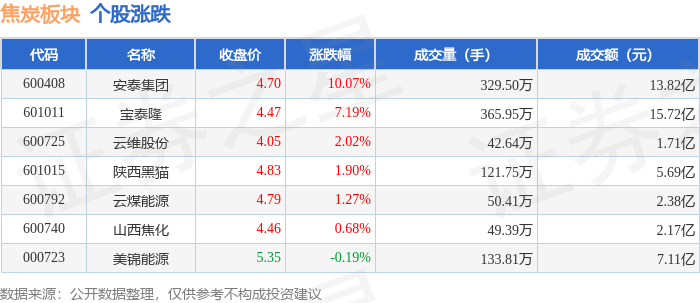
焦炭板块11月11日涨2.07%,安泰集团领涨,主力资金净流入3506.72万元
Zheng Xing Xing Ye Ri Bao· 2025-11-11 08:46
Core Viewpoint - The coking coal sector experienced a 2.07% increase on November 11, with Antai Group leading the gains, while the overall market indices showed declines [1] Group 1: Market Performance - The Shanghai Composite Index closed at 4002.76, down 0.39% - The Shenzhen Component Index closed at 13289.0, down 1.03% [1] Group 2: Coking Coal Stocks Performance - Antai Group (600408) closed at 4.70, up 10.07% with a trading volume of 3.295 million shares and a turnover of 138.2 million yuan - Baotailong (601011) closed at 4.47, up 7.19% with a trading volume of 3.6595 million shares and a turnover of 1.572 billion yuan - Yunwei Co. (600725) closed at 4.05, up 2.02% with a trading volume of 426,400 shares and a turnover of 171 million yuan - Shaanxi Heimao (601015) closed at 4.83, up 1.90% with a trading volume of 1.2175 million shares and a turnover of 569 million yuan - Yunmei Energy (600792) closed at 4.79, up 1.27% with a trading volume of 504,100 shares and a turnover of 238 million yuan - Shanxi Coking (600740) closed at 4.46, up 0.68% with a trading volume of 493,900 shares and a turnover of 217 million yuan - Meijin Energy (000723) closed at 5.35, down 0.19% with a trading volume of 1.3381 million shares and a turnover of 711 million yuan [1] Group 3: Capital Flow Analysis - The coking coal sector saw a net inflow of 35.0672 million yuan from main funds, while retail funds experienced a net outflow of 15.1026 million yuan - The main funds' net inflow for Baotailong was 84.0486 million yuan, while retail funds saw a net outflow of 65.0348 million yuan - Antai Group had a main fund net outflow of 39.3194 million yuan, with retail funds seeing a net inflow of 35.2258 million yuan [2]


安泰集团跌4.92%,成交额2.04亿元,主力资金净流入1069.06万元
Xin Lang Cai Jing· 2025-11-11 01:54
Core Viewpoint - Antai Group's stock price has shown significant volatility, with a year-to-date increase of 98.05%, while recent trading activity indicates a mixed sentiment among investors [1][2]. Company Performance - As of November 11, Antai Group's stock price was 4.06 CNY per share, with a market capitalization of 4.088 billion CNY [1]. - The company has experienced a net inflow of main funds amounting to 10.69 million CNY, with large orders contributing to a total buy of 19.10 million CNY and a sell of 15.62 million CNY [1]. - For the period from January to September 2025, Antai Group reported a revenue of 3.784 billion CNY, a year-on-year decrease of 26.55%, while the net profit attributable to shareholders was -156 million CNY, an increase of 48.18% year-on-year [2]. Shareholder Information - As of September 30, 2025, the number of shareholders for Antai Group was 50,300, a decrease of 2.69% from the previous period, with an average of 19,996 circulating shares per shareholder, an increase of 2.76% [2]. - The company has cumulatively distributed 161 million CNY in dividends since its A-share listing, with no dividends paid in the last three years [3]. Institutional Holdings - As of September 30, 2025, notable institutional shareholders include Guotai Junan CSI Steel ETF, which holds 7.0912 million shares as the sixth-largest shareholder, and Jinyuan Shun'an Yuanqi Flexible Allocation Mixed Fund, which holds 6.2 million shares as the eighth-largest shareholder, both being new entrants [3].
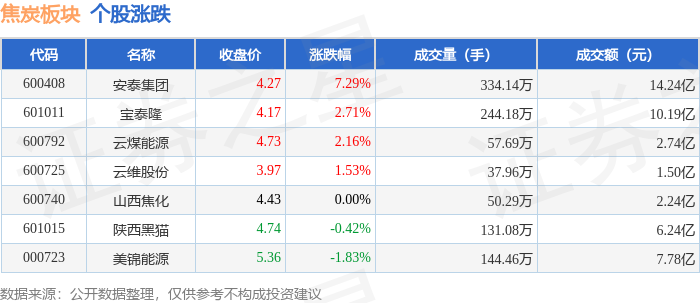
焦炭板块11月10日涨0.31%,安泰集团领涨,主力资金净流入1.45亿元
Zheng Xing Xing Ye Ri Bao· 2025-11-10 08:50
Core Insights - The coke sector experienced a slight increase of 0.31% on November 10, with Antai Group leading the gains [1] - The Shanghai Composite Index closed at 4018.6, up 0.53%, while the Shenzhen Component Index closed at 13427.61, up 0.18% [1] Sector Performance - Antai Group saw a closing price of 4.27, with a significant increase of 7.29% and a trading volume of 3.34 million shares, amounting to a transaction value of 1.424 billion yuan [1] - Baotailong closed at 4.17, up 2.71%, with a trading volume of 2.44 million shares and a transaction value of 1.019 billion yuan [1] - Yunmei Energy closed at 4.73, up 2.16%, with a trading volume of 576,900 shares and a transaction value of 274 million yuan [1] - Yunyuan Co. closed at 3.97, up 1.53%, with a trading volume of 379,600 shares and a transaction value of 150 million yuan [1] - Shanxi Coking Coal remained unchanged at 4.43, with a trading volume of 502,900 shares and a transaction value of 224 million yuan [1] - Shaanxi Black Cat closed at 4.74, down 0.42%, with a trading volume of 1.31 million shares and a transaction value of 624 million yuan [1] - Meijin Energy closed at 5.36, down 1.83%, with a trading volume of 1.44 million shares and a transaction value of 778 million yuan [1] Capital Flow - The coke sector saw a net inflow of 145 million yuan from main funds, while retail funds experienced a net outflow of 47.63 million yuan [1] - The main funds' net inflow for Antai Group was 201 million yuan, accounting for 14.10% of the total, while retail funds had a net outflow of 12.2 million yuan [2] - Baotailong had a main fund net inflow of 25.7 million yuan, representing 2.52%, with retail funds experiencing a net outflow of 13.18 million yuan [2] - Yunmei Energy recorded a main fund net inflow of 9.22 million yuan, while retail funds had a net outflow of 5.92 million yuan [2] - Yunyuan Co. had a main fund net inflow of 8.53 million yuan, with retail funds experiencing a net outflow of 11.44 million yuan [2] - Shanxi Coking Coal saw a main fund net outflow of 7.21 million yuan, while retail funds had a net inflow of 778,690 yuan [2] - Shaanxi Black Cat experienced a main fund net outflow of 39.76 million yuan, with retail funds having a net inflow of 37.8 million yuan [2] - Meijin Energy had a main fund net outflow of 52.36 million yuan, while retail funds saw a net inflow of 59.21 million yuan [2]
《有色》日报-20251110
Guang Fa Qi Huo· 2025-11-10 08:09
1. Report Industry Investment Rating No relevant content provided. 2. Core Views of the Report - For the steel industry, the steel market shows that mills continue to cut production, hot metal declines, apparent demand drops, and inventory reduction slows. The cost support of iron elements is weak, while that of carbon elements is strong. The steel price is unlikely to fall significantly, and the long - coking coal and short - hot rolled coil arbitrage can be held. The unilateral prices of rebar and hot - rolled coil may test previous lows [2]. - For the iron ore industry, the iron ore futures are in a weak downward trend. The supply is expected to increase, and the demand is weakening. Due to the weak steel price, the profitability of mills is declining, which will force the iron ore market to be weak. It is recommended to short iron ore futures on rallies and conduct long - coking coal and short - iron ore arbitrage [4][6]. - For the coke industry, the coke futures fluctuated downward last week. The supply is tight, and the cost support is strong. It is recommended to go long on coke 2601 on dips and conduct long - coking coal and short - coke arbitrage [7]. - For the coking coal industry, the coking coal futures also showed a downward trend last week. The supply is expected to increase slightly, and the demand is weakening. It is recommended to go long on coking coal 2601 on dips and conduct long - coking coal and short - coke arbitrage [7]. 3. Summary by Relevant Catalogs Steel Industry Steel Prices and Spreads - Rebar spot prices in East, North, and South China are 3190 yuan/ton, 3200 yuan/ton, and 3260 yuan/ton respectively, with changes of 0, +10, and - 10 yuan/ton compared to the previous value. Rebar contract prices for 05, 10, and 01 are 3095 yuan/ton, 3132 yuan/ton, and 3034 yuan/ton respectively, all showing declines [2]. - Hot - rolled coil spot prices in East, North, and South China are 3260 yuan/ton, 3190 yuan/ton, and 3260 yuan/ton respectively, all down 10 yuan/ton. Hot - rolled coil contract prices for 05, 10, and 01 are 3254 yuan/ton, 3276 yuan/ton, and 3245 yuan/ton respectively, all down 11 yuan/ton [2]. Cost and Profit - The billet price is 2940 yuan/ton, up 10 yuan/ton; the slab price is 3730 yuan/ton, unchanged. The profits of hot - rolled coils in East, North, and South China are all down [2]. Supply - The daily average hot metal output is 234.2 tons, down 2.1 tons (-0.9%); the output of five major steel products is 856.7 tons, down 18.5 tons (-2.1%); the rebar output is 208.5 tons, down 4.1 tons (-1.9%); the hot - rolled coil output is 318.2 tons, down 5.4 tons (-1.7%) [2]. Inventory - The inventory of five major steel products is 1503.6 tons, down 10.2 tons (-0.7%); the rebar inventory is 592.5 tons, down 10 tons (-1.7%); the hot - rolled coil inventory is 410.5 tons, up 3.9 tons (0.9%) [2]. Transaction and Demand - The building materials trading volume is 8.7 tons, down 2.3 tons (-21%); the apparent demand of five major steel products is 866.9 tons, down 49.5 tons (-5.4%); the apparent demand of rebar is 218.5 tons, down 13.7 tons (-5.9%); the apparent demand of hot - rolled coil is 314.3 tons, down 17.6 tons (-5.3%) [2]. Iron Ore Industry Iron Ore - related Prices and Spreads - The warehouse receipt costs of different iron ore powders all show declines, and the basis of the 01 contract has different changes. The 5 - 9, 9 - 1, and 1 - 5 spreads also have corresponding changes [4]. Spot Prices and Price Indexes - The spot prices of iron ore at Rizhao Port and price indexes such as the Singapore Exchange 62% Fe swap and Platts 62% Fe all decline [4]. Supply - The weekly arrival volume at 45 ports is 3218.4 tons, up 1189.3 tons (58.6%); the global weekly shipping volume is 3213.8 tons, down 174.6 tons (-5.2%); the national monthly import volume is 11632.6 tons, up 1111.6 tons (10.6%) [4]. Demand - The daily average hot metal output of 247 mills is 234.2 tons, down 2.1 tons (-0.9%); the daily average port clearance volume at 45 ports is 320.9 tons, down 15.5 tons (-4.6%); the national monthly pig iron output is 6604.6 tons, down 374.7 tons (-5.4%); the national monthly crude steel output is 7349.0 tons, down 387.8 tons (-5.0%) [4]. Inventory Changes - The port inventory at 45 ports is 14898.83 tons, up 184.8 tons (1.3%); the imported iron ore inventory of 247 mills is 6600.6 tons, up 160.1 tons (1.8%); the inventory available days of 64 mills is 21 days, unchanged [4]. Coke Industry Coke - related Prices and Spreads - The prices of Shanxi and Rizhao Port quasi - first - grade wet - quenched coke (warehouse receipt) are unchanged. The coke 01 and 05 contracts decline, and the coking profit is down [7]. Supply - The daily average output of all - sample coking plants is 63.6 tons, down 1.0 ton (-1.5%); the daily average output of 247 mills is 46.1 tons, down 0.1 ton (-0.34%) [7]. Demand - The hot metal output of 247 mills is 234.2 tons, down 2.1 tons (-0.94%) [7]. Inventory Changes - The total coke inventory is 887.1 tons, down 13 tons (-1.4%); the coke inventories of coking plants, mills, and ports all decline [7]. Supply - demand Gap - The coke supply - demand gap is -3.7 tons, down 0.1 ton (-2.2%) [7]. Coking Coal Industry Coking Coal - related Prices and Spreads - The prices of Shanxi medium - sulfur primary coking coal (warehouse receipt) are unchanged, while the prices of Mongolian 5 raw coal (warehouse receipt) and coking coal 01 and 05 contracts decline. The sample coal mine profit is up [7]. Supply - The raw coal output is 848.4 tons, down 3.4 tons (-0.4%); the clean coal output is 433.0 tons, down 2.0 tons (-0.5%) [7]. Demand - The demand for coking coal is mainly reflected in the coking production, with the daily average output of all - sample coking plants and 247 mills showing declines [7]. Inventory Changes - The clean coal inventory of Fenwei coal mines is 80.4 tons, down 0.8 tons (-0.9%); the coking coal inventories of coking plants and ports increase, while those of mills decrease [7].
广发期货《有色》日报-20251110
Guang Fa Qi Huo· 2025-11-10 07:11
Report Industry Investment Ratings - Not provided in the given content Core Views Steel Industry - Steel prices are unlikely to drop significantly due to tight carbon element supply and reasonable valuation. Single - side trading of rebar and hot - rolled coils may test previous lows, with rebar focusing on the 2900 - 3000 range support and hot - rolled coils on around 3200 support. The strategy of long coking coal and short hot - rolled coils arbitrage can be continued [2]. Iron Ore Industry - Iron ore futures are in a weak downward trend. With steel prices weakening and steel mill profitability declining, iron ore demand will be weak. The overall production of the Simandou project is progressing faster than expected, and it is expected to complete the first shipment of iron ore to the port in October. The strategy is to short iron ore futures on rallies and recommend long coking coal and short iron ore arbitrage [4][6]. Coke and Coking Coal Industry - Coke futures oscillated and declined last week. Although the third - round price increase was implemented and the fourth - round is expected to be implemented, coke production decreased due to losses, and demand was affected by environmental restrictions and weak steel prices. The strategy is to go long on coke 2601 contracts on dips in the 1700 - 1850 range and long coking coal and short coke for arbitrage. Coking coal futures also oscillated and declined. The spot market was strong, but there were concerns about high prices. The strategy is to go long on coking coal 2601 contracts on dips in the 1240 - 1350 range and long coking coal and short coke for arbitrage [7]. Summary by Relevant Catalogs Steel Industry Prices and Spreads - Rebar and hot - rolled coil spot and futures prices showed different changes. For example, rebar spot prices in North China increased by 10 yuan/ton, while those in South China decreased by 10 yuan/ton. Rebar 05 contract price decreased by 7 yuan/ton. Hot - rolled coil spot prices in East and South China decreased by 10 yuan/ton, and hot - rolled coil 05 contract price decreased by 11 yuan/ton. Steel billet price increased by 10 yuan/ton, and plate billet price remained unchanged. Profits of various steel products decreased [2]. Supply - Daily average hot metal output decreased by 2.1 to 234.2 (a decrease of 0.9%), five - major steel product output decreased by 18.5 to 856.7 (a decrease of 2.1%), rebar output decreased by 4.1 to 208.5 (a decrease of 1.9%), and hot - rolled coil output decreased by 5.4 to 318.2 (a decrease of 1.7%) [2]. Inventory - Five - major steel product inventory decreased by 10.2 to 1503.6 (a decrease of 0.7%), rebar inventory decreased by 10.0 to 592.5 (a decrease of 1.7%), and hot - rolled coil inventory increased by 3.9 to 410.5 (an increase of 0.9%) [2]. Transaction and Demand - Building materials trading volume decreased by 2.3 to 8.7 (a decrease of 21.0%), five - major steel product apparent demand decreased by 49.5 to 866.9 (a decrease of 5.4%), rebar apparent demand decreased by 13.7 to 218.5 (a decrease of 5.9%), and hot - rolled coil apparent demand decreased by 17.6 to 314.3 (a decrease of 5.3%) [2]. Iron Ore Industry Prices and Spreads - Iron ore warehouse receipt costs of various varieties decreased, such as the warehouse receipt cost of Carajás fines decreased by 7.7 to 836.3 (a decrease of 0.9%). 01 contract basis of some varieties changed, and spreads between different contracts also changed, like the 5 - 9 spread increased by 0.5 to 21.5 (an increase of 2.4%) [4]. Supply - 45 - port weekly arrivals increased by 1189.3 to 3218.4 (an increase of 58.6%), global weekly shipments decreased by 174.6 to 3213.8 (a decrease of 5.2%), and the national monthly import volume increased by 1111.6 to 11632.6 (an increase of 10.6%) [4]. Demand - 247 steel mills' daily average hot metal output decreased by 2.1 to 234.2 (a decrease of 0.9%), 45 - port daily average dispatch volume decreased by 15.5 to 320.9 (a decrease of 4.6%), national monthly pig iron output decreased by 374.7 to 6604.6 (a decrease of 5.4%), and national monthly crude steel output decreased by 387.8 to 7349.0 (a decrease of 5.0%) [4]. Inventory - 45 - port inventory increased by 184.8 to 14898.83 (an increase of 1.3%), 247 steel mills' imported ore inventory increased by 160.1 to 6600.6 (an increase of 1.8%), and 64 steel mills' inventory available days remained unchanged at 21.0 [4]. Coke and Coking Coal Industry Prices and Spreads - Coke and coking coal futures prices decreased. For example, coke 01 contract price decreased by 20 to 1757 (a decrease of 1.14%), and coking coal 01 contract price decreased by 21 to 1270 (a decrease of 1.6%). Some spot prices remained unchanged, while some coking coal prices decreased slightly, like Mongolian 5 raw coal (warehouse receipt) price decreased by 11 to 1362 (a decrease of 0.8%) [7]. Supply - Coke production decreased, with the daily average output of all - sample coking plants decreasing by 1.0 to 63.6 (a decrease of 1.5%) and 247 steel mills' daily average output decreasing by 0.1 to 46.1 (a decrease of 0.34%). Coking coal production also decreased slightly, with raw coal output decreasing by 3.4 to 848.4 (a decrease of 0.4%) and clean coal output decreasing by 2.0 to 433.0 (a decrease of 0.5%) [7]. Demand - 247 steel mills' hot metal output decreased by 2.1 to 234.2 (a decrease of 0.94%), and coke demand decreased as a result [7]. Inventory - Coke total inventory decreased by 13.0 to 887.1 (a decrease of 1.4%), with inventories in coking plants, steel mills, and ports all decreasing. Coking coal inventory increased in some places and decreased in others. For example, Fenwei coal mine clean coal inventory decreased by 0.8 to 80.4 (a decrease of 0.9%), while all - sample coking plants' coking coal inventory increased by 17.5 to 1070.0 (an increase of 1.7%) [7].
中国ROE中枢趋势性上升,美国ROE中枢趋势性下降:产业经济周观点-20251109
Huafu Securities· 2025-11-09 12:20
Group 1 - The core viewpoint of the report indicates that China's ROE (Return on Equity) is on a rising trend while the US ROE is on a declining trend, suggesting a potential divergence in economic cycles between the two countries [2][3] - Recent data suggests that China's export and price data reflect the effects of anti-involution, with expectations for continued strengthening of corporate profits in China [3][8] - The debt expansion in the US AI industry may reinforce expectations for price improvement and corporate profitability in China, but it could also exacerbate stagflation characteristics in the US, posing risks to US stock performance [3][9] Group 2 - The report highlights a significant decline in China's export growth, with October exports showing a year-on-year decrease of 1.1%, down from 8.3% previously, primarily affected by a drop in exports to the EU [8] - The report notes that the global manufacturing PMI did not weaken in October, indicating that the decline in China's export growth may be more related to supply-side improvements rather than demand-side factors [8] - The report emphasizes that under a recovering price environment, market sentiment may shift towards value stocks, with a focus on export prices and US consumer data in the future [3][9] Group 3 - The report suggests that the configuration of energy investments should primarily respond to the overheating expectations of US AI investments, recommending a focus on short to medium-term trading strategies [3] - Long-term investment opportunities are identified in sectors such as insurance, anti-involution industries, Chinese internet companies, and military trade [3][9] - The report indicates that the performance of the A-share market is expected to rise while the US stock market may decline, reflecting the contrasting economic cycles of China and the US [3][9]
黑色金属日报-20251107
Guo Tou Qi Huo· 2025-11-07 11:56
Report Industry Investment Ratings - **Thread Steel**: ★★★ (implied by the context as more positive) [1] - **Hot Rolled Coil**: ★★★ (implied by the context as more positive) [1] - **Iron Ore**: ★☆☆ [1] - **Coke**: ★☆☆ [1] - **Coking Coal**: ★☆☆ [1] - **Silicon Manganese**: ★☆☆ [1] - **Silicon Iron**: ★☆★ [1] Core Viewpoints - The overall steel market is under pressure due to weak demand expectations and declining exports, with the disk remaining under pressure. The iron ore market is expected to be in a weak and volatile state, while the coke and coking coal markets may be in a relatively strong and volatile state. The silicon manganese and silicon iron markets have strong price support at the bottom [1][2][3][5][6][7] Summary by Category Steel - The disk showed a weak and volatile trend. The demand and production of thread steel and hot rolled coil both declined, with inventory changes varying. Iron - water production continued to fall, and the negative feedback pressure in the industrial chain remained to be alleviated. The overall domestic demand was weak, and steel exports declined from the high level. The disk was under pressure, and attention should be paid to the support at the lower edge of the shock range and marginal demand changes [1] Iron Ore - The disk declined. The global iron ore shipment was at a high level, and the domestic arrival volume increased significantly. The port inventory was accumulating. The terminal demand entered the off - season, and the iron - water production continued to decrease. The supply - demand relationship was gradually loosening, and there was still a risk of negative feedback in the off - season industrial chain. It was expected to be in a weak and volatile state [2] Coke - The price fluctuated downward. After the third round of price increase was quickly implemented, there was an expectation of a fourth round. The coking profit was average, and the daily production and inventory decreased slightly. The downstream demand was weak, and the steel mills had a strong desire to lower the price. The disk price was at a premium, and it was expected to be in a relatively strong and volatile state [3] Coking Coal - The price fluctuated downward. The Mongolian coal import volume was high, and the coking coal production decreased slightly. The total inventory increased slightly, and attention should be paid to the impact of safety inspections. The downstream demand was weak, and the steel mills had a strong desire to lower the price. The disk price was at a discount to Mongolian coal, and it was expected to be in a relatively strong and volatile state [5] Silicon Manganese - The price fluctuated. The iron - water production continued to decline, while the weekly production of silicon manganese increased slightly, and the inventory was slowly accumulating. The manganese ore inventory decreased slightly, and the price had strong support at the bottom [6] Silicon Iron - The price fluctuated. The iron - water production continued to decline, but the export demand increased to about 40,000 tons, and the secondary demand increased marginally. The supply remained at a high level, and the inventory decreased. The price had strong support at the bottom [7]
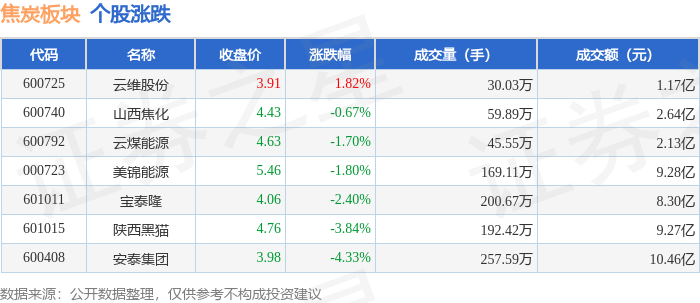
焦炭板块11月7日跌1.88%,安泰集团领跌,主力资金净流出3.4亿元
Zheng Xing Xing Ye Ri Bao· 2025-11-07 08:41
Core Viewpoint - The coke sector experienced a decline of 1.88% on November 7, with Antai Group leading the losses, while the Shanghai Composite Index fell by 0.25% and the Shenzhen Component Index decreased by 0.36% [1] Group 1: Market Performance - The closing prices and changes for key coke stocks are as follows: Yunwei Co. at 3.91 (+1.82%), Shanxi Coking at 4.43 (-0.67%), Yunmei Energy at 4.63 (-1.70%), Meijin Energy at 5.46 (-1.80%), Baotailong at 4.06 (-2.40%), Shaanxi Black Cat at 4.76 (-3.84%), and Antai Group at 3.98 (-4.33%) [1] - The total net outflow of main funds in the coke sector was 340 million yuan, while retail investors saw a net inflow of 253 million yuan [1] Group 2: Fund Flow Analysis - The main fund flow for key stocks showed significant outflows: Yunwei Co. (-478.34 thousand), Shanxi Coking (-1,397.58 thousand), Yunmei Energy (-2,043.57 thousand), Shaanxi Black Cat (-2,391.19 thousand), Antai Group (-6,704.25 thousand), Baotailong (-8,898.43 thousand), and Meijin Energy (-1.31 million) [2] - Retail investors contributed positively to the fund flow, with notable inflows in Yunwei Co. (193.23 thousand), Shanxi Coking (1,110.19 thousand), Yunmei Energy (3,900.67 thousand), Shaanxi Black Cat (873.61 thousand), Antai Group (2,993.13 thousand), Baotailong (5,354.13 thousand), and Meijin Energy (1.09 million) [2]
日度策略参考-20251107
Guo Mao Qi Huo· 2025-11-07 06:35
Report Industry Investment Rating No relevant content provided. Core Viewpoints of the Report - The current macro - level is in a relatively vacuum period, A - shares lack a clear upward main line, market trading volume remains low, and the stock index continues to fluctuate, accumulating momentum for the next round of upward movement. Meanwhile, with policy support and abundant macro - liquidity, there is still strong support below the stock index [1]. Summary by Related Catalogs Macro Finance - **Treasury Bonds**: Asset shortage and weak economy are beneficial to bond futures, but the central bank has recently warned of interest - rate risks, suppressing the upward space, showing an oscillating trend [1]. - **Copper**: The tight pattern of US dollar liquidity has eased, market risk appetite has recovered, and copper prices have stopped falling [1]. - **Aluminum**: Recently, the industrial - side driving force is limited, and the macro - level benefits have been digested, so aluminum prices are oscillating [1]. - **Alumina**: With still a small profit in production, domestic alumina production capacity is continuously released, and both production and inventory are increasing, putting pressure on the spot price. Recently, attention should be paid to the cost support [1]. - **Zinc**: The US government shutdown has reached the longest historical record, and market risk - aversion sentiment has increased. The LME zinc inventory has been continuously decreasing, and the short - squeeze movement has driven zinc prices higher. However, considering the domestic oversupply, caution is needed when chasing high prices [1]. Non - ferrous Metals - **Nickel**: The better - than - expected US ADP data has alleviated concerns about the US economic recession, but the expectation of the Fed's interest - rate cut has been suppressed, and market risk appetite has fluctuated. Indonesia has recently restricted the approval of nickel - related smelting projects again, but the approved projects are not affected. In the fourth quarter, attention should be paid to the approval of nickel - ore quotas in 2026. Nickel prices may oscillate in the short term, and high inventory pressure should be watched out for. It is recommended to trade within a short - term range, and the long - term surplus pattern of primary nickel will continue [1]. - **Stainless Steel**: The better - than - expected US ADP data has alleviated concerns about the US economic recession, but the expectation of the Fed's interest - rate cut has been suppressed, and market risk appetite has fluctuated. Indonesia has restricted the approval of nickel - related smelting projects again, but the approved projects are not affected. In the fourth quarter, attention should be paid to the progress of the approval of Indonesian nickel - ore quotas, and the premium at the ore end is currently stable. The price of raw - material ferronickel has weakened slightly, the social inventory of stainless steel has decreased slightly, and the steel mills' production plan for October is stable. Macro - sentiment is fluctuating, steel mills have recently lifted price limits, and stainless - steel futures are oscillating at the bottom. It is recommended to trade short - term and look for opportunities to sell on rallies [1]. - **Tin**: Recently, the positive macro - sentiment has been digested. Considering that the raw - material end of tin has not recovered and the new - quality demand is expected to be good, it is still recommended to pay attention to the opportunity of going long on dips in the long - term [1]. Precious Metals and New Energy - **Precious Metals (Gold and Silver)**: Judges of the high - court generally question the legitimacy of tariffs, increasing market uncertainty and supporting precious - metal prices. However, the resilience of US economic data has disrupted the interest - rate cut expectation. Precious metals are expected to oscillate within a range in the short term [1]. - **Industrial Silicon**: The production capacity in the northwest is continuously resuming, the start - up in the southwest is weaker than in previous years, and the impact of the dry season is weakened [1]. - **Polysilicon**: In the long - term, there is an expectation of production - capacity reduction. In the fourth quarter, the terminal installation will increase marginally. The anti - involution policy has not been implemented for a long time, and market sentiment has faded [1]. - **Lithium Carbonate**: The traditional peak season for new - energy vehicles is approaching, the energy - storage demand is strong, but the hedging pressure is large [1]. Ferrous Metals - **Rebar**: There are concerns about the potential weakening of industrial demand in the off - season. After the macro - sentiment is realized, attention should be paid to the upward pressure. It is advisable to participate in the out - of - the - money accumulative put option strategy [1]. - **Hot - Rolled Coil**: The off - season effect of the industry is not obvious, but the industrial structure is still loose. Similarly, attention should be paid to the upward pressure on prices after the macro - sentiment is realized [1]. - **Iron Ore**: Near - month production is restricted, but the commodity sentiment is good, and there is still an upward opportunity for far - month contracts [1]. - **Sulfur**: The direct demand is good, and there is cost support, but the supply is high, inventory is accumulating, and the sector is under pressure, with limited price rebound space [1]. - **Coke and Coking Coal**: Coking coal is struggling near the previous high, repeatedly testing the support. The high point of the coke futures price has included the expectation of five rounds of price increases, but the actual three - round price increase has been delayed, and the game is intense. Based on the tight supply, coke and coking coal are relatively strong, but considering the weakening of steel prices and the potential weakening of steel demand in November, the futures prices of coke and coking coal are likely to return to the oscillating range after a false breakout. In the short - term, it is advisable to wait and see, and in the long - term, it is still advisable to go long at low prices. Industrial customers can consider selling hedging [1]. Agricultural Products - **Palm Oil**: In the short term, palm oil still faces the dual pressures of seasonal production increase and weak exports. However, starting from November, Malaysia enters the traditional production - reduction cycle. If export data improve significantly, it may trigger a staged rebound [1]. - **Soybean Oil**: According to the China - US negotiation agreement, China will purchase 12 million tons of US soybeans in the next two months, which may bring a loose expectation for soybean oil in the fourth quarter, and the rebound momentum is insufficient. The actual impact needs to be observed [1]. - **Rapeseed Oil**: The meeting between Chinese and Canadian leaders has brought the expectation of Sino - Canadian relaxation, and the bumper harvest of Canadian rapeseed has put pressure on the futures price [1]. - **Cotton**: Although the production capacity in Xinjiang is expanding, the production capacity in the inland may decrease marginally. At the same time, due to the thinning of spinning profits in Xinjiang, the operating rate may also be affected. The contradiction between the expansion of Xinjiang's production capacity and the reduction of spinning profits makes the cotton demand in the new year highly uncertain. The current futures price has fully priced in the selling pressure of new crops, and the downward space is limited, but under the background of a record - high production of new crops, the basis and futures price may continue to be under pressure [1]. - **Sugar**: Typhoons before and after the National Day have had an adverse impact on the sugar - cane harvest and production in South China. There is a seasonal upward impetus for sugar prices in the short term. In the medium - term, considering the good growth of sugar cane this year, the rebound space after the new - sugar listing is expected to be limited [1]. - **Soybeans and Soybean Meal**: The domestic soybean purchase and crushing profit is poor, and the domestic futures price is undervalued. With the expectation of China's purchase of US soybeans, the import cost of US soybeans is expected to rise, and the domestic futures price is expected to rebound in the short term to repair the crushing profit. However, the current loose supply of domestic soybean - meal spot and the expected loose global soybean supply in the long - term limit the rebound height [1]. - **Paper Pulp**: The current trading logic of paper pulp is related to the trading of old warehouse receipts for the November contract. With weak downstream demand, the futures price is under great pressure. It is recommended to conduct a reverse spread between the November and January contracts [1]. - **Log**: The fundamentals of logs have declined, but the spot price is firm. After a sharp decline in the futures price, the risk - return ratio of short - selling is low. It is recommended to wait and see [1]. - **Live Pigs**: In the past half - month, the spot price has risen alternately in the north and south due to secondary fattening, frozen - product storage, and reluctance to sell, which has postponed the production capacity. There is still pressure on the November slaughter. In the short term, the futures price is at the same level as the spot price, and the futures price will follow the spot price to stabilize and then weaken [1]. Energy and Chemicals - **Crude Oil**: OPEC+ plans to continue a small - scale production increase in December, the short - term geopolitical speculation has cooled down, and the suspension of some China - US trade - tariff policies has eased market sentiment [1]. - **Fuel Oil**: Similar to crude oil, the short - term supply - demand contradiction is not prominent, and it follows the trend of crude oil. The demand for the 14th Five - Year Plan construction rush is likely to be falsified, and the supply of Venezuelan crude oil is sufficient. The profit of asphalt is high [1]. - **Natural Rubber**: There is strong support from raw - material costs, the mid - stream inventory is continuously decreasing, and the commodity - market atmosphere is positive [1]. - **BR Rubber**: The decline of crude - oil prices has reduced the cost support of butadiene, and the supply of synthetic rubber is loose. High - production and high - inventory have not suppressed the price, and the mainstream supply price has been continuously reduced [1]. - **PTA**: Gasoline profit and low benzene price support PX. The gasoline cracking price has risen above $15, prompting refineries to increase gasoline production and reduce the feed of aromatic - hydrocarbon units. Overseas device failures and the decline of the operating load of some domestic reforming units, as well as the rotation inspection of large domestic PTA devices, have led to a decline in domestic PTA production [1]. - **Ethylene Glycol**: The decline of crude - oil prices has led to a decline in ethylene - glycol prices, while the rise of coal prices has slightly strengthened the cost support of domestic ethylene glycol. The "Golden September and Silver October" of the polyester industry is coming to an end, and the domestic demand has not significantly declined [1]. - **Short - Fiber**: Gasoline profit and low benzene price support PX. The rebound of PTA prices has strengthened the basis of short - fiber. Short - fiber prices continue to fluctuate closely with costs [1]. - **Styrene**: The Asian benzene price is still weak, the operating rates of STDP and reforming units have declined, the arbitrage window from Northeast Asia to the US is still closed, the profit of domestic styrene has decreased, the number of styrene - device overhauls has gradually increased, and crude - oil prices have continued to fall [1]. - **Urea**: The export sentiment has eased slightly, and the limited domestic demand restricts the upward space. There is support from anti - involution and cost - end factors [1]. - **PE**: Under high - supply, the inventory pressure is large, the intensity of overhauls has weakened, and the downstream demand is slowly increasing, but the peak season is not prosperous [1]. - **PP**: The support from overhauls is limited, and the new - device production has increased the supply pressure. The downstream improvement is less than expected, and the futures price has returned to the fundamentals, showing a weak - oscillating trend [1]. - **PVC**: The overhauls have decreased compared with the previous period, and the new production capacity has been released, increasing the supply pressure. The rise of coal prices has strengthened the cost support of PVC [1]. - **Caustic Soda**: Many alumina projects in Guangxi are planned to be put into production, the subsequent concentration of overhauls will decrease, the high - concentration caustic soda is at a negative premium, the absolute price is low, and the near - month warehouse receipts are limited, so there is a risk of short - squeeze [1]. - **LPG**: The international oil - gas fundamentals are continuously loose, the CP/FEI prices have weakened, the valuation of the domestic LPG futures price has been repaired, and the domestic spot fundamentals are stable due to short - term cooling and chemical rigid demand [1]. Others - **Container Shipping (European Route)**: The positive macro - sentiment has been gradually digested, the expectation of price increases in the peak season has been priced in advance, and the shipping capacity supply in November is relatively loose [1].