军工

Search documents
建设工业:积极响应“一带一路”倡议深度融入建设
Sou Hu Cai Jing· 2025-08-15 09:20
投资者提问:尊敬的建设工业董秘您好!"一带一路"倡议为众多企业带来了新的发展机遇,军工行业也 在其中积极探索与布局。想了解一下,贵公司的军贸产品在当前"一带一路"建设的大背景下,是否有参 与其中 ?若有参与,主要涉及哪些产品以及哪些"一带一路"沿线国家或地区呢?感谢您的解答! 证券之星消息,建设工业(002265)08月15日在投资者关系平台上答复投资者关心的问题。 建设工业回复:尊敬的投资者,您好!海外市场一直是公司重点开拓的市场领域。公司积极响应国家共 建"一带一路"倡议,深度融入"一带一路"建设,充分挖掘客户资源,增强各业务板块发展潜力。展望未 来,建设工业将秉承"打造世界一流科技企业"的企业愿景,加强国际战略合作,积极拓展国际化业务, 持续提升国际化发展能力。感谢您的关注! 以上内容为证券之星据公开信息整理,由AI算法生成(网信算备310104345710301240019号),不构成 投资建议。 ...

是否入市?机会在哪?谁估值过高?牛市呼声中基金公司最新预判
Bei Ke Cai Jing· 2025-08-15 08:45
Core Viewpoint - The A-share market is experiencing a bullish trend, with significant increases in major indices and a surge in capital inflow, leading to optimistic forecasts from various fund companies regarding future market performance [2][4][8]. Market Performance - As of August 14, 2023, the Shanghai Composite Index, Shenzhen Component Index, and ChiNext Index have increased by 9.39%, 9.96%, and 15.32% respectively since the beginning of the year [8]. - The Shanghai Composite Index reached a year-high of 3700 points on August 14, 2023, with trading volume hitting a record 2.31 trillion yuan [7][8]. Capital Inflow - The A-share market has attracted substantial new capital, with net inflows into ETFs reaching 3774.6 billion yuan by August 14, 2023 [4][12]. Market Drivers - Key factors driving the strong market performance include government support, ample liquidity, continuous policy initiatives, and breakthroughs in various industries [9][14]. - The central government has implemented measures such as interest subsidies on personal consumption loans to stimulate demand [9]. Structural Differentiation - There is a notable structural differentiation in the market, with some sectors, particularly technology and growth sectors like semiconductors and TMT, showing high valuation levels, while others like pharmaceuticals and consumer sectors remain undervalued [10][11]. - The overall A-share market's price-to-earnings (P/E) ratio is around 21 times, with certain sectors exceeding 90% in valuation percentiles [10]. Investment Strategies - Fund companies suggest a barbell strategy combining stable dividend stocks and high-growth technology stocks to navigate market volatility [13]. - Focus areas for investment include industrial metals, aerospace and military sectors, and technology stocks in the Hong Kong market, driven by favorable policies and global demand [14][15].


国防部:日方应在军事安全领域慎重行事
Zheng Quan Shi Bao Wang· 2025-08-15 07:25
Core Viewpoint - The recent deployment of F-35B stealth fighters by Japan, purchased from the United States, marks a significant shift in Japan's military capabilities, as it will be the first time Japan deploys carrier-based fighter jets since World War II [1] Summary by Relevant Sections Military Expansion - Japan has significantly increased its defense budget and is advancing the transformation of its naval forces towards carrier capabilities, alongside the development of offensive weapons such as long-range missiles [1] Regional Security Concerns - There is growing concern in the international community regarding Japan's military expansion and its potential return to militarism, with calls for Japan to adhere to its commitments to peaceful development and to act cautiously in military security matters [1]
【国信策略】红利与现金流:买在无人问津处
Xin Lang Cai Jing· 2025-08-15 03:56
Group 1 - The essence of high dividend strategies lies in investing in mature companies with strong profitability and cash flow, which tend to distribute profits as dividends, creating a positive cycle of stable earnings, continuous dividends, and improved ROE [1] - High dividend strategies can be implemented through various indices, including pure dividend indices, broad-based dividend enhancement, and Smart Beta dividend strategies, each differing significantly in weighting methods, sample constraints, and industry distribution [1] - The largest products linked to low dividend volatility and the CSI Dividend Index typically have high dividend yields, but high dividend rates often come at the expense of growth potential [1] Group 2 - There are three key misconceptions about high dividend strategies: they are not just a "safe haven" in bear markets, interest rate fluctuations do not significantly impact their performance, and short-term gains post-dividend distribution are often less than 50% [2] - The allocation of high dividend assets should follow principles of long-termism, quality factor consideration, avoiding crowded trades, and focusing on expected dividends [2] - "Cash cow" companies are defined by their stable cash flows, which depend on their business models, resource allocation, and profit-driving mechanisms [2] Group 3 - Different asset and liability structures create four types of cash cow paradigms: heavy asset high debt industries rely on scale and quality, while light asset brand-driven industries achieve higher ROE through brand premiums and channel efficiency [3] - Heavy asset low debt industries depend on cost control for profitability, while light asset product-driven industries face unstable competition and pressure on free cash flow [3] Group 4 - Investing in cash cows requires understanding their business model paradigms and industry cycles, with defensive characteristics across all four paradigms [4] - The best investment timing is during the transition from growth to clearing phases in the industry cycle, favoring fundamental leaders within the corresponding paradigm [4] - True cash cows exhibit resilience across cycles, and long-term investments should focus on eliminating weaker players during maturity and avoiding those that fail to transform during secondary growth phases [4]

帮主郑重:3700高地得而复失!三盏信号灯照亮中长线黄金坑
Sou Hu Cai Jing· 2025-08-15 01:43
Group 1: Technical Signals - The market experienced a significant fluctuation, with the Shanghai Composite Index reaching 3704 points before closing down 0.46%, indicating a potential false drop despite high trading volume of 2.31 trillion [3] - There are three conflicting technical signals: the RSI reached a five-year peak of 72, but the 5-day moving average remains at 3660 points, suggesting that the bullish defense has not been breached [3] - Margin trading balance hit a historical peak of 2.03 trillion, but the collateral ratio fell below the 130% warning line, indicating a risk of forced liquidation if a significant drop occurs [3] Group 2: Policy and Capital Dynamics - The People's Bank of China injected 500 billion through reverse repos, with a total of 1.2 trillion added in August, signaling a strong commitment to maintaining liquidity in the market [4] - Insurance capital has been actively acquiring undervalued financial stocks, with China Ping An's recent stake in China Pacific Insurance being a notable example [5] - Speculative trading in digital currencies has surged, but there are signs of profit-taking by institutional investors in military stocks, indicating a shift in market sentiment [5] Group 3: External Variables - The U.S. PPI rose 3.3% year-on-year, but market expectations for a 93.3% chance of a rate cut in September have increased, which could influence A-share technology stocks positively if U.S. markets hold steady [6] - The upcoming meeting between Putin and Trump could impact global risk assets, with potential implications for military and gold sectors [6] - The Beijing Robot Conference is set to showcase 1,500 exhibits, but historical trends suggest that positive news may lead to negative market reactions in related sectors [6] Group 4: Long-term Strategies - Focus on financial stocks like China Pacific Insurance and brokerage firms, which are expected to benefit from valuation recovery and insurance capital acquisitions [7] - Target companies in the lithium hexafluorophosphate supply chain, such as Tianqi Lithium, which holds a 35% market share, and Luxshare Precision, which has seen a 40% increase in Apple product orders [8] - Identify undervalued solar companies like LONGi Green Energy, which has achieved a production efficiency of over 26% in HJT technology, and innovative pharmaceutical firms like Hansoh Pharmaceutical, which has secured overseas orders until 2027 [9] Group 5: Risk Avoidance Areas - Avoid stocks facing significant unlock pressures, such as Haiguang Information, which has a massive unlock of 195.7 billion [10] - Steer clear of robot concept stocks with high turnover rates exceeding 25%, indicating potential volatility [10] - Be cautious with military stocks that are currently in an order drought, as significant orders are not expected until the third quarter [10]


北方国际:不掌握北方工业证券化率相关数据
Jin Rong Jie· 2025-08-15 01:24
Group 1 - The company is the only listed platform for Northern Industries, which is the largest military enterprise under the China Ordnance Industry Group [1] - The company does not possess relevant data regarding its current securitization rate [1] - The inquiry was made by an investor on an interactive platform [1]

千金难买牛回头?沪指创下四年新高后急跌 公募基金解读后市
智通财经网· 2025-08-15 00:56
Group 1 - A-shares have temporarily retreated below 3700 points after an "eight consecutive days" rally, with investors expressing mixed sentiments about the market's performance and future potential [1] - Despite the recent market adjustment, trading volume remains robust, with A-share turnover exceeding 2 trillion yuan on consecutive days, indicating strong market activity [1] - The MSCI China Index has outperformed major global indices with a year-to-date increase of 26.9%, highlighting the strength of Chinese stocks on a global scale [1] Group 2 - The recent surge in A-shares has exceeded most expectations, driven by supportive policies, improved investor sentiment, and strong economic data, particularly in exports [2][3] - The shift in capital market focus from heavy financing to balanced investment and financing has created a healthier market environment, fostering a slow bull market [2] - The increase in A-share financing balance, surpassing 2 trillion yuan for the first time in a decade, reflects heightened investor confidence and a positive outlook for the market [5][6] Group 3 - The current market rally is attributed to a combination of policy support and capital inflows, with the central bank maintaining a "moderately loose" monetary policy to ensure liquidity [4] - Institutional investors have begun to increase their equity allocations, while southbound capital has significantly contributed to the Hong Kong stock market's recovery [4] - The overall market sentiment is improving, with investors showing a greater willingness to enter the market, driven by the positive momentum and potential for future gains [3][7] Group 4 - Fund companies maintain an optimistic outlook for the market, emphasizing the importance of monitoring potential volatility due to profit-taking after recent gains [7] - The focus on sectors such as AI applications, innovative pharmaceuticals, and new consumption trends is expected to drive market performance in the near term [7][8] - The demand for high-yield assets is anticipated to remain strong, supported by a low-interest-rate environment and ongoing policy initiatives aimed at boosting market confidence [8]
巨头大动作!市场调整终于要来了吗?
Mei Ri Jing Ji Xin Wen· 2025-08-15 00:40
Market Overview - The A-share market experienced a collective pullback, with the Shanghai Composite Index losing 0.46% and closing below 3700 points, while the Shenzhen Component and ChiNext Index fell by 0.87% and 1.08% respectively [1] - The total market turnover reached 23062.83 billion yuan, ranking as the tenth highest single-day turnover since the "924" market [1] - A total of 735 stocks rose, while 4648 stocks fell, indicating a median decline of 2.06% in stock performance, reflecting poor profit-making conditions [1] Technical Analysis - The market has shown a significant volume of trading, with a notable pattern of rising and then sharply retreating, suggesting a potential adjustment phase [2] - The Shanghai Composite Index has exhibited a top divergence on the 30-minute chart, necessitating close observation of the daily K-line for signs of a small span top divergence, which could indicate a higher probability of market consolidation or pullback [2] - The support level for the Shanghai Composite Index is identified around 3550 points, which corresponds to the small wave bottom of the Shanghai 50 and CSI 300 indices on August 4 [3] Sector Performance - The financial sector led the market today, with the insurance sector showing the highest gains, followed by banking and securities [4] - Recent news indicated that China Ping An has made a significant investment in China Pacific Insurance, marking a rare instance of one insurance company acquiring another [4] - The securities and insurance sectors are expected to perform strongly during bull market phases, while in non-mainstream phases, they may either follow the market trend or experience slow upward movements [4] AI Hardware Sector - The AI hardware sector saw adjustments today, particularly in the PCB and computing power export segments, which experienced significant declines [7] - Recent news regarding the installation of tracking devices in chip shipments by the U.S. and rumors related to Nvidia's Rubin have contributed to market volatility [7] - Despite short-term adjustments, the AI hardware sector is viewed positively in the medium term, driven by high growth in certain sub-industries and the ongoing technological revolution in artificial intelligence [8] Robotics and Military Sector - The humanoid robotics sector has shown signs of activity after a period of stagnation since March, although a robust market rally may require more time [9] - The military trade concept sector faced a decline of 3.33%, with other military-related sectors also experiencing drops of over 2% [9] - Historical patterns suggest that military stocks may face profit-taking as the September 3 military parade approaches, warranting caution in this sector [9] News Highlights - Apple is reportedly preparing to launch several robots and redesigned smart home devices, with a desktop robot planned for release in 2027 [10] - The China Chemical and Physical Power Industry Association has initiated a proposal to maintain fair competition in the energy storage industry, with 152 companies participating [10] Conclusion - The market is currently under observation for potential small span top divergences in the Shanghai Composite Index, which could lead to consolidation or pullback, although the adjustment space is expected to be limited [10] - Focus on sectors such as artificial intelligence, smart driving, commercial aerospace, humanoid robotics, innovative pharmaceuticals, and solid-state batteries is recommended, as these are anticipated to align with emerging industry trends [10]
中信证券:欧洲提高国防开支,有望对欧洲自全球关键材料械等领域进口带来需求拉动
Xin Lang Cai Jing· 2025-08-15 00:31
Group 1 - The core viewpoint is that nearly 30 European countries have committed to increasing defense spending to 5% of GDP by the 2025 NATO summit, with 3.5% allocated for core defense and 1.5% for broader security [1] - The overall difficulty in achieving the target for European defense spending is highlighted, with an estimated total spending increase of $5.8 trillion, of which approximately 46% is expected to be concentrated in Germany, the UK, and France [1] - In terms of investment direction, about 23% of the $2.9 trillion increase in core defense spending is anticipated to be used for equipment purchases, benefiting European and US-Korean defense contractors [1] Group 2 - Approximately 54% of the $2.9 trillion increase in broader security spending is expected to be directed towards energy and infrastructure, which may stimulate demand for imports in critical materials (such as titanium and hard alloys), energy equipment (including grid equipment, energy storage, and components for new energy equipment), and engineering machinery [1]

国信证券:反内卷,更要买高门槛资产
Zhi Tong Cai Jing· 2025-08-15 00:25
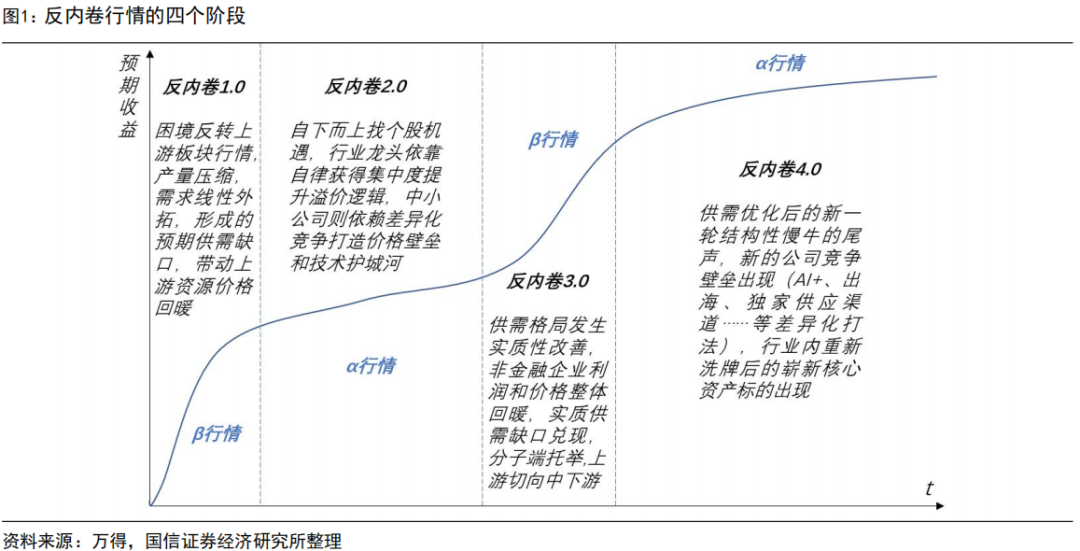
Core Viewpoint - The report from Guosen Securities emphasizes the importance of focusing on investment opportunities that are immune to "involution," highlighting three high-barrier sectors: monopolistic industries like public utilities and rare earths, industries with exclusive products and global competitiveness in hard technology, and sectors where AI accelerates the replacement of repetitive tasks [1][2][3]. Group 1: High-Barrier Industries - Monopolistic barrier assets, such as public utilities (electricity, water) and strategic rare resources (like rare earths), effectively avoid intense market competition and provide stable cash flow and pricing power, making them excellent defensive investments [2][11]. - Global competitive assets are characterized by technological innovation and product exclusivity, allowing companies to successfully expand into overseas markets and create unique advantages, primarily found in high-end manufacturing and hard technology sectors [2][11]. - AI-driven efficiency revolution assets are transforming traditional industries by replacing repetitive labor, significantly enhancing productivity and accelerating the "involution" process in certain sectors [3][19]. Group 2: Market Phases of "Involution" - The "involution" market is currently transitioning from the first phase (involution 1.0) to the second phase (involution 2.0), where the focus shifts from broad industry recovery to individual stock selection based on self-discipline and competitive differentiation [4][6]. - The first phase is characterized by supply-side contraction leading to a supply-demand gap, benefiting upstream resource sectors like steel and coal [4][6]. - The second phase sees a focus on high-quality companies that can achieve market share and profitability recovery through strict production discipline, while smaller firms must innovate and create unique competitive advantages [4][6]. Group 3: Long-Term Investment Strategy - The long-term strategy emphasizes investing in industries with natural high barriers to entry, which can provide stable and higher returns compared to short-term "involution" opportunities [11][13]. - Historical data indicates that monopolistic industries, such as public utilities and strategic rare resources, have shown resilience and sustained performance compared to emerging industries that have faced downturns [11][13]. - The report suggests prioritizing sectors with high entry barriers, such as public utilities and strategic resources, which offer stable cash flows and are less affected by economic cycles [11][13].