
债券

Search documents
上证0-3年国企信用债指数报169.64点
Sou Hu Cai Jing· 2025-08-05 09:27
从债项评级分布来看,上证0-3年国企信用债指数持仓5.49%为"AA"级债券,9.56%为"AA+"级债券, 0.00%为"AA-"级债券,84.95%为"AAA"级债券。 资料显示,上证国企信用债指数系列样本每月调整一次,定期调整生效日为每月首个交易日,定期调整 数据截止日为生效日前一交易日。遇临时调整时,若样本发生摘牌等事件,视情况自事件生效之日起剔 除出指数;样本发生其他事件,参照计算与维护细则处理。 金融界8月5日消息,上证指数高开高走,上证0-3年国企信用债指数 (上证0-3国企债,950247)报169.64 点。 数据统计显示,上证0-3年国企信用债指数近一个月上涨0.13%,近三个月上涨0.72%,年至今上涨 1.27%。 据了解,上证国企信用债指数系列从上海证券交易所上市的公司债和企业债中,选取由国有企业发行的 符合条件的债券作为指数样本,以反映相应国企信用债的整体表现。该指数以2013年12月31日为基日, 以100.0点为基点。 来源:金融界 ...
上证0-3年国债及政策性金融债指数报165.97点
Sou Hu Cai Jing· 2025-08-05 09:27
从债项评级分布来看,上证0-3年国债及政策性金融债指数持仓100.00%为无评级债券。 金融界8月5日消息,上证指数高开高走,上证0-3年国债及政策性金融债指数 (沪0-3国债及政金债, 950231)报165.97点。 数据统计显示,上证0-3年国债及政策性金融债指数近一个月上涨0.07%,近三个月上涨0.46%,年至今 上涨0.55%。 据了解,上证国债及政策性金融债指数系列从上海证券交易所上市的国债和政策性金融债中,选取剩余 期限符合条件的债券作为指数样本,以反映沪市相应期限国债及政策性金融债的整体表现。该指数以 2007年12月31日为基日,以100.0点为基点。 资料显示,该指数系列样本每月调整一次,定期调整生效日为每月首个交易日,定期调整数据提取日为 生效日前一交易日。遇临时调整时,满足条件的新发债券自上市次日起进入指数。若样本发生摘牌等事 件,视情况自事件生效之日起剔除出指数;样本发生其他事件,参照计算与维护细则处理。 来源:金融界 ...
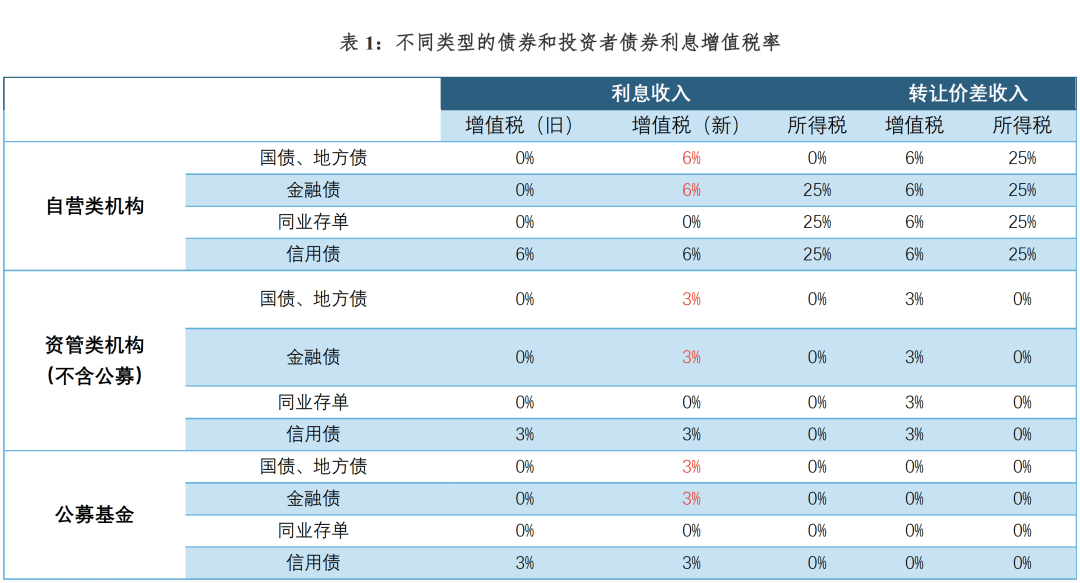
债券增值税调整怎么看——国债、地方债、金融债增值税调整解读
Sou Hu Cai Jing· 2025-08-05 08:25
Core Viewpoint - The Ministry of Finance and the State Taxation Administration announced a tax policy adjustment on interest income from government bonds, local government bonds, and financial bonds, reinstating a 6% value-added tax (VAT) on new issuances starting August 8, 2025, while previously issued bonds remain exempt until maturity [1][2][3] Tax Policy Adjustment - The VAT rate for interest income on government bonds, local government bonds, and financial bonds has been raised from 0% to 6% [3] - The exemption for interest income on government bonds began in 1994, while local government bonds were exempted starting in 2009, and financial bonds were clarified in 2016 [3] - The adjustment adopts a "new and old separation" approach, maintaining tax benefits for bonds issued before August 8, 2025, while new financial bonds will be subject to VAT [3][4] Impact on Different Investor Types - Asset management institutions benefit from a reduced VAT rate of 3% on bond interest income, while self-operated institutions face a 6% VAT [4] - Public funds are exempt from VAT on bond trading profits, and individual investors earning less than 100,000 yuan per month are also exempt from VAT [4][5] Reasons for Adjustment - The adjustment aims to optimize the bond market structure, enhance risk control, and supplement fiscal revenue [7][8] - The bond market has matured, with a total scale reaching 174.93 trillion yuan, indicating that the previous tax incentives have fulfilled their purpose [8] - The adjustment is intended to alleviate the "asset shortage" phenomenon by redirecting funds from government bonds to credit bonds and equity markets [8][9] Market Impact - Short-term, the adjustment may create arbitrage opportunities for older bonds due to their tax-exempt status, while new bond issuance rates may rise [10][11] - The yield spread between new and old bonds could reach 5-10 basis points, with potential for increased returns on older bonds [10][11] - Long-term, the volatility from the tax exemption removal is expected to diminish, with a focus on the pricing of newly issued government bonds [12] Fiscal Revenue Implications - The adjustment is projected to generate over 200 billion yuan in additional tax revenue, with new bond issuances expected to exceed 500 billion yuan in ticket size for 2025 [9][12] - The increase in tax revenue is anticipated to support fiscal income, especially given the rising issuance of government and local government bonds [9][12]

债市周观察:债市短暂触及1.7%以下
Great Wall Securities· 2025-08-05 08:07
1. Report Industry Investment Rating No relevant content provided. 2. Core Viewpoints of the Report - The current VAT policy on bonds is short - term positive and long - term neutral. In the short term, it is beneficial to existing bonds, potentially triggering a pre - layout market for "snapping up old bonds." However, the expected continued decline in interest rates on Monday did not occur, as the improvement in the stock market weakened the bond market, and the "rumor" of the China Development Bank bonds drove up the long - term Treasury bond rates. In the medium term, the policy impact on the bond market tends to be neutral. Despite the intention to divert funds to the stock market, the trend of funds chasing the bond market is difficult to completely reverse due to the "asset shortage" and loose liquidity [2][3][21][22] 3. Summary by Relevant Catalogs 3.1 Interest Rate Bonds Data Review for Last Week - **Funds Interest Rates**: In the week of August 1st, after a slight increase at the end of July, the funds interest rates started to decline. DR001 reached 1.46% on July 28th and then fluctuated down to 1.31%, with a weekly fluctuation of 15BP; R001 rose to 1.56% on July 31st and dropped to 1.35% on August 1st, with a weekly fluctuation of 21BP. DR007 fell from 1.58% on July 28th to 1.42% on August 1st, a decline of 16BP; FR007 dropped from 1.64% to 1.50%, a weekly decline of 14BP [8] - **Open Market Operations**: The central bank's reverse repurchase volume increased slightly to 1.66 trillion yuan, with a similar total maturity volume. The net capital injection was small, and the daily net injection decreased gradually [8] - **Sino - US Market Interest Rate Comparison**: The inversion of the Sino - US bond yield spread slightly decreased. The US 6 - month SOFR rate rose from 4.20% on July 28th to 4.24% on August 1st; the Chinese 6 - month SHIBOR rate remained stable at 1.61%. As of August 1st, the 6 - month interest rate spread between China and the US was - 263BP, with a slightly wider inversion; the 2 - year and 10 - year bond yield spreads were - 227BP and - 252BP respectively, with a slight reduction in the long - and short - term spreads [13] - **Term Spreads**: The term spread of Chinese bonds slightly contracted, while that of US bonds slightly expanded. The 2 - year Chinese bond yield was 1.43%, and the 10 - year was 1.71%, with the 10 - 2 year spread narrowing from 30BP to 28BP. The US bond yield slightly declined, with the 2 - year yield rising to 3.94% and then dropping 25BP to 3.69% on August 1st, and the 10 - year yield dropping 19BP to 4.23%. The 10 - 2 year term spread of US bonds widened 3BP to 54BP [16] - **Interest Rate Term Structure**: The yield curve of Chinese bonds steepened, while that of US bonds flattened and shifted downward. The overall change in the Chinese bond yield curve was small, with the 3 - month yield dropping 2BP and the 3 - 5 year yields dropping about 1 - 2BP. Except for the 3 - month yield, the overall US bond yields dropped about 20BP [16] 3.2 Key Bond Market Events Last Week - **New Policy on Bond Interest Taxation**: On August 1st, the Ministry of Finance and the State Taxation Administration announced that starting from August 8th, the interest income from newly issued national bonds, local government bonds, and financial bonds will be subject to VAT. The interest income from bonds issued before August 8th and the continued issuance after that date will remain VAT - exempt until maturity [23][24] - **Weak PMI Data**: The National Bureau of Statistics data showed that the manufacturing PMI in July was 49.3%, a 0.4 - percentage - point decrease from the previous month, indicating a decline in manufacturing prosperity. In July, the manufacturing industry entered the traditional off - season, and factors such as high temperatures and floods in some areas led to the decline of PMI data [24]
债市日报:8月5日
Xin Hua Cai Jing· 2025-08-05 07:49
Core Viewpoint - The bond market is experiencing strong fluctuations, with short-term impacts from tax adjustments, but the medium to long-term outlook remains supported by fundamentals, liquidity, and demand for allocation [1] Market Performance - On August 5, the bond market showed a strong upward trend, with government bond futures mostly rising. The 30-year main contract increased by 0.06% to 119.320, while the 10-year main contract rose by 0.05% to 108.540 [2] - The yield on the 30-year government bond decreased by 0.25 basis points to 1.914%, and the yields on the 10-year government bonds fell by approximately 0.5 basis points [2] Overseas Bond Market - In North America, U.S. Treasury yields collectively fell, with the 10-year yield down by 2.35 basis points to 4.196% [3] - In Asia, Japanese bond yields also declined, with the 10-year yield down by 3.9 basis points to 1.47% [3] - In the Eurozone, the 10-year French bond yield decreased by 6.3 basis points to 3.282% [3] Primary Market - The China Development Bank's three financial bonds had winning yields below the China Bond valuation, with yields for 2-year, 5-year, and 10-year bonds at 1.5255%, 1.6408%, and 1.7546% respectively [4] - Agricultural Development Bank's 2-year financial bonds had winning yields of 1.5550% and 1.7033% [4] Liquidity and Funding - The central bank conducted a 7-day reverse repurchase operation of 160.7 billion yuan at a rate of 1.40%, resulting in a net withdrawal of 288.5 billion yuan for the day [5] - The Shibor short-term rates mostly declined, with the overnight rate rising slightly by 0.1 basis points to 1.315% [5] Institutional Views - Longjiang Fixed Income expects liquidity to remain reasonably ample in August, with funding rates likely to stay low, but regulatory goals may prevent further declines [7] - CITIC Securities notes that the bond market is experiencing a significant bearish steepening trend, with expectations for stabilization in interest rates [7] - Huatai Fixed Income suggests a flexible approach to trading, with a focus on opportunities above a 10-year government bond yield of 1.7% [7]
债券策略月报:2025年8月中债市场月度展望及配置策略-20250805
Zhe Shang Guo Ji Jin Rong Kong Gu· 2025-08-05 07:01
Group 1: Market Overview - The economic data for July showed a stable performance, with policy stimulus expectations driving market trends, particularly following the announcement of the Yarlung Tsangpo River hydropower station project, which has an investment scale of over 1 trillion yuan, leading to significant increases in equity and commodity markets [3][4] - The Shanghai Composite Index and Shenzhen Component Index recorded increases of 3.74% and 5.32% respectively, reflecting improved market risk appetite [3][4] - The bond market underperformed due to negative factors such as the "stock-bond seesaw" effect and unexpected tightening of liquidity around tax periods, resulting in rising yields across different maturities [4][11] Group 2: Macroeconomic Environment - The macroeconomic environment remains mixed, with GDP growth around 5.35% year-on-year, but nominal growth remains weak at 3.9% [5][35] - Manufacturing PMI for June was recorded at 49.7%, indicating a slight recovery but still below the expansion threshold, suggesting potential economic slowdown in the third quarter [5][35] - The central bank's monetary policy appears hawkish, reducing expectations for further rate cuts in the near term [5][35] Group 3: Bond Market Strategy - Looking ahead to the third quarter, demand remains weak, and short-term policy stimulus expectations are retracting, but the cooling of commodity and stock markets may provide support for the bond market [6][35] - There is potential for a 10-12 basis point downward adjustment in the yields of 10-year and 30-year government bonds, indicating attractive returns for investors [3][6] - The strategy suggests early positioning in varieties that can absorb incremental funds as a favorable approach [6][35] Group 4: Government Bond Issuance - In July, government bond issuance pressure was higher than in June, with local government bonds net issuance reaching 1.2135 trillion yuan, marking it as the second-highest month of net issuance this year [21][22] - The net issuance of treasury bonds in July was 593.3 billion yuan, with expectations for increased supply in August and September [21][22] - The anticipated net issuance scale for government bonds in August and September is projected to be 1.47 trillion and 1.14 trillion yuan respectively, indicating a heavier supply pressure in August [21][22] Group 5: Funding Conditions - The central bank's liquidity injections have led to a decrease in funding costs, with the average rates for DR001 and R001 falling to 1.45% and 1.39% respectively [26][27] - The funding environment for August is expected to remain stable, with historical data suggesting limited changes in funding rates compared to July [27][34] - The net cash flow from the central bank in July was 300 billion yuan, indicating continued support for liquidity in the market [26][27]
机构行为跟踪周报20250805:交易盘“追涨”情绪减弱-20250805
Tianfeng Securities· 2025-08-05 06:42
1. Report Industry Investment Rating There is no information provided in the text regarding the industry investment rating. 2. Core Viewpoints of the Report - Last week, the bond market experienced significant fluctuations, and institutional behavior adjusted accordingly. After a series of market movements, the "chasing up" behavior of trading desks became more cautious, and the allocation desks showed differentiation without forming a joint force [8]. - The bond market vitality index increased. As of August 1st, it rose by 13 pcts to 49% compared to July 25th, and the 5D - MA increased by 1 pct to 45% [1][9]. - In July, the increase in wealth management scale was significantly weaker than the seasonal average. The scale of bond funds also had a notable decline in its month - on - month growth rate, while the month - on - month growth rate of stock funds was larger [4]. 3. Summaries Based on Relevant Catalogs 3.1 Overall Sentiment: Bond Market Vitality Index Increase - The bond market vitality index is compiled based on the historical percentile levels of bond market leverage, turnover rate, bond fund duration, and the implied tax rate of government bonds since 2022 and their correlation with the bond market trend. As of August 1st, it rose by 13 pcts to 49% compared to July 25th, and the 5D - MA increased by 1 pct to 45% [9]. - Indicators of increasing bond market vitality include the trading volume of 10Y government bond active bonds/balance of 9 - 10Y government bonds, inter - bank bond market leverage, median duration of medium - and long - term pure bond funds, and 1 minus the implied tax rate of 10 - year government bonds. Indicators of decreasing bond market vitality include the turnover rate of 30Y government bonds [1][11][12]. 3.2 Institutional Behavior: After Repeated Market Fluctuations, Funds' Bullish Sentiment Became More Cautious 3.2.1 Buying and Selling Strength and Bond Selection - In the cash bond market last week, the order of net buying strength was: overseas institutions and others > other product types > insurance > wealth management > money market funds > funds. The order of net selling strength was: city commercial banks > joint - stock banks > securities firms > rural financial institutions. For ultra - long bonds (bonds with a maturity of over 15 years), the order of net buying strength was: insurance > wealth management > funds > other product types, and the order of net selling strength was: large - scale banks > joint - stock banks > city commercial banks > rural commercial banks > overseas institutions and others [19]. - Currently, the main bond types for various institutions are: large - scale banks focus on 3 - 5Y credit bonds; rural commercial banks focus on 3 - 5Y credit bonds; insurance focuses on 7 - 10Y interest - rate bonds; funds focus on 3 - 5Y interest - rate bonds; wealth management has no obvious main bond type; other product types focus on 7 - 10Y interest - rate bonds [2][24]. 3.2.2 Trading Desks: Interest - Rate Bond Funds Extended Duration, Credit Bond Funds Shortened Duration, and High - Performing Bond Funds Had Smaller Duration Adjustments - As of August 1st, the median duration of the full - sample medium - and long - term pure bond funds increased by 0.03 years to 4.39 years compared to July 25th. Among them, the median durations of pure interest - rate bond funds, interest - rate bond funds, and credit bond funds were 5.67 years, 5.43 years, and 3.95 years respectively, with changes of +0.98 years, +0.86 years, and - 0.47 years. The median durations of high - performing interest - rate bond funds and credit bond funds were 6.79 years and 4.75 years respectively, with changes of - 0.39 years and +0.19 years [2][41]. 3.2.3 Allocation Desks: Wealth Management Continuously Extended Duration, Rural Commercial Banks and Insurance Arranged Ultra - Long Bonds - In the primary market, the subscription demand for treasury bonds and policy - bank bonds increased last week. In the secondary market, large - scale banks' cumulative net purchase of 1 - 3Y treasury bonds this year was higher than the same period last year; rural commercial banks' cumulative net purchase of cash bonds this year was significantly weaker than in previous years, mainly due to the weak net purchase of short - term bonds within 1 year, but their net purchase of 7 - 10Y and over 10Y cash bonds was higher than the same period in previous years; insurance's net purchase of cash bonds and its ratio to premium income were significantly higher than in previous years, mainly because of the sufficient supply of ultra - long - term government bonds; wealth management continued to increase the duration of its net - purchased cash bonds in the secondary market, reaching the highest level since February 23, 2024 [3][55][79]. 3.3 Asset Management Product Tracking: The Increase in Wealth Management Scale in July Was Significantly Weaker than the Seasonal Average - In July, the increase in wealth management scale was weaker than the seasonal average. The actual month - on - month increase was 274.1 billion yuan, while the estimated increase based on the average month - on - month growth rate of the past four months was 1.87 trillion yuan. The month - on - month growth rate of bond fund scale declined significantly in July, while that of stock funds was larger. Last week, the net value of various types of bond funds increased significantly, but they still recorded overall negative returns in the past month [4][90][98].
美债策略周报-20250805
Zhe Shang Guo Ji Jin Rong Kong Gu· 2025-08-05 06:16
Group 1 - The core view of the report indicates that the U.S. Treasury market is experiencing downward pressure due to economic slowdown, with a potential turning point for Treasury yields having been reached [6][7][78] - The July non-farm payrolls showed a significant decline, with only 73,000 jobs added, below the expected 104,000, and previous months' data revised down by 258,000, indicating a weakening labor market [7][50] - The unemployment rate rose to 4.25%, reflecting increasing economic challenges, while GDP growth for Q2 was reported at 3%, primarily driven by net exports, with private consumption weakening [7][57] Group 2 - The report highlights that the Treasury market's liquidity remains ample, with the average daily trading volume of SOFR rising to approximately $2.3 trillion, indicating strong market activity [37][43] - The supply side of the Treasury market shows that the issuance of T-Bills remains high, with the Treasury Department issuing $6.13 trillion in bonds this week, maintaining a consistent issuance structure [20][24] - Demand for U.S. Treasuries remains robust, although short positions are at historical highs, indicating a complex market sentiment where basis trading and roll-over trades are prevalent [27][32] Group 3 - The macroeconomic environment is characterized by a cautious outlook, with the Federal Reserve's July FOMC meeting reflecting a hawkish stance but acknowledging risks to the labor market, suggesting potential for future rate cuts if employment weakens [64][66] - The report anticipates that the economic pressures from tariffs and trade disputes may lead to a more pronounced decline in employment and consumer spending, potentially forcing the Fed to reconsider its monetary policy stance [70][76] - The report recommends specific Treasury securities, including TLT, TMF, and 10-year Treasury futures, as attractive investment opportunities given the current yield environment [7][78]
美债策略月报:2025年8月美债市场月度展望及配置策略-20250805
Zhe Shang Guo Ji Jin Rong Kong Gu· 2025-08-05 06:10
Group 1 - The report indicates that July economic data shows downward pressure, with non-farm payrolls exceeding expectations but structural weaknesses evident, and domestic demand components significantly declining [3][4][73] - The report highlights that the U.S. stock market reached new historical highs in July, while U.S. Treasury yields experienced a notable rebound [4][13] - The report suggests that the 10-year U.S. Treasury yield may reach a new low of 3.6%, breaking the previous low of 3.8% in April [3][7] Group 2 - The report notes that the total issuance of U.S. Treasuries in July was $2.51 trillion, an increase from the previous month's $2.3 trillion [19][20] - It mentions that the demand for U.S. Treasuries has weakened marginally due to the lower attractiveness of U.S. Treasury yields compared to European and Japanese government bonds after currency hedging costs [7][21] - The report states that the issuance of short-term Treasury bills (T-Bills) increased significantly, with a total issuance of $2.37 trillion in July, compared to $1.62 trillion in June [20][27] Group 3 - The report discusses the macroeconomic environment, indicating that the FOMC maintained the policy rate at 4%-4.25% during the July meeting, reflecting a more cautious outlook on economic uncertainty [62][63] - It highlights that the labor market remains resilient, with non-farm payrolls adding 147,000 jobs in June, surpassing expectations [73][79] - The report emphasizes that inflationary pressures are expected to remain moderate, with the CPI rising by 0.3% month-on-month in June, aligning with expectations [73][74] Group 4 - The report outlines the strategy for the U.S. Treasury market, recommending specific instruments such as TLT, TMF, and 10-year and above Treasury futures [3][7] - It suggests that the current economic conditions may lead to a "soft landing," but if the Federal Reserve misjudges inflation, it could result in a "hard landing" scenario [106] - The report indicates that the Treasury market is expected to experience high volatility due to ongoing economic pressures and potential shifts in monetary policy [7][49]
2025年8-10月信用债市场展望:见好就收
Shenwan Hongyuan Securities· 2025-08-05 03:45
Group 1: Report Title and Basic Information - Report title: Outlook for the Credit Bond Market from August to October 2025 [2] - Analysts: Huang Weiping, Yang Xuefang, Zhang Jinyuan [3] - Date: August 5, 2025 [3] Group 2: Core Viewpoints - In the short - term (within 1 month), credit spreads may still have room to compress, but in the next 1 - 3 months, spread compression faces resistance and potential adjustment risks are greater [4][6][32][70][71] - Credit strategy: moderately reduce duration and seize the profit - taking window [4][6] Group 3: 7 - month Review 3.1 Primary Market - In July 2025, the issuance of traditional credit bonds decreased slightly month - on - month, and net supply increased month - on - month. Industrial bond net financing decreased month - on - month but remained at a high level, and urban investment bond net financing turned positive. Bank perpetual and secondary capital (two - tier) bonds' issuance and net supply increased significantly month - on - month. Secondary capital bond issuance and net financing increased, while perpetual bond issuance and net financing decreased [13][16][32] 3.2 Secondary Market - In July, credit bond yields fluctuated upwards, and credit spreads were passively narrowed. Short - term yields decreased slightly, medium - and long - term yields mostly increased, and long - term yields increased more significantly. Credit spreads generally narrowed, with weak - quality medium - term notes and bank perpetual bonds performing better. In terms of credit spreads, ordinary credit bonds' spreads mostly narrowed, two - tier capital bonds' spreads mostly widened, and bank perpetual bonds' spreads mostly narrowed. The term spreads within 5 years generally widened, especially the 3 - 1 year term spread. In terms of holding - period yields, the capital gains of medium - and long - term credit bonds were negative, and the short - term holding - period yields remained positive [19][23][27][31][32] Group 4: 8 - 10 Month Outlook 4.1 Compression Phases of Credit Spreads - Phase 1 (May 1 - May 23): Overall catch - up of credit bonds under loose liquidity. Driven by the implementation of reserve requirement ratio and interest rate cuts, and the expectation of financial disintermediation and deposit transfer, except for some long - term secondary capital bonds, credit bonds generally rose, with yields and credit spreads declining [39][43] - Phase 2 (May 23 - July 18): A scramble for constituent bonds under the expansion of credit bond ETFs, further compressing credit spreads. Driven by continuous loose liquidity and the rapid expansion of credit bond ETFs, medium - and long - term credit bonds continued to catch up, and constituent bonds outperformed non - constituent bonds [48][52][58] 4.2 Characteristics of Credit Bond Market under Recent Adjustments - Credit bond yields had a pulse - type adjustment, but the widening of credit spreads was not obvious. Driven by the rapid rise of commodities and equity assets under the "anti - involution" background, along with tightened liquidity, the bond market had a pulse - type adjustment. The adjustment range of credit bond yields was mostly around 10BP, and the widening of credit spreads was mostly within 5BP. The credit spreads of long - term general credit bonds were even passively narrowing, and the spreads of constituent bonds and non - constituent bonds did not converge [61][65] 4.3 Market Outlook - Short - term (within 1 month): Credit spreads may still have room to compress. Market sentiment eases, redemption pressure eases, and credit bonds still have a positive carry environment and room for carry - trade and leveraging. The VAT recovery policy on interest income of treasury bonds, local bonds, and financial bonds may indirectly benefit general credit bonds [4][70] - Next 1 - 3 months: Spread compression faces resistance, and potential adjustment risks are greater. August - October may be a volatile period for the bond market, with the curve possibly becoming steeper. The difficulty of further loosening liquidity is increasing, and the probability of double - cuts (RRR and interest rate cuts) decreases. The incremental funds for credit bonds may be relatively limited, and their sustainability remains to be seen. The current credit spread protection space is thin, and the market trading structure is fragile. Credit bond ETFs may amplify market volatility [4][32][71] Group 5: Credit Strategies - Moderately reduce duration and seize the profit - taking window. For ultra - long - term credit bonds and credit bond ETF constituent bonds, it may be approaching the profit - taking window [4][6] - For financial bonds,建议 reduce the position and duration of two - tier bonds and pay attention to TLAC non - capital bonds with both offensive and defensive attributes [6] - For general credit bonds, be vigilant about constituent bonds and focus on urban investment bonds and inter - bank bonds. Pay attention to the investment opportunities in 1 - 3 - year AA + and above - grade inter - bank bonds and 1 - 3 - year AA/AA(2)/AA - grade urban investment bonds [6] - Pay attention to the investment opportunities brought by the expansion of the Southbound Bond Connect. The expansion may bring allocation opportunities, and the dim - sum bond market is one of the core expansion directions [6]