
OTA

Search documents
每日投资策略-20251127
Zhao Yin Guo Ji· 2025-11-27 03:55
Market Overview - Global markets showed mixed performance, with the Hang Seng Index closing at 25,928, up 0.13% year-to-date increase of 29.25% [1] - The US markets continued to rise, with the Dow Jones up 0.67% and the S&P 500 up 0.69%, reflecting a year-to-date increase of 11.48% and 15.83% respectively [1] - European markets also saw gains, driven by improved fiscal outlooks in the UK, with the DAX up 1.11% and the CAC up 0.88% [1] Sector Performance - In the Hong Kong market, healthcare, conglomerates, and telecommunications sectors led the gains, while materials, information technology, and energy sectors faced declines [3] - The semiconductor optical module industry is expected to perform strongly, driven by AI infrastructure investments, with significant revenue growth anticipated through 2026 [4][5] Company Insights - Tongcheng Travel reported a robust 3Q25 performance with total revenue reaching 5.5 billion RMB, a 10.4% year-on-year increase, and adjusted net profit of 1.06 billion RMB, up 16.5% [5] - Ideal Auto's 3Q25 results showed a net loss of 625 million RMB, primarily due to a one-time recall cost, but the gross margin remained high at approximately 20.4% [6][7] - The report suggests that Ideal Auto may face challenges in sales and gross margins in the upcoming quarters, leading to a downgrade in rating from "Buy" to "Hold" [7] Investment Recommendations - The semiconductor optical module sector is highlighted as a key investment opportunity, with a buy rating on Zhongji Xuchuang, targeting a price of 591 RMB [4] - Tongcheng Travel is also rated as a buy, with a target price adjustment to 25.4 HKD, reflecting a positive outlook on its core OTA business [5]
社会服务行业周报:淡季不淡,酒店景区免税景气筑底回升-20251125
Orient Securities· 2025-11-25 05:47
Investment Rating - The report maintains a "Positive" investment rating for the social services industry, indicating an expectation of returns exceeding the market benchmark by over 5% [5]. Core Insights - The social services sector is showing resilience during the off-peak season, supported by fundamental data and a shift in funding styles, creating conditions for relative returns across industries [4]. - Key areas of focus include mid-cap blue-chip characteristics, growth potential, and recovery prospects in performance, particularly in OTA, hotels, human resources, and select dining and scenic spots [4]. Summary by Sections Hotels - The hotel sector demonstrates strong fundamentals with a recovery in performance. Huazhu reported a revenue of 7 billion yuan for Q3 2025, a year-on-year increase of 8.1%, surpassing previous growth guidance [8]. - The national hotel RevPAR turned positive in October 2025, showing a year-on-year increase of 2.2%, indicating a stable volume and rising prices [8]. Scenic Spots - The demand for scenic spots remains robust due to the autumn holiday and the upcoming winter season, with double-digit growth in visitor numbers reported [8]. - For instance, the Jianmen Pass scenic area saw a 30% increase in visitors during the autumn holiday, and hotel bookings in Zhejiang rose by 68% [8]. Duty-Free - The duty-free shopping scene in Hainan is recovering, with sales reaching 506 million yuan from November 1-7, 2025, a year-on-year increase of 34.86% [8]. - This recovery is attributed to low base effects, new policies, and promotional activities, alongside a shift in consumer behavior due to international travel restrictions [8]. OTA (Online Travel Agencies) - Ctrip's Q3 2025 report showed a net operating income of 18.3 billion yuan, reflecting a year-on-year increase of approximately 16% [8]. - The international OTA orders grew by about 60%, with inbound travel orders doubling, indicating a strong recovery in domestic travel demand [8].


商贸社服行业周报:双十一大促收官,全网电商销售额平稳增长-20251118
CMS· 2025-11-18 08:34
Investment Rating - The report maintains a "strongly recommended" rating for Alibaba, Pinduoduo, JD.com, and Vipshop, indicating a positive outlook for these companies in the e-commerce sector [17][20][21]. Core Insights - The overall e-commerce sales during the 2025 Double Eleven shopping festival reached 1,695 billion yuan, marking a year-on-year growth of 14.2% [5][24]. - JD.com achieved record sales during the 11.11 event, with a 40% increase in the number of orders and nearly 60% growth in order volume [2][26]. - The report highlights the strong performance of the local life services sector, particularly Meituan, which maintains long-term competitive advantages despite competitive pressures [17]. Summary by Sections E-commerce Sector - The report emphasizes the low valuations of leading e-commerce companies, recommending Alibaba, Pinduoduo, JD.com, and Vipshop as key investment opportunities [17][20]. - Alibaba's e-commerce monetization rate is steadily improving, with significant growth potential in its cloud and AI businesses [17]. - Pinduoduo is expected to see sustainable growth driven by its support plan for merchants and improving global market prospects [20]. Local Life Services - Meituan's long-term investment value remains intact despite short-term competitive disruptions, with a focus on high-value users and operational efficiency [17]. Travel and Tourism - The travel sector is projected to maintain high growth, with recommendations for companies in the OTA and scenic spots, as well as transportation and hotel sectors driven by business travel demand [17]. - The report notes that the restaurant and tourism index rose by 4.81%, outperforming major indices [5][6]. Retail Sector - The report suggests focusing on quality retail trends, with companies like Yonghui adapting to consumer trust and product quality [17]. - The retail sector is experiencing significant growth, with notable increases in various product categories during the Double Eleven sales [5][24].



中金 | 深度布局“十五五”:互联网篇
中金点睛· 2025-11-15 00:07
Consumer Sector - The "14th Five-Year Plan" focused on supply-side structural reforms, while the "15th Five-Year Plan" emphasizes direct stimulation of demand, aiming to significantly boost consumer spending and enhance domestic circulation [2][3] - The goal of the "15th Five-Year Plan" includes increasing the consumer rate and ensuring that domestic demand continues to be the main driver of economic growth, with expectations for retail sales growth to outpace GDP growth [3] - Policies such as government and enterprise subsidies are expected to directly stimulate consumer spending, with a shift from structural optimization to activating consumption [2][3] E-commerce and Retail Innovations - New retail models like live streaming and instant retail are emerging growth areas, leveraging platforms like Douyin and Kuaishou to create new consumer scenarios [4] - Instant retail is evolving from meeting urgent needs to catering to a broader range of consumer demands, creating a positive feedback loop that drives both supply and demand [4][5] - The "15th Five-Year Plan" calls for expanding the supply of quality consumer goods and services, with e-commerce platforms expected to focus on balancing price and quality [3][5] Travel and Tourism - The "15th Five-Year Plan" aims to enhance the quality of tourism services and promote the integration of culture and tourism, with OTA platforms playing a key role in this transformation [6][7] - Domestic tourism is being enriched through cultural elements, while inbound tourism policies are being optimized to lower barriers and enhance the experience for international visitors [7][8] - OTA platforms are responding to national policies by expanding their service offerings and improving the overall travel experience for both domestic and international tourists [6][7] Technology and AI Development - The "15th Five-Year Plan" emphasizes accelerating AI innovation and application, with a focus on enhancing efficiency in existing businesses and driving new demand through AI technologies [9][10] - The demand for cloud computing is surging due to the growing need for AI applications, with Chinese cloud providers expected to benefit significantly from this trend [10] - AI applications are anticipated to revolutionize content production and advertising, with platforms leveraging AI to enhance user engagement and operational efficiency [11][12]


中国AI旅游应用分化加剧:谁在领跑?谁陷停滞?
Sou Hu Cai Jing· 2025-10-06 02:30
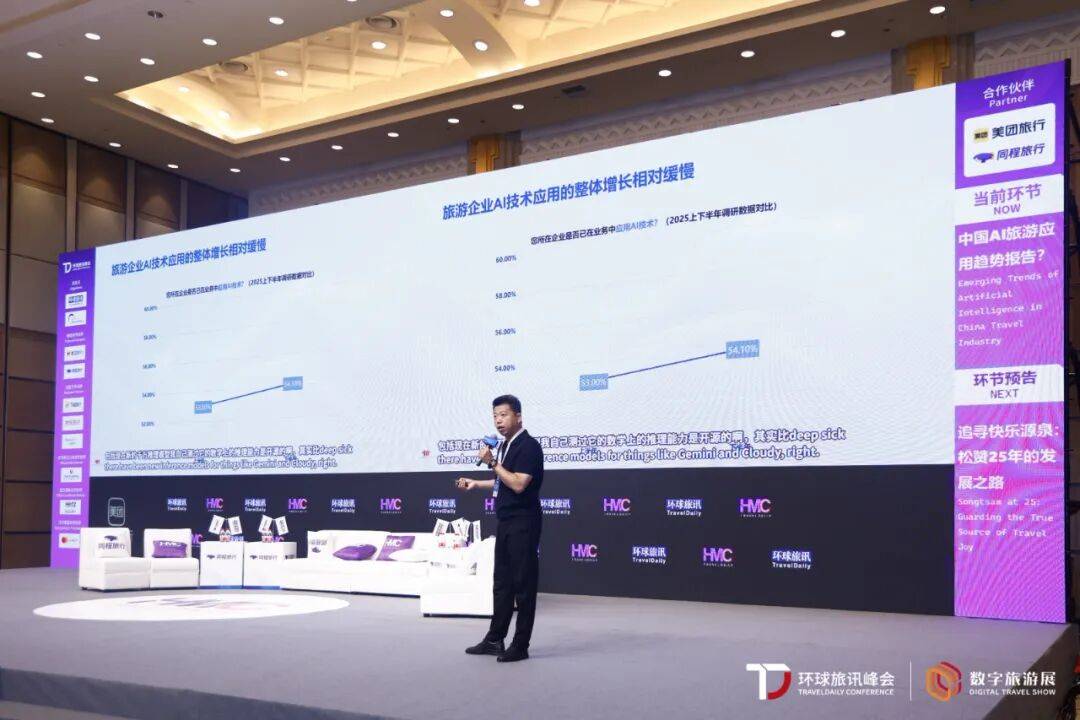
Core Insights - The application of AI in China's tourism industry is evolving from conceptual discussions to practical implementations, significantly transforming operational methods for both travelers and tourism companies [2][3] - A report presented at the 2025 Global Travel Summit highlights the challenges and trends of AI adoption within tourism enterprises, emphasizing the role of grassroots employees over CEOs in driving AI integration [4][5] AI Adoption Trends - In the first half of 2024, 53% of surveyed companies reported using AI, with a slight increase to 54.1% in the second half, indicating a slow adoption rate in B2B contexts despite frequent media coverage of new models [5][6] - Large enterprises (1,000+ employees) saw a decline in AI usage from 80.6% to 74.4%, while medium-sized enterprises (200-500 employees) increased their usage from 38.5% to 53.3% [6][7] Sectoral Disparities - The AI application rates among tourism companies show a clear three-tier differentiation: - The first tier includes technology-intensive sectors like airlines, which have a high AI penetration rate - The second tier consists of business travel companies and travel tech firms, known for their quick adoption of new technologies - The third tier includes OTAs, tourism boards, and scenic spots, which are lagging behind [7][8][9] Organizational Challenges - Despite individual employees using AI, many companies have not established end-to-end AI workflows, indicating a gap in organizational integration [11] - Over 50% of companies believe that external policies and market conditions significantly impact AI technology applications, highlighting the uncertainty in the current environment [12] Application Focus - 76.3% of companies are prioritizing AI for internal operational efficiency, although some application rates, such as store management and personalized recommendations, have decreased due to perceived cost-benefit issues [12][13][14] - A significant portion of companies (46.8%) believes AI will mature within one to two years, reflecting an overly optimistic outlook on AI capabilities [16][18] Key Recommendations for AI Integration - Companies need to redefine their understanding of generative AI, moving beyond viewing it as a mere IT project aimed at replacing human roles [19] - Successful AI implementation requires overcoming three capability bridges: organizational questioning ability, data leadership, and human-machine collaboration [19][20] - Establishing dedicated AI project management offices and cultural performance metrics can facilitate better integration of AI into business processes [20][23]
社会服务行业投资策略报告:经营分化,龙头领跑-20250912
CAITONG SECURITIES· 2025-09-12 11:43
Core Insights - The report indicates a divergence in performance within the social services sector, with leading companies outperforming their peers [5][7] - The overall revenue for the service consumption sector increased by 1.4% year-on-year in 1H2025, reaching 134% of 2019 levels, while profits declined by 11.5%, recovering to 79% of 2019 levels [12][15] - Key segments such as K12 education, human resources, and scenic areas showed both revenue and profit growth, while hotels, restaurants, tourism retail, and higher education faced challenges [12][13] Social Services Overview - In 1H2025, K12 training and human resources sectors saw revenue growth of 14.4% and 10.7%, respectively, with net profits increasing by 39.5% and 49.8% [12][15] - Scenic areas also reported growth, with revenues up by 3.9% and net profits by 2.4% [15] - Conversely, the hotel sector experienced a revenue decline of 4.5% and a significant profit drop of 40.6% [13][15] Travel Services - The hotel industry remains under pressure, with leading hotels like Huazhu Group and Shoulv Hotel showing resilience despite a decline in RevPAR [16][19] - In 1H2025, leading hotels continued to expand, with Huazhu adding 990 new hotels [16][18] - OTA companies benefited from overall travel demand, with significant growth in overseas business [7][24] Scenic Areas and OTA - Domestic tourism numbers surpassed pre-pandemic levels, with a 20.6% increase in travel volume in 1H2025 [24] - Scenic area performance varied, with Xiangyuan Cultural Tourism and Jiuhua Tourism showing strong growth, while Changbai Mountain faced challenges due to weather [29] - The average ticket price for domestic travel has not fully recovered, remaining at 95% of 2019 levels [24] Professional Services - The human resources sector is experiencing a mild recovery, with companies like Keri International and BOSS Zhipin performing well [7][16] - The education sector, particularly K12 training, continues to thrive, with a focus on AI applications enhancing efficiency [7][16] - The exhibition industry is awaiting macroeconomic improvements to boost performance [7][16] Restaurant and Tea Beverage Sector - The restaurant industry is under pressure, with same-store sales declining, while budget-friendly dining options are showing resilience [7][12] - The tea beverage sector is expanding, with leading brands like Mixue and Gu Ming performing exceptionally well [7][12]


国泰海通|批零社服:景气环比改善,享多重红利——社服及商贸零售行业2025年中报业绩综述
国泰海通证券研究· 2025-09-04 12:18
Core Viewpoint - The report indicates that while revenue growth in various sectors has improved in Q1 2025, profit margins have not increased, primarily due to intensified competition affecting profitability [1][2]. Group 1: Revenue and Profit Trends - The social services sector saw a revenue increase of 2.84% in Q2 2025, with a quarter-on-quarter improvement of 2.77 percentage points, attributed to a low base and stable demand [1]. - The retail sector experienced a revenue decline of 6.7% in Q2 2025, a narrowing drop compared to a 12.77% decline in Q1 2025 [1]. - Operating profit margins for the social services sector decreased to 7.61% in Q2 2025, down 0.84 percentage points quarter-on-quarter and 1.65 percentage points year-on-year [1]. Group 2: Sector-Specific Growth Opportunities - The brand retail and AI sectors are benefiting from multiple growth drivers, with the toy IP industry seeing significant momentum, particularly for Miniso, which is expected to focus on fewer but larger store openings to enhance profitability [2]. - The education sector is experiencing a normalization in high school supply and quality improvements, with a notable shift towards AI education by public examination companies [2]. - The smart glasses industry is witnessing rapid product iteration, although performance varies among companies, with Kangnait Optical continuing to show high growth while others like Doctor Glasses and Mingyue Lenses are slowing down [2]. Group 3: Travel and Retail Sector Dynamics - The hotel industry is seeing a reduction in demand decline in Q2 2025, driven by low base effects and operational strategy adjustments [3]. - Online Travel Agencies (OTAs) maintain a stable profit margin and are improving subsidy efficiency while investing overseas [3]. - The supermarket and department store sectors are undergoing significant adjustments, with supermarkets experiencing a revenue decline of 14.47% and continued pressure on profitability in department stores [3].

国泰海通:社服板块收入增速普遍环比25Q1改善 品牌零售、AI及服务消费享受多重红利
智通财经网· 2025-09-04 06:21
Core Viewpoint - The report from Guotai Junan indicates that while the revenue growth in the social service sector has improved in Q2 2025, profits have not increased due to competitive pressures affecting profit margins [1] Group 1: Revenue and Profit Trends - The social service sector's revenue in Q2 2025 increased by 2.84%, showing a quarter-on-quarter improvement of 2.77 percentage points, primarily due to a low base and stable demand [1] - The operating profit margin for the social service sector in Q2 2025 was 7.61%, reflecting a decline of 0.84 percentage points quarter-on-quarter and 1.65 percentage points year-on-year [1] - The retail trade sector's operating profit margin was 1.81%, down 0.7 percentage points quarter-on-quarter, while it was up 0.1 percentage points compared to Q2 2024 [1] Group 2: High Growth Sectors - The collectible toy IP industry is experiencing significant growth, with Miniso reaching a turning point in same-store sales both domestically and internationally, focusing on fewer but larger store openings to improve profit margins [2] - The education sector is seeing improvements in high school supply and quality, with public examination companies actively investing in AI education [2] - The smart glasses industry is accelerating product iteration and market entry, although performance varies among companies, with Kangnait Optical continuing to grow while others like Doctor Glasses and Mingyue Lenses are slowing down [2] Group 3: Travel and Retail Sector Dynamics - The travel chain sector is at a low point but showing signs of stabilization, with hotel demand in Q2 2025 declining at a slower rate due to low base effects and operational strategy adjustments [3] - The OTA (Online Travel Agency) landscape remains stable with healthy profits and efficient subsidy strategies [3] - Supermarkets and department stores are undergoing significant adjustments, with supermarket revenues declining by 14.47% and department stores continuing to face pressure without signs of recovery [3]

如何应对“恐高”情绪
2025-08-18 01:00
Summary of Conference Call Records Industry Overview - The current market is experiencing strong inflows of new funds, particularly from foreign investments and margin financing, indicating a solid foundation for the ongoing bull market [1][6] - Since June, foreign capital has consistently flowed into the market, with passive funds contributing approximately 19 billion USD, equivalent to over 100 billion CNY into A-shares, and a similar amount into Hong Kong stocks [1][6] Key Market Trends - The market's trading volume has increased from 1.5 trillion to 2.3 trillion, with expectations to reach 2.5 trillion [2] - The bull market is still in its second phase of growth, with historical data suggesting that the market is not close to its peak [8] - Current financing balance as a percentage of market capitalization is around 0.85, below the peak of 0.9, indicating that there is still room for growth [8] Investment Strategy - The recommended investment strategy focuses on leading sectors such as brokerage firms, non-ferrous metals, and coal [4] - Attention should also be given to low-level state-owned enterprise restructuring areas, including electricity, power, and travel chains [4] - Growth sectors to watch include the Hang Seng Technology sector and domestic computing power layouts, such as Cambrian [4] Monitoring Market Dynamics - Short-term market peaks are typically accompanied by reduced trading volume; however, if the market continues to rise with increasing volume, it may not reach a peak soon [3][9] - Monitoring changes in trading volume is crucial for identifying potential entry points during market corrections [11] Risk Factors - Two primary risk factors to monitor include changes in overseas liquidity and international relations, particularly the stance of the Federal Reserve during the Jackson Hole meeting [12] - A hawkish tone from the Federal Reserve could trigger market corrections, while international relations, such as the Russia-Ukraine situation, should also be assessed for their potential impact on the market [12] Conclusion - The market remains robust with significant inflows and high trading volumes, suggesting continued upward momentum. However, vigilance is required regarding external factors that could influence market stability and growth potential [10][12]
蓄力新高7:牛市第二轮上涨的规律
CAITONG SECURITIES· 2025-08-10 11:10
Core Insights - The report emphasizes a potential second wave of market growth, focusing on technology and cyclical leaders as key investment opportunities [3][6][11] Liquidity and Market Conditions - The report notes a decline in U.S. non-farm employment figures, raising concerns about the U.S. economy and increasing expectations for interest rate cuts, with a 10Y/2Y U.S. Treasury yield drop of 10BP/18BP since August [4][12] - Continuous monetary easing is highlighted, with weekly reverse repos exceeding 1 trillion yuan for four consecutive weeks, and a strong inflow into the bond market expected due to anticipated tax incentives [4][12] - Market trading volume remains stable at 1.6 to 1.8 trillion yuan, with financing balances nearing 2 trillion yuan, indicating robust new inflows [4][12] Investment Themes - The report identifies three main investment themes: 1. **Leading Companies**: Focus on sectors like non-ferrous metals, military industry, and state-owned enterprise restructuring, with PPI hitting a bottom [4][12] 2. **Domestic Innovation**: Anticipation of a recovery in domestic technology and semiconductor sectors, with high utilization rates in domestic foundries and clear expansion trends [5][13] 3. **Global Expansion**: The report discusses the ongoing global expansion of new investments in cultural sectors, gaming, and innovative pharmaceuticals [5][14] Market Phases and Performance - Historical analysis indicates that each market cycle sees a flow of new capital from institutional investors to retail investors, with the current phase identified as a second wave of growth [6][14][15] - The report outlines the performance of various sectors across different market phases, noting that technology and cyclical sectors are expected to lead in the current second wave of growth [16][30] PPI Trends - The report discusses the PPI cycle, indicating that PPI has reached a bottom and is expected to recover, which aligns with the performance of cyclical sectors [32][33]