
新消费

Search documents
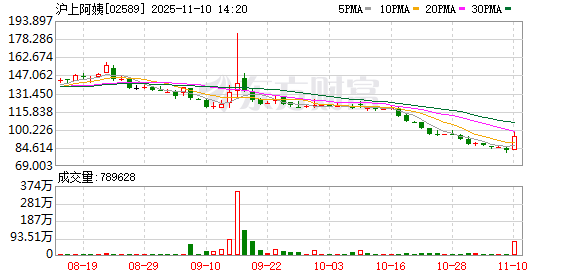
港股新消费概念股午后延续涨势,沪上阿姨大涨近15%
Mei Ri Jing Ji Xin Wen· 2025-11-10 06:21
每经AI快讯,11月10日,港股新消费概念股午后延续涨势,沪上阿姨大涨近15%,卫龙美味涨超10%, 泡泡玛特、蜜雪集团涨超8%,古茗涨超7%,茶百道涨超5%。 (文章来源:每日经济新闻) ...

CPI与PPI数据释放积极信号,港股消费ETF(513230)现涨超2%
Mei Ri Jing Ji Xin Wen· 2025-11-10 03:24
Group 1 - The Hong Kong stock market opened higher on November 10, with the consumer sector showing strong performance, particularly the Hong Kong Consumer ETF (513230) which rose over 2% [1] - Key stocks within the ETF, such as Pop Mart and Great Wall Motors, led gains of over 7%, while other companies like Samsonite, Gu Ming, and BYD also saw increases of over 4% [1] - The National Bureau of Statistics released October inflation data, indicating a 0.2% month-on-month and year-on-year increase in the Consumer Price Index (CPI), with the core CPI rising 1.2% year-on-year, marking the sixth consecutive month of growth [1] Group 2 - Huajin Securities noted that the October inflation data reflects a continued improvement in both core CPI and Producer Price Index (PPI), with the PPI showing a 0.1% month-on-month increase, the first rise this year [1] - The report highlighted that the recovery in service consumption, rising gold prices, and higher food prices contributed to the positive CPI trend, while the narrowing decline in PPI was attributed to the "anti-involution" trend [1] - The necessity of expanding domestic demand to solidify the domestic supply-demand cycle has become more prominent, with expectations for greater fiscal expansion by the central government in 2026 to boost consumption and effective investment [1] Group 3 - The Hong Kong Consumer ETF (513230) tracks the CSI Hong Kong Stock Connect Consumer Theme Index, encompassing a wide range of consumer sectors, including leading new consumption brands and internet e-commerce giants [2] - The ETF includes major players such as Pop Mart, Lao Pu Gold, and Miniso, as well as tech and e-commerce leaders like Tencent, Kuaishou, Alibaba, and Xiaomi, highlighting its strong technology and consumer attributes [2]
港股新消费概念盘初走强,沪上阿姨涨超10%
Mei Ri Jing Ji Xin Wen· 2025-11-10 03:04
Group 1 - The Hong Kong stock market for new consumption concepts showed strength at the beginning of trading on November 10, with notable gains in several stocks [1] - "Hushang Auntie" (02589.HK) surged over 10%, indicating strong investor interest [1] - "Pop Mart" (09992.HK) rebounded with an increase of over 6%, reflecting positive market sentiment [1] Group 2 - Other stocks in the sector, including "Weilong Delicious" (09985.HK), "Naixue's Tea" (02150.HK), "Chabaidao" (02555.HK), and "Mixue Group" (02097.HK), also experienced upward movement [1]

港股开盘 | 恒指高开0.3% 科网股走强
智通财经网· 2025-11-10 01:40
Group 1 - The Hang Seng Index opened up 0.3%, with the Hang Seng Tech Index rising 0.36%, driven by strong performance in tech stocks like Alibaba and Tencent, both gaining over 1% [1] - According to GF Securities, the foundation for a bull market in Hong Kong stocks remains intact, but the evolution is likely to be characterized by "oscillating upward" rather than rapid increases, with a strong fundamental drive expected in November [1][2] - Wang Qian from Yongying Fund noted that recent adjustments in Hong Kong stocks were due to weakened upward momentum and increased uncertainties, leading some investors to take profits [1][2] Group 2 - Market focus will shift towards policy implementation and interest rate trends by year-end, with potential for a rebound in Hong Kong stocks if U.S. interest rates confirm a downward trend and domestic economic recovery signals become clearer [2] - Guotai Junan Securities highlighted that the valuation of the Hong Kong internet sector has become highly attractive, with the Hang Seng Internet Technology Index's latest PE at 21.45, placing it in the 16.09% historical low range [2][3] - The core narrative of Hong Kong internet stocks is shifting from user growth to "AI empowerment," indicating a fundamental change in growth drivers [2] Group 3 - Zhang Xia, Chief Strategy Analyst at招商证券, stated that the Hang Seng Tech Index remains at a historically low valuation compared to major global indices, indicating significant room for valuation recovery [3] - The current Hong Kong market is primarily driven by liquidity, with external liquidity uncertainties potentially leading to short-term oscillations, but medium to long-term prospects remain positive with expected inflows from southbound and foreign capital [3][4] - Guotai Haitong Securities noted that the current position of Hong Kong stocks is low compared to historical and overseas levels, suggesting potential for upward movement and increased foreign capital inflows exceeding 1.5 trillion yuan next year [4][5] Group 4 - Morgan Stanley attributed the strength of the Hong Kong stock market to factors such as capital inflows, stabilization in the real estate market, robust retail sales, and a revival in IPO activities [5]
哑铃策略应对风格再平衡 机构建议布局“周期+科技”
Shang Hai Zheng Quan Bao· 2025-11-09 17:28
Group 1 - The core viewpoint is that the A-share market is experiencing a phase of style rebalancing, with a focus on "cyclical + technology" strategies due to significant performance improvements in cyclical sectors and the need for technology stocks to digest previous gains [1][2] - Institutions suggest that while cyclical sectors show strong performance, the long-term trend remains in favor of technology growth, particularly driven by AI narratives [1][2] - The current market environment indicates that the stability of the corporate overseas environment and AI industry trends are crucial variables influencing various sectors, including TMT, non-ferrous metals, chemicals, and electric new energy [1] Group 2 - Analysts emphasize the importance of recognizing the cyclical sectors' performance improvements as seen in Q3 reports, while also noting that technology growth remains the market's main focus [2][3] - The recommendation for investors is to adopt a "barbell strategy" that balances risks and returns by investing in both cyclical and technology sectors [2] - There is a suggestion to explore investment opportunities in cyclical sectors like steel, chemicals, and new consumption, alongside technology applications in AI and innovative pharmaceuticals [3]
市场风格切换是否进入博弈期?|每周研选
Shang Hai Zheng Quan Bao· 2025-11-09 15:41
Market Overview - A-shares experienced narrow fluctuations this week, with a clear sign of style rebalancing as cyclical sectors like chemicals, lithium batteries, and photovoltaics strengthened, while previously leading tech growth stocks continued to consolidate [1] - The market is expected to maintain a rapid rotation of hotspots, reflecting the gradual establishment of the "anti-involution" theme [21] Investment Strategies - Investors should focus on the phase rebalancing between technology and cyclical styles, as cyclical sectors show significant performance improvement in Q3 reports, while tech growth stocks need to digest their previous gains [1][13] - Two main strategies are suggested for next year's economic direction: one focusing on cyclical sectors like steel, chemicals, and agriculture, and the other on strong industry trends represented by AI computing [7] Sector Insights - The technology sector's development has shifted from reliance on overseas computing infrastructure to leveraging China's advantages in electricity, manufacturing, and infrastructure, indicating a revaluation of Chinese assets [5] - The cyclical sector is currently in a rebound phase, with potential opportunities in power equipment and chemicals, while the tech sector remains a long-term market focus despite current high-level consolidation [9][13] Future Market Trends - The market is likely to enter a major upward phase from November to December, with a stronger than usual style change expected in Q4 [17] - The upcoming spring market may start as early as December this year, driven by a rebalancing of positions in high-deviation sectors [19]
A股分析师前瞻:年末为什么会出现仓位与风格的再平衡?
Xuan Gu Bao· 2025-11-09 13:15
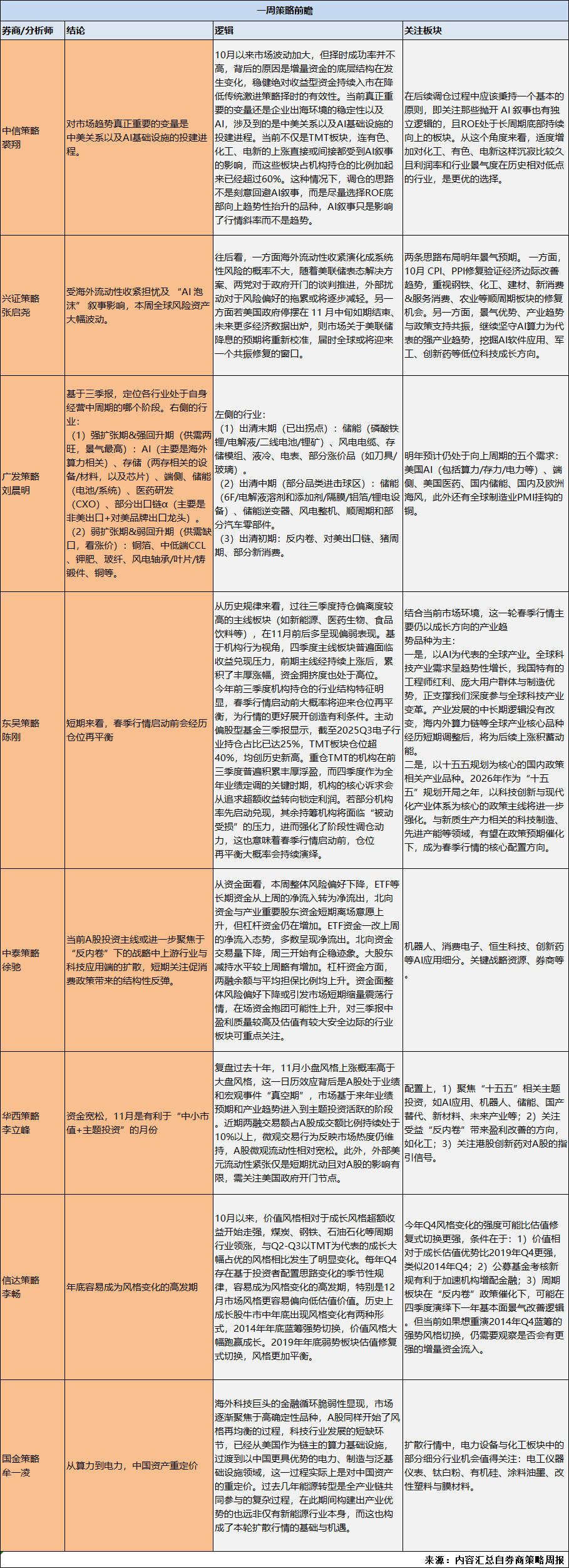
Group 1 - The focus of brokerage strategy analysts this week is on year-end style rebalancing, with historical patterns indicating that sectors with high deviation in holdings during the third quarter, such as new energy, pharmaceuticals, and food and beverage, tend to show weaker performance around November [1][3] - The fourth quarter is expected to face profit-taking pressure in main sectors, as previous main lines have accumulated significant gains, leading to high levels of capital crowding [1][3] - The structure of institutional holdings in the first three quarters of this year is evident, suggesting a high probability of position rebalancing before the spring market rally, which will create favorable conditions for better market performance [1][3] Group 2 - The strategy team from Guojin highlights the fragility of financial cycles among overseas tech giants, leading to a focus on high-certainty varieties, with A-shares also beginning a process of style rebalancing [2][4] - The transition of the tech industry's development from U.S.-led computing infrastructure to China's advantages in electricity, manufacturing, and general infrastructure represents a repricing of Chinese assets [2][4] - In the diffusion market, opportunities in specific sub-sectors within the electric equipment and chemical sectors are worth attention, including electrical instruments, titanium dioxide, organic silicon, and specialty plastics [2][4] Group 3 - The strategy team from Dongwu notes that the spring market rally is likely to experience a position rebalancing before its initiation, with a focus on sectors that have independent logic beyond AI narratives and are experiencing upward trends in ROE from long-term lows [1][3] - The analysis indicates that the small-cap style has a higher probability of rising compared to large-cap style in November, attributed to A-shares being in a performance and macro event "vacuum period," leading to active theme investments based on next year's performance expectations [1][3] Group 4 - The strategy team from Huaxi reviews the past decade, noting that November is favorable for "small-cap value + theme investment," with the market entering an active phase based on performance expectations and industry trends [1][3] - The current investment focus in A-shares may further concentrate on upstream industries and technology applications under the "anti-involution" strategy, with short-term attention on policies promoting consumption [1][3]
兴业证券:海外扰动下的布局思路
智通财经网· 2025-11-09 08:23
Core Viewpoint - The report from Industrial Securities highlights significant volatility in global risk assets due to concerns over tightening overseas liquidity and discussions surrounding an "AI bubble" [1] Group 1: Market Conditions - Global risk assets have experienced substantial fluctuations this week, influenced by a lack of economic data, frequent hawkish statements from the Federal Reserve, and rising liquidity pressures in the money market due to government shutdown and fiscal constraints [1] - The strong dollar has suppressed global stock markets and commodity prices, with technology-heavy indices like Nikkei 225, Korean stock index, and Nasdaq leading the decline [1] Group 2: Future Outlook - The probability of overseas liquidity tightening evolving into systemic risk is low, as solutions from the Federal Reserve and bipartisan negotiations to reopen the government are progressing, which may gradually alleviate external disturbances on risk appetite [2] - If the U.S. government shutdown ends as expected in mid-November and more economic data is released, market expectations for Federal Reserve rate cuts will be recalibrated, potentially creating a window for global recovery [3] Group 3: AI Industry Analysis - The current discussions around the "AI bubble" have caused some disturbances in the domestic AI industry chain, but Industrial Securities believes that AI's empowerment of traditional industries is still in its early stages, making it incomparable to the internet bubble of 1999-2000 [4] - The development logic of the AI industry is clear, with major global tech companies continuously defining their AI strategies, and the fundamentals of leading companies in the U.S. stock market remain strong due to ongoing R&D investments and capital expenditures [4] Group 4: Investment Strategies - The "14th Five-Year Plan" emphasizes AI as a key driver for national competition and technological innovation, indicating that the AI industry chain will be a focus area with favorable prospects next year [5] - The year-end market is seen as an important window for positioning in sectors expected to perform well in the coming year, with a focus on cyclical sectors such as steel, chemicals, construction materials, and new consumption [6][7] - High-growth sectors expected to see net profit growth of over 30% next year include AI hardware, new energy, and military industries, while sectors with expected growth of 10%-30% include pharmaceuticals and AI downstream applications [7][8]

瑞银全球金融市场部中国主管房东明:期待2026年成为配置型国际投资者投资中国的大年
Zheng Quan Ri Bao Wang· 2025-11-07 04:04
Core Insights - China's capital market has significantly opened up, with approximately 90% to 95% of the foreign investment access goals achieved, indicating a mature and complete foreign institutional access mechanism [1] - The focus should now be on improving risk management tools, expanding interconnectivity targets, and enhancing capital utilization efficiency to further increase the international appeal of the Chinese market [1] - The provision of predictable macro policies and robust growth fundamentals of listed companies are crucial for attracting long-term international investors [1] Group 1: International Investor Trends - International investors are increasingly active in China, with a notable rise in trading-type investors contributing significantly to market liquidity since September of the previous year [1] - In contrast, allocation-type investors are extending their research efforts and closely monitoring developments in Chinese listed companies, policies, and technological innovations [1] - As of November 7, 2023, foreign institutions have conducted 8,406 research sessions involving 770 A-share companies, focusing on sectors such as telecommunications, pharmaceuticals, semiconductors, and robotics [2] Group 2: Investment Preferences and Growth Sectors - International investors show a preference for large-cap blue-chip stocks with good liquidity and attractive valuations, while also focusing on high-growth sectors like technology, AI, innovative pharmaceuticals, and new consumption [4] - The attractiveness of growth sector companies is often linked to specific events and timing, with recent developments enhancing international recognition of China's technological innovation capabilities [4] - Companies with strong fundamentals, favorable industry policies, and global competitiveness are more appealing to overseas investors, who prioritize long-term strategies over short-term performance [4] Group 3: Globalization and Future Outlook - As Chinese companies expand internationally, sectors like new consumption and innovative pharmaceuticals are gaining increased attention from international investors [5] - Companies must focus on continuous product or model innovation to maintain competitiveness in overseas markets, emphasizing the importance of talent acquisition and local partnerships [5] - The attractiveness of Chinese assets to international investors is expected to rise further by 2026, despite potential market volatility in late 2025, with expectations of sector rotation enhancing overall asset valuations [5]
港股,走到哪一步了?
Xin Lang Cai Jing· 2025-11-07 00:47
Market Overview - The Hong Kong stock market narrative has shifted, regaining global capital attention with continuous net inflows from mainland funds and a recovery in foreign investment confidence [1][2] - The market is currently in a phase of recovery and structural optimization, supported by the accumulation of domestic funds and a renewed interest from foreign investors [2] Sector Performance - The technology sector in Hong Kong, represented by the Hang Seng Tech Index, was active in the first half of the year, while the A-share technology sector gained momentum in the second half, indicating a rotation in industry cycles rather than significant capital shifts between the two markets [2][3] - The core industries in Hong Kong are concentrated in internet and innovative pharmaceuticals, which have seen a recovery in valuations after a prolonged period of underperformance [3] AH Premium Dynamics - The AH premium, which reflects the price difference between A-shares and H-shares, has shown new characteristics, with some companies listed in Hong Kong trading at a premium compared to their A-share counterparts, a reversal of the previous norm [4] - This shift is attributed to limited supply and strong demand for certain stocks, as well as changes in market conditions and trading mechanisms [4] Growth and Valuation - The growth of certain assets in the past year, despite significant price increases, is seen as a correction from previously low valuations rather than a bubble, as many quality companies were undervalued [6] - The current market focus on emerging industries such as innovative pharmaceuticals and AI indicates that these sectors are still in early growth stages, with significant potential for future expansion [6] Investment Opportunities - The innovative pharmaceutical sector in Hong Kong is viewed as having long-term potential, with Chinese companies gaining global market share and moving towards self-innovation [8][9] - The new consumption sector has become a notable feature of the Hong Kong market, driven by companies seeking to capitalize on the IPO opportunities available in Hong Kong [10] Dividend Appeal - The Hong Kong dividend sector offers attractive yields, with many companies providing returns of 5% to 6%, which is higher than the 3% to 4% typically seen in A-shares [11] - The potential for policy changes regarding dividend taxation could further enhance the attractiveness of Hong Kong's dividend stocks [11] Market Structure and Trends - The Hong Kong market is transitioning from a traditional value-oriented approach to a growth-oriented one, as evidenced by the rise of the Hang Seng Tech Index [12] - The market's unique position as a bridge between mainland China and international investors highlights its strategic importance in the global capital landscape [13]