石化

Search documents
这个冬日,有“娘家人”温暖相伴
Xin Lang Cai Jing· 2026-01-22 17:07
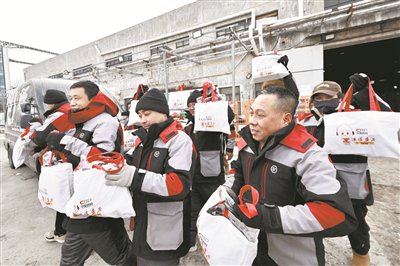
Group 1 - The article highlights the efforts of various labor unions in Beijing to provide warmth and support to outdoor workers during the cold winter season [6][7][8] - Union activities include distributing warm supplies such as gloves, thermal pads, and hot drinks to workers like sanitation workers, construction workers, and delivery personnel [6][7][8] - The initiatives aim to enhance the morale and working conditions of outdoor laborers, ensuring they feel cared for and supported during harsh weather [6][7][8] Group 2 - Specific examples include the distribution of thermal supplies by the Beijing Public Transport Maintenance Company and the timely delivery of "warm packages" to delivery workers by the Daxing District labor union [6][7] - The article emphasizes the emotional impact of these gestures, with workers expressing gratitude and increased motivation due to the support from their unions [7][8] - The overall message conveys a sense of community and solidarity among workers and their unions, fostering a supportive environment during challenging times [6][7][8]

恒逸石化(000703.SZ):拟5亿元-10亿元回购股份
Ge Long Hui A P P· 2026-01-22 11:23
格隆汇1月22日丨恒逸石化(000703.SZ)公布,拟回购股份资金总额不低于人民币50,000万元,不超过人 民币100,000万元,本次回购股份的价格不超过15.00元/股,回购股份用于实施员工持股计划或股权激 励。 ...

转投中国!30万吨绿色甲醇制聚烯烃项目,为何放弃欧洲?
Zhong Guo Hua Gong Bao· 2026-01-22 08:55
希克斯指出,欧洲的监管规定、审批流程以及资金获取的总体速度和复杂性等一系列因素,导致Vioneo放弃安特卫普项目。"越 来越明显的是,在当前形势下,从经济角度来看这个项目是不可行的。"她表示,虽然欧洲的相关政策正在朝着正确的方向发 展,但这一过程需要时间。 希克斯表示,该公司仍在与潜在客户进行谈判。该项目选址于中国"能为客户带来更有竞争力的价格优势……归根结底就是价格 问题,而这样的选择会加快我们为客户提供服务的能力。"她同时指出,项目在中国的建设成本及施工进度,也是需要考虑的关 键因素。 Vioneo的决定对欧洲石化行业又是一个沉重的打击。由于市场供应过剩、需求疲软、投入成本高昂,叠加价格具有竞争力的进口 产品的冲击,欧洲石化行业早已处于持续低迷的状态之中,众多化工厂已经或宣布将永久关闭。 安特卫普项目原本计划每年从中国进口80万吨可再生甲醇作为原料,通过甲醇制烯烃工艺生产乙烯和丙烯,进而生产聚乙烯和聚 丙烯。 不过,希克斯表示,Vioneo并未排除未来在欧洲建立新工厂的可能性。她强调,能够获得可再生甲醇供应来源,是任何潜在选址 地点都必须满足的关键条件。 1月16日,欧洲化工初创企业Vioneo宣布,放弃 ...

站在新起点,2026年东营这么干
Da Zhong Ri Bao· 2026-01-22 06:11
Core Viewpoint - Dongying City is committed to high-quality development and modern construction, setting ambitious economic and social development goals for 2026, including a GDP growth target of approximately 5.5% and a public budget revenue growth of about 2.3% [1] Group 1: Economic Development Goals - The main economic goals for 2026 include a GDP growth of around 5.5%, public budget revenue growth of about 2.3%, and the creation of over 30,000 new urban jobs [1] - Dongying plans to complete energy-saving and emission reduction targets while improving environmental quality [1] Group 2: Project Construction and Investment - Dongying will focus on project construction as a key driver for economic stability, with a total investment of 617.8 billion yuan in 346 key projects, aiming to complete 100 billion yuan in investments within the year [2] - The city plans to attract over 330 new projects with investments exceeding 100 million yuan, including over 45 projects from Fortune 500 companies and central enterprises [2] Group 3: Consumption and Service Sector - Dongying aims to stimulate consumption by hosting over 100 themed consumption activities, focusing on sectors like automotive, home appliances, and dining [2] - The city will introduce more than 30 flagship stores and develop new consumption scenarios to enhance consumer experience [2] Group 4: Policy Support - Dongying will effectively align with central macro policies and utilize national investment and bond issuance to support local projects [3] - The city plans to implement local measures to optimize policy execution and ensure that businesses can fully benefit from available policies [3] Group 5: Industrial Transformation - Dongying is focused on upgrading traditional industries and developing a modern industrial system, with significant investments in petrochemical and new energy sectors [4] - The city will promote projects in rubber tires, non-ferrous metals, and oil equipment, while also advancing the lithium battery industry [4] Group 6: Service Industry Development - Dongying recognizes the need to enhance its service sector, aiming to develop logistics and digital transformation initiatives [5] - The city plans to support around 400 enterprises in digital transformation and establish smart factory pilot projects [5] Group 7: Infrastructure Development - Dongying will advance major infrastructure projects, including transportation and energy, to support economic growth [7] - The city aims to complete key railway and port projects, enhancing logistical capabilities [7] Group 8: Urban and Rural Development - Dongying will continue urban renewal efforts and promote rural revitalization, focusing on agricultural efficiency and environmental improvements [8] - The city plans to upgrade 65 old residential communities and enhance agricultural land quality [8] Group 9: Employment and Education - Dongying will implement actions to stabilize employment for key groups, including hosting over 200 recruitment events [9] - The city aims to improve educational quality and healthcare services, enhancing overall community well-being [9]
石化行业:成本支撑与节前补库共振,市场或延续偏强走势
Sou Hu Cai Jing· 2026-01-22 02:54
【免责声明】本文仅代表作者本人观点,与和讯网无关。和讯网站对文中陈述、观点判断保持中立,不 对所包含内容的准确性、可靠性或完整性提供任何明示或暗示的保证。请读者仅作参考,并请自行承担 全部责任。邮箱:news_center@staff.hexun.com 1月石化市场偏强运行,原油上涨对化工品形成支撑,有机化工指数月均环比涨2.4%。受装置检修叠加 春节前补库支撑芳烃产业链强势上涨。而油品类偏弱,炼厂高负荷生产而物流、基建进入传统淡季。烯 烃新增产能加大供应压力,下游塑编、包装需求复苏缓慢,产业链承压。2月虽行业处于传统淡季,但 节前备货及节后稳增长的需求预期逐渐启动,下游备货节奏逐步增强。供应端新增产能较少,叠加原油 看涨,预计2月石化行业延续偏强走势。 石化行业:成本支撑与节前补库共振,市场或延续偏强走势 ...
石化ETF(159731)近11天获得连续资金净流入,合计“吸金”4.14亿元
Xin Lang Cai Jing· 2026-01-22 02:10
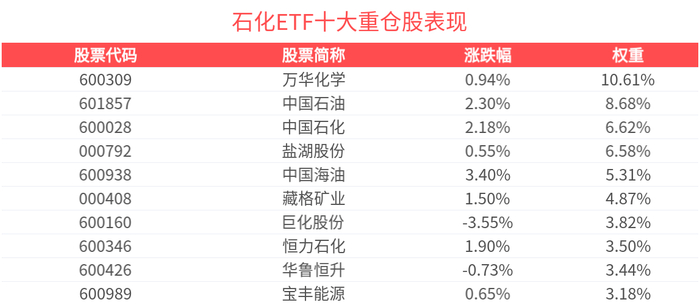
截至2026年1月22日 9:48,中证石化产业指数强势上涨1.16%,成分股和邦生物上涨7.82%,金发科技上 涨4.78%,中国海油上涨3.40%,川发龙蟒,中国石油等个股跟涨。相关ETF方面,石化ETF(159731)近 11天获得连续资金净流入,合计"吸金"4.14亿元,最新规模达6.98亿元,创新高。 | 股票代码 | 股票简称 | 涨跌幅 | 权重 | | --- | --- | --- | --- | | 600309 | 万华化学 | 0.94% | 10.61% | | 601857 | 中国石油 | 2.30% | 8.68% | | 600028 | 中国石化 | 2.18% | 6.62% | | 000792 | 盐湖股份 | 0.55% | 6.58% | | 600938 | 甲国海油 | 3.40% | 5.31% | | 000408 | 藏格矿业 | 1.50% | 4.87% | | 600160 | 巨化股份 | -3.55% | 3.82% | | 600346 | 恒力石化 | 1.90% | 3.50% | | 600426 | 곳을恒计 | -0.73% | 3 ...
东营|站在新起点,2026年东营这么干
Da Zhong Ri Bao· 2026-01-22 01:25
Core Viewpoint - Dongying City is focusing on high-quality development and modern construction, with specific economic and social development goals set for 2026, including a GDP growth target of approximately 5.5% and a public budget revenue growth of about 2.3% [2] Group 1: Economic Development Goals - The main expected goals for 2026 include a GDP growth of around 5.5%, public budget revenue growth of 2.3%, synchronization of resident income with economic growth, and the creation of over 30,000 new urban jobs [2] - The city plans to complete energy-saving, emission reduction, and environmental quality improvement targets [2] Group 2: Project Construction and Investment - Dongying will prioritize project construction as a key driver for economic stability, with a total investment of 617.8 billion yuan in 346 key projects, aiming to complete 100 billion yuan in investments within the year [3] - The city plans to attract over 330 new projects with investments exceeding 100 million yuan, including more than 45 projects from Fortune 500 companies and central enterprises [3] Group 3: Consumption and Service Sector Development - Dongying aims to stimulate consumption by organizing over 100 themed consumption activities in sectors like automotive, home appliances, and dining [3] - The city will introduce more than 30 first stores and develop new consumption scenarios to enhance consumer engagement [3] Group 4: Policy Support and Implementation - Dongying will effectively align with central macro policies and utilize national investment and bond policies to support local projects [4] - The city will implement provincial policies aimed at stability and quality improvement, optimizing policy execution processes [4] Group 5: Industrial Transformation and Innovation - The city is focusing on upgrading traditional industries and developing a modern industrial system, with significant projects in petrochemicals and new materials [5] - Dongying will promote the lithium battery industry and support the construction of the Zero Carbon Industrial Park [5] Group 6: Service Industry Development - Dongying will enhance service industry development by accelerating the construction of logistics parks and promoting digital transformation in approximately 400 enterprises [6] - The city aims to establish high-level innovation platforms and deepen collaboration with educational institutions for technological advancements [6] Group 7: Reform and Market Environment - The city will enhance service quality and market vitality through institutional innovation and optimizing the business environment [7] - Dongying plans to deepen state-owned enterprise reforms and improve performance evaluation systems [7] Group 8: Infrastructure Development - Dongying will advance major infrastructure projects, including the completion of the Dongying section of the Jinwei High-speed Railway and the construction of specialized railway lines [8] - The city will also focus on ecological protection and biodiversity conservation initiatives [8] Group 9: Urban and Rural Development - Dongying will promote urban renewal and rural revitalization, with plans to upgrade 65 old residential communities and improve agricultural productivity [9] - The city aims to create high-standard farmland and promote salt-tolerant crop varieties [9] Group 10: Employment and Social Services - Dongying will implement actions to stabilize employment for key groups, including hosting over 200 recruitment events [10] - The city will enhance educational quality and healthcare services, ensuring that development benefits are equitably distributed among residents [10]
“GDP万亿俱乐部”再添三城 专家倡言城市评价迈入“市值时代”
证券时报· 2026-01-22 00:12
Core Viewpoint - The article highlights the emergence of three new cities—Dalian, Xuzhou, and Wenzhou—joining China's "trillion-yuan club" by 2025, bringing the total number of such cities in mainland China to 30 [1][2]. Group 1: New "Trillion-Yuan Cities" - Wenzhou is set to surpass a GDP of 1 trillion yuan by 2025, becoming the third "trillion-yuan city" in Zhejiang province after Hangzhou and Ningbo [4]. - Xuzhou's GDP is projected to grow by approximately 5.8%, reaching 953.712 billion yuan in 2024, and is expected to cross the 1 trillion yuan mark in 2025, making it the sixth "trillion-yuan city" in Jiangsu province [5]. - Dalian anticipates a GDP growth of over 5.5%, with a projected GDP of 951.69 billion yuan in 2024, also expected to exceed 1 trillion yuan by 2025, marking a breakthrough for Northeast China [5]. Group 2: Common Characteristics and Development Strategies - The three new cities share a strong industrial foundation and leading industry clusters, such as Xuzhou's renowned engineering machinery cluster, Wenzhou's private economy-driven electrical and apparel industries, and Dalian's complete petrochemical industry chain [5][6]. - Experts emphasize the importance of "industry anchoring + institutional adaptation" for the success of these cities, highlighting the need for a flexible and efficient business environment [6]. - Each city has a unique positioning strategy: Wenzhou as a pioneer of private economy, Xuzhou as a leader in the Huaihai Economic Zone, and Dalian aiming to become a Northeast Asia international shipping center [6]. Group 3: Future Prospects and Competitors - Other cities are also vying to join the "trillion-yuan club," with potential candidates like Yancheng, Yangzhou, and Shaoxing in the Yangtze River Delta region aiming for this goal during the 14th Five-Year Plan period [10]. - Xiamen is projected to become the third "trillion-yuan city" in Fujian province by 2025, with a GDP of 858.901 billion yuan in 2024 [10]. - Shenyang is expected to become the second "trillion-yuan city" in Liaoning province, with a GDP of 902.71 billion yuan in 2024, indicating a high probability of surpassing the 1 trillion yuan mark during the 14th Five-Year Plan [10]. Group 4: Urban Development Evaluation System - The article calls for a re-evaluation of urban development metrics, moving beyond mere GDP figures to include quality indicators such as per capita GDP, total factor productivity, and green innovation intensity [12]. - It suggests incorporating metrics like the Gini coefficient of resident income and the number of patents per capita into the evaluation system for "trillion-yuan cities" to promote a shift from scale expansion to modernization focused on people [12]. - The transition from a "GDP era" to a "market value era" is proposed, where the total market value of listed companies in a city serves as a precise measure of development quality [13].

2026 凝心聚力绘新卷 砥砺奋进开新局
Xin Lang Cai Jing· 2026-01-21 22:36
Core Viewpoint - Harbin aims to achieve a balanced economic growth with a GDP increase of 5% and a focus on enhancing production capacity and quality across various sectors, while ensuring social stability and environmental sustainability [11]. Economic Development Goals - The expected economic growth targets for Harbin include: - GDP growth of 5% - Agricultural output growth of 3.5% - Industrial value-added growth of 5.5% - Fixed asset investment growth of 7% - Retail sales growth of approximately 4.5% - Public budget revenue growth of 6% - Synchronization of urban and rural residents' income growth with economic growth - A reduction of carbon emissions per unit GDP by about 3.8% [11]. Consumer and Investment Expansion - Strategies to boost consumption include: - Developing new consumption formats and enhancing service supply - Implementing policies for replacing old consumer goods to stimulate urban and rural consumption - Expanding service consumption and promoting traditional brands [12]. - Investment strategies focus on: - Targeting key sectors for long-term investment support - Attracting foreign strategic investors and expanding industrial investments with over 700 projects and investments exceeding 60 billion yuan [12]. Industry Development - Emphasis on fostering new and future industries such as: - Digital economy and biotechnology - High-end equipment, aerospace, and renewable energy sectors - Upgrading traditional industries like manufacturing and food production through technological improvements [13]. - The goal is to create competitive advantages by strengthening supply chains in emerging sectors [13]. Tourism and Cultural Development - Plans to enhance tourism include: - Upgrading key scenic areas and promoting winter sports tourism - Integrating cultural, sports, and commercial activities to boost tourism appeal [14]. - Development of high-quality tourist attractions and services to improve visitor experience [14]. Agricultural and Rural Development - Agricultural initiatives aim to: - Enhance production capacity and quality through technology and sustainable practices - Maintain grain planting areas above 30 million mu and grain production above 25 billion jin [15]. - Focus on rural revitalization and improving living conditions through infrastructure development [16]. Reform and Open Economy - Efforts to improve the business environment include: - Streamlining administrative processes and enhancing digital government services - Strengthening legal protections for market participants [17]. - Expansion of high-level open cooperation, particularly in cross-border trade and logistics [17]. Urban Development and Infrastructure - Urban planning will focus on: - High-standard implementation of urban construction projects, including heating and transportation infrastructure [18]. - Initiatives for urban renewal and environmental improvements, including waste management and pollution control [19]. Social Welfare and Employment - Employment strategies include: - Expanding job opportunities for youth and vulnerable groups, targeting over 87,000 new urban jobs [20]. - Enhancements in social security and healthcare services to improve overall community well-being [20].
尾盘,瞬间涨停!
Zhong Guo Zheng Quan Bao· 2026-01-21 12:21
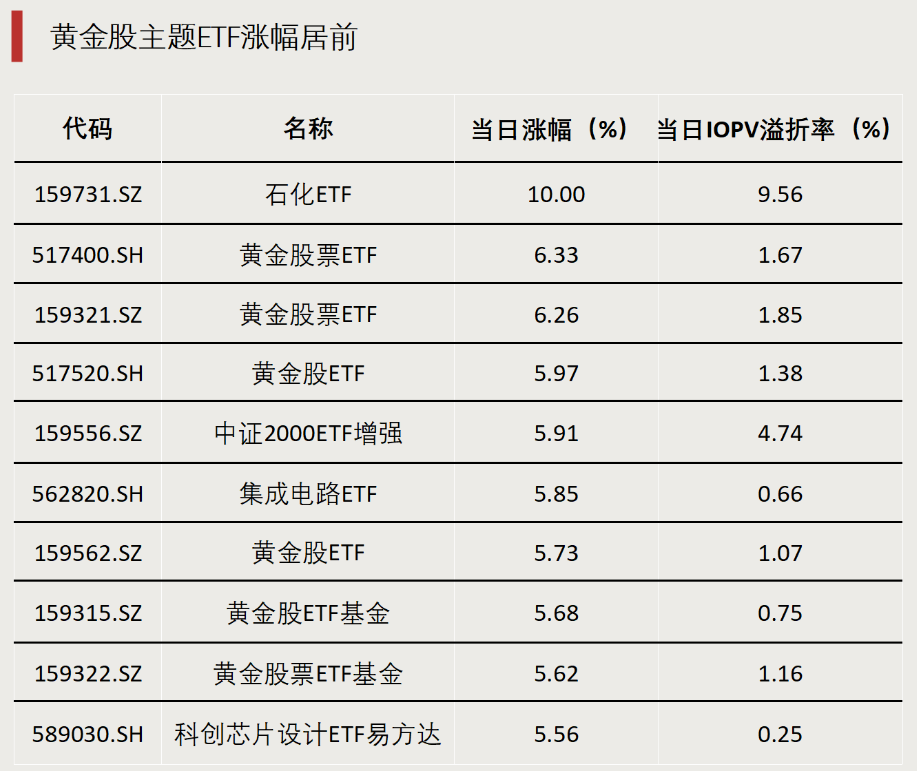
Group 1 - The core viewpoint of the articles highlights the strong performance of the non-ferrous and semiconductor sectors, with gold-related ETFs and chip-related ETFs leading in gains on January 21 [1][4][5] - The ShiHua ETF (159731) experienced a sudden surge, hitting the daily limit, which is suspected to be a result of a trading error [1][5] - The market saw significant net outflows from ETFs, totaling nearly 500 billion yuan on January 20, with a cumulative outflow of 903 billion yuan over the first two trading days of the week [3][12] Group 2 - The gold stock theme ETFs showed notable gains, with the leading ETFs reporting increases of 6.33% to 6.26% on January 21, driven by geopolitical uncertainties and a shift towards risk aversion [5][6] - The semiconductor sector is experiencing a bullish trend, with strong performance in storage and computing chips, leading to price increases across the supply chain due to rising AI demand and supply chain bottlenecks [7] - The banking sector and consumer goods faced declines, with multiple bank ETFs showing negative performance, indicating a shift in market sentiment [8][9] Group 3 - The trading activity in broad-based ETFs remained active, with the HuShen 300 ETF (510300) achieving a transaction volume of 23.208 billion yuan, and several other broad-based ETFs exceeding 10 billion yuan in trading volume [2][10][11] - Several ETFs disclosed their fourth-quarter reports for 2025, including the Securities ETF from Guolianan and the 1000 Enhanced ETF from Tianhong [14]