
军工

Search documents
美国被教训惨了?55国外援集结,美副总统下挑战书,想断中方后路
Sou Hu Cai Jing· 2026-02-09 08:51
Core Viewpoint - The recent "Rare Earth Meeting" held by the United States aims to form an international alliance against China, with the goal of reducing dependence on Chinese rare earth resources [1][3]. Group 1: Meeting Purpose and Attendance - The meeting was attended by representatives from 55 countries, including South Korea, Japan, and Australia, indicating the formation of a coalition against China [1]. - U.S. Secretary of State Rubio highlighted the strategic intent behind the meeting, which is to counter China's influence in the rare earth sector [1]. Group 2: U.S.-China Relations and Rare Earth Dependency - The U.S. has become heavily reliant on China for rare earth elements, with over 90% of rare earth products depending on Chinese exports [5]. - The U.S. faced significant challenges when China responded to U.S. tariffs by imposing its own tariffs and restricting rare earth exports, which put the U.S. in a difficult position [3][5]. Group 3: Strategic Implications and Future Outlook - The U.S. aims to reshape the global rare earth supply chain to reduce reliance on China, but achieving this goal is projected to take at least ten years due to China's dominance in purification technology [7]. - The meeting serves as a signal to China that more countries are aligning with the U.S., indicating a diplomatic effort to isolate China in the context of rare earth resources [7][8]. - The U.S. is attempting to challenge China through this meeting, reflecting a sense of anxiety over its strategic failures in dealing with China [8].


资金跟踪系列之三十二:杠杆资金加速净流出,机构ETF、北上卖出放缓
SINOLINK SECURITIES· 2026-02-09 08:43
Macro Liquidity - The US dollar index has rebounded, and the degree of "inversion" in the China-US interest rate spread has narrowed. The nominal and real yields of 10Y US Treasuries have both declined, indicating a decrease in inflation expectations [1][15] - Offshore US dollar liquidity has marginally loosened, while the domestic interbank funding environment remains balanced and slightly loose. The term spread (10Y-1Y) has narrowed [1][22] Market Trading Activity - Market trading activity has decreased, with most indices experiencing an increase in volatility. Sectors such as media, communication, retail, military, and building materials have trading heat above the 90th percentile [2][30] - The volatility of most indices has increased, with military, petrochemical, and non-ferrous metal sectors reaching above the 80th percentile [2][32] Institutional Research - The banking, electronics, new energy, military, and computer sectors have seen high research activity. The research intensity in new energy, military, media, food and beverage, and utilities sectors has continued to rise [3][42] Analyst Forecasts - Analysts have continued to raise net profit forecasts for the entire A-share market for 2026/2027. The proportion of stocks with upward revisions in net profit forecasts has increased [4][50] - Specific sectors such as non-ferrous metals, retail, communication, pharmaceuticals, and machinery have also seen upward adjustments in their 2026/2027 net profit forecasts [4][21] - The net profit forecasts for the ChiNext Index and the SSE 50 have been raised for 2026/2027, while the forecasts for the CSI 500 and CSI 300 have been adjusted differently [4][23] Northbound Trading Activity - Northbound trading activity has decreased, continuing to net sell A-shares, but the magnitude of selling has slowed. In the top 10 active stocks, the buy-sell ratio in sectors like communication, food and beverage, and machinery has increased [5][31] - For stocks with northbound holdings of less than 30 million shares, there has been a net buying in sectors such as chemicals, non-ferrous metals, and petrochemicals, while net selling has occurred in TMT, pharmaceuticals, and military sectors [5][33] Margin Financing Activity - Margin financing activity has continued to decline, reaching the lowest point since July 2025. Last week, there was a net sell of 51.596 billion yuan across various sectors, with electronics, non-ferrous metals, communication, and chemicals being sold off the most [6][35] - Only the communication and non-bank financial sectors saw an increase in the proportion of financing purchases [6][38] Active Equity Funds and ETFs - Active equity funds have continued to increase their positions, particularly in non-ferrous metals, media, and steel sectors, while reducing positions in finance, food and beverage, and new energy sectors [8][45] - The correlation of active equity funds with large/mid/small-cap value has increased, while the correlation with growth has decreased [8][48] - New equity fund establishment has decreased, with both active and passive funds seeing a decline in scale. ETFs have seen renewed net subscriptions, primarily driven by individual investors [8][50]
A股风格之辩:成长不只科创!
Hua Er Jie Jian Wen· 2026-02-09 08:27
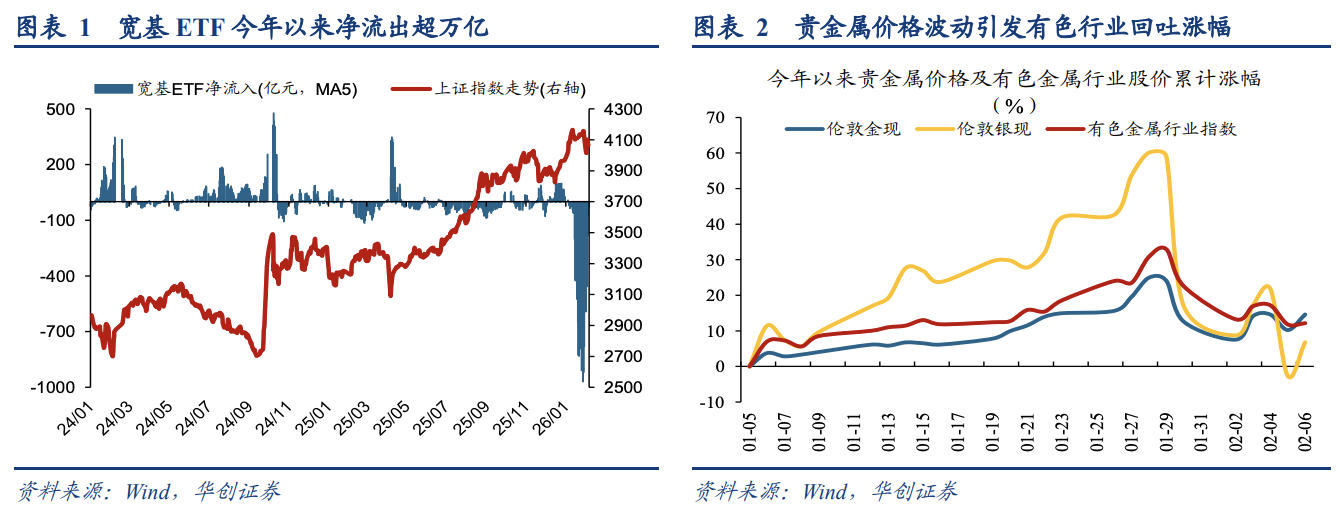
Core Viewpoint - The market has experienced a significant short-term adjustment, but a new allocation window has opened, with a focus on cyclical recovery and the real estate chain [1][11]. Market Adjustment and Liquidity - The market has undergone a sharp but brief adjustment, with a cumulative net outflow of 1.02 trillion yuan from broad-based ETFs this year and a net outflow of 58.2 billion yuan from leveraged funds over the past five trading days, marking a new high since April of last year [2][9]. - Investor sentiment indicators show that the market temperature near the 4000-point level of the Shanghai Composite Index is close to the 3800-point level from November of last year, with 130 companies hitting the daily limit down on February 2, surpassing the previous high of 107 companies on November 21 [6][9]. Investment Style Shift - A profound change in investment style is occurring, with growth stocks expected to outperform value stocks. Growth opportunities are not limited to the technology sector but also include cyclical and real estate chains [1][18]. - The remaining liquidity is expected to slow down, leading to large-cap stocks outperforming small-cap stocks. Since August 2025, large-cap stocks have significantly outperformed small-cap stocks, with the CSI 500 index rising by 31% compared to a 22% increase in the National Equity Index 2000 [23][25]. Annual Allocation Strategy - The main allocation theme for the year is expected to be driven by technology and cyclical sectors. Investors are advised to redefine the boundaries of "growth" and seek performance elasticity in cyclical and real estate chains, rather than focusing solely on the technology sector [26]. - The report highlights that the expected profit recovery for 2025 is clear, with the earnings forecast upgrade rate increasing from 65% in November last year to 96% currently [15][18]. Economic Indicators and Market Trends - The return of physical re-inflation is anticipated, with expectations of PPI turning positive, which will enhance EPS pricing and highlight the advantages of growth, profitability, and quality factors [21][22]. - The market environment is expected to shift, with valuation factors becoming less influential over the next year, and high valuations in small-cap stocks potentially reaching their limits [25].
主力资金来护盘啦,怎么玩!题材板块快速轮动,还有哪些投资机会?
Sou Hu Cai Jing· 2026-02-09 07:58
Group 1 - The current funding situation in the A-share market is abundant, with performance improvement and industrial trends providing opportunities for low-cost positioning despite short-term volatility [1] - The core driving forces behind the current market rally and the revaluation of Chinese assets are the reconstruction of international order and the trend of industrial innovation in China, which are expected to continue supporting Chinese asset performance through 2026 [1] - The top five sectors with net inflows include semiconductors, domestic software, military industry, photovoltaics, and large finance [1] Group 2 - In the U.S. stock market, major companies are reporting mixed earnings, with market focus on AI and capital expenditure expectations [3] - Meta's advertising business and AI investments have positively impacted market confidence, leading to a post-market increase of over 10% [3] - The metal mining sector shows strong performance, benefiting from rising commodity prices and capacity release, with approximately 66% of companies in the sector reporting positive earnings forecasts [3] Group 3 - As of now, over half of the annual earnings forecasts for 2025 have been disclosed, with high growth areas primarily in the automotive sector, where over 50% of companies are reporting positive forecasts [5] - The high-end manufacturing sector, particularly in renewable energy-related power equipment, is showing signs of bottoming out, with expectations of gradual recovery in early 2026 [5] - The renewable energy supply chain is undergoing a rebalancing after a period of rapid expansion and adjustment, with inventory digestion nearing completion [5] Group 4 - The overall market trend is strong in the short term, although there is a lack of significant new capital entering the market [7] - The number of stocks that rose significantly outnumbered those that fell, indicating a positive market sentiment [8] - The Shanghai Composite Index is attempting to break through, with expectations of a protective market environment as institutional funds may reduce positions ahead of the holiday [11]

国证国际港股晨报-20260209
国投证券(香港)· 2026-02-09 05:35
Group 1: Market Overview - The Hong Kong stock market indices experienced a decline, with the Hang Seng Index falling by 1.21%, the Hang Seng China Enterprises Index down by 0.68%, and the Hang Seng Tech Index decreasing by 1.11% [2] - Despite the drop in Hong Kong stocks, there is an expectation for a rebound following a strong performance in the US stock market, where the Dow Jones rose by 2.47%, reaching a historical high [4] - The trading volume in the Hong Kong market decreased to HKD 247.9 billion, with short-selling accounting for approximately 22.16% of the total [2] Group 2: Sector Performance - Large tech stocks faced pressure, with sectors such as mobile gaming, cloud computing, and AI applications showing weakness [3] - Conversely, the lithium battery and new energy vehicle sectors performed well, with NIO-SW forecasting its first quarterly profit in Q4 2025, boosting the automotive supply chain [3] - Consumer-related sectors, including tea beverages, dairy products, and tobacco, showed increased activity ahead of the Lunar New Year, indicating a rise in consumer demand [3] Group 3: Company Analysis - Geely Automobile - Geely Automobile reported a significant increase in January export sales, with total sales reaching 270,000 units, a year-on-year increase of 1%, and export sales soaring by 121% to 61,000 units [7] - The main brand, Lynk, and Zeekr brands showed varied performance, with Zeekr achieving a 100% increase in sales, highlighting its competitive edge in the high-end market [7] - Geely's AI and intelligent driving technologies are leading in the industry, with the introduction of the World Action Model (WAM) and the G-ASD intelligent driving solution, aiming for advanced autonomous driving capabilities [9] Group 4: Future Outlook - Geely is expected to see strong sales growth across its brands, supported by increased exports and a favorable product cycle, with a target price set at HKD 26 and a buy rating maintained [9]
军工行业迎三轮驱动新发展格局,军工ETF(512660)上涨1.6%,连续2日资金净流入超1亿元
Mei Ri Jing Ji Xin Wen· 2026-02-09 05:23
Core Viewpoint - The Chinese military industry is evolving from a reliance on domestic demand to a new development pattern driven by three engines: "domestic demand foundation, foreign trade expansion, and civilian backfeeding" [1] Group 1: Domestic Demand - The first curve focuses on domestic military demand, emphasizing "preparation for war" and equipment modernization, supported by stable growth in defense budgets and equipment upgrades [1] - Key growth directions include strong deterrence through high-precision and systematic unmanned low-cost solutions [1] Group 2: Foreign Trade - The second curve represents military trade expansion, where China's military trade share continues to rise due to cost-effectiveness, systematic combat capabilities, and geopolitical strategic cooperation [1] - China is becoming a significant global supplier in the military trade sector [1] Group 3: Civilian Applications - The third curve involves the civilian application of military technology, leading to the emergence of trillion-level new industries such as commercial aerospace, low-altitude economy, future energy, deep-sea technology, and large aircraft [1] - This trend fosters the development of new processes, materials, and devices, creating a virtuous cycle of "military technology for civilian use, backfeeding military industry" [1] Group 4: Investment Vehicle - The military ETF (512660) tracks the CSI Military Industry Index (399967), which selects listed companies related to the military industry from the Shanghai and Shenzhen markets [1] - The index covers sectors such as aviation, aerospace, shipbuilding, weaponry, military electronics, and satellites, reflecting the overall performance of military-themed listed companies [1] - The index has a relatively balanced industry allocation, with a focus on aviation equipment and military electronics, and presents a small to mid-cap style overall [1]
国泰海通·策略前瞻丨坚定信心,持股过节
国泰海通证券研究· 2026-02-08 14:56
Group 1 - The core viewpoint of the article emphasizes that despite recent volatility and panic selling in the Chinese stock market, it is a good opportunity to hold stocks through the holiday season, as the market is expected to stabilize and enter a spring rally [2][4] - The article highlights that the focus of domestic policy is shifting towards domestic demand, which is anticipated to boost the economic outlook and asset returns in China [4][5] - The article suggests that the recent emphasis from the Chinese government on stabilizing the capital market and the increase in stock buybacks by listed companies indicate a positive trend for the A-share market [4][5] Group 2 - The article discusses the significant decline in domestic demand over the past five years, with real estate investment down by 45%, sales area down by 50%, and housing prices down by 30%, which has negatively impacted consumer spending [5][15] - It notes that the Chinese government has prioritized domestic demand as a key economic task for the year, with various policy measures expected to be introduced to support this shift [5][15] - The article points out that the market's expectations and holdings in domestic demand-related sectors are currently at a low point, suggesting potential for recovery and growth in these areas [5][15] Group 3 - The article identifies emerging technology as a main investment theme, highlighting that competition between China and the US is shifting from trade to production efficiency [6][17] - It recommends sectors such as consumer services, food and beverage, and aviation for domestic demand, while also suggesting investments in internet, media, computing, robotics, and military technology for emerging tech [6][17] - The financial sector is noted as a stabilizing force in the market, with recommendations for brokerage firms, insurance, and banks due to the growing demand for wealth management [6][17] Group 4 - The article recommends several themes for investment, including commercial aerospace, robotics, urban renewal, and domestic consumption, indicating a broad range of opportunities across different sectors [6][31] - It highlights the potential for growth in the commercial aerospace industry, driven by advancements in space computing and satellite technology [31][32] - The robotics sector is expected to see significant developments, with new products being showcased and advancements in manufacturing capabilities [34][35] - Urban renewal projects are anticipated to receive increased investment, particularly in infrastructure and public space improvements [36][37] - The article emphasizes the importance of service consumption as a new economic engine, with various initiatives aimed at boosting this sector [39][40]

【十大券商策略】持股过节,兼具胜率与赔率!眼下是加仓良机
券商中国· 2026-02-08 14:39
Group 1 - The core viewpoint is that there is no need to worry about short-term market fluctuations, as the underlying trends indicate a shift from virtual to real economies in Europe and the US, alongside the disruptive innovation brought by AI [2] - The urgency for strategic security investments and new infrastructure in the US reflects a growing competition, balancing short-term shareholder interests with long-term strategic value [2] - China's capital market has already completed the pricing adjustment from virtual to real, currently undergoing a verification and pricing process for quality and efficiency improvements [2] Group 2 - A potential "favorable timing and conditions" for a new upward cycle in the A-share market is anticipated in the coming months, particularly around the Spring Festival [3] - Historical data shows that February, especially around the Spring Festival, is a period of strong market activity, with small-cap stocks likely to outperform [3] - The recent market pullback is seen as an opportunity to regain confidence and prepare for the upcoming upward cycle, especially around the 4000-point level [3] Group 3 - The global market is quickly pricing in the potential hawkish stance of the Federal Reserve, while the Chinese government is shifting its focus towards domestic demand, which is expected to boost economic prospects [5] - The recent emphasis from the China Securities Regulatory Commission on stabilizing the capital market is expected to support a gradual recovery in the A-share market [5] - Recommendations include focusing on emerging technologies and sectors such as consumer services, food and beverage, and traditional manufacturing [5] Group 4 - The recent global asset adjustment is more about digesting emotions rather than fundamental changes, with a favorable environment for market recovery expected post-Spring Festival [6] - Key sectors to focus on include technology manufacturing, resource products, and infrastructure chains, with a particular emphasis on AI hardware and high-end manufacturing [6] - The upcoming period is expected to see increased industry catalysts and a rise in risk appetite, creating opportunities for thematic investments [6] Group 5 - The Hang Seng Technology Index is seen as having value for investment, with expectations of a rebound once the liquidity shock subsides [7] - The market is expected to experience a stronger performance post-Spring Festival, with a focus on sectors benefiting from the "14th Five-Year Plan" [7] - The rotation of investment focus is anticipated to accelerate in February, particularly towards sectors like oil, food and beverage, and construction materials [7] Group 6 - The global risk-off mode has led to a reevaluation of assets, with a focus on physical assets and a recovery in manufacturing trends [8] - Recommendations include investing in commodities like oil, copper, and lithium, as well as sectors with confirmed bottoming out in the Chinese manufacturing industry [8] - The return of capital and easing of pressure from quantitative tightening are expected to support a recovery in consumer sectors [8] Group 7 - The recent adjustments in the A-share market are primarily driven by internal factors, with external shocks having limited impact on the fundamental industry landscape [9][10] - The market sentiment has been sufficiently released, and a continuation of the spring market rally is anticipated post-Spring Festival [10] - Key sectors to watch include AI computing, chemical industries, and power equipment, with potential catalysts from local policy signals [10] Group 8 - The market is expected to maintain a range-bound oscillation, with a shift towards value and consumer sectors as high-valuation tech stocks face selling pressure [12] - Defensive sectors like banking and food and beverage are likely to attract investment, while growth sectors may regain focus post-Spring Festival [12] - The upcoming policy window and recovery in risk appetite are expected to shift market attention back to growth sectors with clear performance catalysts [12]

机构论后市丨短期结构仍由科技主导,中期高股息板块或成为主线之一
第一财经网· 2026-02-08 10:09
Group 1 - The A-share market has experienced declines, with the Shanghai Composite Index down 1.27%, the Shenzhen Component down 2.11%, the ChiNext down 3.28%, and the Sci-Tech Innovation Board down 4.31% [1] - Citic Securities highlights a conflict between short-term interests and long-term value in overseas markets, driven by a heightened urgency for real economy investments and the disruptive innovation brought by AI [1] - China’s capital market has already transitioned towards real economy pricing, focusing on quality and efficiency improvements, suggesting that short-term market fluctuations should not cause anxiety [1] Group 2 - China Galaxy Securities recommends a "light position for the holiday" strategy to mitigate risks while retaining opportunities for the post-holiday spring market, particularly in a transitional phase where policy expectations have partially materialized [2] - The focus should be on two main lines: the "anti-involution" concept driven by improved supply-demand dynamics and the emphasis on sectors with safety margins in valuations, such as non-ferrous metals, basic chemicals, steel, cement, and financials [2] - The second line of focus includes key areas like semiconductors, AI, new energy, military, and aerospace, which are aligned with the new production capacity logic in the domestic economy [2] Group 3 - Zhongtai Securities indicates that the market will maintain a structurally active and oscillating pattern, with technology sectors remaining active in the short term, particularly in AI applications, robotics, and semiconductor equipment [3] - High-dividend sectors are expected to gain traction as the market transitions from high-elasticity trading to more certain configurations post-Spring Festival, with a focus on low-valuation, stable earnings, and high dividend certainty [3] Group 4 - Guojin Securities notes that the global AI industry cycle is entering a new phase, with a shift in focus towards infrastructure investments that cannot be disrupted by AI, leading to a revaluation of physical assets [4] - Recommendations include investing in physical assets like oil, copper, aluminum, and lithium, as well as sectors with global comparative advantages such as electrical equipment and engineering machinery [4] - The consumption recovery channel is expected to benefit from capital inflows, easing of balance sheet pressures, and trends in personnel re-entry, particularly in aviation, duty-free, hotels, and food and beverage sectors [4]
对A股的几点理解:持股过节还是持币过节?
Yin He Zheng Quan· 2026-02-08 09:58
Group 1 - The pricing environment of the A-share market has not undergone a significant shift, reflecting the dynamic relationship between macroeconomic totals and the A-share market. Economic recovery signs are evident for 2025, but the pace of recovery in 2026 will require time [2][4] - The A-share market exhibits a notable "calendar effect" around the Spring Festival, with historical trends indicating a preference for high-dividend, consumer, and defensive sectors before the festival, while small-cap and growth styles tend to perform better post-festival [2][12] - The current valuation levels of the A-share market are relatively high, with the overall A-index PE (TTM) at 23.04 times, placing it in the 93.71 percentile since 2010, while the PB (LF) is at 1.90 times, in the 54.40 percentile [2][17] Group 2 - Two important supports for the A-share market are policy stability and liquidity. Since September 2024, a series of policies have been introduced to stabilize expectations and increase market liquidity, aimed at promoting high-quality development in the capital market [2][4] - The A-share market's upward momentum remains strong, with a significant probability of an increase post-Spring Festival. A cautious strategy of "lightly holding stocks during the festival" is recommended to mitigate risks while retaining opportunities for participation in the spring market [2][4] - Key investment directions include sectors benefiting from improved supply-demand dynamics and industry profit recovery, such as non-ferrous metals, basic chemicals, steel, cement, and construction materials, as well as focus areas like semiconductors, artificial intelligence, new energy, and aerospace [2][4][31]