
炼油

Search documents
塞尔维亚唯一炼油厂面临停运 武契奇:美对俄制裁恐殃及塞民生
Xin Hua She· 2025-11-26 05:50
Core Points - Serbian President Vucic stated that the NIS refinery, controlled by Russian enterprises, will cease operations within four days if the U.S. does not lift sanctions, which could lead to significant economic troubles for Serbia [1] - NIS currently faces difficulties due to a lack of crude oil supply, and while Serbia has sufficient fuel reserves for short-term needs, the shutdown of NIS would disrupt the production of gasoline, diesel, and aviation fuel, posing risks to national security [1] - NIS produces approximately 80% of Serbia's fuel market, making it critical for the country's energy supply [1][2] Company Overview - NIS is partially owned by Russian companies, with 44.9% and 11.3% of shares held by Russian oil and gas firms, while the Serbian government holds 29.9% [2] - The U.S. Treasury imposed sanctions on the Russian oil industry affecting NIS, with measures taking effect on October 9 [2] - NIS has requested temporary relief from sanctions during negotiations for the sale of Russian-held shares, but has not received a response from the U.S. [2] Government Response - The Serbian government has approved the import of 38,000 tons of gasoline and 66,000 tons of diesel as a national reserve [1] - Vucic proposed that the U.S. grant NIS a 50-day period to sell Russian shares, with the possibility of the Serbian government taking over NIS if the sale is not completed [2]
塞尔维亚唯一炼油厂面临停运 武契奇:美对俄制裁恐殃及塞民生
Xin Hua She· 2025-11-26 03:12
Group 1 - Serbian President Vucic stated that the NIS refinery, controlled by Russian enterprises, will cease operations within four days if the US does not lift sanctions, which could lead to significant economic troubles for Serbia [1][4] - NIS is currently facing difficulties due to a lack of crude oil supply, with Vucic emphasizing that the sanctions imposed on Russia are adversely affecting Serbia [1][3] - NIS produces approximately 80% of Serbia's fuel market, making it critical for the country's energy security, and experts warn that relying solely on imports will not save NIS from potential bankruptcy [3][4] Group 2 - Serbia has sufficient fuel reserves to meet short-term energy needs, with diesel reserves at 55,000 tons and gasoline reserves at 50,000 tons, expected to last until the end of December [3] - The Serbian government has approved the import of 38,000 tons of gasoline and 66,000 tons of diesel as part of national reserves [3] - The US Treasury Department imposed sanctions on the Russian oil industry affecting NIS, with the sanctions taking effect on October 9, and the US is seeking a complete withdrawal of Russian investment from NIS [4]


中国银河证券:化工业供需双底基本确立 2026年或开启“戴维斯双击”
智通财经网· 2025-11-25 09:13
Group 1: Oil and Chemical Industry Outlook - China Galaxy Securities forecasts Brent crude oil prices to range between $60-70 per barrel by 2026, with costs expected to stabilize [1] - The chemical industry is experiencing negative capital expenditure growth since 2024, with supply expected to contract due to the "anti-involution" trend and accelerated elimination of outdated overseas capacity [1] - The "14th Five-Year Plan" draft emphasizes expanding domestic demand, combined with the onset of the US interest rate cut cycle, which is expected to open up demand for chemical products [1] - A dual bottom in supply and demand is anticipated, with strong policy expectations catalyzing a potential cyclical upturn in the chemical industry by 2026, leading to a "Davis Double Play" from valuation recovery to earnings growth [1] Group 2: Specific Chemical Sector Recommendations - PTA industry is operating at low levels, with increasing calls for anti-involution; recommended companies include Hengli Petrochemical, Rongsheng Petrochemical, Xinfon Ming, and Tongkun [1] - Polyester filament capacity is becoming concentrated, with industry self-discipline enhancing cyclical elasticity; recommended companies include Xinfon Ming, Tongkun, and Hengyi Petrochemical [1] - The spandex industry is expected to see increased concentration; recommended companies include Huafeng Chemical and Xinxiang Chemical Fiber [1] - Global demand for pesticides is improving, with bottom-priced varieties likely to rebound; recommended companies include Yangnong Chemical, Runfeng Shares, Jiangshan Shares, Guangxin Shares, and Lier Chemical [1] - Organic silicon capacity expansion is nearing completion, with supply-demand dynamics expected to improve; recommended companies include Hesheng Silicon Industry, Xin'an Shares, and Dongyue Silicon Material [1] - The titanium dioxide industry is facing challenges and opportunities; recommended company is Longbai Group [1] - Refining capacity is being optimized, with a shift from oil to chemicals enhancing effective supply; recommended companies include Sinopec, PetroChina, Rongsheng Petrochemical, and Hengli Petrochemical [1] Group 3: Demand-Supported Chemical Sectors - Strong pricing power from suppliers is expected to sustain high demand for potash fertilizers; recommended companies include Yara International and Dongfang Iron Tower [2] - Phosphate supply and demand remain tight, benefiting resource-based companies; recommended companies include Batian Shares, Yuntianhua, Xingfa Group, and Chuanheng Shares [2] - Strict quota policies are expected to sustain high demand for refrigerants; recommended companies include Juhua Co., Sanmei Co., and Yonghe Co. [2] - Amino acids are expected to maintain their upward trend, with overseas capacity gradually exiting; recommended companies include New Hope Liuhe, Andisu, and Meihua Biological Technology [2] - The chlorinated sugar market is anticipated to see anti-involution, with significant potential for allulose; recommended companies include Jinhui Industrial, Bailong Chuangyuan, and Baolingbao Biology [2] - Vitamins are leading the current round of chemical price increases, entering the second phase; recommended companies include New Hope Liuhe and Zhejiang Medicine [2] - The EU's preliminary anti-dumping ruling is expected to reassess the value of overseas tires; recommended companies include Sailun Tire and Senqilin [2] - The civil explosives industry is developing steadily, with policy guidance likely accelerating industry consolidation; recommended companies include Guangdong Hongda, Yipuli, and Jiangnan Chemical [2] Group 4: New Materials and Technologies - Lightweight humanoid robots may benefit from PEEK as a key solution; recommended companies include Zhongyan Shares, Water Shares, and Guoen Shares [3] - AI is driving global demand for computing power, with electronic-grade PPO expected to grow; recommended companies include Shengquan Group and Dongcai Technology [3] - The domestic substitution of core chip materials, particularly photoresists, is accelerating; recommended companies include Wanrun Shares and Dinglong Shares [3]

巴林将于2026年主办世界炼油峰会,强化区域能源枢纽地位
Shang Wu Bu Wang Zhan· 2025-11-25 05:09
巴林《每日论坛报》11月21日报道,巴林宣布将于2026年4月13日至15日主 办"世界炼油峰会"(World Refining Summit),本次峰会由巴林石油与环境部 与BAPCO Refining合作举办。该消息由石油与环境部长、气候事务特使 Mohammed bin Mubarak Bin Daina博士在参加欧洲炼化技术大会(ERTC)时 宣布。媒体报道指出,此次大会被视为炼化与石化领域的重要国际活动,吸引 全球专家、行业领导者和专业人士参会,进一步彰显巴林在区域炼油及能源产 业中的枢纽地位。 (原标题:巴林将于2026年主办世界炼油峰会,强化区域能源枢纽地位) ...
俄炼厂遭袭 中国成品油出口与硫黄市场迎机遇
Zhong Guo Hua Gong Bao· 2025-11-24 12:06
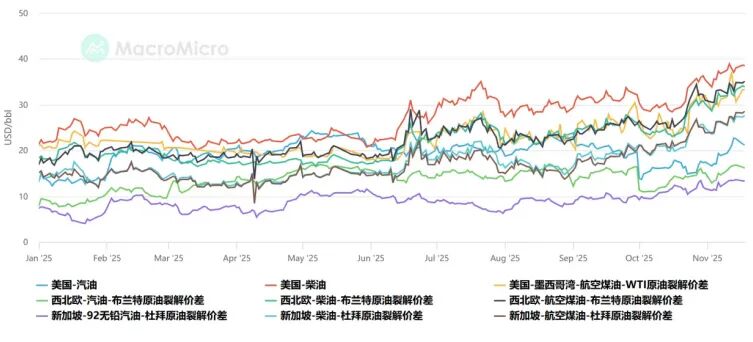
Core Viewpoint - The ongoing drone attacks by Ukraine on Russian energy infrastructure have significantly impacted Russia's refining capacity, leading to a surge in global oil product prices and creating new opportunities for China's oil product exports and sulfur industry [1][4][10]. Group 1: Impact on Russian Refining Capacity - Since November 2025, Ukraine has conducted multiple drone strikes targeting key Russian refineries, including Ryazan, Samara, and Volgograd, resulting in a 6% decrease in overall Russian refining output [1]. - The Ryazan refinery, one of Russia's four major refineries with an annual processing capacity of 13.1 million tons (340,000 barrels per day), suffered damage to its distillation units and fuel storage tanks [1]. - The Volgograd refinery, with an annual capacity of 15.7 million tons, has faced multiple shutdowns due to these attacks, further exacerbating the decline in Russian refining capacity [1]. Group 2: Global Oil Product Price Surge - The reduction in Russian refining capacity has led to a significant increase in overseas oil product crack spreads, with the 3-2-1 crack spread reaching $32.13 per barrel, the highest level since March 2024, reflecting a more than 30% increase from October's average [2]. - Diesel prices have seen the most substantial rise among oil products, indicating a high-profit cycle for the refining industry [2]. Group 3: Sulfur Market Dynamics - The attacks have also disrupted sulfur production, as Russia is the second-largest sulfur producer globally, accounting for 15%-20% of the world's supply [4]. - Domestic sulfur prices have surged, with the port spot index reaching 3,990 yuan per ton in late November, marking an increase of over 1,000 yuan per ton in just over a month and a rise of approximately 2,500 yuan per ton since the beginning of the year [4]. - Forecasts suggest that sulfur prices may exceed 5,000 yuan per ton in 2026 due to a tight supply-demand balance [4]. Group 4: Opportunities for Chinese Companies - The international supply gap has created a favorable window for China's oil product exports, with a total export quota of 40.195 million tons for 2025 [7]. - Major state-owned enterprises dominate China's oil product export market, with Sinopec and PetroChina holding significant shares [7]. - The sulfur industry in China is experiencing a dual benefit of rising prices and increasing demand, particularly due to the growth in the new energy sector and solid-state battery technology [7][8]. Group 5: Market Position of Leading Companies - China's total sulfur production capacity is approximately 16.8 million tons per year, with Sinopec, PetroChina, and Rongsheng Petrochemical being the top three producers, collectively holding over 70% of the market share [8][10]. - A price increase of 100 yuan in sulfur can lead to significant profit gains for leading companies, indicating a positive outlook for profitability in the current high-demand environment [8].



成品油周报:原油转弱成品油出口利润维持高位国内柴油裂解利润回升-20251124
Zhong Tai Qi Huo· 2025-11-24 09:13
1. Report Industry Investment Rating No relevant content provided. 2. Core Viewpoints of the Report This week, Brent crude oil first rose and then fell to the $62 area, with the focus of the crude oil market shifting to geopolitical and financial - end asset liquidity. Geopolitical risks have cooled down. The refined oil cracking profit remains at a high level, and the market has entered a rhythm where the current demand is resilient but weak in the long - term. The main supply has declined, and the inventory has decreased at a low level. The diesel cracking profit has continuously risen and recovered. It is recommended to take profit and wait and see for the cracking profit in the short term, and participate at low levels in the medium term [7]. 3. Summary According to the Directory 3.1 Product Oil Price Analysis - The price difference between gasoline and diesel has slightly widened, and the support for gasoline is stronger than that for diesel [15]. - The cracking spread of gasoline and diesel has hit a high as crude oil prices fall [45]. 3.2 Product Oil Supply Analysis - **Crude Oil Import and Inventory**: The import volume and inventory of crude oil show certain trends and fluctuations over time [54][57]. - **Crude Oil Processing Volume**: The processing volume of crude oil by refineries, including main refineries and local refineries, has different changes in monthly and weekly data [63][66][68]. - **Domestic Atmospheric and Vacuum Distillation Unit Capacity**: The operating rates of main refineries and local refineries' atmospheric and vacuum distillation units have different trends [70]. - **Domestic Gasoline and Diesel Production**: The production of gasoline and diesel has monthly and weekly data changes, and the diesel - to - gasoline ratio also shows corresponding trends [72][74][78][80][84]. - **Domestic Kerosene Production**: The production of kerosene has shown certain trends in monthly data [86]. - **Profit**: The profits of different types of refineries and their sub - items have different changes [89][92][94][96][99]. - **Coking**: The coking profit, inventory, and production of petroleum coke have corresponding data changes [101][103][105]. 3.3 Product Oil Demand Analysis - **Domestic Gasoline, Diesel, and Kerosene Exports**: The export volumes and export profits of gasoline, diesel, and kerosene have different trends [111][113][116]. - **Gasoline and Diesel Apparent Consumption**: The apparent consumption of gasoline and diesel has monthly and weekly data changes [119][124]. - **Automobile Sales and Ownership**: The sales, ownership, and related indicators of automobiles, including new - energy vehicles, have different trends [129][131]. - **Congestion Delay Index**: The congestion delay index is reflected by the average weekly passenger volume of the subway in major cities [136]. - **Logistics and Express Delivery Index**: The development trend, ability, service quality, and scale indexes of the logistics and express delivery industry have different trends [138]. - **Purchasing Managers' Index (PMI)**: The PMI and its sub - items (such as employment, new orders, production, etc.) have monthly data changes [141][143]. - **Industrial Added Value**: The industrial added value and industrial electricity consumption have corresponding trends [146]. - **Excavators and Heavy Trucks**: The sales, cumulative sales, and working hours of excavators, as well as the sales of heavy trucks, have different trends [148][150]. - **Executed Flights**: The number of executed flights, including international and domestic flights, is presented [152]. - **Gas Station Profit**: The weekly retail profits of gasoline and diesel at gas stations have different trends [155]. - **Freight Volume**: The freight volume in different regions and types (such as Shenzhen, import - export, etc.) has different trends [158][160][162]. 3.4 Product Oil Inventory Analysis - **Commercial Inventory of Gasoline and Diesel**: The commercial inventories of gasoline and diesel at the national and main refinery levels have weekly data changes [169][172]. - **Inventory of Gasoline and Diesel at National Local Refineries**: The inventory rates and inventory volumes of gasoline and diesel at local refineries, especially in Shandong, have weekly data changes [175]. - **Social Inventory of Gasoline and Diesel**: The social inventories of gasoline and diesel at the national level have weekly data changes [182]. - **Sales - to - Production Ratio of Local Refineries**: The sales - to - production ratios of diesel and gasoline at local refineries, including Shandong local refineries, have weekly data changes [177][179]. - **Zhongtai Product Oil Index**: The Zhongtai gasoline and diesel indexes at the national, main refinery, and local refinery levels have weekly data changes [185][187]. 3.5 Market Summary - **Device Maintenance Plan**: The maintenance plans of main refineries and local refineries, including the names of refineries, locations, maintenance devices, capacities, start times, and end times, are presented [191][193][196]. - **Industry News**: No specific industry news content is provided in the text.
供需持续改善推动景气度上行,石化ETF(159731)打开低位布局窗口
Mei Ri Jing Ji Xin Wen· 2025-11-21 03:40
Group 1 - The A-share market experienced fluctuations on November 21, with the Petrochemical ETF (159731) declining over 3.5%, while only Tongcheng New Material and Sankeshu showed positive performance among its holdings [1] - The Petrochemical ETF has seen net inflows in 8 out of the last 10 trading days, totaling 16.91 million yuan [1] - The chemical sector is witnessing structural opportunities, particularly in the refining segment due to supply-side factors such as attacks on Russian refineries and closures of some refining capacities in Europe and the U.S., leading to high global refining profits [1] Group 2 - Sulfur prices have surged due to strong demand from the new energy and fertilizer sectors, while supply is constrained by slow growth in refining capacity and geopolitical factors [1] - Policies aimed at reducing "involution" are expected to alleviate price competition pressures in the chemical sector, promoting price recovery [1] - According to Shenwan Hongyuan, oil prices are expected to remain in a neutral range by 2026, with refining and polyester sectors likely to see a recovery in profitability due to supply contraction [1] Group 3 - The Petrochemical ETF closely tracks the CSI Petrochemical Industry Index, with the basic chemical industry accounting for 60.85% and the oil and petrochemical industry for 32.16% of the index [2] - As the supply and demand in the petrochemical industry continue to improve, the performance of sub-sectors is expected to rise [2]
燃料油日报:阿祖尔炼厂装置有望在近期重启-20251121
Hua Tai Qi Huo· 2025-11-21 01:59
1. Report Industry Investment Rating - High-sulfur fuel oil: Neutral in the short term, bearish in the medium term [2] - Low-sulfur fuel oil: Neutral in the short term, bearish in the medium term [2] - Cross-variety: None [2] - Cross-period: None [2] - Spot-futures: None [2] - Options: None [2] 2. Core Viewpoints of the Report - The main contract of Shanghai Futures Exchange fuel oil futures closed up 2.45% at 2,553 yuan/ton overnight, while the main contract of INE low-sulfur fuel oil futures closed down 0.06% at 3,153 yuan/ton [1] - Crude oil prices continue to oscillate weakly. Although there are short-term disturbances from geopolitical and macro factors, the medium-term expectation of oversupply in the oil market is gradually being realized, which exerts some pressure on the unilateral price of fuel oil [1] - In terms of the fundamentals of fuel oil itself, low-sulfur fuel oil has recently performed stronger than high-sulfur fuel oil, but the situation reversed again yesterday [1] - The low-sulfur fuel oil market lacks a sustainable upward driver. Part of the Azur refinery's facilities under maintenance due to malfunctions are expected to restart around November 29, and Kuwait's low-sulfur fuel oil shipments have been zero so far in November. Supply will resume after the facilities restart [1] - There are still supporting factors in the high-sulfur fuel oil market. In particular, Ukrainian drones have continuously attacked Russian refineries, leading to a decline in their operating rates. Recent fuel oil shipments have been low, and the impact of US sanctions may further materialize [1] 3. Summary by Relevant Catalogs Market Analysis - The main contract of Shanghai Futures Exchange fuel oil futures closed up 2.45% at 2,553 yuan/ton overnight, and the main contract of INE low-sulfur fuel oil futures closed down 0.06% at 3,153 yuan/ton [1] - Crude oil prices are in a weak oscillation. The medium-term oversupply expectation in the oil market is pressuring fuel oil prices [1] - Low-sulfur fuel oil recently outperformed high-sulfur fuel oil, but the situation reversed. The low-sulfur market lacks a sustainable upward driver, while the high-sulfur market has supporting factors [1] Strategy - High-sulfur fuel oil: Neutral in the short term, bearish in the medium term [2] - Low-sulfur fuel oil: Neutral in the short term, bearish in the medium term [2] - No strategies for cross-variety, cross-period, spot-futures, and options [2]
俄称控制库皮扬斯克 乌称打击俄炼油厂
Yang Shi Xin Wen Ke Hu Duan· 2025-11-20 23:39
Core Viewpoint - The ongoing conflict between Russian and Ukrainian forces continues to escalate, with both sides claiming territorial control and engaging in military operations against each other [1] Group 1: Russian Military Actions - Russian military forces have maintained an offensive across the front lines, claiming control over Kupiansk in the Kharkiv region and over 80% of the Volchansk area, as well as 70% of the territory in the Donetsk region known as Red Army City (Ukrainian name: Pokrovsk) [1] - The Russian Defense Ministry reported that they have fully controlled the miners' area in Red Army City and have initiated regular patrols in the region [1] Group 2: Ukrainian Military Actions - The Ukrainian Armed Forces launched a new strike on the Ryazan oil refinery in Russia, aiming to weaken Russian military capabilities, confirming a precise hit that resulted in a fire in the secondary processing area [1] - Ukrainian forces reported that they repelled 38 out of 43 attacks launched by Russian troops in the Pokrovsk direction on the same day [1] Group 3: Discrepancies in Reporting - The Ukrainian Armed Forces General Staff stated that the information reported by Russian Chief of General Staff Gerasimov to President Putin is provocative and not factual, asserting that Kupiansk remains under Ukrainian control [1] - The claims made by Gerasimov regarding Russian control over 80% of Volchansk and 70% of Pokrovsk were also disputed by Ukrainian officials, indicating a significant divergence in the narratives presented by both sides [1]

研报掘金丨华泰证券:上调中国石化AH股评级至“买入” 硫磺供需矛盾致炼油板块回暖
Ge Long Hui· 2025-11-18 08:09
Core Viewpoint - The report from Huatai Securities indicates that due to the peak in China's crude oil processing capacity and constraints on overseas supply, global sulfur supply growth is facing bottlenecks, while demand is steadily increasing in sectors such as global phosphate fertilizer consumption and the production of new materials like lithium batteries, nylon, and titanium dioxide [1] Industry Summary - In 2024, China's apparent sulfur consumption is expected to grow by 8.6% year-on-year, with imports accounting for 47% of the total, reflecting a year-on-year increase of 12.7% [1] - The increasing dependence on foreign sulfur and the global supply-demand imbalance are projected to lead to a 152% rise in sulfur prices by November 14, 2025, reaching 3,930 yuan per ton [1] Company Summary - China Petroleum & Chemical Corporation (Sinopec) has a sulfur production capacity of 8.88 million tons per year, making it the largest sulfur supplier in China [1] - The recovery in sulfur market conditions is expected to boost the company's refining segment, alongside a turning point in the petrochemical sector's capacity cycle [1] - As a result, Huatai Securities has upgraded the company's A/H rating to "Buy," with a target price of 7.60 yuan and 6.26 Hong Kong dollars [1]