公用事业

Search documents
氪星晚报|智元机器人将举办全球首个大型机器人晚会“机器人奇妙夜”;黄金一度暴跌1000美元,业内提示警惕抄底风险;中共中央、国务院:培育京津雄地区创新三角
3 6 Ke· 2026-02-02 12:05
Group 1: Major Companies - Tesla has achieved large-scale production of dry electrode batteries, which is a significant breakthrough in lithium battery manufacturing technology, reducing costs, energy consumption, and factory complexity while significantly improving scalability [1] - Zhiyuan Robotics is preparing for the world's first large-scale robot gala, "Robot Wonderful Night," featuring hundreds of robots performing various acts, which will be live-streamed soon [1] - Tokyo Electric Power Company has initiated a restructuring effort to improve its financial situation and is seeking potential alliance partners, with a goal to cut costs by approximately 31 trillion yen (200 billion) over the next decade [1] Group 2: Investment and Financing - "Fengshi Technology" has secured 30 million in strategic investment, which will be used for high-value utilization of Antarctic krill and the development of krill phospholipid pharmaceuticals, as well as expanding intelligent production lines to support global market development [5] - "Linghou Robotics" has completed over 100 million in Pre-B round financing, led by NIO Capital, with participation from several other investment institutions [6] Group 3: Industry Trends - The Data×AI Super Company Annual Conference gathered over 80 decision-makers from major companies to discuss the implementation of AI, highlighting that in the AI era, a company's advancement is marked by token consumption and productivity is measured by the proportion of AI employees [2] - Ant Group has launched the "AI Credit" incentive program to promote comprehensive AI integration within the organization, offering additional rewards for teams and individuals making significant contributions to AI [3] - VinFast plans to accelerate its global expansion of electric motorcycles, targeting markets in the Philippines, Indonesia, India, Thailand, and Malaysia, with multiple models set to be launched [4]


华创证券张瑜:美股四季度盈利观察
Xin Lang Cai Jing· 2026-02-02 07:17
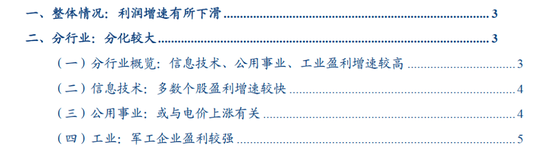
Overall Situation - The profit growth rate of S&P 500 companies for Q4 is 10.8%, down from 24.1% in Q3 2025, but still considered high historically [2][22] - As of February 1, 180 companies have reported their Q4 earnings, representing about half of the total market capitalization of the S&P 500 [2][22] Industry Breakdown - There is significant divergence in profit growth across industries; 7 out of 11 sectors reported negative profit growth [9][31] - Only the Information Technology, Financial, Industrial, and Utility sectors showed positive profit growth [9][31] - The Information Technology sector had a profit growth rate of 44.5%, contributing 12.6% to the overall profit growth of the sample companies [9][31] Information Technology - 25 companies in the Information Technology sector reported earnings, with 21 showing positive profit growth and 18 exceeding 10% growth [12][33] - Notable performers include SanDisk with a growth rate of 672%, Western Digital at 210%, Micron Technology at 180.2%, Broadcom at 97%, and Oracle at 94.7% [12][33] Utilities - The Utilities sector performed well, with two companies reporting a combined profit growth rate of 251.1% [14][36] - This performance is likely linked to rising electricity prices, with the CPI for electricity services showing a year-on-year increase of 6.7% in December 2025 [14][36] Industrial - The Industrial sector saw a profit growth rate of 45.9%, driven largely by military production [17][38] - Key companies include Boeing, which returned to profitability, Lockheed Martin with a growth rate of 155%, Northrop Grumman at 66.7%, and General Electric Aerospace at 34.9% [17][38] - The production index for aerospace and other transportation equipment has been rising rapidly since September 2025, averaging a year-on-year growth of 20.9% over the last four months [17][38]

美股四季度盈利观察
一瑜中的· 2026-02-02 07:13
Overall Situation - The profit growth rate of S&P 500 companies has declined, with a reported growth of 10.8% for Q4 2025, down from 24.1% in Q3 2025, although it remains at a relatively high level historically [3][12]. Industry Analysis - There is significant divergence in profit growth across industries, with 7 out of 11 sectors reporting negative growth. Only the information technology, financial, industrial, and utility sectors showed positive growth, with information technology contributing 12.6% to the overall profit growth of sample companies at a rate of 44.5% [4][15]. Information Technology - In the information technology sector, 25 companies reported earnings, with 21 showing positive profit growth. Notably, 18 companies had growth rates exceeding 10%, with standout performers including SanDisk at 672%, Western Digital at 210%, Micron Technology at 180.2%, Broadcom at 97%, and Oracle at 94.7% [5][18]. Utilities - The utility sector performed well, with two companies reporting a combined profit growth of 251.1%. This performance is likely linked to rising electricity prices, with the Consumer Price Index (CPI) for electricity services showing a year-on-year increase of 6.7% in December 2025 [6][22]. Industrial - The industrial sector saw a profit growth rate of 45.9%, driven largely by military production. Key companies included Boeing (returning to profitability), Lockheed Martin with a growth of 155%, Northrop Grumman at 66.7%, and General Electric Aerospace at 34.9%. The production index for aerospace and other transportation equipment has risen significantly, averaging a year-on-year growth of 20.9% over the last four months [7][24].

2025年业绩预告有哪些线索值得关注?
Yin He Zheng Quan· 2026-02-02 06:21
Core Insights - The report highlights that as of January 31, 2025, 2,956 A-share listed companies have disclosed their annual performance forecasts, with a disclosure rate of 54% and a positive forecast rate of 37% [2][4][7] - The report indicates that the technology manufacturing sector shows a high positive forecast rate, reflecting an upward trend in its economic outlook [29] - Certain cyclical industries are benefiting from price increases and product structure improvements, while overseas business expansion is opening new growth avenues [29] Disclosure and Positive Forecast Rates - Among the disclosed companies, 1,092 have positive forecasts, categorized into "turning profitable," "continuing profit," "slight increase," and "expected increase" types [4][10] - The disclosure rates vary by sector, with the ChiNext board having a high positive forecast rate of 39%, followed by the main board at 37%, the Sci-Tech Innovation board at 36%, and the North Exchange at 33% [7][10] - The non-bank financial, non-ferrous metals, automotive, beauty care, and public utilities sectors have positive forecast rates exceeding 50%, while coal, real estate, light manufacturing, and food and beverage sectors have rates below 25% [11][12] Profit Growth Rates - The median growth rate of net profit attributable to shareholders for the 2,956 A-shares is 17.95%, an increase of 12.42 percentage points from the third quarter of 2025 [17][20] - The main board's median net profit growth rate is 14.46%, while the ChiNext board leads with 25.34% and the Sci-Tech Innovation board follows at 21.83% [20][22] - In terms of industry performance, non-ferrous metals and non-bank financial sectors show median net profit growth rates above 40%, while sectors like commercial retail and food and beverage show significantly negative growth rates [22][23] Investment Outlook - The report suggests focusing on sectors with high net profit growth rates and low price-to-earnings ratios, such as personal care, marine equipment, gas, and securities [29] - Technology manufacturing sectors like electric motors, ground weaponry, and wind power equipment are expected to benefit from trends in renewable energy and AI, despite higher valuations [29] - Policy support for key areas such as artificial intelligence and aerospace is anticipated to catalyze growth in related industries [29]
警报!A股资金像无头苍蝇乱撞,指数一调整,个股就普跌,资源股暴涨,科技股就崩盘
Sou Hu Cai Jing· 2026-02-01 09:05
Market Overview - The A-share market is experiencing a chaotic state, with major indices showing little decline while most individual stocks are significantly down, leading to investor frustration [1] - On January 26, 2026, despite minor index declines, over 3,700 stocks fell, while resource stocks like gold and coal surged, indicating a lack of coherent market direction [1][3] Capital Flow Dynamics - The chaotic market reflects intense but disorganized capital battles among several key sectors, including high-position cyclical stocks and technology growth sectors [3][4] - High-position cyclical stocks, particularly in non-ferrous metals, saw significant price fluctuations driven by speculative capital, leading to market panic when these stocks dropped [3][4] - Funds exiting high-position stocks did not disappear but shifted towards technology sectors like semiconductors and AI, which are supported by clear industrial policies, although this transition was weak due to overall market fear [4][5] Investment Behavior - As high-position and growth sectors underperformed, some funds moved towards undervalued stocks in sectors like liquor, real estate, and finance for safety, but this was more of a technical rebound rather than a fundamental recovery [5][10] - The current market is characterized by a "stock selection" approach rather than a focus on index performance, emphasizing the importance of individual stock value assessments [13] Market Sentiment and Valuation - The extreme volatility is exacerbated by a lack of new capital entering the market, leading to a "stockholder's game" where existing funds are aggressively reallocated, causing erratic price movements [6][8] - Many high-flying stocks have reached historical valuation peaks, creating bubbles that are vulnerable to rapid declines upon any negative news, while traditional sectors remain undervalued but lack growth expectations [8][9] Sector Analysis - For high-position cyclical products like non-ferrous metals and precious metals, the risk-reward ratio has deteriorated significantly, making further investment risky [9] - In contrast, sectors like semiconductors and robotics, despite recent adjustments, have strong long-term growth prospects supported by domestic demand and favorable policies, presenting potential investment opportunities [11] Strategic Recommendations - Investors are advised to manage their positions carefully, maintain a comfortable cash reserve, and avoid impulsive trading behaviors in a volatile market [13][14] - A balanced investment strategy should include both growth sectors with clear performance expectations and stable dividend-paying stocks to mitigate volatility [14][16] - Reducing trading frequency and focusing on long-term fundamentals rather than short-term market fluctuations is recommended for navigating the current market environment [16] Broader Market Context - The Hong Kong stock market is showing different characteristics, with technology indices at historically low valuations and increasing international capital interest, providing an alternative investment avenue [16]
公用事业行业周报(2026.01.26-2026.01.30):新建新型储能容量电价,多元电价体系逐步完善-20260201
Orient Securities· 2026-02-01 07:43
Investment Rating - The report maintains a "Positive" outlook on the utility sector, indicating a favorable investment environment for the industry [8]. Core Insights - The introduction of a new capacity pricing mechanism for new energy storage and the gradual improvement of a diversified pricing system are key developments. The National Development and Reform Commission and the National Energy Administration have issued guidelines to enhance the capacity pricing mechanism for coal and gas power generation, as well as for pumped storage [8]. - The report highlights that coal prices have slightly rebounded, while coal inventories have decreased. The short-term outlook for spot coal prices is expected to remain stable, with limited upward potential due to a generally loose supply-demand balance in the coal market [8]. - The performance expectations for the utility sector have reached a low point, making undervalued utility assets worth attention. The report suggests that the utility sector remains a quality dividend asset for long-term investment [8]. Summary by Sections Policy Developments - The new capacity pricing mechanism aims to improve project profitability for new energy storage and encourage longer storage durations, thus promoting further capacity installations [8]. - The policy also seeks to stabilize revenue expectations for coal and gas power plants by providing a "minimum wage" for these adjustable power sources [8]. Market Trends - The report notes that the average spot electricity price in Guangdong has increased by 70.2% year-on-year, while Jiangsu's spot price rose by 11.7% week-on-week [11][13]. - Coal prices have shown a slight increase, with the Qinhuangdao Q5500 coal price at 692 RMB/ton, reflecting a 1.0% week-on-week rise [16]. Performance Analysis - The utility sector index has decreased by 1.7%, underperforming the CSI 300 index by 1.8 percentage points [34]. - The report identifies that the hydroelectric sector has shown the highest weekly increase among sub-sectors, while solar and wind sectors have faced declines [36]. Investment Recommendations - The report recommends several stocks within the utility sector, including Jiantou Energy, Huadian International, and Guodian Power, all rated as "Buy" [8]. - It also suggests focusing on high-quality hydropower companies and those with significant wind power contributions, indicating potential growth in these areas [8].





25Q4基金转债持仓分析:固收+继续扩张,增配科技化工
GOLDEN SUN SECURITIES· 2026-02-01 06:40
1. Report Industry Investment Rating No relevant information provided. 2. Core View of the Report In Q4 2025, against the backdrop of a strong equity market, there was still demand for "Fixed - Income +" allocation. The convertible bond market's outstanding balance increased slightly, while the proportion of convertible bonds held by institutions decreased. Some types of funds increased their positions in convertible bonds, while others reduced them. Convertible bond funds saw a decline in their convertible bond positions and an increase in leverage, with their average returns in Q4 2025 lower than the CSI Convertible Bond Index. There were significant increases in positions in industries such as petroleum and petrochemicals, national defense and military industry, while some industries like communication and non - ferrous metals were significantly reduced [1][3]. 3. Summary According to the Directory 3.1 Public Fund Convertible Bond Holdings - **Overall situation**: In Q4 2025, the scale of convertible bonds held by public funds accounted for 57.74% of the total convertible bond market value, a decrease of 4.08 pcts compared to Q3. The position decreased slightly by 0.05 pcts. The outstanding balance of the convertible bond market was 533.89 billion yuan, a 4.30% increase compared to Q3 2025. The market value of convertible bonds held by public funds was 308.251 billion yuan [1][8]. - **Fund type structure**: The fund types that held more convertible bonds were secondary bond funds (36.41%), convertible bond funds (36.29%), primary bond funds (21.90%), partial - debt hybrid funds (3.30%), and flexible allocation funds (2.10%). Compared to Q3 2025, secondary bond funds and primary bond funds increased their positions in convertible bonds, with the market value of convertible bonds held by secondary bond funds increasing by 3.963 billion yuan (+3.72%) and that of primary bond funds increasing by 1.639 billion yuan (+2.53%). Flexible allocation funds also increased by 0.088 billion yuan (+1.40%). Convertible bond funds and partial - debt hybrid funds reduced their positions, with the market value of convertible bonds held by convertible bond funds decreasing by 10.996 billion yuan (-9.07%) and that of partial - debt hybrid funds decreasing by 2.160 billion yuan (-17.75%) [1][13]. - **Funds with large - scale holdings**: As of Q4 2025, there were 1,921 public funds holding convertible bonds, with a total market value of 308.251 billion yuan. Among them, 62 funds held convertible bonds with a market value of over 1 billion yuan, with a total market value of 213.525 billion yuan, accounting for 69.27% of the market value of public funds investing in convertible bonds, a 0.23% decrease compared to Q3. 281 funds held convertible bonds with a market value of over 100 million yuan, with a total market value of 288.495 billion yuan, accounting for 93.59% of the market value of public funds investing in convertible bonds, a 0.24% increase compared to Q3 2025 [2][18]. 3.2 Convertible Bond Fund Convertible Bond Holdings - **Market value change**: As of Q4 2025, there were 40 convertible bond funds, holding a total market value of convertible bonds of 110.209 billion yuan, a decrease of 10.996 billion yuan compared to Q3 2025, a 9.07% decrease [2][22]. - **Position and leverage change**: The convertible bond position of convertible bond funds decreased from 87.17% in Q3 2025 to 86.82%, a decrease of 0.35 pcts. The leverage ratio increased from 135.17% to 142.34%, an increase of 7.17 pcts [2][25]. - **Return performance**: In Q4 2025, the average annualized return of the CSI Convertible Bond Index was 6.03%, and the average annualized return of convertible bond funds was 3.69%. There were 28 convertible bond funds with positive returns, among which Baoying Rongyuan Convertible Bond A had the best return of 16.41%, and Huatai - PineBridge Convertible Bond A also performed well with a return of 15.31%. 15 convertible bond funds outperformed the CSI Convertible Bond Index and the convertible bond fund index, with a win - rate of 37.5% [3][28]. - **Industry position adjustment**: Public funds significantly increased their positions in industries such as petroleum and petrochemicals, national defense and military industry, steel, public utilities, electronics, and machinery. The market value of convertible bonds in the petroleum and petrochemical industry held by public funds increased by 59.23% compared to Q3 2025, and that in the national defense and military industry increased by 30.40%. Public funds held a total of 8.224 billion yuan of convertible bonds in the steel industry. In terms of reduction, industries such as communication, non - ferrous metals, building materials, automobiles, and media had significant decreases in the market value of convertible bonds held by public funds in Q4 2025 [3][33]. - **Top - holding convertible bonds**: The top five heavy - holding convertible bonds of convertible bond funds were Industrial Bank Convertible Bond, 25 Treasury Bond 08, Shanghai Bank Convertible Bond, Wens Convertible Bond, and 25 Treasury Bond 01. The top five heavy - holding individual bonds held by 38 convertible bond funds in Q4 2025 involved a total of 67 bonds [4][35].
超千家上市公司2025年业绩预喜 有色金属与AI等行业表现突出
Sou Hu Cai Jing· 2026-01-31 01:34
Core Viewpoint - Nearly 3000 listed companies have reported their 2025 performance forecasts, reflecting the mixed fortunes across various industries, with 37.20% of companies expecting positive results, marking a 4 percentage point increase from 2024 [1] Group 1: Performance Forecasts - A total of 2844 companies have released their 2025 performance forecasts, with 1058 companies expecting positive outcomes, including increases and recoveries from losses [1] - The proportion of companies forecasting positive results has increased from 33.19% in 2024 to 37.20% in 2025, reversing a declining trend [1] Group 2: Economic Context - National Bureau of Statistics data indicates that profits of industrial enterprises above designated size in 2025 have shown positive growth, reversing a three-year decline from 2022 to 2024, signaling economic stabilization and recovery [1] Group 3: Industry Highlights - Key industries such as non-ferrous metals, electronics, public utilities, and automotive are performing particularly well, driven by the accelerated implementation of artificial intelligence (AI) [1] - The rise in prices of commodities like gold and copper, along with certain basic chemical products, combined with capacity release, has contributed to the positive performance forecasts of listed companies [1]
中山公用事业集团股份有限公司2025年度业绩预告
Zhong Guo Zheng Quan Bao - Zhong Zheng Wang· 2026-01-30 23:17
Performance Forecast - The company expects a positive net profit for the year 2025, with an anticipated increase of over 50% compared to the previous year [1] - The performance forecast period is from January 1, 2025, to December 31, 2025 [1] Communication with Auditors - The performance forecast has not undergone preliminary auditing by the accounting firm, but initial discussions have taken place without any disagreements [1] Reasons for Performance Change - The company demonstrates strong resilience in a complex and competitive external environment by adjusting its industry and resource structure, implementing refined operational management, and leveraging forward-looking fund investments to enhance core business value and profit margins [1]

解释城市|纽约市城市服务型制造对上海发展制造业有哪些参考
Xin Lang Cai Jing· 2026-01-30 10:23
Core Insights - The article discusses the economic structure and industrial layout of New York City, highlighting the distribution of major industry sectors and their impact on the regional economy [2][7]. - It emphasizes the concentration of economic activity in a few key sectors while many others contribute relatively less, illustrating a dual characteristic of concentration and dispersion in New York's economy [7][8]. Economic Structure - In 2023, New York City's total economic output was $1,285.74 billion, with a clear distinction between "core pillar industries" (over 10% contribution), "mid-tier supporting industries" (3%-10%), and "specialty supplementary industries" (below 3%) [7][8]. - The "core pillar industries" include finance and insurance, real estate, information, and professional and technical services, collectively contributing $785.84 billion, or 61.1% of the city's GDP [8]. Key Industries - The finance and insurance sector alone accounts for approximately 25% of New York City's GDP, underscoring its status as a global financial center [8]. - Real estate and rental services are significant contributors, primarily driven by transactions, property management, and related services concentrated in Manhattan [8]. - The information sector has seen rapid growth, increasing from 10% to 12.4% of GDP over the past 20 years, while professional and technical services contribute around 10% [8]. Supporting Industries - "Mid-tier supporting industries" encompass public administration, wholesale and retail trade, healthcare, and accommodation and food services, collectively making up 23.3% of the economy [9][10]. - These industries are essential for maintaining the city's operational stability and resilience against economic fluctuations, as they are less affected by short-term economic changes [10]. Specialty Industries - "Specialty supplementary industries" include agriculture, mining, utilities, construction, manufacturing, transportation, management services, education, and arts and entertainment [11]. - Although these industries have a lower economic contribution, they play a vital role in supporting core industries and enhancing the city's cultural vibrancy [11]. Manufacturing Sector - Manufacturing's share of New York City's GDP has drastically declined to only 0.8% in 2023, reflecting a broader trend of urban centers moving away from manufacturing towards service-oriented economies [14][19]. - The historical context shows that manufacturing was once a significant part of New York's economy, particularly post-World War II, but has since diminished due to the rise of the service sector [15][18]. Current Manufacturing Landscape - The remaining manufacturing in New York is characterized by "urban service-oriented manufacturing," focusing on light industries such as food and apparel, which cater directly to local consumer needs [22][23]. - The manufacturing sector is primarily composed of food manufacturing (26.9%), apparel manufacturing (15.0%), and printing (13.4%), indicating a strong alignment with urban consumption patterns [25][22].