工业制造

Search documents
股市观察20250815:沪指突破“924”高点!A股下一站去哪里?
Sou Hu Cai Jing· 2025-08-16 09:58
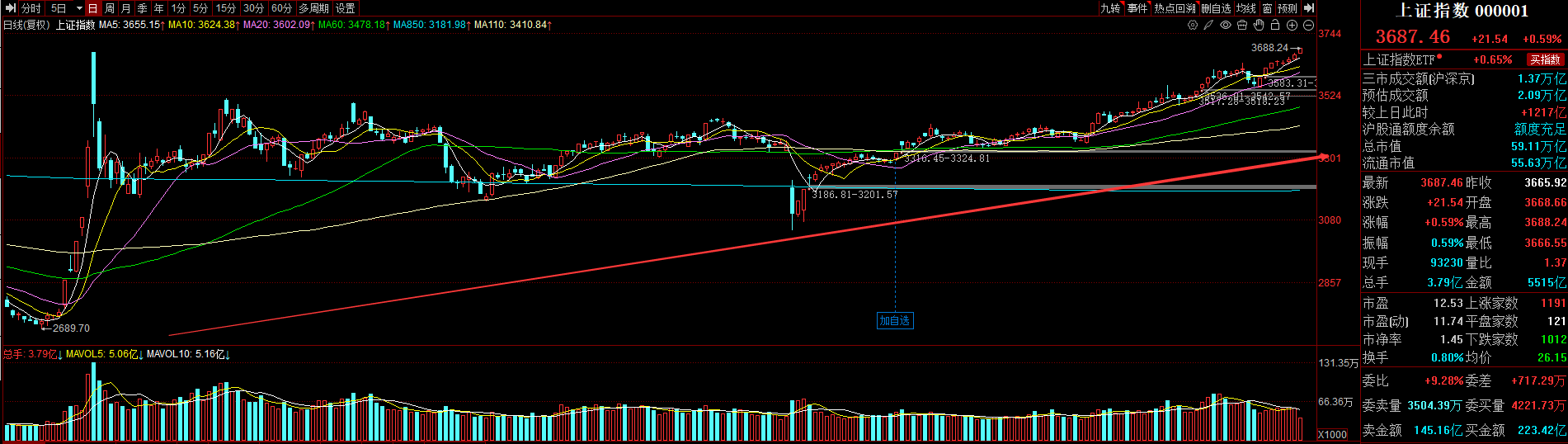
Market Overview - The Shanghai Composite Index has surpassed 3674.4 points, reaching a new high since December 2021 [1] - The "924 market" on October 8, 2024, saw the index open up 10.13% and close at 3674.4 points, marking a historic peak driven by strong policy support [3] Policy Impact - A series of robust policies were introduced by the central bank, financial regulators, and the China Securities Regulatory Commission on September 24, which contributed to the market rally [3] - The State Council emphasized measures to boost the capital market and guide long-term funds into the market during a press conference on October 8 [3] Market Trends - The research team believes that the A-share market has entered its fifth bull market, characterized as a "systematic slow bull," with a shift in asset allocation towards equity assets by residents [5] - The long-term target for the Shanghai Composite Index is likely to exceed the 3700-point mark [5] Sector Performance - The financial sector remains a key driver of the index's strength, with a notable performance from brokerage firms, while the banking sector has seen a pullback [6] - Leading brokerages such as Guosheng Securities and Changcheng Securities have shown significant gains [6] Investment Opportunities - Recent trends indicate three main drivers for the brokerage industry: an increase in T0 client numbers, steady growth in client margin scales, and a noticeable increase in leverage among existing clients [10] - The research team anticipates that the equity allocation by insurance funds, wealth management, and public offerings will likely rebound, opening growth opportunities for brokerage services [10] Large-cap Stocks - Eight large-cap stocks, including Industrial Fulian and Zijin Mining, have reached historical highs, indicating strong performance in the market [11] - The market has shown a trend where large-cap stocks outperform smaller indices, likely due to institutional funds entering the market [11] Future Outlook - The research team predicts that the A-share market will continue to experience a fluctuating upward trend, with a focus on large financial stocks and large-cap companies as potential investment targets [12]






深圳市海铭鸥工业有限公司成立 注册资本20万人民币
Sou Hu Cai Jing· 2025-08-16 06:15
Core Viewpoint - Shenzhen Haimingou Industrial Co., Ltd. has been established with a registered capital of 200,000 RMB, indicating a new player in the industrial sector focusing on various manufacturing and service activities [1] Company Summary - The legal representative of the company is Pan Xinkui [1] - The company’s registered capital is 200,000 RMB [1] - The business scope includes sales of traffic and public management signs, wholesale and retail of hardware products, and research and development of hardware products [1] - Additional activities include sales of high-performance non-ferrous metals and alloys, special steel materials, and various industrial components [1] - The company also engages in advertising services, digital content production, and industrial design services [1] Industry Summary - The establishment of Shenzhen Haimingou Industrial Co., Ltd. reflects ongoing developments in the industrial sector, particularly in manufacturing and service provision [1] - The diverse range of activities suggests a strategic positioning to cater to multiple market needs, including industrial automation and advertising [1]
发布会纪要|消费趋势、反内卷成效......国家统计局最新回应
Di Yi Cai Jing· 2025-08-15 06:06
Group 1: Economic Overview - The trend of expanding consumption in China remains unchanged, with new consumption drivers continuing to grow [1] - Despite facing risks and challenges, the long-term positive support conditions and basic trends of the economy have not changed [1] - The macroeconomic policies are showing effectiveness, with market demand expanding and new productive forces developing [1] Group 2: Export Growth - China's exports are expected to grow in the second half of the year due to several favorable conditions, including the diversification of foreign trade and enhanced competitiveness of export products [2] - The overall stability of consumer prices in July indicates positive changes, although the market still faces weak demand [2] - Policies aimed at expanding domestic demand and promoting a unified national market are expected to continue yielding positive effects [2] Group 3: Investment Landscape - Investment in China continues to expand, with structural optimization, although there are temporary pressures on investment growth [3] - There is significant potential for investment, as per capita capital stock remains lower compared to developed countries [3] - Efforts to promote a unified national market and optimize the investment environment are crucial for stimulating private investment and expanding effective investment [3] Group 4: Green Development - China is focusing on creating new growth areas in green development, achieving significant results with an increasing "green content" in economic development [4] - In July, production of new energy products such as electric vehicles and lithium-ion batteries saw year-on-year growth of 17.1% and 29.4%, respectively [4] Group 5: Industrial Production - Industrial production remained stable in July, with ongoing improvements in development quality, despite external complexities and pressure on industrial profits [5] - There are favorable conditions for the positive development of industrial production, emphasizing the need to expand domestic demand and strengthen innovation [5]

三变科技: 2025年半年度财务报告
Zheng Quan Zhi Xing· 2025-08-14 16:26
Core Viewpoint - The financial report of Sanbian Technology Co., Ltd. for the first half of 2025 shows a decrease in total revenue and net profit compared to the same period in 2024, indicating potential challenges in maintaining growth and profitability [1][4][6]. Financial Statements Assets - Total assets increased from 2,152,617,400.98 yuan at the beginning of the period to 2,332,436,597.98 yuan at the end, reflecting a growth of approximately 8.4% [1][2]. - Current assets rose from 1,759,761,397.15 yuan to 1,958,169,712.48 yuan, an increase of about 11.3% [1][3]. - Inventory significantly increased from 530,208,665.18 yuan to 708,197,568.11 yuan, marking a rise of approximately 33.6% [1][3]. Liabilities - Total liabilities decreased slightly from 1,496,278,514.79 yuan to 1,469,205,246.32 yuan, a decline of about 1.8% [2][4]. - Current liabilities increased from 1,255,405,821.23 yuan to 1,368,933,720.97 yuan, reflecting a growth of approximately 9% [2][3]. Equity - Total equity rose from 656,338,886.19 yuan to 863,231,351.66 yuan, an increase of about 31.5% [2][4]. - The capital reserve increased significantly from 23,770,128.63 yuan to 184,420,296.06 yuan, indicating a substantial growth in equity financing [2][4]. Income Statement - Total operating revenue decreased from 849,653,161.18 yuan in the first half of 2024 to 744,388,059.07 yuan in 2025, a decline of approximately 12.4% [4][5]. - Total operating costs also decreased from 793,529,612.26 yuan to 711,919,197.31 yuan, a reduction of about 10.3% [4][5]. - Net profit for the period was not explicitly stated but indicated a decline compared to the previous year, with basic and diluted earnings per share both at 0.12 yuan, down from 0.2 yuan [5][6]. Cash Flow Statement - Net cash flow from operating activities improved to 1,174,537.32 yuan in 2025 from a negative cash flow of -54,609,445.05 yuan in 2024, indicating a recovery in operational efficiency [6][7]. - Cash and cash equivalents at the end of the period increased to 303,715,538.41 yuan from 73,594,041.98 yuan, reflecting a significant improvement in liquidity [6][7].

港股量化系列研究之一:南向资金在港股行业轮动中的应用
Xiangcai Securities· 2025-08-14 10:36
Quantitative Models and Construction Methods 1. Model Name: Southbound Capital Monthly Net Purchase Model - **Model Construction Idea**: This model uses the monthly net purchase amount of Southbound Capital to evaluate its effectiveness in driving sector rotation in the Hong Kong stock market[12][40]. - **Model Construction Process**: - The net purchase amount for each stock is calculated as: $$ S_{i,t} = (N_{i,t} - N_{i,t-1}) * P_{i,t} $$ Where: \( N_{i,t} \) = Southbound Capital holdings of stock \( i \) on day \( t \)[37] \( P_{i,t} \) = Average price of stock \( i \) on day \( t \)[37] - The sector-level net purchase amount is aggregated as: $$ Ind_{t} = \sum S_{i,t} $$ Where \( Ind_{t} \) represents the cumulative net purchase amount for the sector on day \( t \)[37]. - **Model Evaluation**: The model demonstrates a positive Rank IC mean, indicating its effectiveness in sector rotation strategies[40]. 2. Model Name: Market Cap-Adjusted Southbound Capital Model - **Model Construction Idea**: Adjust the Southbound Capital net purchase amount by sector market capitalization to improve strategy performance[40]. - **Model Construction Process**: - The net purchase amount is calculated as in the previous model. - Adjustments are made based on the market capitalization of each sector to normalize the influence of large-cap sectors[40]. - **Model Evaluation**: This adjustment improves strategy returns and reduces maximum drawdown compared to the unadjusted model[46][48]. 3. Model Name: Three-Year Percentile Southbound Capital Model - **Model Construction Idea**: Use the three-year percentile rank of Southbound Capital net purchases to identify sector preferences over a longer historical period[40]. - **Model Construction Process**: - Calculate the three-year percentile rank of the net purchase amount for each sector. - Rank sectors based on their percentile values to determine rotation preferences[40]. - **Model Evaluation**: The three-year percentile model provides a longer-term perspective but shows slightly lower Rank IC values compared to the unadjusted model[40]. 4. Model Name: Market Cap-Adjusted Three-Year Percentile Model - **Model Construction Idea**: Combine market capitalization adjustments with the three-year percentile rank to enhance strategy robustness[40]. - **Model Construction Process**: - Apply market cap adjustments to the three-year percentile rank of net purchases. - Rank sectors based on the adjusted values to guide rotation decisions[40]. - **Model Evaluation**: This model achieves the best overall performance, with the highest Sharpe ratio and IR among all tested strategies[46][48]. --- Model Backtest Results 1. Southbound Capital Monthly Net Purchase Model - **Annualized Return**: 4.73% - **Excess Return**: 3.22% - **Maximum Drawdown**: 56.01% - **Sharpe Ratio**: 0.3130 - **IR**: 0.3864[52] 2. Market Cap-Adjusted Southbound Capital Model - **Annualized Return**: 5.40% - **Excess Return**: 3.89% - **Maximum Drawdown**: 50.24% - **Sharpe Ratio**: 0.3384 - **IR**: 0.3901[52] 3. Three-Year Percentile Southbound Capital Model - **Annualized Return**: 3.61% - **Excess Return**: -2.05% - **Maximum Drawdown**: 54.33% - **Sharpe Ratio**: 0.2704 - **IR**: 0.1498[52] 4. Market Cap-Adjusted Three-Year Percentile Model - **Annualized Return**: 7.99% - **Excess Return**: 2.33% - **Maximum Drawdown**: 45.84% - **Sharpe Ratio**: 0.4350 - **IR**: 0.4713[52] --- Quantitative Factors and Construction Methods 1. Factor Name: Southbound Capital Monthly Net Purchase - **Factor Construction Idea**: Measure the monthly net purchase amount of Southbound Capital to assess its impact on sector rotation[40]. - **Factor Construction Process**: - Calculate the net purchase amount for each stock and aggregate it at the sector level as described in the model construction process[37]. - **Factor Evaluation**: The factor shows a positive Rank IC mean, indicating its predictive power for sector rotation[40]. 2. Factor Name: Market Cap-Adjusted Southbound Capital - **Factor Construction Idea**: Adjust the net purchase amount by sector market capitalization to reduce bias from large-cap sectors[40]. - **Factor Construction Process**: - Apply market cap adjustments to the net purchase amount as described in the model construction process[40]. - **Factor Evaluation**: The adjustment improves the factor's effectiveness, as evidenced by higher Rank IC values[40]. 3. Factor Name: Three-Year Percentile Southbound Capital - **Factor Construction Idea**: Use the three-year percentile rank of net purchases to capture longer-term sector preferences[40]. - **Factor Construction Process**: - Calculate the three-year percentile rank for each sector's net purchase amount[40]. - **Factor Evaluation**: The factor provides a longer-term perspective but shows slightly lower Rank IC values compared to the unadjusted factor[40]. 4. Factor Name: Market Cap-Adjusted Three-Year Percentile - **Factor Construction Idea**: Combine market cap adjustments with the three-year percentile rank to enhance factor robustness[40]. - **Factor Construction Process**: - Apply market cap adjustments to the three-year percentile rank as described in the model construction process[40]. - **Factor Evaluation**: This factor achieves the best overall performance, with the highest Rank IC values among all tested factors[40]. --- Factor Backtest Results 1. Southbound Capital Monthly Net Purchase Factor - **Rank IC Mean**: 7.72% - **Rank IC t-Value**: 24.31%[41] 2. Market Cap-Adjusted Southbound Capital Factor - **Rank IC Mean**: 5.15% - **Rank IC t-Value**: 15.66%[41] 3. Three-Year Percentile Southbound Capital Factor - **Rank IC Mean**: 4.13% - **Rank IC t-Value**: 12.75%[41] 4. Market Cap-Adjusted Three-Year Percentile Factor - **Rank IC Mean**: 4.55% - **Rank IC t-Value**: 14.82%[41]
复旦复华:8月11日召开董事会会议
Mei Ri Jing Ji Xin Wen· 2025-08-12 11:23
Core Viewpoint - Fudan Fuhua (SH 600624) announced a board meeting held on August 11, 2025, to discuss external investment proposals for its subsidiaries [1] Group 1: Company Financials - For the fiscal year 2024, Fudan Fuhua's revenue composition is as follows: Industrial sector accounts for 48.28%, Software development for 42.88%, Real estate for 6.57%, and Other businesses for 2.27% [1] - As of the report date, Fudan Fuhua's market capitalization is 5 billion yuan [1]

大爆发!多股连续涨停!
Zheng Quan Shi Bao· 2025-08-12 04:40
Group 1: Market Overview - The Asia-Pacific stock markets showed strength, with the Nikkei 225 index rising over 2% to reach a historical high, while the Korean Composite Index and India's SENSEX30 index increased nearly 1% [1] - A-shares also performed well, with the Shanghai Composite Index hitting a new yearly high, and the ChiNext and Sci-Tech 50 indices showing strong performance [1] - The Hong Kong stock market showed slight weakness, with the Hang Seng Index experiencing a minor decline [1] Group 2: Sector Performance - The financial sector was notably strong, with Guosheng Financial Holdings hitting the daily limit, and Postal Savings Bank and Agricultural Bank reaching new highs [1] - The human brain engineering concept saw significant activity, with Cambrian Technologies surging over 13% and breaking the 800 yuan/share mark, while Tibet Pharmaceutical hit the daily limit [1] - The liquid cooling server concept gained traction, with Shenling Environment hitting the daily limit and Industrial Fulian rising over 8% to reach a new high [1] - The industrial hemp sector emerged strongly, with Fu'an Pharmaceutical and Rhine Biology both experiencing substantial gains [1] - Several local stocks from Xinjiang performed well, with Bayi Steel, Beixin Road and Bridge, and Xinjiang Communications Construction achieving three consecutive daily limits [1] Group 3: Xinjiang Local Stocks - Xinjiang local stocks showed strong performance, with Bayi Steel, Beixin Road and Bridge, and Xinjiang Communications Construction all achieving three consecutive daily limits [2] - The establishment of the New Tibet Railway Company, with a registered capital of 95 billion yuan, is expected to boost infrastructure projects in the region [2] - The New Tibet Railway project is anticipated to significantly increase cement demand, estimated at around 4 million tons, which could enhance cement consumption growth in Xinjiang and Tibet [2] Group 4: Human Brain Engineering - The human brain engineering concept experienced a strong surge, with Cambrian Technologies rising over 13% and other companies like Tibet Pharmaceutical and Xiangyu Medical also showing gains [3] - The Ministry of Industry and Information Technology, along with six other departments, issued guidelines to promote the development of the brain-computer interface industry, aiming for breakthroughs in key technologies by 2027 [3][4] - The guidelines outline the establishment of a robust industrial ecosystem and the cultivation of globally influential leading enterprises by 2030 [3][4] Group 5: Liquid Cooling Servers - The liquid cooling server concept saw active trading, with Shenling Environment rising over 15% and Industrial Fulian increasing by approximately 7% [5][6] - The demand for computing power continues to rise due to the AI wave, leading to increased power consumption in server chips [6] - The transition from traditional air cooling to liquid cooling is driven by the need for efficient heat dissipation in high-density computing environments [6]
政企同频共振,山东民企奏响“量稳质升”向新曲
Qi Lu Wan Bao Wang· 2025-08-11 05:39
政策支持固然重要,但企业内生动力才是根本。山东民营企业深明此理,主动锻造核心竞争力。魏桥创 业集团董事长张波点明关键——科技创新与绿色发展是核心驱动力。该集团正推进全域数智化转型,引 入AI优化生产,打造智能工厂,并谋划在"十五五"期间构建新能源轻量化产业集群。这份前瞻性布局, 正是山东民企向"新"而行的缩影。同时,"差异化战略"成为众多企业共识,力求在激烈市场中以"人无 我有、人有我优"的独特优势开辟新天地(301277)。 问题导向的行动,最终指向高质量发展之路。服务民企专项行动的"六个着力",既是对当下痛点精准施 策,更是为长远发展铺路搭桥。省委金融办创新探索"数据信用""订单融资"模式,正是推动金融服务从 传统抵押向价值创造转变的生动实践。这些举措旨在激活民企内生动力,使其在"数智化、绿色化、高 端化"的新航道上行稳致远。 山东民企的"量稳质升"并非偶然。它源于政府以高频互动与精准政策营造的良性生态,更来自企业自身 在科技创新、绿色转型与差异化竞争中的不懈攀登。从"企业呼声"到"政策回声",再到"发展强音",山 东正谱写政企同频共振的三重奏。山东民企在这样一片沃土上,必能以"强省建设"为己任,把"世界 ...
新华财经早报:8月10日
Xin Hua Cai Jing· 2025-08-10 01:14
Economic Indicators - In July, China's CPI increased by 0.4% month-on-month, reversing a 0.1% decline from the previous month, and the year-on-year core CPI rose by 0.8%, marking the highest increase since March 2024 [3] - The PPI in July decreased by 0.2% month-on-month, but the decline was narrowed by 0.2 percentage points compared to the previous month, marking the first contraction since March [3] Agricultural Sector - The Ministry of Agriculture and Rural Affairs reported that China's pork production and consumption account for about 60% of total meat consumption, and measures will be taken to adjust the breeding of approximately 1 million sows to prevent price volatility [3] Small and Medium Enterprises - The China Small and Medium Enterprises Development Index (SMEDI) for July remained stable at 89.0, with significant increases in sectors such as construction, transportation, real estate, and information technology [3] Trade and Tariffs - The U.S. trade-weighted average tariff rate has risen to 20.11%, significantly higher than the 2.44% at the beginning of the year, indicating a substantial increase in trade barriers [5] - The World Trade Organization has downgraded the global goods trade growth forecast for 2026 from 2.5% to 1.8%, citing recent tariff adjustments as a negative influence on global trade prospects [5] International Relations - European leaders emphasized that any diplomatic solution regarding the Ukraine crisis must protect the significant security interests of Europe and Ukraine [5] - Discussions are ongoing between Qatar and the U.S. regarding a comprehensive ceasefire agreement for the Gaza conflict, expected to be submitted for discussion soon [5]

楼市快报||2025年上半年重庆房地产市场总结与分析
Sou Hu Cai Jing· 2025-08-08 08:51
Policy Overview - In January 2025, Chongqing government issued policies to improve the housing tax pilot program, excluding non-local buyers from taxation on ordinary residential purchases [2] - From February 8, 2025, the trading restrictions on previously limited housing in central urban areas were lifted, enhancing market liquidity [2] - By April 15, 2025, the first mortgage rate was reduced to 3.25%, and the down payment ratio for first homes dropped to 15% [2] High-Quality Housing Initiatives - On May 19, 2025, Chongqing's planning authority introduced measures to support high-quality residential development, focusing on safety, comfort, and sustainability [3] - The 2025 housing development plan aims to supply approximately 15 million square meters of commercial housing and 24,000 rental housing units [3] Real Estate Market Analysis - From January to June 2025, industrial land transactions dominated, accounting for 68.42% of total land sales, while residential land made up about 21.05%, with a 71.43% increase in transaction numbers year-on-year [6] - The average floor price for residential land in central Chongqing rose to 7,410 yuan/m², a 15.69% increase from the previous year [8] Residential Market Performance - The average residential price in central Chongqing was 14,054 yuan/m² in the first half of 2025, down 7.1% year-on-year [13] - Residential sales volume reached approximately 237.1 million m², a 10.7% increase year-on-year, while supply decreased by 10.9% [13] Commercial Real Estate Trends - The average price for commercial properties in central Chongqing was 11,559 yuan/m², reflecting a 1.3% increase year-on-year [14] - Commercial transaction volume decreased by 23.7%, indicating ongoing challenges in the commercial real estate sector [15] Office Space Market - The average price for office space was 9,901 yuan/m², a 6.2% increase year-on-year, but transaction volume fell by 60.3% [23] - Key areas for office transactions included Shapingba, Jiangbei, and Yubei, with significant declines in other regions [26] Industrial and Warehouse Market - Investment in key industrial projects reached 240.95 billion yuan, achieving 50.2% of the annual target, with a focus on high-end and green industrial transformation [29] - Despite external economic pressures, the industrial land market showed significant growth, supported by government policies [29] Overall Market Summary - The residential market is stabilizing in core areas, while commercial and office sectors continue to face inventory challenges [30] - The overall real estate market in Chongqing remains in an adjustment phase, with some signs of recovery in select areas [30]