软件

Search documents
海外周报春节海外市场回顾IEEPA违法后特朗普的Plan B
Soochow Securities· 2026-02-23 06:40
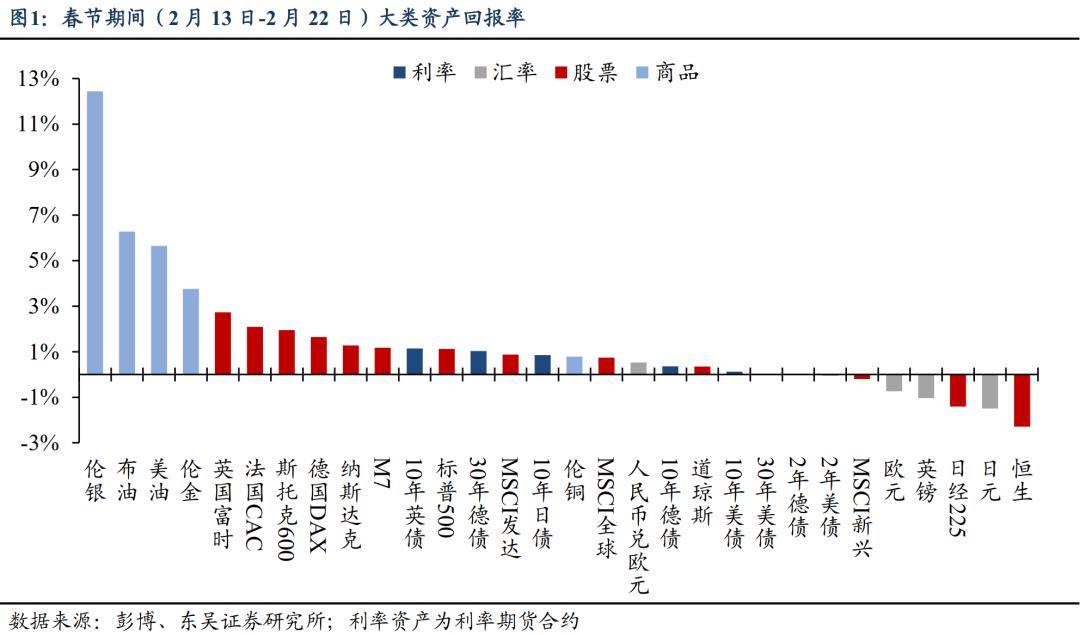
Market Overview - During the Spring Festival period, overseas markets were impacted by geopolitical tensions in Iran, ongoing concerns about AI in the US stock market, and the release of key economic data such as US CPI and GDP[2] - Gold and the US dollar index rose in tandem, while US Treasury yields, US stocks, and commodities initially declined before rebounding[2] Economic Data - The US GDP for Q4 2025 was reported at +1.4%, significantly below expectations of +2.8% and the previous quarter's +4.4%, primarily due to a -0.9% contribution from government spending[16] - Core CPI and PCE inflation remained sticky, with PCE inflation exceeding expectations, indicating ongoing inflationary pressures[14] Asset Performance - Silver led the performance among major assets during the Spring Festival with a 12.44% increase, driven by the escalation of the Iranian situation and rising oil prices[3] - European stock indices outperformed US stocks during this period, with the UK, France, and Germany leading the global equity market[3] Policy and Tariffs - The US Supreme Court ruled that Trump's IEEPA tariffs were illegal, leading to the announcement of a new 10% global tariff under Section 122, effective February 24[27] - Trump threatened to increase tariffs on certain economies from 10% to 15%, indicating potential legislative moves to solidify tariff legality[27] Future Outlook - The combination of better-than-expected US economic data and the Supreme Court ruling is expected to boost risk appetite, particularly benefiting export chains and cyclical sectors until mid-March[8] - A significant rebound in the US economy is anticipated in Q1 2026, driven by the end of the government shutdown's negative impact and the effects of previous interest rate cuts[26]
美银:应对地缘需“交易石油、持有黄金”,美股摆脱低迷需“两大外部冲击”
Hua Er Jie Jian Wen· 2026-02-23 03:09
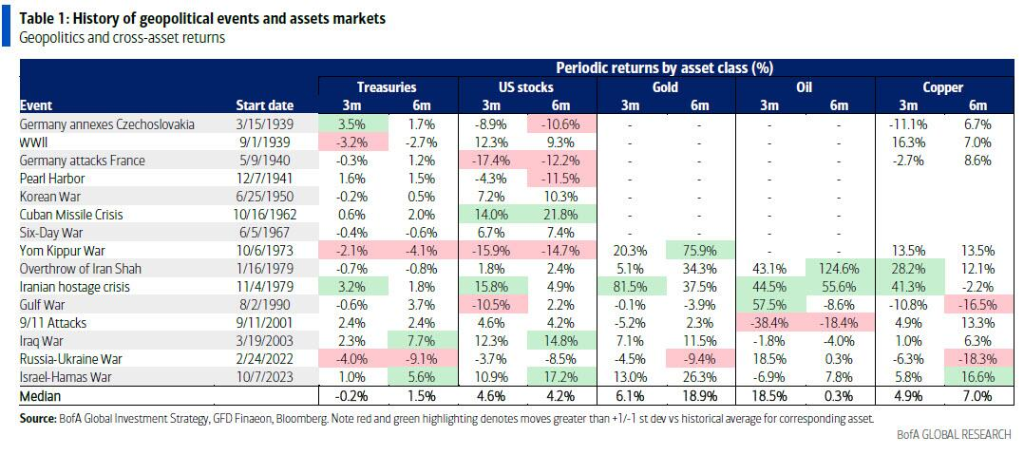
Core Viewpoint - The market logic for 2026 has fundamentally shifted, with significant differentiation within the AI concept and capital flows moving from the US to Japan and South Korea [1][2]. Group 1: Market Style Changes - The market is moving away from capital-intensive "spenders" like the tech giants (Mag7) and is embracing "builders" in infrastructure, such as semiconductors and raw materials [2]. - There is a notable shift in capital from "disruptors" (software stocks) to "applicators" of AI technology (banking stocks) [2]. - The current market is experiencing a high level of volatility, with technology, telecom, and financial sectors comprising 56% of the S&P 500 index, raising concerns about potential market collapse if the leading stocks decline faster than the rising ones [2]. Group 2: Geopolitical Trading Rules - Oil is expected to be the best-performing asset in 2026 due to geopolitical tensions, particularly between the US and Iran [3]. - Historical data indicates that oil typically sees an average increase of 18% in the first three months following geopolitical shocks, outperforming gold (+6%) and US stocks (+4%) [3]. - Over a six-month period, gold tends to outperform oil, with an average increase of 19%, while oil may give back its gains [3]. Group 3: External Shocks Needed for Market Breakthrough - The US stock market requires two external shocks to break its current high-level stagnation: a collapse in Middle Eastern oil prices and a potential easing of US-China trade tensions [5][6]. - A change in Middle Eastern regimes could ensure a stable oil supply, alleviating inflationary pressures [6]. - A potential trade agreement in April could help reduce tariffs, addressing inflation concerns and improving the approval ratings of the current administration [9]. Group 4: Capital Flow Trends - The "American exceptionalism" narrative appears to be waning, with only 26% of global stock fund inflows expected to go to US stocks in 2026, the lowest share since 2020 [10]. - Recent data shows record net inflows into international stock funds, particularly towards South Korea (storage chip concept) and Japan (reflation narrative), with South Korea experiencing the largest six-week net inflow of $17.7 billion [13]. Group 5: Bull & Bear Indicator Insights - The Bull & Bear Indicator currently stands at 9.4, indicating an "extreme bull market," just below the historical peak of 9.5 [16]. - Historical analysis shows that when this indicator exceeds 9.5, significant market corrections typically follow within three months, with the Nasdaq index averaging an 8.6% decline [19][20].

春节海外市场回顾:IEEPA违法后特朗普的Plan B
Sou Hu Cai Jing· 2026-02-23 02:06
Group 1: Major Asset Review - During the Spring Festival holiday, overseas markets experienced significant events including the escalation of the Iran geopolitical conflict, ongoing concerns regarding AI themes in the US stock market, and the release of important economic data such as CPI and GDP. Gold and the US dollar index rose, while US Treasury yields, stocks, and commodities initially declined before rebounding. Silver led the gains with a 12.44% increase, driven by the Iran situation and a Supreme Court ruling on tariffs [1][5][12] - The AI industry narrative showed divergence, with ongoing concerns about the valuation and monetization pace of US AI software, while Asian markets, particularly South Korea, reached new highs due to their core advantages in AI infrastructure [8][9] Group 2: Overseas Economic Insights - US economic data during the Spring Festival remained robust, with January core CPI and PCE inflation showing strong persistence. The Q4 2025 GDP was significantly below expectations due to government shutdown impacts, but other indicators like new housing starts and core durable goods orders exceeded forecasts, indicating overall steady growth [2][12][14] - The Q4 2025 US GDP growth rate was reported at 1.4%, well below the expected 2.8%, primarily affected by a -0.9% contribution from government spending, marking the largest drag since Q2 2020. Despite this, AI-related investments remained strong, and a rebound in government spending is anticipated to positively impact growth in Q1 2026 [14][21][26] Group 3: Overseas Political Developments - The US Supreme Court ruled that Trump's IEEPA tariffs were illegal, leading to the announcement of a new 10% global tariff under Section 122, effective February 24. Trump threatened to increase tariffs on certain economies to 15%. This legislative move may include broader fiscal measures to ensure the legality of the tariffs [3][27][30] - The ongoing negotiations between the US and Iran regarding nuclear issues have seen some progress, but key disagreements remain. Trump has set a deadline for resolution, indicating a preference for negotiation supplemented by limited military action if necessary [3][35]
AI盛宴的终局测试:软件崩盘与英伟达(NVDA.US)的财报时刻
智通财经网· 2026-02-22 05:46
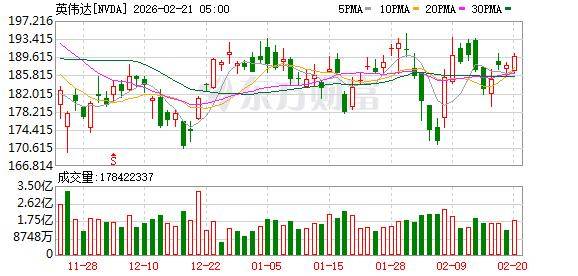
Core Insights - The software sector is experiencing a significant downturn, with the S&P 500 Software and Services Index dropping over 18% in a few weeks, leading to a nearly $1 trillion loss in market value. This reflects deeper structural anxieties about the impact of AI Agents on the software industry's value distribution logic [1][2] - OpenAI's release of the GPT-5.3-Codex-Spark model, based on Cerebras chips, signals a diversification in hardware dependencies, potentially weakening NVIDIA's GPU monopoly [1][5] - NVIDIA's upcoming earnings report is seen as a critical test of whether AI spending can continue to grow amid these challenges, with market expectations shifting towards the sustainability of cloud providers' capital expenditures [1][8] Software Industry Dynamics - The core concern driving the software sector's decline is not short-term profit fluctuations but a fundamental worry about the disruption of existing business models. The emergence of AI Agents threatens the traditional SaaS model, which has been a reliable growth engine for the tech industry [2] - AI Agents can bypass traditional user interfaces, allowing for more efficient workflows that could reduce the need for multiple software subscriptions, thereby diminishing software companies' pricing power and long-term growth expectations [2] AI Infrastructure Investment Logic - The investment logic for AI infrastructure is predicated on the assumption that application layers will continue to expand, driving demand for computational power. Major cloud providers have significantly increased their AI capital expenditures, with some seeing year-over-year increases exceeding 50% [3] Market Concerns and Implications - As software valuations decline, questions arise about the timing of returns on substantial investments in AI infrastructure. If application layers fail to generate sufficient profits to offset rising software subscription costs, demand for cloud computing resources may slow [4] - This could create a "bullwhip effect," where minor fluctuations in end-user demand lead to significant order volatility for upstream chip manufacturers like NVIDIA [4] Hardware Ecosystem Changes - OpenAI's shift to Cerebras chips represents a significant signal of hardware ecosystem diversification, although NVIDIA currently retains a dominant market share. The move indicates a strategic balance to avoid reliance on a single supplier [5][6] - The emergence of alternative chip solutions could challenge NVIDIA's pricing power and market dominance, especially if application layer profitability comes under pressure [6][7] NVIDIA's Earnings Report Significance - Analysts expect NVIDIA to report better-than-expected results due to existing order backlogs, but the market's focus will be on management's guidance regarding future capital expenditures and the sustainability of AI application profitability [8][9] - The key questions revolve around whether cloud providers will continue to expand data centers and if AI applications are beginning to generate scalable returns. A shift in market sentiment from "narrative" to "returns" could significantly impact NVIDIA's valuation [9][12] Conclusion - The downturn in the software industry signals a critical juncture in the AI revolution, with potential implications for the entire AI ecosystem. NVIDIA, while positioned at the top of the supply chain, is sensitive to changes in the application layer's profitability and growth dynamics [11][12] - The upcoming earnings report is not just about quarterly profits but also about the fundamental question of whether AI spending is driven by belief or actual cash flow. The market is awaiting clarity on NVIDIA's ability to sustain its growth narrative amid evolving industry dynamics [12]

关税风暴叠加美伊博弈 英伟达能否再救AI牛市?
Jing Ji Guan Cha Wang· 2026-02-22 02:26
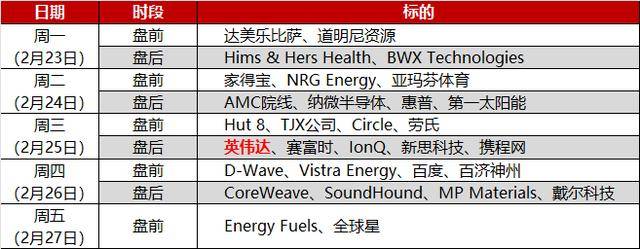
Group 1 - The US stock market rebounded this week, with all three major indices recording weekly gains, including the S&P 500 and Nasdaq Composite, both up over 1% [2] - Nvidia's upcoming earnings report is seen as a critical indicator for the sustainability of the AI boom, with Oppenheimer expecting results to exceed market expectations, although there are concerns about the difficulty of delivering surprises [4][5] - The software sector's earnings are becoming increasingly important due to the intensifying impact of AI, with BakerAvenue Wealth Management highlighting the need for companies to adapt and innovate [5] Group 2 - The market is facing uncertainty due to President Trump's announcement of a potential increase in tariffs from 10% to 15% on global goods, which may require market participants to digest this new information [3] - Upcoming economic events include speeches from Federal Reserve officials and key economic indicators such as the US consumer confidence index and PPI, which could influence market sentiment [6]


环球下周看点:关税风暴叠加美伊博弈英伟达能否再救AI牛市?
Sou Hu Cai Jing· 2026-02-22 00:41
Market Overview - The US stock market rebounded this week, with all three major indices recording weekly gains, including the S&P 500 and Dow Jones both rising over 1% [2] - The market sentiment was boosted by the US Supreme Court ruling that the Trump administration's large-scale tariff measures lacked clear legal authority [2] - However, uncertainty arose as Trump announced plans to increase the import tax rate on global goods from 10% to 15% and indicated that new legally permissible tariff measures would be announced in the coming months [2] Economic and Corporate Events - German Chancellor Merz is scheduled to visit Washington for talks with Trump regarding tariffs, aiming to present a unified EU stance [2] - The risk of military conflict between the US and Iran is increasing as negotiations stall, with officials from both countries and some Gulf and European diplomats indicating heightened tensions [2] - Trump's upcoming State of the Union address may address military actions in Iran, although the White House has not confirmed this [2] Earnings Reports and Market Sentiment - Earnings reports are crucial for determining the sustainability of market trends, with Oppenheimer expecting results to exceed market expectations [3] - Nvidia's performance is highly anticipated, but there are concerns that the market's expectations may make it difficult for the company to deliver surprises [3] - The importance of earnings reports in the software sector has increased due to the impact of AI, with BakerAvenue emphasizing the need for companies to adapt and innovate [4] Upcoming Economic Events - Key economic events next week include speeches from Federal Reserve officials and various economic indicators such as factory orders and consumer confidence [4] - Notable dates include Trump's State of the Union address and the release of the US PPI year-on-year data [4]
环球下周看点:关税风暴叠加美伊博弈 英伟达能否再救AI牛市?
Sou Hu Cai Jing· 2026-02-21 23:09
Group 1 - The US stock market rebounded this week, with all three major indices recording gains, including the S&P 500 and Nasdaq Composite, both up over 1% [1] - The Supreme Court's ruling against the Trump administration's large-scale tariffs under the International Emergency Economic Powers Act boosted market sentiment [1] - Trump announced plans to increase the global import tax rate from 10% to 15%, introducing new uncertainty for the market [1] Group 2 - Nvidia's upcoming earnings report is seen as a critical indicator for the sustainability of the AI boom, with expectations for results exceeding market forecasts [2] - The importance of earnings reports from the software sector has increased due to the intensifying impact of AI, with companies needing to adapt and innovate [3] - Despite weakness in tech stocks, sectors like energy, industrials, and consumer staples continue to support index performance [3] Group 3 - Key economic events next week include speeches from Federal Reserve officials and the release of various economic indicators, such as factory orders and consumer confidence [4] - Trump's State of the Union address is scheduled, which may provide insights into his administration's economic policies [4]
国联民生证券:今年美联储继续降息的概率依然不低
智通财经网· 2026-02-21 11:35
Group 1: Economic Outlook - The probability of the Federal Reserve continuing to cut interest rates this year remains high due to structural pressures on the economy and employment [1][16] - The U.S. GDP annualized quarter-on-quarter growth rate unexpectedly declined to 1.4% in the fourth quarter, indicating potential economic risks [1][16] - The K-shaped economic divergence in the U.S. is becoming more pronounced, with middle and low-income groups facing limited consumption capacity due to high inflation and stagnant wages [1][16] Group 2: Market Reactions - The overseas markets experienced significant movements during the Spring Festival, with oil prices leading among major assets due to the Iranian situation, while software stocks faced pressure from AI concerns [2] - The U.S. stock market was buoyed by earnings expectations and a recovery in risk appetite, despite concerns over potential fiscal pressures from the ruling on tariffs [2] Group 3: Geopolitical Factors - Geopolitical events, particularly the U.S.-Iran negotiations and developments in U.S.-China relations, are influencing global risk preferences and commodity prices [7][8] - The upcoming visit of former President Trump to China is seen as a critical moment for risk management and rule reconstruction between the two largest economies [8] Group 4: Tariff Developments - The Supreme Court's ruling that tariffs imposed by Trump were illegal represents a significant setback, leading to the potential return of approximately $175 billion in tariffs, which could exacerbate U.S. fiscal pressures [11][13] - Trump's administration is responding with temporary global tariffs under Section 122, which may reduce the impact of previous tariffs [11] Group 5: Investment Opportunities - Despite concerns over excessive investment in AI, the current adjustment in the AI sector is viewed as healthy, with structural opportunities still present, particularly in scarce hardware and quality model targets [5] - Gold is expected to regain its pricing value as volatility stabilizes, while oil prices may improve as supply-demand dynamics shift in the first quarter [7]

“AI颠覆一切”重创市场之际 “聪明钱”如何斩获阿尔法? 答案是短线战术操作
Zhi Tong Cai Jing· 2026-02-21 07:44
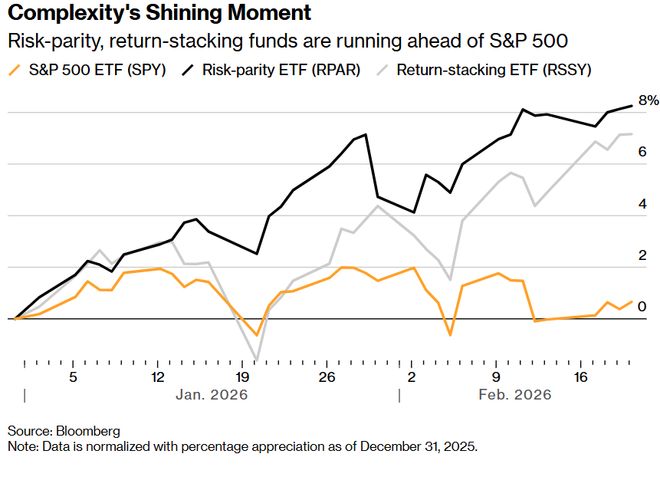
Core Insights - The article highlights that hedge funds and active stock pickers have outperformed benchmark indices due to market volatility driven by tariff fluctuations, AI disruption fears, and geopolitical tensions in the Middle East [1][7][10]. Group 1: Market Conditions - The current market is characterized by high instability and multiple factors causing disruption, including tariff uncertainties, AI-related concerns impacting software and growth sectors, and escalating geopolitical tensions in the Middle East [5][6][9]. - The S&P 500 software and services index has dropped approximately 15% since late January, erasing nearly $1 trillion in market value due to fears surrounding AI's disruptive potential [6][9]. Group 2: Investment Strategies - Hedge funds employing short-term tactical strategies and active stock selection have achieved significant "alpha" returns, outperforming the S&P 500 index by nearly double in recent months [7][12]. - The Bloomberg All Hedge Index reported a nearly 3% increase in hedge fund performance, marking the best relative performance against the S&P 500 in over two years [12][16]. - Complex strategies such as risk parity and return stacking have shown superior performance compared to traditional buy-and-hold strategies, which have become less effective in the current volatile environment [5][6][11]. Group 3: Economic Indicators - Bond yields, credit spreads, and the S&P 500 index have remained relatively stagnant, contrasting with the dynamic nature of short-term tactical trading favored by institutional investors [2][17]. - The market is currently not a passive investment paradise but rather a phase where tactical opportunities exist amidst liquidity and directional challenges [8][18].
阿波罗高管警告:私募股权软件投资"多车连环相撞",行业面临估值重置
Sou Hu Cai Jing· 2026-02-20 21:23
Core Viewpoint - The private equity industry is facing a reckoning due to the disruptive impact of artificial intelligence on software investments, as highlighted by Apollo Global Management's partner David Sambur [1][3]. Group 1: Industry Insights - Apollo Global Management manages approximately $938 billion in assets and has expressed concerns about the industry's failure to recognize the transformative effects of AI on the software sector [1]. - Sambur noted that signs of impending trouble were evident as early as 2022, particularly following the launch of ChatGPT by OpenAI and the rising interest rates, which have contributed to the current challenges [3]. - The private equity sector invested a record $348 billion in the Software as a Service (SaaS) space in 2021, raising questions about the concentration of investments and potential risks associated with groupthink [3]. Group 2: Current Market Conditions - Many software investments made during the pandemic are nearing the end of their traditional holding periods, creating uncertainty about whether these assets can be exited at favorable prices, which may impact fundraising and deal-making in the private equity sector [3]. - Sambur emphasized the need for the industry to prepare for a "much-needed valuation reset" [3]. Group 3: Apollo's Position - Apollo has disclosed a "zero exposure" to the software sector within its private equity business, with overall exposure to the sector being less than 2% [4]. - Despite this cautious stance, Apollo's stock has declined by over 14% this year [4]. - From 2015 to 2025, private equity buyers have acquired over 1,900 software companies, with total transaction values exceeding $440 billion [4]. Group 4: Other Firms' Responses - Other notable merger and acquisition firms, such as Thoma Bravo and Vista Equity Partners, have been meeting with investors to reassure them about their limited or manageable exposure to the software sector [5].