先进制造业

Search documents
上市公司如何打破“中年危机”? 人工智能成为企业发展新动能
Hua Xia Shi Bao· 2025-11-22 14:13
Core Insights - The 20th Central Committee of the Communist Party of China emphasizes high-quality development as the main theme for the 14th Five-Year Plan period, highlighting the importance of enterprises as micro-subjects of economic and social development [2][3] - Chinese enterprises, particularly private ones, face a complex and uncertain development environment, necessitating a focus on cultivating new productive forces and enhancing survival capabilities [2] - The "mid-life crisis" phenomenon among listed companies indicates that after reaching maturity, companies may experience a decline in health, which requires attention from older listed firms [4][5] Group 1: High-Quality Development - The focus on industrial transformation and upgrading is essential for achieving high-quality development and creating world-class enterprises [6] - Traditional industries need optimization through equipment upgrades, technological advancements, and brand building to enhance high-end product supply [6] Group 2: AI as a New Growth Driver - The application and maturity of artificial intelligence (AI) in Chinese enterprises have significantly increased, with a strong expectation for further growth in AI application over the next 12 months [7][8] - The integration of AI into business models is becoming more mature, driving innovation across various sectors [7][8] Group 3: Corporate Health Index - The newly established Corporate Sustainable Development Health Index (CSHI) aims to provide a standard for evaluating high-quality sustainable development among enterprises [4] - The CSHI shows a non-linear relationship with company age, indicating that health levels improve initially but may decline as companies mature, signaling potential "mid-life crises" [5]


——2026年度策略展望:牛市第三年,时间重于空间
EBSCN· 2025-11-21 10:43
Group 1: Long-term Bull Market Foundation - The current bull market has lasted over a year, with the index performance approaching a structural bull market, indicating significant room for growth compared to previous comprehensive bull markets [15] - The improvement in liquidity is a key factor for the current bull market, but historical trends show that long-term bull markets are often supported by improved fundamental expectations [19][28] - The relationship between market performance and fundamentals becomes more stable over longer time periods, emphasizing the importance of fundamental factors for sustained market performance [19] Group 2: Earnings Stability and Structural Highlights - In 2026, price changes are expected to become a major driver of earnings, with A-share earnings projected to gradually recover, reaching a growth rate of approximately 10% [2][82] - The recovery in prices is anticipated to be driven by policies aimed at stabilizing prices and demand, which will alleviate downward pressure on prices in various industries [69] - The structural highlights in earnings are expected to come from sectors like AI and semiconductors, which are likely to continue their performance validation [82] Group 3: Focus on Resident Funds and the "14th Five-Year Plan" - Resident funds are the most significant source of capital for the A-share market, with a notable trend of "deposit migration" expected to continue, driven by higher relative returns in the capital market [89][90] - High-risk preference funds have been the main incremental source of capital in the current bull market, similar to trends observed in 2015 [90] - Middle-risk preference funds are anticipated to become a major incremental source in the next phase, particularly as the "money-making effect" of public funds becomes more evident [106][111] Group 4: Industry Main Lines and Potential Switches - The TMT and advanced manufacturing sectors are expected to remain the main lines of the bull market in 2026, with significant growth potential as they enter the second phase of the bull market [5][91] - There may be potential sectoral switches, particularly towards cyclical and financial sectors, as market conditions evolve [5][109] - The focus on technology growth, consumption, and resource sectors is expected to present thematic investment opportunities [5][110]
晶采观察丨有“量”有“质” 中西部地区外贸“新”潮涌动
Yang Guang Wang· 2025-11-21 06:33
Core Insights - The article highlights the significant growth of cross-border exports in Zhengzhou, with a nearly fourfold increase in value in the first ten months of the year, reflecting the robust development of foreign trade in China's central and western regions [1] - The total import and export value of goods in the central and western regions reached 6.68 trillion yuan, leading the national foreign trade growth rate [1] - The regions are focusing on both quantity and quality improvements in foreign trade, supported by upgraded logistics and favorable policies [1][2] Group 1: Quantity Growth - The central and western regions are experiencing a notable increase in foreign trade volume, driven by continuous upgrades in transportation and logistics [1] - Zhengzhou has established an efficient cross-border logistics network through the "Air Silk Road" and the China-Europe Railway Express, enhancing trade efficiency [1] - Policy incentives, such as the establishment of cross-border e-commerce pilot zones, have simplified customs processes and reduced operational costs for businesses [1] Group 2: Quality Improvement - The transformation of foreign trade in the central region is shifting from quantity to quality, with a focus on industrial upgrades and brand development [2] - Local industries are moving from passive order-taking to proactive international expansion, exemplified by brands like Xuchang wigs and Luoyang steel cabinets [2] - The export structure is optimizing, with "new three types" of products seeing a 47.35% increase, and electric vehicles experiencing a remarkable growth rate of 125.39% [2]
刘泉红:锚定强国建设推进产业体系现代化
Jing Ji Ri Bao· 2025-11-21 00:04
Core Viewpoint - The modernization of the industrial system is the material and technical foundation for China's modernization, emphasizing the importance of a robust real economy and a modernized industrial system as key to building a socialist modernized strong country [1][2][3]. Group 1: Importance of Modern Industrial System - The establishment and development of any social economic system are supported by a corresponding material foundation, with a modern industrial system being crucial for modernization [2]. - Successful modernization in various countries has been linked to the process of industrial system modernization, which provides a strong material basis for economic development [2]. - The lack of a modern industrial system in some developing countries has led to insufficient and unsustainable modernization [2]. Group 2: Strategic Tasks and Goals - The "14th Five-Year Plan" prioritizes the construction of a modern industrial system and the consolidation of the real economy as the first strategic task [1]. - The construction of a modern industrial system is a long-term and complex systemic project that requires a focus on the real economy and the continuous upgrading of traditional industries alongside the cultivation of emerging industries [4][12]. Group 3: Key Directions for Development - The modernization of the industrial system should focus on three main directions: intelligent, green, and integrated development [5][7][8]. - Intelligent development involves deep transformation across the entire production chain, utilizing data and AI technologies to create a smart industrial ecosystem [6]. - Green transformation aims to integrate low-carbon and circular economy principles throughout the industrial process, emphasizing the importance of green technology innovation [7]. Group 4: Enhancing Traditional Industries - Traditional industries play a crucial role in maintaining a reasonable proportion of manufacturing and ensuring the integrity of the industrial system [12]. - The optimization and upgrading of traditional industries are essential to avoid the structural dilemmas faced by developed countries due to deindustrialization [12]. - New technologies, particularly digital and green technologies, are reshaping traditional production models and development paths [12]. Group 5: Fostering New and Future Industries - The intersection of the new technological revolution and industrial transformation presents significant opportunities for building a modern industrial system [13]. - China has made notable advancements in sectors like renewable energy, establishing competitive supply chains and leading in technology innovation [13]. - Future industries driven by cutting-edge technologies require a robust mechanism for disruptive innovation and risk-sharing [13]. Group 6: Service Industry Development - The service industry is a vital component of the modern industrial system, with its share of GDP expected to increase as industrialization progresses [14]. - Enhancing the quality and efficiency of the service industry can drive industrial transformation and meet the evolving needs of society [14]. - There is significant potential for growth in China's service sector, particularly in high-end and quality service offerings [14]. Group 7: Infrastructure Development - A modernized infrastructure system is essential for the efficient operation of the industrial system, influencing resource allocation and economic efficiency [15][16]. - China has made substantial progress in infrastructure development, including extensive transportation networks and digital infrastructure [16]. - Addressing existing imbalances and enhancing the adaptability of infrastructure is crucial for supporting the modernization of the industrial system [16].
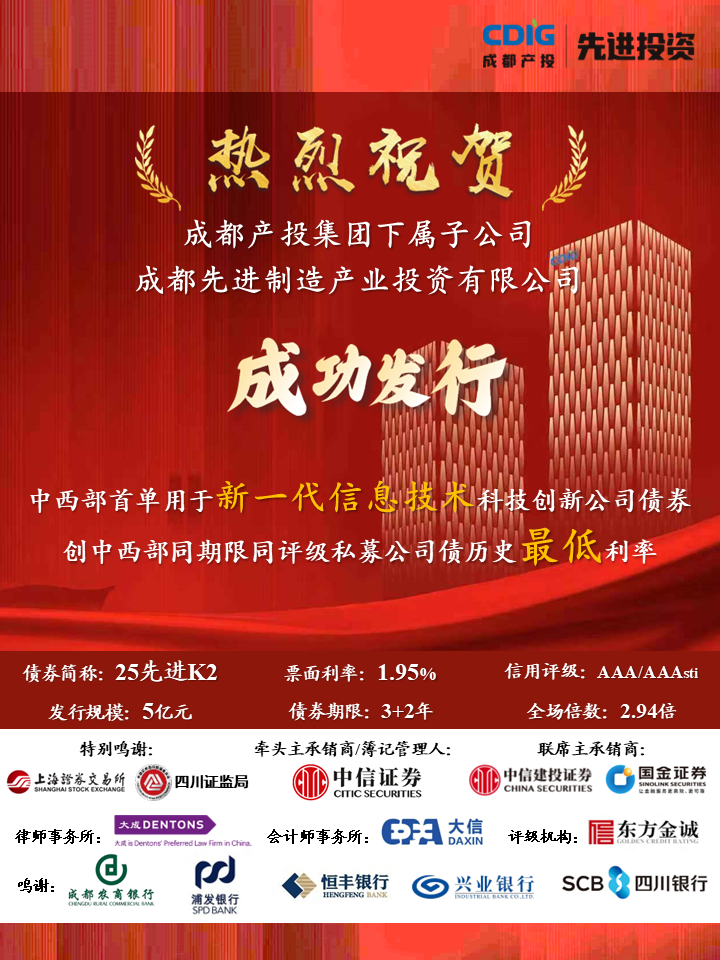
中西部首单落地!成都先进投资公司成功发行新一代信息技术科创债
Mei Ri Jing Ji Xin Wen· 2025-11-18 14:03
Core Viewpoint - Chengdu Advanced Manufacturing Industry Investment Co., Ltd. successfully issued the first technology innovation bond for new generation information technology in the Midwest, marking a significant step in market-oriented financing for state-owned enterprises [1][3] Group 1: Bond Issuance Details - The bond issuance amounted to 500 million yuan, with a term of 3+2 years and a coupon rate of 1.95%, which is the lowest historical rate for similar bonds in the Midwest [4] - The funds raised will be specifically allocated to projects related to new generation information technology, targeting the electronic information industry cluster in the province [4] Group 2: Strategic Importance - The issuance aligns with Sichuan's strategy to build an innovative hub for national technological self-reliance and secure supply chains, requiring diverse capital and financial participation [4] - This bond issuance reflects the capital market's high recognition of the company's comprehensive strength and strategic alignment [3][4] Group 3: Company Performance and Future Plans - Since its establishment, the company has invested over 50 billion yuan, driving total investments exceeding 400 billion yuan, and has actively engaged in various industrial funds [5] - The company has achieved significant growth, with total assets exceeding 60.3 billion yuan and profits over 940 million yuan, reflecting a compound annual growth rate of approximately 31% and 56% respectively [6] - Moving forward, the company aims to leverage this bond issuance to enhance its investment capabilities in advanced manufacturing and attract major industrial projects [6]
肇庆前三季GDP增长4.6%,先进制造业增速近三成领跑
Nan Fang Du Shi Bao· 2025-11-18 12:28
Economic Overview - The GDP of Zhaoqing reached 212.48 billion yuan in the first three quarters of 2025, reflecting a year-on-year growth of 4.6%, indicating robust economic performance and structural optimization [2] Agriculture Sector - The total output value of agriculture, forestry, animal husbandry, and fishery reached 51.226 billion yuan, with a year-on-year growth of 5.5%, showcasing a solid agricultural foundation [3] - Major agricultural products such as vegetables, pigs, and aquatic products saw stable growth, ensuring sufficient supply for residents [3] - Agricultural professional and auxiliary activities grew by 11.5%, indicating improvements in socialized services and professional management in agriculture [3] Industrial Sector - The industrial economy showed a stable overall performance with a year-on-year increase of 4.0% in the added value of industrial enterprises above designated size [4] - Advanced manufacturing, particularly in the automotive sector, grew by 17.8%, while electrical machinery and equipment manufacturing increased by 15.2% [4] - The added value of advanced manufacturing rose by 15.9%, and advanced equipment manufacturing surged by 27.3%, highlighting strong industrial upgrading [4] Consumer Market - The total retail sales of consumer goods reached 92.179 billion yuan, with a year-on-year growth of 2.7%, indicating a steady recovery in the consumer market [5] - Sales of upgraded consumer goods, such as home appliances and audio-visual equipment, saw significant increases of 74.8% and 63.0%, respectively, reflecting a growing demand for quality living [5] - Online consumption remained active, with retail sales through public networks growing by 8.2% [5] Financial Support and Price Stability - The balance of various loans in the city grew by 7.2% by the end of September, outpacing deposit growth, indicating strong financial support for the real economy [6] - The Consumer Price Index (CPI) decreased by 0.5% year-on-year, with notable declines in food prices, helping to lower living costs for residents [7] Economic Resilience - Despite challenges in fixed asset investment, positive trends are emerging, such as a narrowing decline in commodity housing sales by 4.8 percentage points compared to the first half of the year [8] - Overall, Zhaoqing's economy is enhancing its internal driving force amid structural adjustments, with expectations for sustainable and high-quality development as growth policies take effect [8]

黄群慧:现代化产业体系要统筹好产业政策与竞争政策
Jing Ji Guan Cha Bao· 2025-11-18 11:57
Core Viewpoint - The article emphasizes the need to effectively integrate industrial policy and competition policy to build a modern industrial system, moving beyond the binary debate of whether to have industrial policy or not [2][4]. Group 1: Modern Industrial System - The construction of a modern industrial system should focus on advanced manufacturing as its backbone, reflecting a deeper understanding of economic development stages [4]. - The current manufacturing sector in China accounts for approximately 30% of GDP, and there is a need to maintain a reasonable proportion of manufacturing within the economy [4][5]. - The article highlights the issue of "premature de-manufacturing," where the domestic manufacturing share is declining, while China's global manufacturing share is increasing [5]. Group 2: Policy Coordination - The integration of industrial policy and competition policy should be based on the maturity of technology, with different focuses at various stages of industrialization [6]. - For emerging industries with unclear technological paths, competition policy should be emphasized to encourage innovation, while industrial policy can provide directional guidance [6]. - The article suggests that R&D investment should be significantly increased, with a target of 12% during the 14th Five-Year Plan, although achieving this may be challenging [7]. Group 3: Addressing "Involution Competition" - "Involution competition" is identified as a fundamental issue in building a unified market, affecting both micro and macroeconomic levels [9][10]. - The article discusses the need for unified government actions to enhance overall efficiency and facilitate the free flow of resources across regions [9]. - The emergence of platform economies is noted as a new characteristic of "involution competition," where platforms exert significant pricing power over the entire supply chain [10][11].
长三角释放高质量发展动能
Guo Ji Jin Rong Bao· 2025-11-18 09:11
Core Insights - The Yangtze River Delta (YRD) region, comprising Shanghai, Jiangsu, Zhejiang, and Anhui, achieved a combined GDP of 25.18 trillion yuan in the first three quarters of 2025, accounting for 24.81% of the national GDP, reinforcing its status as a key economic driver in China [1][2][3] Economic Performance - The YRD's economic growth remains robust, with Jiangsu leading at 10.28 trillion yuan, followed by Zhejiang (6.85 trillion yuan), Shanghai (4.07 trillion yuan), and Anhui (3.98 trillion yuan), all showing growth rates above the national average [2][3] - Among 41 cities in the YRD, 31 cities outpaced the national average growth rate of 5.2%, with 14 cities exceeding 6% growth [3][4] City Development Dynamics - The first tier of cities includes nine trillion-yuan cities, with Shanghai, Suzhou, Hangzhou, Nanjing, Ningbo, Wuxi, Hefei, Nantong, and Changzhou contributing significantly to the regional economy, collectively accounting for 57.6% of the YRD's total GDP [3][4] - The second tier includes cities with GDPs between 600 billion and 800 billion yuan, while the third tier consists of cities with GDPs between 500 billion and 600 billion yuan, indicating a balanced regional development [4] Industrial Growth and Transformation - Advanced manufacturing is identified as a cornerstone of the YRD economy, with Shanghai's tertiary sector contributing 79.1% to its GDP, and significant growth in high-tech manufacturing sectors [6][7] - Jiangsu's high-tech industries accounted for 51.8% of its industrial output, with notable growth in sectors like optical fiber and lithium-ion battery manufacturing [6][7] Consumption and Market Dynamics - The recovery of the consumer market is contributing to the YRD's high-quality development, with diverse drivers such as policy incentives boosting physical consumption [9][10] - Jiangsu leads in social retail sales, reflecting its substantial consumer market potential, while Zhejiang's growth in retail sales is supported by digital economy integration and innovative consumption models [10][11] Competitive City Aspirations - Cities like Wenzhou and Xuzhou are on track to achieve trillion-yuan GDP status, with Wenzhou focusing on private sector growth and Xuzhou leveraging national strategic support [11][12] - The successful elevation of these cities would expand the YRD's "trillion-yuan club" to 11 members, enhancing the region's economic influence nationally [14]

我省推动先进制造业和现代服务业全要素宽领域高水平深度融合
Zheng Zhou Ri Bao· 2025-11-18 08:51
Core Viewpoint - The provincial government has issued a notification to promote the integration of advanced manufacturing and modern service industries, aiming to cultivate development zones that enhance productivity and establish a modern industrial system [1] Group 1: Development Goals - The notification outlines a "1+2+4+N" target task system, focusing on key areas and critical links to deepen the integration of manufacturing and service industries [1] - The plan aims to cultivate around 20 innovative development zones annually, characterized by significant quality and efficiency, and a sound ecological system [1] Group 2: Application and Criteria - The application for the integration development zones is open to counties and provincial-level development zones, with specific criteria including a manufacturing value-added ratio of over 30% and a GDP exceeding 20 billion yuan for counties or 10 billion yuan for development zones [1] - The application process will occur annually, with a focus on significant achievements in transforming manufacturing enterprises towards service-oriented models [1] Group 3: Key Tasks - Eight major tasks are highlighted for the development zones, including the establishment of application scenarios that leverage technologies such as digital twins, IoT, and AI [2] - The cultivation of leading enterprises and specialized service providers is emphasized to enhance collaboration and innovation across the industry chain [2] - The construction of platforms and service centers to support common service needs in manufacturing is also a priority, alongside the promotion of brand development and evaluation [2]
人力资源服务业与制造业融合发展 深圳入选国家级试点城市
2 1 Shi Ji Jing Ji Bao Dao· 2025-11-18 03:27
Core Viewpoint - The Ministry of Human Resources and Social Security has issued a notice to promote the integration of human resources services with the manufacturing industry, with 39 cities, including Guangzhou and Shenzhen, selected for pilot tasks [1][4]. Group 1: Shenzhen's Initiatives - Shenzhen will focus on key industries, enterprises, and tasks through innovative mechanisms, enhancing labor security for manufacturing, expanding service networks, and nurturing emerging business formats [1][3]. - The city plans to establish recruitment and training joint bodies to encourage social participation and facilitate collaboration between manufacturing companies and human resources service agencies [3]. - A mechanism for adjusting labor supply and demand will be explored, ensuring that key industries and enterprises meet their labor needs [3]. Group 2: Human Resources Service Development - Shenzhen aims to create four human resources service industry clusters, including dedicated recruitment service areas for manufacturing within the China Shenzhen Human Resources Service Industry Park [3]. - The city will leverage advanced technologies like artificial intelligence to develop intelligent human resources products, promoting innovation and cross-industry integration [3]. - Support will be provided for human resources service agencies to accompany manufacturing enterprises in their overseas expansion, offering comprehensive human resources services [3]. Group 3: National Context - By the end of 2024, there will be 74,000 various human resources service institutions nationwide, employing 1.09 million people, providing services to 300 million laborers annually during the 14th Five-Year Plan period [4]. - The selected pilot cities cover major economic and manufacturing regions across the country, indicating a strong foundation for human resources services and advanced manufacturing clusters [4].