光伏电池

Search documents
建邦材料有限有限公司 (前称為建邦高科有限公司)(H0290) - 申请版本(第一次呈交)
2025-11-06 16:00
香港聯合交易所有限公司與證券及期貨事務監察委員會對本申請版本的內容概不負責,對其準確性 或完整性亦不發表任何意見,並明確表示概不就因本申請版本全部或任何部分內容而產生或因倚賴 該等內容而引致的任何損失承擔任何責任。 Janbon High Tech Co., Ltd. 建 邦 高 科 有 限 公 司 (「本公司」) (於開曼群島註冊成立的有限公司) 的申請版本 警 告 本申請版本乃根據香港聯合交易所有限公司(「聯交所」)及證券及期貨事務監察委員會(「證監會」)的 要求而刊發,僅用作提供資訊予香港公眾人士。 本申請版本為草擬本,其內所載資料並不完整,亦可能會作出重大變動。您閱覽本文件,即代表您知 悉、接納並向本公司、其獨家保薦人、整體協調人、顧問或包銷團成員表示同意: 倘於適當時候向香港公眾人士提出要約或邀請,準投資者務請僅依據呈交香港公司註冊處註冊的本 公司招股章程作出投資決定;有關文本將於發售期內向公眾刊發。 (a) 本文件僅為向香港公眾人士提供有關本公司的資料,概無任何其他目的;投資者不應根據本文 件中的資料作出任何投資決定; (b) 在聯交所網站登載本文件或其任何補充、修訂或更換附頁,並不引起本公司、其 ...
永和智控:曹德莅所持公司股份累计被司法冻结200万股
Mei Ri Jing Ji Xin Wen· 2025-10-30 11:42
Company Overview - Yonghe Intelligent Control (SZ 002795) announced that as of the disclosure date, the controlling shareholder and actual controller, Mr. Cao Deli, holds approximately 43 million shares, accounting for 9.65% of the total share capital [1] - Mr. Cao has pledged a total of 4.5 million shares, which represents 10.46% of his holdings and 1.01% of the total share capital [1] - Additionally, 2 million shares held by Mr. Cao have been judicially frozen, accounting for 4.65% of his holdings and 0.45% of the total share capital [1] Financial Performance - For the first half of 2025, Yonghe Intelligent Control's revenue composition is as follows: Industrial sector accounts for 89.41%, Medical services and others account for 10.57%, and Photovoltaic battery cells account for 0.02% [1] - As of the announcement date, Yonghe Intelligent Control has a market capitalization of 2.3 billion yuan [1]

易成新能前三季减亏55%背后:战略转型进行时,现金流挑战犹存
3 6 Ke· 2025-10-29 00:31
Core Viewpoint - Yicheng New Energy's Q3 2025 report reveals a contradictory picture of revenue growth, narrowing losses, and tight cash flow, alongside high accounts receivable [1][3]. Financial Performance - For Q3 2025, the company reported revenue of 9.41 billion yuan, a year-on-year increase of 20.23%, while net loss was 950.34 million yuan, with a non-recurring net loss of 985.18 million yuan [1]. - Year-to-date revenue reached 30.1 billion yuan, up 12.79% year-on-year, but net loss was 2.65 billion yuan, showing a reduction in losses compared to the previous year [1]. - The operating cash flow net amount was -357 million yuan, a decrease of 406 million yuan year-on-year, indicating ongoing cash flow issues [1][4]. Business Transformation - The company has undergone significant strategic adjustments, moving from substantial losses in 2024 to a path of recovery, albeit with challenges [1][2]. - The decline in revenue in 2024 was primarily due to a sharp drop in battery cell sales and falling prices of graphite electrode products [1][2]. Cash Flow Crisis - The cash flow situation remains dire, with a net cash flow decrease of 816.14% year-on-year and accounts receivable reaching 2.246 billion yuan, a 37.34% increase from the beginning of the year [4]. - Accounts receivable and notes receivable combined amount to approximately 2.703 billion yuan, accounting for 89.78% of revenue, indicating that most sales have not converted into actual cash flow [4]. - The company's monetary funds stood at 1.285 billion yuan against interest-bearing liabilities of 4.363 billion yuan, resulting in a monetary funds to current liabilities ratio of only 30.83%, highlighting weak short-term debt repayment capacity [4]. Strategic Layout - Yicheng New Energy is focusing on "high-end carbon materials" and "new energy storage" as its main business areas, having divested from the loss-making photovoltaic cell business [5][6]. - The acquisition of Shanxi Meishanhu Company has strengthened the company's graphite electrode production capacity, with an expected increase in overall profitability [6]. - The company is also expanding its new energy storage capabilities through acquisitions and partnerships, including a framework cooperation agreement with CATL's subsidiary [6]. - The strategic restructuring is supported by the controlling shareholder, China Pingmei Shenma Group, which is undergoing a strategic merger with Henan Energy Group, potentially providing new resource integration opportunities [6]. Industry Insight - Yicheng New Energy's experience reflects broader trends in China's renewable energy sector, emphasizing the need for companies to balance innovation with stability amid technological changes and market fluctuations [7]. - The path to profitability and sustainable cash flow remains a critical challenge for the company, as it seeks to navigate its transformation [7].

永和智控光伏电池片业务营收占比仅0.02% 拟折价五成剥离亏损资产
Chang Jiang Shang Bao· 2025-10-14 07:49
Core Viewpoint - Yonghe Intelligent Control is facing challenges in its photovoltaic business and is actively pursuing the divestiture of its loss-making assets [1][2][3] Group 1: Business Performance - In 2023 and 2024, Yonghe Intelligent Control reported revenues of 948 million yuan and 823 million yuan, representing year-on-year decreases of 4.19% and 13.19% respectively, with net losses of 156 million yuan and 297 million yuan [1] - The photovoltaic cell business generated only 198,940 yuan in revenue in 2024, a staggering year-on-year decline of 95.18%, accounting for just 0.24% of total revenue, with a gross margin of -3020.96% [1] - For the first half of 2025, the company achieved revenues of 367 million yuan, down 12.88% year-on-year, with net losses of 37.62 million yuan and 35.20 million yuan, reflecting a reduction in losses of 33.1% and 36.52% respectively [2] Group 2: Asset Divestiture - Yonghe Intelligent Control announced the termination of a 61.4 million yuan deal to transfer 51% of its stake in Taixing Pule New Energy Technology Co., Ltd. to Shenzhen Fanrong Industrial Co., Ltd. [1] - Following the termination, the company quickly listed the 51% stake in Taixing Pule and all related debts for public sale, with a minimum listing price of 30.49 million yuan [2] - The price for the 51% stake has decreased by 50% compared to the previous transaction [3] Group 3: Financial Status of Taixing Pule - Taixing Pule reported revenues of 6.95 million yuan and 58,800 yuan for 2024 and the first five months of 2025, with net losses of 195 million yuan and 44.09 million yuan respectively [3] - As of May 2025, Taixing Pule had total assets of 273 million yuan and negative net assets of 30.4 million yuan, indicating a state of insolvency [3] Group 4: Control Change - Yonghe Intelligent Control is in the process of changing its control structure, with the current controlling shareholder planning to transfer control through share transfers and voting rights delegation [3]
永和智控:10月10日召开董事会会议
Mei Ri Jing Ji Xin Wen· 2025-10-13 11:46
Core Viewpoint - Yonghe Intelligent Control announced a temporary board meeting to discuss the public transfer of 51% equity and debt of Puluo New Energy Technology (Taixing) Co., Ltd. [1] Company Summary - Yonghe Intelligent Control's revenue composition for the first half of 2025 is as follows: Industrial sector accounts for 89.41%, medical services and others account for 10.57%, and photovoltaic cell production accounts for 0.02% [1] - As of the report date, Yonghe Intelligent Control has a market capitalization of 2.2 billion yuan [1]
本周3家上市、11家递表,今年香港上市累计募资1465亿 | 香港IPO周报(截至20250919)
Xin Lang Cai Jing· 2025-09-22 05:37
Group 1 - The core viewpoint of the news highlights the recent IPO activities in Hong Kong, with a total of 293 companies having submitted applications this year, resulting in 64 listings, including 61 IPOs that raised a total of HKD 1,464.98 billion [2] - This week, three companies are set to be listed: He Meng (02525.HK) with a market capitalization of HKD 41.60 billion and a decline of 7.24%, Health 160 (02656.HK) raising HKD 4.00 billion with a significant increase of 138.69%, and Jingfang Pharmaceutical-B (02595.HK) with HKD 18.20 billion and a rise of 106.47% [1] - The companies that submitted applications this week include Xianweida Biotechnology-B, Shiyoupai, Ruoyuchen, Shimeite, Huqin Technology, Nuandong Insight, Aikemu Fa-B, Beijing Junzheng, Zhongrun Solar Energy, and New Element-B, all scheduled for submission on September 15-19 [3] Group 2 - The total amount raised through IPOs this year in Hong Kong is HKD 1,464.98 billion, indicating a robust market despite fluctuations in individual stock performances [2] - The significant percentage increases in the stock prices of Health 160 and Jingfang Pharmaceutical-B suggest strong investor interest and market confidence in these sectors [1] - The diverse range of industries represented in the recent applications, including biotechnology, consumer electronics, and insurance technology, reflects the dynamic nature of the Hong Kong IPO market [3]

数字龙头齐聚港交所 2家净利过亿过会丨IPO一周要闻
Sou Hu Cai Jing· 2025-09-21 00:11
Group 1: IPO Market Activity - The Hong Kong IPO market has seen a surge in diverse companies, including leaders in digital healthcare and lidar technology, with significant activity from sectors like prefabricated steel structures and photovoltaic cells [2][3] - Health160, China's largest digital healthcare service platform, saw its stock price soar by 137.34% on its debut, covering over 260 cities and connecting 44,600 medical institutions [6] - Hesai Technology, a leader in the lidar sector, achieved a dual listing on both US and Hong Kong exchanges, with a market capitalization exceeding HKD 36 billion on its first day [7][8] Group 2: Companies Approved for IPO - Yuan Chuang Technology has received approval for its mainboard IPO, focusing on the research, production, and sales of rubber tracks for agricultural and engineering machinery, with projected revenues of CNY 1.261 billion in 2022 [4] - New Guangyi, a high-tech enterprise specializing in high-performance functional materials, also received approval for its IPO, with revenues expected to grow from CNY 455 million in 2022 to CNY 657 million in 2024 [5] Group 3: New Listings - Jinfang Pharmaceutical made its debut on the Hong Kong Stock Exchange, with an opening surge of 115.79%, focusing on innovative therapies for tumors and autoimmune diseases [9] - Meilian Steel Structure, a prefabricated steel structure service provider, has refiled for an IPO, reporting a revenue increase of 180% year-on-year for the first half of 2025 [10][11] Group 4: Upcoming IPOs - Zijin Gold International plans to raise approximately USD 3.2 billion through its IPO, potentially becoming the largest IPO since May, coinciding with record-high gold prices [17][18] - Huakin Technology, a leading smart product platform, has submitted its IPO application, reporting a revenue increase of 113.06% year-on-year for the first half of 2025 [12]

麦科田拟港股IPO获中国证监会接收材料
Zhi Tong Cai Jing· 2025-09-19 12:22
Group 1: Macotian - Macotian plans to conduct an IPO in Hong Kong and has received material acceptance from the China Securities Regulatory Commission for its full circulation application [1] - The company offers a comprehensive product portfolio that meets clinical needs across various healthcare settings, including hospitals and community health centers [1] - As of June 30, 2025, Macotian has commercialized over 50 life support products, 80 minimally invasive products, and 210 in vitro diagnostic products, with a presence in over 140 countries and regions [1] Group 2: Shengwei Times - Shengwei Times is a provider of urban ride-hailing services and intercity passenger transport information services in China, ranking 14th in the ride-hailing market by GTV in 2024 [2] - The company has undertaken digital passenger transport projects in 17 provinces, autonomous regions, and municipalities as of June 30, 2025 [2] - Shengwei Times collaborates with various passenger transport companies to offer customized services, establishing operations in over 30 provinces and regions [2] Group 3: Zhongrun Solar Energy - Zhongrun Solar Energy specializes in the manufacturing and sales of N-type and P-type photovoltaic cells, with vertical expansion into the photovoltaic module industry [3] - The company ranks second globally in photovoltaic cell manufacturing by external shipment volume, holding a market share of 14.6% for the year 2024 [3] - Zhongrun Solar Energy has a market share of 18.3% among specialized photovoltaic cell manufacturers, serving over 1,000 customers across more than 32 countries and regions [3]
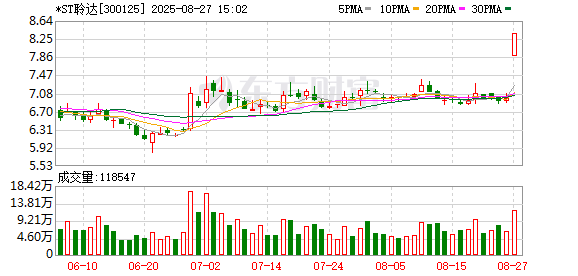
利空出尽?行政处罚落定*ST聆达开盘涨停 或重整告别光伏行业
Xin Jing Bao· 2025-08-28 02:45
Core Viewpoint - *ST Lingda (300125.SZ) has experienced a significant stock price increase following the announcement of administrative penalties, indicating market optimism about its restructuring efforts and potential recovery from past operational challenges [1][2]. Group 1: Administrative Penalties and Market Reaction - On August 26, *ST Lingda received a notice of administrative penalties from the Dalian Regulatory Bureau, confirming violations related to undisclosed external guarantees and related party fund occupation, resulting in a warning and fines [1]. - The first trading day after the announcement saw *ST Lingda's stock price hit the daily limit, opening at a 20% increase to 8.36 yuan per share [1]. Group 2: Restructuring and Investment - Following creditor applications for restructuring, the Liu'an Intermediate People's Court initiated pre-restructuring for *ST Lingda, with a consortium led by Zhejiang Zhongling Technology Co., Ltd. and Hefei Weidi Semiconductor Materials Co., Ltd. designated as the pre-restructuring investors [1][2]. - In March, Hefei Weidi appointed its subsidiary, Jinzhai Jinwei Semiconductor Materials Co., Ltd., as a participant in the restructuring investment, alongside several financial investors [2]. Group 3: Future Business Direction - If the restructuring is successful, *ST Lingda may exit the photovoltaic industry and integrate assets under the control of Peng Qian, who is also the actual controller of Zhejiang Zhongling and the listed company Jingce Electronics [2][3]. - The restructuring investment agreement indicates that *ST Lingda plans to leverage the industrial resources of its investors to gradually introduce new business lines, such as electrochromic EC film materials and high-precision metal masks, aligning with the investors' existing operations [3].

利空出尽?行政处罚落定*ST聆达开盘涨停,或重整告别光伏行业
Xin Jing Bao· 2025-08-27 07:01
Core Viewpoint - *ST Lingda (300125.SZ) experienced a 20% limit-up on the first trading day after receiving an administrative penalty, indicating market optimism despite ongoing restructuring efforts [2]. Group 1: Administrative Penalty and Restructuring - On August 26, *ST Lingda disclosed receiving an administrative penalty notice from the Dalian Regulatory Bureau, confirming violations related to undisclosed external guarantees and related party fund occupation, resulting in a warning and a fine [2]. - The company transitioned from its core waste heat power generation business to the photovoltaic sector in 2020 but faced declining profitability and production halts due to technological iterations and price drops, leading to its restructuring application by creditors [2]. - The Lu'an Intermediate Court initiated pre-restructuring for the company, with a consortium led by Zhejiang Zhongling Technology Co., Ltd. and Hefei Weidi Semiconductor Materials Co., Ltd. appointed as the pre-restructuring investors [2]. Group 2: Investment and Control - In March, Hefei Weidi designated its subsidiary, Jinzhai Jinwei Semiconductor Materials Co., Ltd., as a participant in the restructuring investment, while other financial investors were also appointed [3]. - The actual controllers of Jinzhai Semiconductor and Zhejiang Zhongling are both Peng Qian, who is also the actual controller of listed company Jingce Electronics (300567.SZ), a leader in the flat panel display signal testing field [3]. - Jingce Electronics, established in 2006 and listed in 2016, has a market capitalization of approximately 18.9 billion yuan and reported a revenue of 2.565 billion yuan with a net profit of -97.59 million yuan last year [3]. Group 3: Strategic Transition - The restructuring investment agreement indicates that post-restructuring, *ST Lingda will leverage the industrial resources of its investors to gradually introduce new business lines, such as electrochromic EC film materials or high-precision metal mask plate production, aligning with regulatory requirements [5]. - Zhejiang Zhongling is involved in the research and manufacturing of precision metal mask plates (FMM), which will be part of the company's strategic transition [5].