工业母机

Search documents
11项重点任务擘划陕西“十五五”蓝图
Zhong Guo Fa Zhan Wang· 2026-01-27 06:42
Core Viewpoint - The recent meeting of the Shaanxi Provincial Committee emphasizes the importance of high-quality development during the 14th Five-Year Plan period, outlining key tasks for the 15th Five-Year Plan to enhance industrial development, technological innovation, and regional coordination [1][4]. Industrial Development - The focus is on constructing a modern industrial system with Shaanxi characteristics, prioritizing the development of trillion-level industrial clusters in modern energy, advanced manufacturing, strategic emerging industries, cultural tourism, and modern services [2][3]. - The strategy includes promoting "chain-based" development and enhancing the integration of production services, with a strong emphasis on advanced manufacturing and the digital economy [2]. Innovation System - The proposal aims to enhance the overall effectiveness of the innovation system by advancing the construction of the Xi'an regional science and technology innovation center and optimizing the "Qin Chuang Yuan" innovation-driven platform [3]. Regional Coordination - The plan outlines a strategy for regional coordinated development, emphasizing the roles of Xi'an and Yulin as growth poles and promoting complementary development among the three major regions of Guanzhong, Shaanbei, and Shaannan [4]. Economic Integration - The proposal highlights the importance of integrating into the new development pattern, focusing on stimulating domestic demand and enhancing the role of Shaanxi as a strategic link in domestic and international dual circulation [5][6]. Social Welfare - The plan emphasizes improving the quality of life for residents, focusing on employment, income, education, healthcare, and social security, with specific measures to promote high-quality employment and increase residents' income levels [7]. Environmental Sustainability - The proposal includes measures to strengthen ecological security and promote green, low-carbon development, while also addressing pollution prevention and enhancing safety in key areas [8].
科创天津 开创未来
Xin Lang Cai Jing· 2026-01-26 22:09
科技创新和产业创新,分别作为"源头活水"和"转化桥梁",是发展新质生产力的基本路径。在科技革命 与产业变革交织演进的新时代,如何扎实推动科技创新和产业创新深度融合? (来源:天津日报) 转自:天津日报 "全面强化科技创新支撑引领""增强天开园全域全要素创新引领辐射""做优科创服务生态""一体推进教 育科技人才发展"……昨天,政府工作报告中的这些话语,句句聚势提气、字字聚力暖心,让代表委员 们振奋不已。 细心的代表研读这份报告时发现,"创新""科创""科技创新"等关键词分布于各个章节段落,是政府工作 报告中"妥妥"的"高频词"。 科创天津,开创未来!市两会上,代表委员们带来"新"声,围绕科创赋能、"教科人"一体化发展、推动 科研成果落地转化等议题,提出了一系列既有实效又有远见的建议。站在"十五五"发展的新起点,大家 结合各条战线、各个领域的科创突破点,谋划"硬核"举措,共论打造"科创天津",努力为天津高质量发 展注入创新动能。 市人大代表、天津龙创恒盛实业有限公司董事长龙凤祥 争做"头鲸" 科创引航智造"深海" "误差控制在微米级,这是我们自主研发的高速高精联轴器交出的成绩单!"市人大代表、天津龙创恒盛 实业有 ...
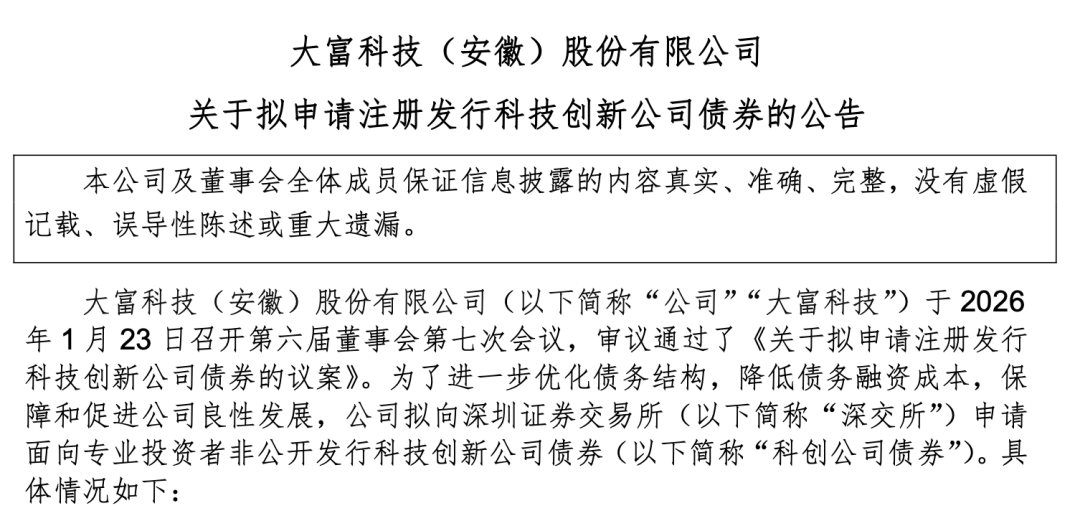
大富科技“双线”求生:拟申请发债+剥离亏损资产
Shen Zhen Shang Bao· 2026-01-25 14:02
Group 1 - Company plans to issue up to 300 million yuan in non-public bonds to professional investors, with the funds aimed at operational needs, debt repayment, and project investments [1] - Company has been experiencing declining performance, with revenues projected to drop to 2.495 billion yuan in 2023 and 2.324 billion yuan in 2024, while net losses are expected to worsen from 170 million yuan to 476 million yuan [3] - In response to ongoing losses, the company intends to sell a 49% stake in Dasheng Graphite for 206 million yuan to divest from underperforming assets [4][5] Group 2 - Dasheng Graphite, in which the company holds a 49% stake, reported revenues of 133 million yuan and a net loss of 38.27 million yuan in 2024, with further losses in 2025 [5] - The company aims to streamline operations and improve liquidity by divesting low-efficiency assets, aligning with its strategic focus on core business areas [5]


金融产品周报20260125:持续看多,关注周期行业的长期机会
Soochow Securities· 2026-01-25 07:50
Investment Rating - The report maintains a bullish outlook, focusing on long-term opportunities in cyclical industries [2][24]. Core Viewpoints - The macro timing model for January 2026 scored 0, indicating a 76.92% probability of an increase in the Wande All A Index over the following month, with an average expected gain of 3.18% [24][31]. - The report emphasizes the strong upward momentum in cyclical industries, particularly in non-ferrous metals and chemicals, driven by global macro events [24][25]. - Short-term investments in thematic sectors such as commercial aerospace, AI applications, and space photovoltaics have shown significant rebounds, although caution is advised due to potential volatility from rapid price increases [25][27]. Fund Size Statistics - In the period from January 19 to January 23, 2026, the top three increasing equity ETF types were: thematic index ETFs (59.135 billion), industry index ETFs (7.975 billion), and cross-border industry index ETFs (5.346 billion) [9][10]. - The top three increasing equity ETF products were: power grid equipment ETF (7.326 billion), chemical ETF (5.717 billion), and sci-tech chip ETF (3.953 billion) [10][14]. - The top three increasing equity ETF tracking indices were: segmented chemical index (9.829 billion), power grid equipment thematic index (7.326 billion), and SSH gold stock index (5.251 billion) [18][20]. Market Outlook - The report suggests a positive outlook for the A-share market in January 2026, with a focus on the micro-cap index and the CSI 500 leading the market [24][25]. - Long-term recommendations include a focus on non-ferrous metals and chemicals, with silver prices surpassing the psychological level of 100, indicating potential for further increases [24][25]. - The report anticipates a market characterized by oscillating upward trends, recommending a growth-oriented ETF allocation [67][68].
金融产品周报20260125:持续看多,关注周期行业的长期机会-20260125
Soochow Securities· 2026-01-25 06:28
Fund Size Changes - The top three increasing equity ETF types from January 19 to January 23, 2026, are: Theme Index ETF (¥591.35 billion), Industry Index ETF (¥79.75 billion), and Cross-Border Industry Index ETF (¥53.46 billion) [9] - The top three decreasing equity ETF types during the same period are: Scale Index ETF (-¥3348.87 billion), Cross-Border Strategy Index ETF (-¥7.12 billion), and Style Index ETF (-¥0.19 billion) [9] Market Outlook - The macro timing model's score for January 2026 is 0, indicating a 76.92% probability of the Wande All A Index rising in the following month, with an average increase of 3.18% [24] - The report maintains a bullish outlook, emphasizing long-term opportunities in cyclical industries, particularly in non-ferrous metals and chemicals [24] - The price of London silver surpassed the psychological level of 100 on January 23, 2026, indicating potential for further increases [24] Investment Recommendations - The report suggests a focus on growth-oriented ETF allocations, particularly in sectors like commercial aerospace, AI applications, and space photovoltaics, which have shown short-term rebounds [27] - The recommended ETFs include those focused on chemical, electric grid equipment, and semiconductor sectors, with specific stocks highlighted for each ETF [69] Risk Considerations - The model's predictions are based on historical data, which may not hold in the future, and there are risks associated with macroeconomic performance falling short of expectations [70]
【招银研究|政策】政策协同发力,着力扩大内需——2026年1月20日财政新闻发布会点评
招商银行研究· 2026-01-23 10:59
Core Viewpoint - The article discusses six fiscal and financial support policies aimed at stimulating private investment and promoting consumer spending, utilizing tools such as fiscal interest subsidies, financing guarantees, and risk-sharing mechanisms to lower financing costs for enterprises and reduce the consumption burden on residents [1][2]. Policy Content: Three Additions and Three Optimizations - Three new policies include: - Implementation of interest subsidy policy for loans to small and micro enterprises, with a 1.5% annualized subsidy for fixed asset loans, capped at 50 million per entity, focusing on key industries such as new energy vehicles and pharmaceuticals [2]. - Establishment of a special guarantee plan for private investment, with a total amount of 500 billion over two years, supporting loans for equipment purchases and business upgrades, including mid-sized enterprises for the first time [2]. - Creation of a risk-sharing mechanism for private enterprise bonds, providing credit enhancement support and loss compensation for bond issuances [3]. - Three optimized policies include: - Expansion of the equipment update loan interest subsidy policy to include more sectors and extend the support period, maintaining a 1.5% subsidy [4]. - Extension of the service industry loan interest subsidy policy until December 31, 2026, increasing the loan cap from 1 million to 10 million [4]. - Optimization of personal consumption loan interest subsidy policy, extending the support period and including credit card installment payments, with a 1% subsidy rate [4]. Policy Effectiveness: Expanding Demand and Credit Expansion - The fiscal interest subsidies are expected to significantly increase in scale from 60-90 billion in 2025 to 1,000-1,300 billion in 2026, with specific allocations for small and micro enterprises, equipment updates, service industry loans, and personal consumption loans [6][8]. - The combination of fiscal interest subsidies and fiscal subsidies is anticipated to effectively stimulate investment and consumption, with a notable impact on sectors like equipment upgrades and durable consumer goods [7][8]. Credit Impact: Demand Release and Differentiated Effects - The policy is expected to improve financing willingness and release credit demand, with differing effects between enterprises and residents [9]. - For enterprises, the policy is projected to significantly boost medium and long-term loans, with estimated savings of 1.75% in financing costs due to combined interest subsidies and structural policy rate cuts [10]. - For residents, despite the expanded support for non-housing consumption loans, conservative financial behavior may limit the effectiveness of the policy, leading to a focus on refinancing existing high-interest loans rather than increasing new loans [10].
已有银行主动沟通!中小微企业贷款贴息1.5个百分点
Zhong Guo Jing Ying Bao· 2026-01-21 06:03
Core Viewpoint - The Ministry of Finance has issued a notice to implement a loan interest subsidy policy for small and micro private enterprises, providing a 1.5% annual subsidy on eligible fixed asset loans and new policy financial tool funds starting from January 1, 2026 [1][2][3] Group 1: Policy Details - The subsidy applies to fixed asset loans and new policy financial tool funds for small and micro private enterprises involved in key industry chains, including sectors like new energy vehicles, medical equipment, and artificial intelligence [2][3] - The subsidy is capped at 50 million yuan per loan and is available for a maximum term of 2 years, with the policy initially set for one year but subject to extension [2][3] - The annualized interest rate for some small enterprises, after subsidy, could range between 1.00% and 2.00% [4] Group 2: Implementation and Oversight - Eligible enterprises can apply for loans through designated banks, which will approve loans based on market principles and legal frameworks [4] - The Ministry of Finance and financial regulatory authorities will conduct joint inspections to ensure compliance and prevent misuse of funds [4][5] - There is a strong emphasis on monitoring the flow of funds to ensure they are used for legitimate business upgrades and not for speculative activities [4][5] Group 3: Economic Impact - The policy aims to address the investment shortfall in the private sector, particularly in fixed asset investments, by encouraging small and micro enterprises to invest in high-tech and critical areas [3][5] - The initiative is expected to stimulate economic growth and support the development of new growth drivers within the private economy [3][5]
重点支持仪器仪表,中小微企业贷款贴息政策落地
仪器信息网· 2026-01-21 03:55
Core Viewpoint - The article discusses a joint policy issued by five government departments to support small and micro enterprises (SMEs) through a loan interest subsidy program, specifically targeting the instrumentation industry, with a subsidy rate of 1.5% per annum for eligible fixed asset loans, capped at 50 million yuan per enterprise and with a maximum term of 2 years [1][2]. Group 1: Policy Overview - The policy aims to stimulate investment and production expansion among SMEs, enhancing the vitality of the private economy and promoting high-quality economic development [2][3]. - The interest subsidy is specifically designed for SMEs in key sectors, including instrumentation, and aims to reduce financing costs and improve capital efficiency [2][4]. Group 2: Eligible Sectors and Loan Details - The policy supports various key industries, including new energy vehicles, industrial mother machines, pharmaceuticals, medical equipment, and instrumentation, among others [4]. - The subsidy applies to fixed asset loans issued from January 1, 2026, with a maximum subsidy of 1.5% per annum for a term not exceeding 2 years, and a loan cap of 50 million yuan per enterprise [4][5]. Group 3: Implementation Mechanism - The implementation involves a "total-to-total" model where financial departments coordinate directly with banks to streamline the process of subsidy allocation and management [6]. - Eligible enterprises can apply for loans directly from designated banks, which will assess applications based on market principles and legal frameworks [7]. Group 4: Monitoring and Reporting - Banks are required to report monthly on the execution of the policy, including loan issuance and subsidy usage, to ensure transparency and accountability [10][11]. - The Ministry of Finance will conduct joint inspections to monitor compliance and address any violations related to the subsidy program [11].

财政金融协同促内需一揽子措施出台 加大个人消费贷款和服务业经营主体贷款贴息力度
Zhong Guo Zheng Quan Bao· 2026-01-20 23:16
Group 1 - The core viewpoint of the article is the introduction of a comprehensive set of fiscal and financial policies aimed at boosting domestic demand, particularly through enhancing consumer spending and supporting private investment [1][4]. Group 2 - The optimization of the "dual subsidy" policy includes increased subsidy amounts for personal consumers, with the subsidy per transaction rising from 500 yuan to 3000 yuan, and for service industry enterprises, the loan subsidy limit increased from 1 million yuan to 10 million yuan [2]. - The implementation period for the optimized personal consumption and service industry loan subsidy policies has been extended to the end of 2026, with potential for further extension based on effectiveness [2]. - The coverage of financial institutions has expanded from over 20 national institutions to more than 500, enhancing accessibility for consumers and businesses [3]. Group 3 - The policy to stimulate private investment includes a subsidy of 1.5% on fixed asset loans for equipment updates, applicable for a maximum of two years, and covers loans issued from 2026 onwards for technology innovation [4]. - The subsidy for small and micro enterprises includes a 1.5% annual subsidy on fixed asset loans, with a maximum loan size of 50 million yuan, and is set to be implemented for one year with the possibility of extension [5]. - A special guarantee plan for private investment has been established with a total quota of 500 billion yuan, aimed at enhancing government financing guarantees and directing financial resources to support quality goods and services [5].
从消费端到供给端 政策“组合拳”精准发力
Bei Jing Shang Bao· 2026-01-20 16:57
Core Viewpoint - The current economic situation in China is characterized by strong supply but weak demand, prompting the National Development and Reform Commission (NDRC) and the Ministry of Finance to emphasize the need for macroeconomic policies that strengthen domestic circulation and expand domestic demand [1][3][4]. Group 1: Domestic Demand Expansion Strategy - The NDRC plans to formulate a five-year strategy for expanding domestic demand from 2026 to 2030, focusing on creating new demand through innovative supply [1][3][4]. - The strategy aims to achieve a dynamic balance between supply and demand, promoting an economic model driven by domestic demand and consumption [3][4]. Group 2: Fiscal Policy and Support Measures - The Ministry of Finance will maintain necessary levels of fiscal deficit, debt, and expenditure, ensuring that overall spending increases, particularly in key areas such as consumption and social welfare [1][5]. - A total of 1.3 trillion yuan (approximately 1.9 billion USD) in long-term special bonds will be issued to support consumption, with 300 billion yuan allocated specifically for the "old-for-new" consumption subsidy program [5]. Group 3: Consumer Incentives and Support - The "old-for-new" policy has significantly boosted consumption, with expectations that it will drive sales of related goods by over 2.6 trillion yuan (approximately 3.7 billion USD) [5]. - The NDRC will implement personal consumption loan interest subsidy policies, extending the implementation period to the end of 2026, and expanding the support scope to include credit card installment payments [10]. Group 4: Support for Small and Medium Enterprises (SMEs) - A new loan interest subsidy policy for SMEs will provide a 1.5% annual subsidy on fixed asset loans, with a cap of 50 million yuan (approximately 7 million USD) per enterprise [18][19]. - The policy targets key industries such as new energy vehicles, advanced manufacturing, and production services, aiming to stimulate investment and support industrial upgrades [19][20]. Group 5: Regulatory and Market Improvements - The NDRC will work on eliminating unreasonable restrictions in the consumption sector and establishing management methods for new consumption formats and scenarios [12][14]. - Efforts will be made to enhance the efficiency of fund usage and support for SMEs, including lowering investment thresholds and improving project approval processes [16][21].