
投行

Search documents
32万/平豪宅遭疯抢:揭秘中国新富阶层的财富密码与资产保卫战
Sou Hu Cai Jing· 2025-09-22 18:23
Core Insights - The recent sale of a luxury duplex in Shanghai for 32.68 million yuan per square meter reflects a significant shift in wealth allocation among China's new affluent class, amidst a slowing economy [1][3] - The overall average price of the project reached 20.5 million yuan per square meter, with a subscription rate of 190%, indicating a stark contrast to the sluggish ordinary housing market [3][9] Buyer Demographics - Three main buyer categories have been identified: 35% are internet entrepreneurs, including executives from short video platforms and cross-border e-commerce founders; 20% are owners of hidden champion manufacturing firms in the Yangtze River Delta; and 25% are financial professionals, including private equity fund managers and investment banking managing directors [4][5] Luxury Real Estate as an Asset Anchor - Luxury properties serve three core functions: as a preservation tool in an era of currency overproduction, as a risk isolation firewall, and as a means of accessing elite educational resources, which are seen as hard currency for social mobility [7][9] Shifts in Asset Allocation - The phenomenon at Jinling Huating indicates a paradigm shift in asset allocation among the wealthy, with the proportion of top-tier real estate in their portfolios rising from 15% to 25%, reflecting a move towards core asset strategies [9][10] - The hot sales of luxury properties suggest a growing demand for asset concealment, moving away from traditional luxury goods [9][10] Market Sentiment and Social Implications - The luxury real estate market acts as a barometer for the new economy's wealth generation capabilities and reflects a lack of confidence in traditional investment channels [10][11] - The phenomenon of luxury properties selling out rapidly raises questions about its impact on social mobility and wealth distribution in the context of China's common prosperity policy [10][11]


深挖犹太人对美国影响力,就明白中美博弈到底谁才是真正的对手
Sou Hu Cai Jing· 2025-08-14 05:55
Group 1 - The dialogue between a Chinese scholar and a Jewish tycoon highlights the contrasting perceptions of intelligence, with the Jewish tycoon praising the subtlety and low-profile nature of Chinese wisdom [1] - The competition between China and the Jewish community has intensified, with ongoing media coverage of the US-China rivalry indicating a broader geopolitical struggle [3][4] - The Jewish community in the US, despite being only 2% of the population, wields significant influence in politics and economics, with key positions held by Jewish individuals [6] Group 2 - Jewish individuals dominate major financial institutions in the US, controlling significant capital and political resources, which allows them to exert influence over global wealth through the dollar hegemony [7] - The historical context of Jewish influence in China dates back to the Opium Wars, where Jewish families played a role in economic control, impacting China's decline [9] - China's rise on the global stage signals a challenge to Jewish influence, with a firm stance against external pressures and a commitment to national rejuvenation [11][13]


纽铜“惊魂一跌”!特朗普关税引发巨震,高位做多者损失惨重,铜市逻辑生变?
Hua Xia Shi Bao· 2025-08-05 00:36
Core Viewpoint - The U.S. government has announced a 50% tariff on imported copper semi-finished products and high-copper-content derivatives, effective August 1, which has led to a significant drop in copper prices on the COMEX, highlighting the unexpected nature of the policy and its impact on the market [3][9]. Group 1: Tariff Impact - The 50% tariff applies to copper semi-finished products such as copper pipes, wires, rods, and sheets, as well as high-copper-content derivatives like fittings and electrical components, while excluding copper ore, concentrates, and cathodes [9][10]. - Following the announcement, COMEX copper futures prices fell by over 18% in a single day, marking the largest single-day drop in history [3][5]. - The market had anticipated a broader application of tariffs, leading to a miscalculation by major investment banks like Goldman Sachs, which had advised clients to buy call options on copper futures prior to the announcement [3][6]. Group 2: Market Reactions - The COMEX-LME (London Metal Exchange) copper premium rose from a neutral position to approximately 30% before the tariff announcement, driven by speculation about the tariffs [5][10]. - After the tariff announcement, the COMEX copper premium returned to a neutral position, indicating a significant market correction [5][10]. - Investors who had taken long positions in copper futures prior to the announcement faced substantial losses due to the rapid price decline [6][7]. Group 3: Supply and Demand Dynamics - The U.S. has a significant annual copper consumption of approximately 1.7 million tons, with a production shortfall of about 770,000 tons, necessitating imports primarily from Chile, Canada, and Mexico [9][10]. - The U.S. copper import policy aims to protect domestic production capabilities, as the country has limited smelting capacity, producing only about 3.3% of global refined copper [10][11]. - Analysts suggest that the copper market will need to adjust to the new tariff environment, with potential long-term implications for supply and demand dynamics, particularly as the market digests the impact of the tariffs [13][14]. Group 4: Future Outlook - Analysts predict that the main factors influencing copper prices in the second half of the year will include copper concentrate shortages, rising raw material costs, and the potential for a U.S. interest rate cut [13][14]. - The copper market is expected to return to fundamental supply and demand considerations, with the recent tariff policy's negative impact largely absorbed by the market [14]. - There is a recommendation for investors to consider trading in less policy-affected markets like LME and SHFE (Shanghai Futures Exchange) copper futures, as the long-term upward trend in copper prices remains intact despite short-term volatility [14].

阿里离职员工“万字长文”刷屏了,但大企业病真的能治吗?
创业邦· 2025-06-13 03:30
Core Viewpoint - The article discusses the prevalence of "corporate disease" in large internet companies, exploring its causes and potential remedies [3][4]. Group 1: Existence of "Corporate Disease" - Large internet companies, like those in other industries, commonly suffer from "corporate disease" as they scale [4]. - The article highlights that the inefficiencies seen in foreign financial institutions are mirrored in domestic financial firms, which have adopted similar bureaucratic processes [5]. Group 2: Causes of "Corporate Disease" - Rapid expansion of personnel in internet companies is often driven by personal interests of supervisors rather than actual business needs, leading to redundancy and inefficiency [6]. - The management style and culture adopted from traditional industries contribute to a decline in operational effectiveness, referred to as "financialization" [6][10]. Group 3: Challenges in Addressing "Corporate Disease" - Once an organization grows too large, reducing its size becomes challenging, and layoffs can further decrease morale and efficiency [9]. - Management is often aware of the issues but struggles to implement effective solutions due to the complexity of organizational structures [9][12]. Group 4: Cultural Misalignment - The rapid growth of internet companies often outpaces the evolution of their management practices, leading to a disconnect between the original entrepreneurial spirit and current corporate practices [10]. - The desire to emulate "elite" corporate cultures can lead to unsustainable practices that do not align with the company's operational needs [11][12]. Group 5: Conclusion on Treatment - Addressing "corporate disease" is complex and may not always be successful, as many large companies in traditional industries have also failed to overcome similar challenges [13].

我国经济良好开局增强国际投资者信心
Jin Rong Shi Bao· 2025-06-03 01:39
Group 1 - Moody's decision to maintain China's sovereign credit rating reflects confidence in China's macroeconomic governance and signals stability to global markets [1][4] - Since September last year, China has implemented a series of incremental policies, with a fiscal deficit rate planned at around 4%, an increase of 1 percentage point from the previous year [2] - The consumer market has shown significant growth, with double-digit increases in sectors like home appliances and communication equipment, and foreign trade reaching historical highs [2] Group 2 - International investors' confidence in China's economic prospects has risen, with major foreign institutions like Goldman Sachs and JPMorgan raising their 2025 GDP growth forecasts for China by 0.6 and 0.7 percentage points respectively [3] - The Hong Kong IPO market has performed exceptionally well, raising a total of $9 billion this year, a 320% increase year-on-year, indicating strong demand for Chinese assets in the primary market [3] - A UBS report indicates that 30% of family offices in the Asia-Pacific region plan to increase allocations to Greater China, reflecting global capital's confidence in China's capital markets [4]

巴克莱:引人深思!美股估值下调与重估的过山车行情
智通财经网· 2025-05-19 01:45
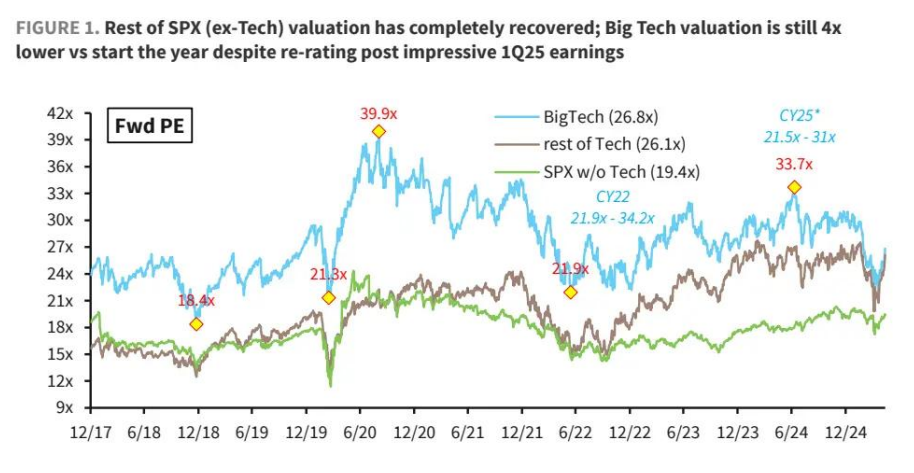
Group 1 - The core viewpoint is that despite significant valuation adjustments and rapid re-evaluations, large U.S. tech stocks are still trading at approximately four times lower than their expected prices by the end of 2024, with strong earnings in Q1 2025 confirming solid growth drivers [1][4] - The S&P 500 index, excluding tech stocks, has shown resilience during the sell-off, with valuations rebounding despite weak earnings in the consumer sector [1][3] - The S&P 500 index's forward price-to-earnings ratio currently stands at 22 times, benefiting from the improved valuations of non-tech stocks, which are up 0.5 percentage points since the beginning of the year [1] Group 2 - The uncertainty caused by tariffs may have peaked, but pre-emptive purchasing behavior by consumers and businesses has masked some economic damage not yet reflected in macroeconomic hard data [3] - Q1 2025 earnings exceeded expectations, but signs of consumer weakness are evident in the non-essential and essential goods sectors, which are among the few showing year-over-year earnings per share contraction [3][4] - The valuation of large tech stocks has rebounded from a significant drop (from 31 times to 21.5 times) to approximately 27 times, which appears reasonable given the positive news in cloud services, data centers, and artificial intelligence [4]
最大的风险解除了
表舅是养基大户· 2025-03-05 13:31
上周五晚上开始,咱有提到,川宝本周的国会演讲,将是短期最大的不确定性,全球资金都在提前避险, 今天石头落地,全球风险资产普涨 , 港股恒生科技涨超4%,德国今晚涨超3%,基本都修复了这轮避险带来的下跌,包括大饼今晚也涨回9万美刀以上了,美股虽然还没开盘,但昨 晚就上演了一轮日内的触底反弹,盘前美股的股指期货也都是上涨的。 川宝的演讲没什么超预期的东西,要说有,可能就是把对等关税的实施日期,从4月1日改为了4月2日,因为他觉得愚人节"不吉利",怕别人误会 是在开玩笑 。 演讲没有超预期,甚至前一晚上,美国的商务部长表示和加拿大、老墨正在全天候通话,这意味着,今天25%的关税即使落地了,后续也还是有 继续谈判的空间,所有的威胁都是谈判桌上的筹码而已。 资产价格在risk off(避险)和risk on(追逐风险)的切换上,这轮表现得非常敏感。 比如港股,恒生科技是日内11点左右触底后,一路反弹的,日本、韩国和中国台湾也基本类似的节奏, 而川宝的演讲,从北京时间早上9点开 始,持续了100分钟左右,也就是正好11点前结束 ,大家消化了一下,觉得,嗯,没事了,继续奏乐继续舞吧。 事实上,昨天南向港股通资金净流出,主要 ...