
新能源车

Search documents
宁德亿纬等推出员工持股及激励计划,美国OBBBA法案细则更新
Zhong Guo Neng Yuan Wang· 2026-02-24 01:54
国信证券近日发布锂电产业链双周报(2026年2月第2期):政策端,车用固态电池首部国标或于4月审 查报批、7月正式发布。设备端,灵鸽科技中标百吨级硫化物固态电解质产线。电池端,当升科技 (300073)与辉能科技就固态电池与新能源产业达成合作,国轩高科(002074)携手巴斯夫共同开发固 态电池技术。 以下为研究报告摘要: 【行业动态】 固态电池产业化加速推进:政策端,车用固态电池首部国标或于4月审查报批、7月正式发布。设备端, 灵鸽科技中标百吨级硫化物固态电解质产线。电池端,当升科技与辉能科技就固态电池与新能源产业达 成合作,国轩高科携手巴斯夫共同开发固态电池技术。 国内新能源车:2026年1月新能源车销量94.5万辆,同比微增、环比-45%;国内新能源车渗透率40.3%, 同比+1.3pct,环比-12.0pct。 欧洲&美国新能源车:2026年1月欧洲九国新能源车销量20.52万辆,同比+20%、环比-37%;新能源车 渗透率为30.6%,同比+7.1pct、环比-5.9pct。2026年1月,美国新能源车销量为7.76万辆,同比-31%、环 比-30%;新能源车渗透率为7.0%,同比-3.0pct、环 ...




动储收官迎新高,碳酸锂趋势反转
Zhong Guo Neng Yuan Wang· 2026-02-24 01:26
Group 1: Lithium Battery Market Insights - The price of lithium carbonate reached 170,000 yuan/ton, an increase of 42% compared to the previous month, while lithium hydroxide was priced at 165,000 yuan/ton, up 62% month-on-month [1][2] - In December, the wholesale sales of domestic new energy passenger vehicles reached 1.42 million units, showing a month-on-month increase of 3% but a decrease of 10% compared to the previous month; the total for the year was 14.21 million units, reflecting a year-on-year growth of 26% [1][2] Group 2: Market Performance Review - Since January 2026, the lithium battery sector has shown active performance, with most segments outperforming the CSI 300 and SSE 50 indices; the lithium mining and negative electrode segments saw significant gains, with the lithium mining sector leading with a 26% increase [3] - The monthly transaction volume for most lithium battery-related sectors increased, with the low-altitude economy segment experiencing the highest growth of 44% [3] Group 3: Industry Trends and Innovations - The lithium carbonate market is experiencing a cyclical reversal, leading to inflation across the industry chain and the emergence of new technologies such as sodium batteries; historical analysis indicates that from 2015 to 2025, lithium carbonate has undergone two complete cycles driven by policy and demand [4] - The solid-state battery industry is accelerating towards commercialization, with expectations of 36 GWh of global solid-state battery shipments by 2025; advancements in materials and production processes are being made, with companies like CATL and NIO making significant progress [8] Group 4: Energy Storage Developments - In December, domestic energy storage installations reached 63 GWh, a year-on-year increase of 95% and a month-on-month increase of 441%, driven by year-end project completions; the total for the year was 146 GWh, reflecting a 33% year-on-year growth [6] - The U.S. energy storage market saw a total installation of 39 GWh for the year, with a year-on-year growth of 39%, although this was below expectations due to uncertainties from the Inflation Reduction Act [6] Group 5: Investment Recommendations - In 2026, the lithium battery sector is expected to experience a significant increase in both volume and price, alongside breakthroughs in solid-state technology; companies recommended for investment include CATL, EVE Energy, and Keda Technology, among others [9]

锂电1月洞察:动储收官迎新高,碳酸锂趋势反转
SINOLINK SECURITIES· 2026-02-23 10:45
Investment Rating - The report maintains a "Buy" rating for the electric power equipment and new energy industry [1] Core Insights - The lithium battery sector is experiencing a price surge, with lithium carbonate prices rising to 170,000 CNY/ton, a 42% increase from the previous month, and lithium hydroxide prices increasing by 62% to 165,000 CNY/ton [1] - In December, the wholesale sales of domestic new energy passenger vehicles reached 1.42 million units, with a year-on-year increase of 26% for the entire year [1] - The report highlights a reversal in the lithium carbonate cycle, driven by domestic energy storage capacity subsidy policies and the explosive growth of global new energy demand [3][32] Summary by Sections Section 1: Research Insights - The lithium carbonate market is at a cyclical turning point, with prices expected to rise significantly, impacting the entire lithium battery supply chain [14][15] - Sodium batteries are emerging as a cost-effective alternative, with a clear long-term cost advantage over lithium iron phosphate batteries [26][30] Section 2: Industry Tracking and Review - The global new energy vehicle market showed strong growth in December, particularly in China and Europe, while the U.S. market faced challenges [34][36] - In December, domestic energy storage installations reached 63 GWh, a 95% year-on-year increase, indicating a shift towards market-driven growth [40] Section 3: Investment Recommendations - The report recommends focusing on companies involved in lithium carbonate, separators, and solid-state battery technologies, including Ningde Times, Yiwei Lithium Energy, and others [7][32]


电新行业周报:春晚机器人齐亮相,可重复使用火箭商业化进程加速-20260223
Western Securities· 2026-02-23 08:06
Investment Rating - The report provides a positive investment rating for the electric power equipment industry, highlighting growth opportunities in renewable energy and related technologies [2][3][4]. Core Insights - The report emphasizes the increasing role of renewable energy in meeting electricity demand, with a target for 70% of market-based electricity by 2030 [3][61]. - Significant advancements in solid-state battery technology are noted, with national standards expected to be published in July 2026, which will help standardize the industry [51]. - The commercial space sector is accelerating, with companies like Starship Glory completing significant funding rounds to enhance reusable rocket technology [2][57]. Summary by Sections Electric Power Equipment - The report indicates that by 2025, new electricity demand will be met primarily by renewable energy sources, with a goal of 60% renewable energy capacity by that year [3][61]. - The wind power sector is projected to add 110 GW of onshore capacity and 6.59 GW of offshore capacity by 2025, reflecting a robust growth trajectory [4][58]. Solid-State Batteries - The national standard for automotive solid-state batteries is set to clarify terminology and classifications, which is crucial for industry development [51]. - A strategic partnership between companies like Dangsheng Technology and Huineng Technology aims to enhance solid-state battery material performance and production [52]. Commercial Space - Starship Glory has secured 50.37 billion yuan in D++ round financing, which will accelerate the commercialization of reusable rocket technology [2][57]. - The report highlights the growing demand for commercial space launches, driven by advancements in reusable rocket technology [2][57]. Renewable Energy Trends - The report notes a significant increase in the production and sales of new energy vehicles, with January 2026 seeing a 100.8% year-on-year increase in exports [21][30]. - The solar power sector is experiencing a reduction in tariffs for Indian products exported to the U.S., which is expected to boost market competitiveness [49].
平安证券(香港)港股晨报-20260223
Ping An Securities Hongkong· 2026-02-23 07:57
五震荡走低,险守二十天线。恒指随外围低开 132 港股回顾 点,跌幅随即扩大至 247 点,低见 23730 点,其后跌幅 一度收窄至仅 20 点,午后大盘走势偏软,尾盘沽压再 度扩大。截至收盘,恒指收报 23831 点,下跌 145 点或 0.61%;国指收报 9656 点,下跌 47 点或 0.49%,大市 成交进一步减至 827.99 亿。港股通录得净流入资金 4.84 亿,其中港股通(沪)净流入 2.83 亿,港股通(深)净 流入 2.01 亿。板块方面,本地地产、软件、5G 概念板 块跌幅靠前;黄金股逆市走强。 港股马年首个交易日主要股指表现分化,恒生指 数跌 1.1%报 26413.35 点,恒生科技指数跌 2.91% 报 5211.5 点,恒生中国企业指数跌 1.22%报 8959.56 点,恒生红筹指数逆势涨 0.09%报 4384.28 点,大市成交 1653.73 亿港元。盘面 上,互联网科技股普跌,百度跌超 6%,阿里巴巴 跌近 5%;半导体股走弱,华虹半导体跌近 6%,中 芯国际跌超 3%。国产 AI 大模型板块逆势走强, 智谱涨近 43%,MiniMax 涨超 14%,两者市值均突 ...
张军:告别经济“温差”,要避免增长过于结构性
Di Yi Cai Jing Zi Xun· 2026-02-23 04:04
2026.02.23 以规划设定的目标为基础,如果我们要在2035年把按现价美元汇率计算的人均GDP从目前约14000美元 提高到25000美元以上,还要保持每年人均GDP约6%的名义增速。考虑到未来10年人口平均每年下降约 0.35%(按基准情形的预测),且假设人民币对美元汇率不变,GDP平均每年名义增长约5.6%即可实现 目标。 然而,2025年GDP实际增速为5%,名义增速仅3.9%,因为GDP通胀率为-1.1%。这就出现了实际GDP增 速较高与整个经济处于偏冷的紧缩状态并存的局面。等于说温度计上显示的数字跟人们的体感不一致, 形成了温差。 只有一种情况会导致这样的"温差"出现。那就是增长过于结构化,过于集中在少数相对独立的领域,而 这些领域的扩张虽然可以提高实际GDP增速,却无法生成宏观的平衡与稳定局面,极端情形甚至可以出 现所谓"没有发展的增长"现象。 这些年来,尽管中国经济实现了5%左右的实际GDP增长,但其增长来源越来越集中化结构化了。新能 源车、人工智能等极少数科技产业推动了实际GDP增长,但整个宏观经济反而变冷了。经济总需求和收 入流量收缩趋势未见缓解,物价下降,导致名义GDP增速和实际GD ...


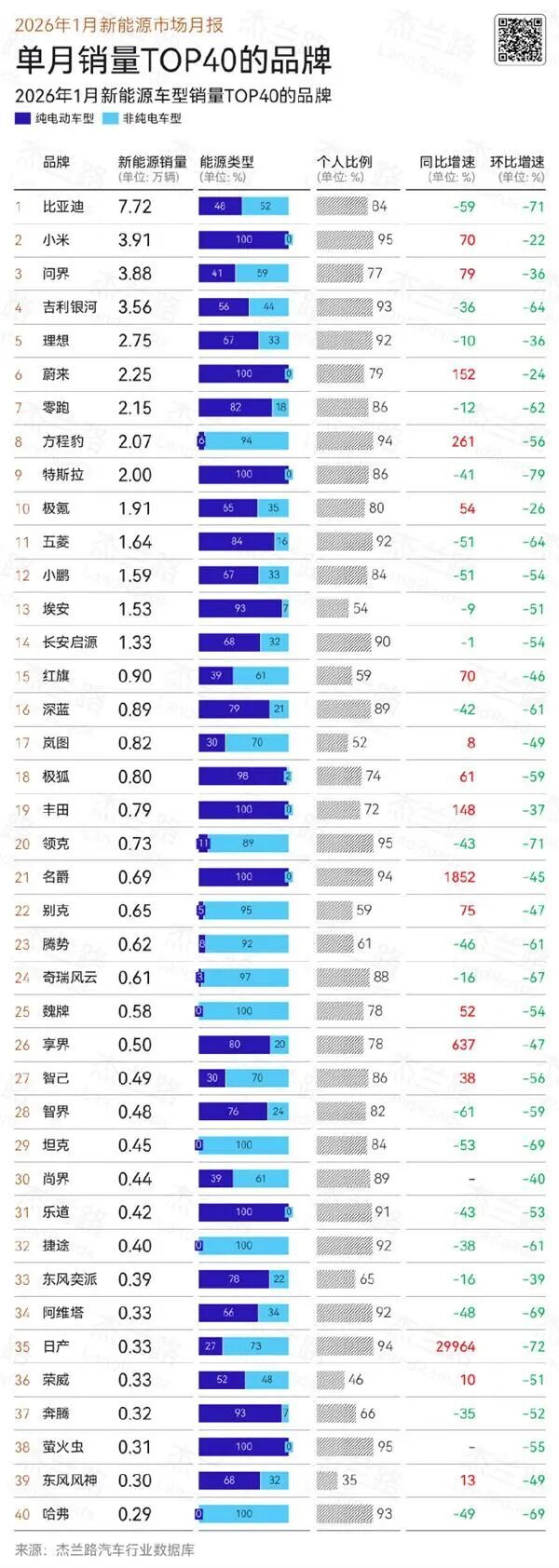
2026年1月新能源车销量:比亚迪第一,小米力压问界跃升至第二
Hang Zhou Ri Bao· 2026-02-21 10:20
近日,知名调研机构杰兰路 LandRoads 给出的报告显示,国内2026 年1月新能源乘用车市场销量上,小 米已经跃升至第二。 报告显示,2026 年 1 月新能源乘用车总销量 56.3 万辆,同比下降 20%,环比下降 58%。 能源类型来看:纯电车型销量 34.4 万辆,同比下降 11%,环比下降 56%;插混车型销量 15.2 万辆,同 比下降 35%,环比下降 63%;增程车型销量 6.7 万辆,同比下降 15%,环比下降 52%。 2026 年 1 月乘用车市场新能源渗透率为 36.3%,相较上月 ( 57.4% ) 有较大下滑,与 2025 年 1 月 ( 38.5% ) 相比亦有些许下滑。 1 月新能源轿车销量冠军依然是吉利银河星愿,销量 1.49 万辆;其次是比亚迪秦 Plus DM-i 0.76 万辆、 MG4 EV 0.68 万辆;比亚迪海豚 0.58 万辆;五菱缤果 S 0.56 万辆。 此外,1 月新能源 SUV 销量第一是小米 YU7,销量 3.79 万辆,其也是 1 月新能源全品类销量冠军;其 次是蔚来 ES8 1.84 万辆;方程豹钛 7 销量 1.76 万辆;特斯拉 Mode ...


万亿外资巨头调仓!贝莱德调仓曝光:增持英伟达、苹果、微软等
Sou Hu Cai Jing· 2026-02-21 02:14
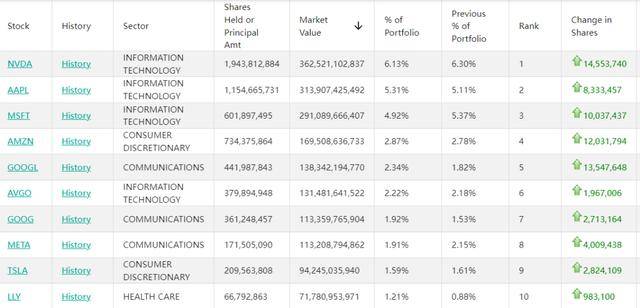
Core Insights - BlackRock, a major asset management firm, reported a total portfolio value of $5.92 trillion for Q4 2025, reflecting a 3.67% quarter-over-quarter increase [1] - The firm added 247 new stocks to its portfolio while liquidating 165 stocks during the same period [1] - The top ten holdings accounted for 30.41% of the total portfolio value [1] Group 1: Major Stock Movements - The top five stocks purchased by BlackRock included Google-A, Google-C, Eli Lilly, Micron, and Apple [1] - The top five stocks sold were SPDR S&P 500 ETF CALL, ServiceNow, MicroStrategy, AT&T, and Kellanova [1] Group 2: Technology Sector Focus - BlackRock's top ten holdings are heavily weighted in technology, including Nvidia, Apple, Microsoft, Amazon, Google-A, Broadcom, Google-C, Meta, Tesla, and Eli Lilly [2] - Nvidia saw a 0.75% increase in shares held, totaling approximately 1.94 billion shares valued at about $362.52 billion, making it the largest holding at 6.13% of the portfolio [2][4] - Apple shares increased by 0.73%, with approximately 1.15 billion shares valued at about $313.91 billion, representing 5.31% of the portfolio [2][4] - Microsoft holdings increased by 1.70%, totaling around 601.90 million shares valued at approximately $291.09 billion, accounting for 4.92% of the portfolio [2][4] - Amazon's holdings rose by 1.67%, with about 734.38 million shares valued at approximately $169.51 billion, making up 2.87% of the portfolio [2][4] Group 3: New Investments in Materials and Chemicals - BlackRock has diversified into new materials and chemicals, with new positions in Solstice Advanced Materials valued at approximately $838 million and Qnity Electronics valued at around $1.3 billion [6] - In the electric vehicle sector, BlackRock significantly increased its holdings in NIO and Xpeng, while slightly reducing its position in Li Auto [6] - NIO shares were increased by 337,590 to 5.58 million shares, reflecting a 153% increase in holdings valued at approximately $2.85 million [6] - Xpeng shares were increased by 77,980 to 2.87 million shares, with a total value of approximately $5.82 million [6] - Li Auto shares were reduced by 61,400 to 826,200 shares, with a total value of approximately $1.40 million [6]


小鹏汽车固态电池技术突破,AI战略转型加速
Jing Ji Guan Cha Wang· 2026-02-19 21:12
Group 1 - Core viewpoint: Xiaopeng Motors has made significant advancements in solid-state battery technology and is accelerating its transformation into an AI technology company, while short-term subsidies during the Spring Festival are providing support to the new energy vehicle market [1] Group 2 - Recent event: On February 16, 2026, Xiaopeng Motors announced the completion of full-scene road testing for its solid-state battery, which has an energy density of 450Wh/kg, a range exceeding 1000 kilometers, and can charge to 80% in 10 minutes, enhancing its competitive edge in the new energy sector [1] - Spring Festival market stimulus: During the Spring Festival period (up to February 19, 2026), multiple subsidy policies have driven the demand for new energy vehicles, particularly in county markets, with Xiaopeng Motors experiencing increased foot traffic in its county stores and strong demand for models priced between 100,000 to 150,000 yuan [1] - AI strategic transformation: On February 14, 2026, Xiaopeng Motors clarified its positioning as an "AI technology company," focusing on autonomous driving and robotics, aiming to reconstruct its profit model through AI technology and enhance its influence in the industry [1] Group 3 - Stock performance: From February 13 to 19, 2026, Xiaopeng Motors-W (09868.HK) saw a price fluctuation of -0.57%, closing at 69.65 HKD on February 16, while Xiaopeng Motors (XPEV.N) in the US experienced a -0.68% change, closing at 17.58 USD on February 19 [2] - Fund flow: On February 13, 2026, Xiaopeng Motors-W in the Hong Kong stock market had a net inflow of 10.0341 million HKD, indicating some investors are positioning themselves at lower prices [2] - Technical analysis: As of February 16, 2026, Xiaopeng Motors-W's stock price was below the middle band of the Bollinger Bands (71.5 HKD), with the MACD histogram turning positive, suggesting a potential need for short-term consolidation [2]
政策暖风频吹,新能源车加速"下沉"
2 1 Shi Ji Jing Ji Bao Dao· 2026-02-16 09:36
Core Insights - The Chinese automotive market is experiencing a surge in consumer interest, particularly in the lower-tier cities, driven by the new "national subsidy" policy and the traditional peak consumption period around the Spring Festival [1][2] - The shift of automotive dealerships from suburban areas to shopping malls indicates increasing competition and a strategic move to capture consumer attention [1] - Price remains a decisive factor for consumers in third and fourth-tier cities, with brands like Extreme Fox and Li Auto focusing on affordable models and attractive promotional offers [2] Automotive Market Trends - The demand for electric vehicles (EVs) is rising in rural areas, with a notable increase in the ownership of brands like BYD and Wuling [3][4] - The sales volume of EVs in rural markets is growing faster than in urban areas, with projections indicating a significant increase in total sales from 397,000 units in 2020 to nearly 7.6 million units by 2024 [4] - The Chinese government is supporting the rural market for EVs through policies that promote the integration of EVs with other consumer goods, aiming to boost rural consumption [4] Charging Infrastructure Development - The construction of charging facilities is on a rapid growth trajectory, with a projected total of 20.09 million charging points by the end of 2025, marking a 49.7% year-on-year increase [5] - The government of Henan province plans to build 29,000 new public charging points by 2025, significantly alleviating range anxiety for EV owners [5] - The development of charging infrastructure is crucial for enhancing the convenience of EV ownership, particularly in rural areas where consumers express a preference for electric vehicles if charging facilities are adequate [4][5]