运输

Search documents
科技股回调之际 交易员追逐“抗AI”股票
Xin Lang Cai Jing· 2026-02-06 17:57
Group 1 - The core viewpoint of the article highlights a shift in investor sentiment towards companies that cannot be easily replicated by artificial intelligence (AI), as technology stocks face declines [1] - The S&P 500 index has dropped by 0.9% this week, primarily due to concerns over AI disrupting business models, particularly in the software sector [1] - In contrast, sectors such as residential construction, transportation, and heavy machinery manufacturing have seen strong gains, with the consumer staples sector rising by 5.2%, marking its best weekly performance since 2022 [1] Group 2 - The Dow Jones Industrial Average has outperformed both the S&P 500 and the tech-heavy Nasdaq 100, indicating a preference for traditional economic giants over tech stocks [1] - This trend contradicts the logic that has driven the U.S. stock market bull run over the past three years, where tech stocks were seen as the main market drivers due to expectations of economic transformation through AI [1] - Investors are rotating towards "anti-AI" sectors, which possess tangible, real-world attributes, as noted by JonesTrading's chief market strategist Michael O'Rourke, suggesting that dull industries may now hold unprecedented appeal [1]
三年牛市逻辑逆转!科技股成弃子,AI无法替代的实体崛起
Jin Shi Shu Ju· 2026-02-06 12:31
Group 1 - The core viewpoint of the articles highlights a shift in investor sentiment towards sectors that are less likely to be disrupted by AI technology, such as construction, transportation, and heavy machinery, while technology stocks are experiencing declines due to concerns over AI's impact on their business models [1][2][3] - The S&P 500 index has seen a decline, primarily driven by software stocks, while essential consumer goods stocks have risen by 4.7%, potentially marking their best weekly performance since 2022 [1] - JonesTrading's chief market strategist, Michael O'Rourke, notes that investors are gravitating towards sectors with "anti-AI attributes," which are seen as safer investments in the current market environment [1] Group 2 - Analysts from Citizens and Baird indicate that the construction sector is benefiting from the spring home-buying season, with potential for further price increases if funds rotate from tech stocks into construction stocks [2] - The machinery manufacturing and transportation sectors are also expected to achieve their best weekly performance since May of the previous year, supported by declining interest rates and stronger-than-expected economic resilience [2] - Essential consumer goods and chemical companies are categorized as anti-AI sectors, with companies like Dollar General and Dow Chemical seeing positive market performance due to anticipated improvements in demand and industry conditions [3] Group 3 - The chemical sector is expected to rebound as market conditions improve, with analysts predicting a recovery in earnings for commodity chemical companies amid a rotation of funds away from high-growth tech sectors [3] - The market has shown a divergence, with truck transportation, machinery manufacturing, and essential consumer goods reaching historical highs, while the tech-heavy Nasdaq 100 index has declined by 6% since its peak in October [3]
科技股回调 “抗AI”板块成为新赢家
Xin Lang Cai Jing· 2026-02-06 11:53
Group 1 - The core viewpoint of the article highlights that companies in sectors less susceptible to artificial intelligence are emerging as winners amid a decline in technology stocks [1] - The S&P 500 index fell by 2%, primarily driven down by software companies, while sectors such as homebuilders, transportation companies, and heavy machinery manufacturers experienced strong gains [1] - Essential consumer goods companies, viewed as safe havens during economic downturns, rose by 4.7%, potentially marking their best weekly performance since 2022 [1] Group 2 - Michael O'Rourke, Chief Market Strategist at JonesTrading, notes that investors are rotating into "anti-AI" sectors, which include industries with tangible, real-world elements [1] - Analysts from Citigroup and Citizens emphasize that the core activities of these companies, such as manufacturing, distribution, and assembly, are not areas where artificial intelligence can easily replace human involvement [1] - Jay McCanless from Citizens states that human presence is still essential for tasks like building homes, reinforcing the idea that certain industries will remain resilient against AI advancements [1]
Carrier (CARR) - 2025 Q4 - Earnings Call Transcript
2026-02-05 13:32
Financial Data and Key Metrics Changes - For Q4 2025, reported sales were $4.8 billion, adjusted operating profit was $455 million, and adjusted EPS was $0.34, reflecting a year-over-year decline largely due to lower volumes in higher-margin CSA residential and light commercial businesses, leading to a 9% decline in organic growth, partially offset by a 3% tailwind from foreign currency translation [15][16] - Total company orders were up over 15% in the quarter, driven by strength in CSA commercial, indicating continued strong demand for products in this market [16][21] - Free cash flow in Q4 was approximately $900 million, with full-year free cash flow of about $2.1 billion, aligning with expectations [16] Business Line Data and Key Metrics Changes - CSA segment had a challenging quarter with organic sales down 17%, while commercial sales were up 12%, but this was offset by a nearly 40% decline in residential sales and a 20% decline in light commercial sales [17] - The CSE segment saw organic sales down 2%, with commercial up mid-single digits, offset by declines in residential and light commercial [18] - The transportation segment experienced a strong quarter with 10% organic sales growth, driven by exceptional growth in container business [20] Market Data and Key Metrics Changes - In the Climate Solutions Asia Pacific segment, strength in India and Australia was offset by weakness in residential and light commercial in China, leading to an overall 9% sales decline [19] - The residential heating market in Europe, particularly in Germany, continues to be challenging, with expectations of mid- to high-single-digit declines in the overall market [18][46] Company Strategy and Development Direction - The company aims to focus on outsized growth in products, aftermarket, and system offerings, with significant investments in data centers and HVAC solutions [4][6] - The company is positioned to outgrow the commercial HVAC market, with expectations of double-digit revenue growth, including a 50% increase in data centers [6] - The company plans to continue investing in technology differentiation and maintaining a strong balance sheet while returning cash to shareholders [4] Management's Comments on Operating Environment and Future Outlook - Management noted that the short cycle residential and light commercial market softened more than expected in the second half of 2025, but they are positioned for stronger incrementals when these markets recover [3][14] - The company expects flat to low mid-single-digit organic growth for 2026, with continued double-digit growth in commercial and aftermarket globally, offset by expected softness in shorter cycle businesses [22][24] - Management emphasized the importance of operational excellence and controlling costs while preparing for a potential recovery in demand [26] Other Important Information - The company distributed $3.7 billion to shareholders through buybacks and dividends [4] - The company expects to repurchase about $1.5 billion in shares in 2026 [24] Q&A Session Summary Question: Can you discuss the expected margins in CSA for Q1? - Management expects CSA margins in Q1 to be close to about 15%, with higher sales compared to Q4 2025 [32] Question: What is the full-year guidance for the CSA residential business? - Management anticipates industry units to be down 10%-15%, with their sales expected to be down high single digits year-over-year, benefiting from low single-digit pricing [44] Question: How are channel inventories in CSA residential? - Management reported that channel inventories are down about 32% year-over-year, aligning with their targets [53] Question: What are the implications of recent comments from NVIDIA regarding chiller demand? - Management stated that data centers will require a combination of liquid cooling and traditional cooling, and they are working closely with NVIDIA on future cooling requirements [80]

地缘风险加剧催化,交运ETF(561320)大涨3%
Mei Ri Jing Ji Xin Wen· 2026-02-04 06:32
Core Viewpoint - The transportation ETF (561320) surged by 3% due to escalating geopolitical risks, which have led to volatility in tanker freight rates driven by panic stockpiling, decreased passage efficiency, and increased insurance premiums [1] Group 1: Geopolitical Risks and Freight Rates - Geopolitical risks have intensified, causing tanker freight rates to exhibit high volatility and significant risk premium attributes [1] - Factors contributing to this volatility include panic stockpiling, decreased passage efficiency, and soaring insurance premiums [1] Group 2: Dry Bulk Market Performance - The Baltic Dry Index (BDI) has shown strong performance despite the off-season, indicating a robust market trend this year [1] - The performance of the Supramax shipping rates has been particularly notable, driven by supply-side disruptions from storms and high waves, leading to temporary capacity tightness [1] - On the demand side, smooth exports of iron ore from Brazil and continued volume from West African bauxite have supported this strong performance [1] Group 3: Transportation Index Overview - The transportation ETF (561320) tracks the mainland transportation index (000945), which includes various transportation companies operating in mainland China, such as rail, road, sea, and air transport [1] - This index reflects the overall performance of China's transportation industry and includes representative stocks that illustrate the development status and market trends of different transportation modes [1]
中国神华20260203
2026-02-04 02:27
Summary of the Conference Call Company and Industry - **Company**: China Shenhua Energy Company - **Industry**: Energy and Mining Key Points and Arguments Asset Acquisition Update - The Shanghai Stock Exchange accepted the asset acquisition application on January 30, 2026, with an expedited review process expected to complete by mid-2026 [2][5] - The company aims to finalize the asset acquisition and consolidation in the first half of 2026 [2][5] Asset Details - The acquisition includes coal, coal power, and coal chemical assets, with coal reserves of 20.5 billion tons and recoverable reserves of 13 billion tons [9][10] - The operational capacity is approximately 20 million tons of coal and 13.23 million kilowatts of power generation capacity [9][10] - Capital expenditure for these projects is estimated at around 80 billion yuan over the next five years [10] Financial Performance - The net profit attributable to shareholders for the first three quarters was higher than expected, but the annual forecast indicates a potential decrease of 2-3 billion yuan due to non-recurring expenses [12][13] - The company experienced a 1.7% decline in coal production in 2025, primarily due to land acquisition delays in the eastern Mongolia region [14] Production and Sales Outlook - The production plan for 2026 is still under review, with expectations of maintaining a stable production level compared to 2025 [17] - The company has a balanced production state in the Shendong mining area, with minor fluctuations due to resource depletion [16] Pricing and Revenue - The average selling price of electricity decreased by 4.5% in the first three quarters of 2025, with expectations of continued downward pressure on prices in 2026 [33][34] - Capacity fees are projected to increase from 50% to 70%, which will positively impact profit stability and cost compensation [35][36] Capital Expenditure Plans - The capital expenditure for 2025 is expected to be lower than planned due to project delays and regulatory approvals [51][52] - Future capital expenditures are anticipated to remain stable, with significant investments in new coal mining projects and upgrades to existing facilities [55][57] Transportation and Logistics - The transportation segment saw a positive performance in the second half of 2025, attributed to increased external coal purchases [48][49] - Overall transportation prices remained stable, with minor adjustments based on government regulations [49] Regulatory Environment - The approval process for coal mines is decentralized, with significant authority resting at the provincial level, affecting production capacity management [29][30] Conclusion - The company is focused on completing the asset acquisition and maintaining stable production levels while navigating regulatory challenges and market pressures. Future capital expenditures will be strategically allocated to enhance operational efficiency and expand capacity.

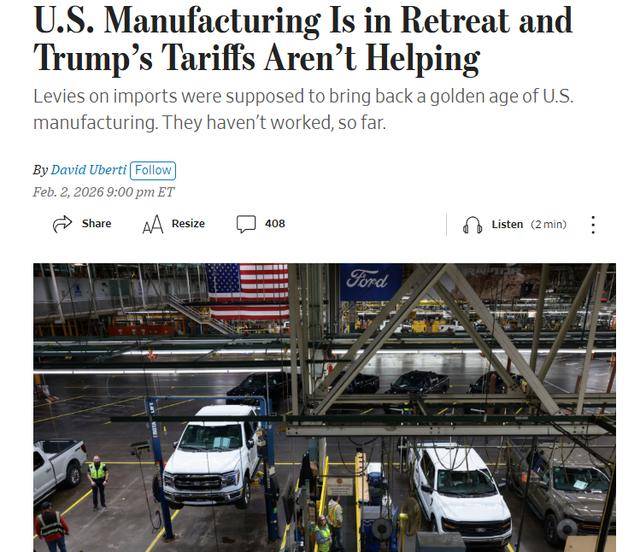
美国制造业“黄金时代”未现,反而持续走弱
Sou Hu Cai Jing· 2026-02-03 12:37
Core Viewpoint - The article highlights that despite the U.S. government's commitment to revitalize manufacturing through tariffs and industrial policies, the manufacturing sector continues to weaken, failing to achieve the promised "golden age of American manufacturing" [1] Group 1: Employment and Manufacturing Activity - U.S. manufacturing jobs have decreased for eight consecutive months since the announcement of the "liberation day" tariff policy, with over 200,000 jobs lost in 2023, marking the lowest employment level since the end of the COVID-19 pandemic [4] - The manufacturing index from the Institute for Supply Management (ISM) has remained in contraction territory for 26 months, indicating persistent weakness in manufacturing activity [4] - Analysts believe that the brief uptick in new orders and production data in January 2023 is insufficient to reverse the overall downward trend in the manufacturing sector [4] Group 2: Investment and Policy Uncertainty - The uncertainty surrounding the "stop-and-go" tariff policies is dampening investment willingness among businesses, with recent threats from the U.S. President to impose new tariffs on Europe, Canada, and South Korea exacerbating the risk of policy changes [5] - Business executives describe the past year as a "wasted investment period" due to the unpredictability of tariff policies [5] Group 3: Industry-Specific Challenges - Insteel Industries, a wire products company, reports that it has not benefited from the tariff policies, facing domestic raw material shortages due to increased steel tariffs, which have risen to 50% [6] - A manufacturer operating 23 factories globally notes that tariffs have raised the costs of steel and aluminum, limiting the ability to invest in new areas such as data centers and electrical equipment [8] - The CEO of Skyline, a furniture manufacturer, points out that high interest rates and weak consumer demand are also negatively impacting manufacturing demand, with tariffs on wood and textiles from Vietnam increasing costs and destabilizing supply chains [8]

拉煤货车换新能源车头才能进厂,环保不容掩耳盗铃
Xin Jing Bao· 2026-02-02 03:07
为响应环保部门对大气污染防治的要求,拉煤的"国六"货车需换电动车头,才能进厂卸货? 新京报记者近日赴河南多地调查发现,一些造纸、火电企业,只允许新能源电动货车入厂。由此,催生 了货车"换头"的生意:有人专门在厂区外租赁新能源电动车头,根据使用时长不同,收费200元至400元 不等,也有货车因等待卸货耗时长,被收费数百元。 公开信息显示,2023年7月印发的《河南省推动生态环境质量稳定向好三年行动计划(2023—2025 年)》明确提出:到2025年,火电、钢铁等行业大宗货物清洁运输比例达到80%以上。 "基层在执行和落实政策过程中可能出现了偏差。"对于多地出现"换头进厂"的情况,河南省生态环境厅 有关负责人表示,从未要求企业限制"国六"排放标准货车运输,将进行实地调研,及时解决目前出现的 问题。 提高大宗货物清洁运输比例,本是优化运输结构、推进环境治理的重要举措之一。近年来,从国家到地 方,对此均有相关部署。但在河南部分县市,该政策在执行中却催生出"换车头进厂"的荒诞一幕,这不 仅无助于实际减排,还额外增加了运输成本、降低了物流效率,暴露出明显的形式主义隐患。 从调查来看,"换车头"操作主要是企业为应对环保绩 ...
新车送车员:时光在路上
Xin Lang Cai Jing· 2026-01-30 18:44
Core Insights - The article highlights the life and challenges faced by a truck delivery driver, Zhang Dawei, who transitioned from being a ride-hailing driver to a heavy truck delivery driver, emphasizing the unpredictability and demands of the job [5][6]. Group 1: Industry Overview - The truck delivery industry requires drivers to adapt to various challenges, including route planning, fuel management, and vehicle maintenance, which are critical for successful deliveries [6]. - The industry is characterized by long hours and significant time away from home, impacting personal lives and family relationships of drivers [8]. Group 2: Personal Experience - Zhang Dawei's journey into the truck delivery sector began in 2022, where he learned the intricacies of the job through practical experience, including a challenging first delivery that taught him valuable lessons about fuel management [6]. - The article details a specific delivery journey of 1,690 kilometers from Shandong to Jiangxi, showcasing the logistical challenges and the need for strategic planning regarding charging costs and travel routes [7]. - Zhang Dawei's commitment to his job is evident as he balances the demands of long-distance driving with the desire to spend time with his son, highlighting the personal sacrifices made by drivers in this industry [8].

今年春运新能源车出行将达3.8亿辆次
Zhong Guo Qi Che Bao Wang· 2026-01-30 08:43
Core Insights - The overall transportation economy in 2025 is stable with progress, characterized by growth in transportation production, rapid port throughput growth, and high levels of transportation investment [2][3] Group 1: Transportation Production - The total operating freight volume reached 587 billion tons in 2025, marking a year-on-year increase of 3.2%. By mode, freight volumes increased by 2% for rail, 3.4% for road, 3.2% for waterway, and 13.3% for civil aviation [2] - The express delivery business volume reached 199 billion pieces, reflecting a year-on-year growth of 13.7% [2] Group 2: Port Throughput - The total port cargo throughput was 1.834 billion tons in 2025, with a year-on-year increase of 4.2%. Domestic and foreign trade throughput grew by 4% and 4.7%, respectively [2] - Container throughput reached 35 million TEUs, up 6.8% year-on-year, with domestic and foreign trade container throughput increasing by 2.4% and 9.8%, respectively [2] Group 3: Cross-Regional Personnel Flow - The cross-regional personnel flow reached 66.86 billion person-times in 2025, a year-on-year increase of 3.5%. Rail and civil aviation passenger volumes grew by 6.7% and 5.5%, while road passenger flow increased by 3.3% [3] Group 4: Transportation Investment - Transportation fixed asset investment is expected to exceed 3.6 trillion yuan in 2025. By mode, rail investment reached 901.5 billion yuan, while road and waterway investments exceeded 2.6 trillion yuan, and civil aviation investment was 120 billion yuan [3] Group 5: Spring Festival Transportation Predictions - During the 2026 Spring Festival, cross-regional personnel flow is expected to reach a historical high of 9.5 billion person-times over 40 days, with a daily average of 299 million person-times during the 9-day holiday [7] - The peak single-day flow is predicted to reach 340 million person-times, with highway traffic expected to peak at 71 million vehicles [7] - The total number of new energy vehicle trips is anticipated to reach 380 million, setting a historical record [7] Group 6: Transportation Capacity Enhancements - The Ministry of Transport has made targeted deployments to enhance transportation capacity, including increasing transport capacity across various modes and ensuring efficient connections between long-distance transport and urban traffic [8] - Specific measures include extending operating hours, shortening intervals between departures, and enhancing service guarantees at key hubs [8] Group 7: New Energy Vehicle Transport in Hainan - During the Spring Festival, the demand for passenger and vehicle transport in Hainan is expected to increase significantly, with over 4.66 million passengers and 1.17 million vehicles anticipated, representing year-on-year growth of 12% and 10%, respectively [9] - The transport capacity for new energy vehicles is projected to increase from an average of 3,500 units per day to 5,000 units per day [10]