
国防军工

Search documents
沪指探底回升再收十字星,止跌企稳了吗?
Sou Hu Cai Jing· 2026-01-21 01:01
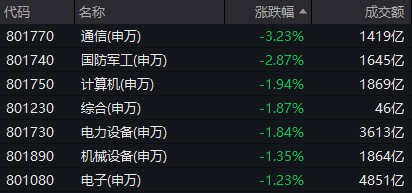
Market Overview - On January 20, the A-share market experienced adjustments, with the Shanghai Composite Index briefly falling below 4100 points before closing at 4113.65, a slight decrease of 0.01% [1] - The Shenzhen Component Index and the ChiNext Index also saw declines, closing down 0.97% and 1.79% respectively [1] Sector Performance - According to Wind data, previously strong sectors such as telecommunications, computers, and electronics led the market decline on January 20 [2] - The telecommunications sector fell by 3.23% with a trading volume of 141.9 billion, while the defense and military industry dropped by 2.87% with a volume of 164.5 billion [3] - The computer sector decreased by 1.94% with a trading volume of 186.9 billion, and the electronics sector fell by 1.23% with a volume of 485.1 billion [3] Market Dynamics - Analysts attribute the market adjustment to two main factors: the impact of counter-cyclical policy adjustments and a shift in market style [5] - Recent trading days have shown a significant decrease in trading volume, with three out of the last four days recording less than 3 trillion in trading volume [5] - The market is experiencing a "high-low switch," with funds moving towards traditional sectors as earnings forecasts for listed companies are set to peak [5] Technical Analysis - The Shanghai Composite Index formed a doji candlestick pattern, indicating potential stabilization, but the market remains cautious with a focus on defensive strategies [5] - Analysts suggest that as long as the index does not fall below 4080 points, there is a likelihood of a resumption of upward momentum [6] - The average price-to-earnings ratios for the Shanghai Composite and ChiNext are currently above their three-year median levels, indicating suitability for medium to long-term investments [6] Earnings Season Impact - As earnings forecasts enter a peak disclosure period, the correlation between stock prices and earnings is expected to increase significantly [7] - The market may undergo structural adjustments based on fundamentals, with previous hot sectors facing earnings validation while some low-priced, high-quality stocks may attract new capital [7]

融资盘激增股市却跌了?监管点刹背后是一场怎样的博弈?
Sou Hu Cai Jing· 2026-01-20 17:13
2026年伊始,A股市场便以一派火热景象迎接投资者,市场热度在多个维度均有所体现,尤其以融资余额的迅猛增长最为引人注目。数据显示,从2025年12 月15日至2026年1月14日短短一个月内,A股融资余额犹如脱缰野马,自2.489万亿元一路飙升至2.681万亿元附近,增幅逼近2000亿元,投资者借钱炒股的热 情空前高涨。1月12日,单日融资净买入额更是创下阶段性纪录,高达460.5亿元。 杠杆资金的持续涌入,也反映出市场对某些特定板块的狂热追捧。据统计,电子、国防军工、计算机、电力设备等行业在过去一个月内融资净买入额均突破 百亿元大关,其中电子行业以高达315亿元的融资净买入额遥遥领先。 然而,就在市场一片欢腾之际,监管之手悄然伸出。1月14日午间休市时段,沪深北三大交易所同步发布公告,宣布自当日起将融资保证金最低比例由80% 上调至100%。此举无疑是一记重拳,直击市场过热后的非理性炒作行为。值得注意的是,此次调整采取"新老划断"原则,仅适用于新开融资合约,存量合 约则不受影响,体现出监管层呵护市场的良苦用心。 其次,市场结构正在发生深刻变化。前期被热炒的AI应用、商业航天等题材股,由于缺乏业绩支撑,成为资 ...

谨慎加仓?
第一财经· 2026-01-20 10:40
Market Overview - The A-share market shows a differentiated adjustment pattern, with the Shanghai Composite Index demonstrating resilience, regaining the 4100-point level, primarily driven by the real estate, banking, and oil sectors [4] - A total of 2231 stocks experienced an increase [5] - The market exhibited a clear divergence, with the real estate sector leading gains, while the TMT (Technology, Media, Telecommunications) sector and power equipment faced significant adjustments [6] Trading Activity - The total trading volume of both markets reached 1 trillion yuan, an increase of 2.56%, indicating a moderate increase in trading activity as funds shifted from previously popular sectors to those with lower valuations or solid fundamentals [7] - Institutional investors are reallocating their portfolios, selling off previously popular sectors like power equipment and telecommunications, and moving towards defensive sectors such as banking, construction, insurance, and real estate [9] Fund Flows - There was a net outflow of 68.4 billion yuan from major funds, while retail investors saw a net inflow [8] - Retail investors are absorbing the selling pressure and speculating on themes, with some funds flowing into short-term overbought stocks, partially offsetting the outflow from popular sectors like semiconductors and commercial aerospace [9] Investor Sentiment - As of January 20, 32.96% of investors increased their positions, while 20.13% reduced their holdings, with 46.91% remaining unchanged [12] - Retail investor sentiment is currently at 75.85% [10]

A股尾盘,多股逆势拉升封板,6股获巨额资金抢筹
Zheng Quan Shi Bao· 2026-01-20 09:39
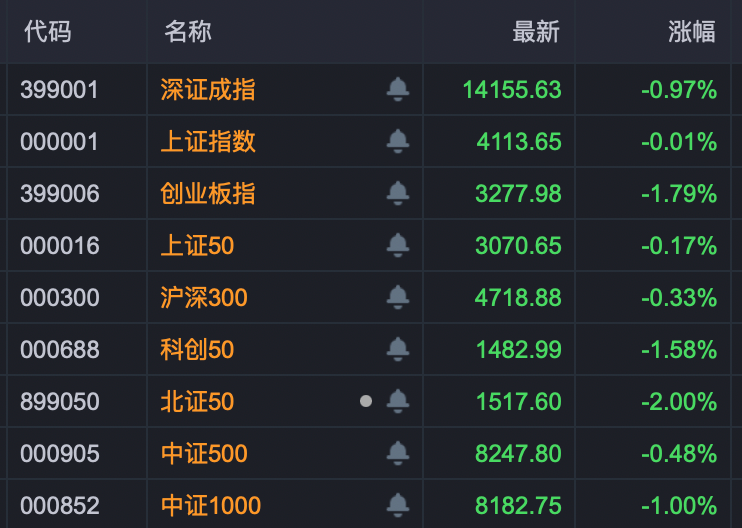
Market Overview - On January 20, the A-share market experienced fluctuations, with the Shanghai Composite Index barely holding above 4100 points and the ChiNext Index falling below 3300 points, while the Shenzhen Component, CSI 300, and CSI 500 all closed with small bearish candles. The market turnover reached 2.8 trillion yuan [1]. Index Performance - The Shenzhen Component Index closed at 14155.63, down 0.97% - The Shanghai Composite Index closed at 4113.65, down 0.01% - The ChiNext Index closed at 3277.98, down 1.79% - The CSI 300 Index closed at 4718.88, down 0.33% - The CSI 500 Index closed at 8247.80, down 0.48% [2]. Sector Performance - Chemical, precious metals, real estate, and aviation sectors showed the highest gains, while aerospace equipment, photovoltaic equipment, communication devices, and glass fiber sectors experienced the largest declines [2]. Fund Flow Analysis - The public utilities sector saw a net inflow of over 3.7 billion yuan, while the construction and decoration sector received over 3.6 billion yuan. Real estate, banking, basic chemicals, and building materials sectors each gained over 2 billion yuan in net inflows. Transportation and retail sectors also saw net inflows exceeding 1 billion yuan. Conversely, electronics, power equipment, communications, defense, and computer sectors experienced net outflows exceeding 10 billion yuan [3]. Notable Stocks - China XD Electric (601179) saw a net inflow of 1.561 billion yuan, with a price increase of 8.84% - Shanzhi High-Tech (000981) had a net inflow of 1.423 billion yuan, with a price increase of 6.69% - Zhejiang Wenhu (600986) had a net inflow of 1.318 billion yuan, with a price increase of 10.04% - China Power Construction (601669) had a net inflow of 1.305 billion yuan, with a price increase of 7.02% [4]. Market Outlook - According to Yingda Securities, the Shanghai Composite Index is expected to oscillate around the 4100-point mark, indicating a market cooling period. This does not suggest a deep correction but rather a healthy consolidation after rapid gains. Investors are advised to take profits on short-term high-flying stocks while looking for value opportunities in underperforming sectors with solid fundamentals [4]. Future Predictions - Zhongyin International predicts that by 2026, the core broad-based indices of the Chinese stock market may see an overall increase of over 40%, driven by nearly 20% profit growth and 20% valuation improvement. Key sectors expected to lead include technology manufacturing, biomedicine, national defense, and non-ferrous metals, while sectors like communications, internet, brokerage insurance, new consumption, and real estate may have potential for catch-up gains [5]. Commodity Trends - Precious metals stocks surged in the afternoon, with the sector index reversing from an early drop of over 3% to a gain of 3.5%, reaching a historical high. Notable stocks include Hunan Silver and Zhaojin Gold, which quickly hit the daily limit [5][6]. - International gold and silver prices continued to rise, with London spot gold surpassing $4700 per ounce, marking a historical high. The trend of central banks purchasing gold is expected to support gold prices amid ongoing geopolitical tensions [6]. Chemical Industry Insights - The chemical sector showed strong performance, with various sub-sectors like daily chemicals and petrochemicals experiencing significant gains. The recent global price surge in chemicals has been noted, with major companies like BASF and Dow increasing prices across multiple regions [7][9]. - Recent data indicates that chemical product prices have generally increased, with synthetic rubber seeing the highest rise of 11.7% [9].
如何从一二级市场联动寻找产业债交易信号?(行业篇)
Soochow Securities· 2026-01-20 09:28
Report Industry Investment Rating No information provided in the content. Core Viewpoints - The secondary - market trends of industrial bond sub - industries show a divergence in the correlation between primary and secondary markets. This divergence may be due to differences in supply among industries and differences in bond liquidity and trading popularity within each industry. If an industry has many issuing entities with strong willingness and ability to issue bonds and is in a good development trend, the probability of a synchronous resonance relationship between primary - market supply and secondary - market demand is relatively high, which can improve the accuracy of judging trading signals of narrowing spreads from daily net financing [1][14]. - Most industries have trading signals transmitted from primary - market supply to secondary - market demand, including comprehensive, non - ferrous metals, and others. Some industries show a stronger negative correlation between primary - market supply and secondary - market demand, such as comprehensive and non - ferrous metals. Some industries have a weak correlation between daily net financing and daily spreads, including communication and food and beverage [2][4]. Summary by Directory 1. Industrial Bond Sub - industries Show Divergence in Primary - Secondary Market Trend Correlation - **Research Method**: Classify industrial bond issuers by Shenwan primary industries, calculate the daily net financing and daily credit spreads of each sub - industry from January 1, 2025, to December 19, 2025, to observe the correlation between primary - market supply and secondary - market demand [12]. - **Divergence Performance**: Most industries have trading signals transmitted from primary - market supply to secondary - market demand, while some do not show this feature significantly [13]. - **Reasons for Divergence**: Differences in supply among industries are related to the number, size, and life - cycle stage of issuing entities. Differences in bond liquidity and trading popularity within industries are related to the scale of outstanding bonds, valuation levels, and event catalysts [14]. 1.1. Industries with Obvious Correlation - **Comprehensive Industry**: From January to March 2025, daily net financing decreased and daily spreads increased; from March to June, daily net financing increased and daily spreads decreased; from June to December, both were in a low - level oscillation [21]. - **Non - ferrous Metals Industry**: From January to July 2025, daily net financing increased and daily spreads decreased; from July to September, daily net financing decreased and daily spreads increased; from October to December, both were in a low - level oscillation [25]. - **Other Industries**: Similar analysis is conducted for industries such as pharmaceutical biology, social services, and others, with different trends in different time intervals [27][30][32]. - **Common Features**: These industries generally have a large scale of outstanding bonds and high institutional investor attention, which is conducive to the transmission of primary - market supply changes to secondary - market spread changes [3][87]. 1.2. Industries with General Correlation - **Industries Included**: Communication, food and beverage, and other industries have a weak correlation between daily net financing and daily spreads, and the linkage and transmission between primary - and secondary - market indicators are relatively weak [4][13]. - **Reasons**: These industries have low participation in the bond market, and their secondary - market trading demand is more affected by overall bond - market trends, industry risk premiums, and liquidity premiums. Different types of industries have specific reasons for the weak correlation [4][90][91].
两市主力资金净流出957.23亿元,电力设备行业净流出居首
Zheng Quan Shi Bao Wang· 2026-01-20 09:20
Market Overview - On January 20, the Shanghai Composite Index fell by 0.01%, the Shenzhen Component Index decreased by 0.97%, the ChiNext Index dropped by 1.79%, and the CSI 300 Index declined by 0.33% [1] - Among the tradable A-shares, 2,233 stocks rose, accounting for 40.85%, while 3,102 stocks fell [1] Capital Flow - The main capital experienced a net outflow of 95.723 billion yuan, marking the 11th consecutive trading day of net outflows [1] - The ChiNext saw a net outflow of 36.169 billion yuan, the Sci-Tech Innovation Board had a net outflow of 10.781 billion yuan, and the CSI 300 constituents experienced a net outflow of 24.880 billion yuan [1] Industry Performance - Among the 11 primary industries, 20 sectors saw gains, with the top performers being Oil & Petrochemicals and Building Materials, which rose by 1.74% and 1.71%, respectively [1] - The sectors with the largest declines included Communication and National Defense & Military Industry, which fell by 3.23% and 2.87%, respectively [1] Industry Capital Inflows - The Banking sector led with a net inflow of 1.472 billion yuan and a daily increase of 0.80%, followed by the Real Estate sector with a net inflow of 0.627 billion yuan and a daily increase of 1.55% [1] - The Electric Power Equipment sector had the largest net outflow of 19.054 billion yuan, with a daily decline of 1.84%, followed by the Electronics sector with a net outflow of 18.394 billion yuan and a decline of 1.23% [2] Individual Stock Performance - A total of 1,686 stocks experienced net inflows, with 693 stocks having inflows exceeding 10 million yuan, and 109 stocks with inflows over 100 million yuan [3] - Shanghai Electric saw the highest net inflow of 0.858 billion yuan, with a daily increase of 8.13%, followed by China Power Construction and Shanzhi Gaoke with net inflows of 0.644 billion yuan and 0.522 billion yuan, respectively [3] - The stocks with the largest net outflows included Xinyi Sheng, Zhongji Xuchuang, and Shenghong Technology, with outflows of 2.137 billion yuan, 2.068 billion yuan, and 1.858 billion yuan, respectively [3]
A股尾盘,多股逆势拉升封板!6股获巨额资金抢筹!
Xin Lang Cai Jing· 2026-01-20 08:47
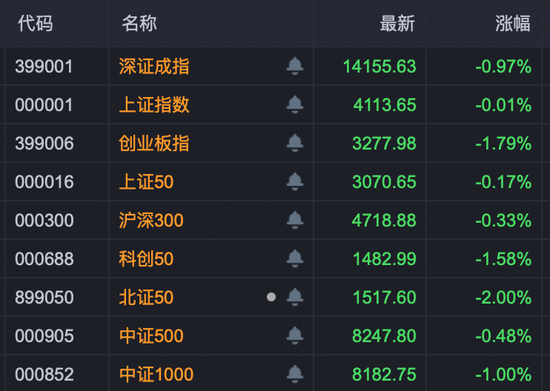
Market Overview - The A-share market experienced fluctuations with the Shanghai Composite Index barely holding above 4100 points, while the ChiNext Index fell below 3300 points. Major indices like the Shenzhen Component, CSI 300, and CSI 500 closed with small bearish candles, and the market turnover reached 2.8 trillion yuan [1][11]. Index Performance - The latest index performances are as follows: - Shenzhen Component: 14155.63 (-0.97%) - Shanghai Composite: 4113.65 (-0.01%) - ChiNext Index: 3277.98 (-1.79%) - CSI 300: 4718.88 (-0.33%) - CSI 500: 8247.80 (-0.48%) [2][12]. Sector Performance - The chemical, precious metals, real estate, and aviation sectors showed the highest gains, while aerospace equipment, photovoltaic equipment, communication devices, and glass fiber sectors faced the largest declines [2][12]. Fund Flow Analysis - The public utilities sector saw a net inflow of over 3.7 billion yuan, while the construction and decoration sector received over 3.6 billion yuan. Real estate, banking, basic chemicals, and building materials also attracted over 2 billion yuan each. In contrast, sectors like electronics, power equipment, and defense saw net outflows exceeding 10 billion yuan [3][13]. Notable Stocks - Key stocks with significant net inflows include: - China Xidian: 15.63 yuan (+8.84%) with a net inflow of 1.56 billion yuan - Shanzhi High-Tech: 5.42 yuan (+6.69%) with a net inflow of 1.42 billion yuan - Zhejiang Wenhu: 9.97 yuan (+10.04%) with a net inflow of 1.32 billion yuan [4][14]. Future Market Outlook - Yingda Securities suggests that the market is in a cooling phase, with the Shanghai Composite Index fluctuating around the 4100-point mark. This does not indicate a deep correction but rather a healthy consolidation after rapid gains. Investors are advised to take profits on overbought stocks while looking for value opportunities in underperforming sectors [5][15]. Long-term Projections - Zhongyin International forecasts that by 2026, the core broad-based index of the Chinese stock market could see an overall increase of over 40%, driven by nearly 20% profit growth and 20% valuation expansion. Key sectors expected to lead include technology manufacturing, biomedicine, and defense, while sectors like telecommunications and real estate may have potential for catch-up gains [5][15]. Precious Metals Market - The precious metals sector saw significant activity, with gold prices reaching a historical high of over 4700 USD per ounce. Domestic gold futures also surged, reflecting strong demand amid ongoing global economic uncertainties [6][16]. Chemical Industry Trends - The chemical sector is experiencing a global price surge, with major companies like BASF and Dow Chemical implementing price increases across various regions. Recent data indicates that 11 out of 16 monitored chemical products have seen price increases, with synthetic rubber rising by 11.7% [8][19]. Structural Investment Opportunities - Galaxy Securities highlights that new demand drivers are expected to accelerate a cyclical reversal in the chemical industry, suggesting a focus on structural investment opportunities as supply constraints emerge [20].
博时市场点评1月20日:两市继续震荡,市场风格切换
Xin Lang Cai Jing· 2026-01-20 08:41
Economic Overview - The core economic data for 2025 indicates a year-on-year GDP growth of 5.0%, with Q4 GDP growth at 4.5%, aligning with market expectations [1][7] - In December, the industrial added value increased by 5.2% year-on-year, while fixed asset investment showed a cumulative decline of 3.8% [1][7] - Retail sales growth in December was only 0.9%, highlighting weak domestic demand [1][7] - The economic environment is characterized by stronger supply than demand, with external demand outperforming internal demand [1][7] Policy and Strategic Initiatives - The National Development and Reform Commission (NDRC) plans to implement a strategy to expand domestic demand from 2026 to 2030, aiming to create new demand through new supply [2][9] - A national-level merger fund is being considered to promote industrial integration and optimize the competitive landscape [9] - The establishment of a unified national market is a long-term goal, which will enhance resource allocation efficiency and improve the market environment [9] Market Performance - On January 20, the A-share market saw declines across major indices, with the Shanghai Composite Index at 4113.65 points, down 0.01%, and the Shenzhen Component Index at 14155.63 points, down 0.97% [10][11] - The market turnover reached 28,044.27 billion yuan, showing a slight increase from the previous trading day [12] - The two financing balances reported a decrease to 27,231.75 billion yuan [12]
莱昂纳多董事长提出与芬坎蒂尼未来合并的设想
Sou Hu Cai Jing· 2026-01-20 08:13
芬坎蒂尼与莱昂纳多均为意大利政府控股企业,目前已在多个项目中开展合作。然而,由于政治因素与商业优先事项上的分歧,双方此前有关深化产业整合 的讨论一直未能取得进展。 中国航空新闻网讯:据外媒1月19日报道,意大利国防与航空航天巨头莱昂纳多集团董事长斯特凡诺·蓬泰科尔沃日前公开表示,未来可能与意大利国有造船 企业芬坎蒂尼集团进行合并。 蓬泰科尔沃在米兰博科尼大学举行的一次会议上作出上述表态。当时,芬坎蒂尼集团运营执行副总裁克劳迪奥·西西利诺也在听众席就座。蓬泰科尔沃表 示:"希望有一天我们之间能够合并。"不过他并未进一步阐述具体细节。 ...

粤开市场日报-20260120-20260120
Yuekai Securities· 2026-01-20 07:54
Market Overview - The A-share market indices closed down today, with the Shanghai Composite Index falling by 0.01% to 4113.65 points, the Shenzhen Component Index down by 0.97% to 14155.63 points, the Sci-Tech 50 down by 1.58% to 1482.99 points, and the ChiNext Index down by 1.79% to 3277.98 points [1][14] - Overall, there were 2231 stocks that rose and 3102 stocks that fell, with a total market turnover of 27,777 billion yuan, an increase of 693 billion yuan compared to the previous trading day [1] Industry Performance - Among the Shenwan first-level industries, the sectors that performed well included Petroleum & Petrochemicals (up 1.74%), Building Materials (up 1.71%), Real Estate (up 1.55%), Transportation (up 1.25%), Construction Decoration (up 1.24%), and Basic Chemicals (up 1.15%) [1][14] - Conversely, the sectors that saw declines included Communication (down 3.23%), Defense & Military (down 2.87%), and Computer (down 1.94%) [1][14] Concept Sector Performance - The leading concept sectors with gains today included Cultivated Diamonds, Cement Manufacturing Selection, Real Estate Selection, Major Infrastructure Central Enterprises, Chemical Raw Materials Selection, Food Processing Selection, Advanced Packaging, Gold and Jewelry, First-Class Real Estate Developers, Aviation Transportation Selection, Banking Selection, Central Enterprises, Old Infrastructure, Western Major Infrastructure, and Superhard Materials [2][11]