
电信

Search documents
港股央企红利50ETF(520990)跌0.77%,成交额2.09亿元
Xin Lang Cai Jing· 2025-12-15 07:13
Core Viewpoint - The Invesco Great Wall CSI National New Hong Kong Stock Connect Central Enterprise Dividend ETF (520990) has shown significant growth in both share count and asset size in 2024, despite a recent decline in its closing price [1][2]. Group 1: Fund Performance - As of December 12, 2024, the fund's latest share count is 5.626 billion, with a total asset size of 5.853 billion yuan, reflecting a 50.18% increase in shares and a 67.17% increase in size year-to-date [1]. - The fund's management fee is 0.50% annually, and the custody fee is 0.10% annually [1]. Group 2: Trading Activity - The fund recorded a total trading volume of 3.103 billion yuan over 231 trading days this year, averaging 135 million yuan per day [1]. - In the last 20 trading days, the cumulative trading amount was 3.368 billion yuan, with an average daily trading amount of 168 million yuan [1]. Group 3: Fund Management - The current fund managers are Gong Lili and Wang Yang, with returns of 20.71% and 6.80% respectively during their management periods [2]. - The fund's top holdings include major companies such as China Petroleum, China Mobile, and China Shenhua, with significant weightings in the portfolio [2][3]. Group 4: Top Holdings - The top holdings and their respective portfolio weights are as follows: - China Petroleum: 10.88% with a market value of 469 million yuan - China Mobile: 10.33% with a market value of 445 million yuan - China Shenhua: 9.72% with a market value of 419 million yuan - China National Offshore Oil: 9.54% with a market value of 411 million yuan - COSCO Shipping Holdings: 8.43% with a market value of 364 million yuan - Sinopec: 7.42% with a market value of 320 million yuan - China Telecom: 4.54% with a market value of 196 million yuan - China Unicom: 3.45% with a market value of 149 million yuan - China Coal Energy: 2.59% with a market value of 112 million yuan - China Resources Land: 2.23% with a market value of 9.607 million yuan [3].
Stock markets open lower on foreign fund outflows, weak global trends
BusinessLine· 2025-12-15 04:43
Market Overview - Equity benchmark indices Sensex and Nifty declined in early trade due to a weak trend in global markets and persistent foreign fund outflows, with Sensex down 384.39 points to 84,883.27 and Nifty down 122.9 points to 25,924.05 [1] - Foreign Institutional Investors (FIIs) offloaded equities worth ₹1,114.22 crore, while Domestic Institutional Investors (DIIs) bought stocks worth ₹3,868.94 crore [4] Sector Performance - Major laggards from Sensex firms included Mahindra & Mahindra, Bharti Airtel, Trent, NTPC, Bajaj Finserv, and Power Grid [2] - Gainers included Asian Paints, Hindustan Unilever, UltraTech Cement, Bharat Electronics, and Tata Steel [2] Global Market Influence - Asian markets are trading lower, led by declines in Japan and South Korea, as investors await key economic data releases from China and the US [3] - US markets ended lower on Friday, contributing to the cautious sentiment in Asian markets [3] Currency and Commodities - The Indian Rupee depreciated 9 paise to an all-time low of 90.58 against the US dollar [5] - Brent crude oil prices increased by 0.52% to $61.43 per barrel [5]


AI恐慌下的避震器!印度股市2026年或成对冲AI泡沫风险的重要工具”
Zhi Tong Cai Jing· 2025-12-15 01:44
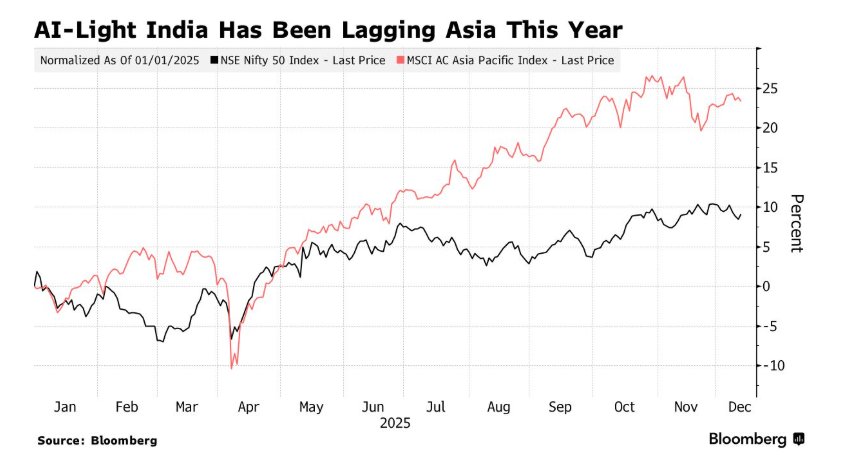
全球大型资管机构们正在把印度股票市场视为对冲AI泡沫破裂风险的首选市场标的,随着近期甲骨文、英伟达以及博通等 近年来受益于AI热潮的科技巨头们股价大幅下跌,市场对于AI泡沫破裂的担忧情绪显著升温,惧怕出现"堪比2000年互联 网泡沫破裂时期的科技股熊市暴跌轨迹"。而印度市场,正引起全球对冲基金经理们的新增关注,他们希望在来年分散股 票投资风险。 来自欧洲的资管巨头Aberdeen Group Plc认为印度股票明年会出现反弹;另外两家资管巨头Principal Asset Management Co.与 Eastspring Investments则认为,印度市场与"AI叙事"交易的相关性较低,可作为对冲其他股市(尤其是科技股集中度很高的 股市——比如美国、韩国以及中国台湾)的重要工具。来自汇丰与Jefferies Financial Group Inc.的资深策略师们也表达了类 似观点。 全球资金开始将印度股市视为抵御人工智能风险的对冲工具 "印度在2026年可以成为投资组合中一个很好的分散化与多元化资产配置,因为它与其他偏向AI的大型市场的相关性较 低,而AI交易热潮一旦暂停,资金就会大规模流向印度,"P ...
固定收益周报:事件性冲击结束-20251214
Huaxin Securities· 2025-12-14 14:01
1. Report Industry Investment Rating No relevant content is provided in the report. 2. Core View of the Report - The overall macro - policy aims to stabilize the macro - leverage ratio. The liability growth rate of the real - sector is expected to decline in December 2025, and the government debt growth rate is also expected to continue to fall. - The economic situation on the asset side is weak, with the physical quantity data in October weaker than that in September. It is necessary to focus on when the economy will stabilize and pick up. - The stock - bond ratio is in an interval - shock state, currently with risk - preference at the upper limit of the interval and trending downward later. The stock - bond ratio is in favor of bonds, and the equity style is in favor of value [17][19][22]. 3. Summary According to Relevant Catalogs 3.1 National Asset Balance Sheet Analysis - **Liability Side**: In November 2025, the liability growth rate of the real - sector was 8.7%, the same as the previous value, and it is expected to drop to around 8.5% in December. The government debt growth rate was 13.1% at the end of November, and is expected to fall to around 12.5% in December. The capital market was basically stable last week, mainly due to the renewal of 750 billion special treasury bonds on the 12th, with a high probability of subsequent marginal convergence [17][18]. - **Fiscal Policy**: The net increase of government bonds last week was 298.1 billion yuan, higher than the planned net decrease of 510.2 billion yuan. It is planned that the government bonds will have a net decrease of 119.2 billion yuan next week [2][18]. - **Monetary Policy**: Last week, the capital trading volume and price increased on a weekly average basis, and the term spread was stable. The one - year treasury bond yield fluctuated narrowly, closing at 1.39% on the weekend. The term spread between the ten - year and one - year treasury bonds was stable at 45 basis points. The yield fluctuation ranges of the ten - year and thirty - year treasury bonds are expected to be around 1.6% - 1.9% and 1.8% - 2.3% respectively [2][18]. - **Asset Side**: The physical quantity data in October was weaker than that in September. The annual real economic growth target in 2025 is about 5%, and the nominal economic growth target is about 4.9%. It is necessary to observe whether 5% will become the central target for China's nominal economic growth in the next 1 - 2 years [3][19]. 3.2 Stock - Bond Ratio and Stock - Bond Style - **Economic Cycle**: Since 2011, China has entered a period of declining potential economic growth, which seems to have ended in the fourth quarter of 2024. The government put forward three policy goals in 2016, and currently the liability - side convergence has not ended but the space is limited [6][20]. - **Overseas Situation**: China and the US are in a state of equal - power competition. If the valuation of the US technology field is re - evaluated, global funds may flow to China. It is necessary to focus on whether the RMB exchange rate will enter an appreciation channel [6][21]. - **Market Performance**: Last week, the capital market was stable, with stocks and bonds rising slightly, and the equity style shifting to growth - dominance. The bond yields at both long - and short - ends declined slightly, and the stock - bond ratio was in favor of bonds [7][21]. - **Investment Recommendation**: It is recommended to allocate long - term bonds and value - type equity assets. This week, it is recommended to allocate the Shanghai Composite 50 Index (80% position) and the 30 - year treasury bond ETF (20% position) [8][22]. 3.3 Industry Recommendation - **Industry Performance Review**: This week, A - shares fell on heavy volume. Among the Shenwan primary industries, communication, national defense and military industry, electronics, machinery, and power equipment had the largest increases, while coal, petroleum and petrochemicals, steel, real estate, and textile and clothing had the largest declines [30]. - **Industry Crowding and Trading Volume**: As of December 12, the top five crowded industries were electronics, power equipment, communication, machinery, and computers, while the bottom five were beauty care, comprehensive, petroleum and petrochemicals, steel, and coal. The trading volume of the whole A - shares rebounded this week, with the trading volume of some industries increasing and that of some industries decreasing [31][34]. - **Industry Valuation and Earnings**: This week, among the Shenwan primary industries, the PE (TTM) of communication, electronics, national defense and military industry, machinery, and comprehensive increased the most, while that of coal, petroleum and petrochemicals, steel, real estate, and textile and clothing decreased the most. Industries with high 2024 full - year earnings forecasts and relatively low current valuations include banks, securities, insurance, etc. [37][38]. - **Industry Prosperity**: Externally, the demand is declining marginally, with the global manufacturing PMI falling and the export growth rates of some countries fluctuating. Domestically, the second - hand housing price fell last week, and quantity indicators showed mixed trends [42]. - **Public Offering Market Review**: In the second week of December, most active public - offering equity funds outperformed the CSI 300. As of December 12, the net asset value of active public - offering equity funds increased slightly compared with that in Q4 2024 [60]. - **Industry Recommendation**: In the de - leveraging cycle, the stock - bond ratio is only slightly in favor of equities, and the value style is more likely to dominate. A recommended A + H dividend portfolio includes 13 stocks, and the A - share portfolio includes 20 stocks, mainly concentrated in industries such as banks, telecommunications, petroleum and petrochemicals, and transportation [9][65].
FIPA举办2025年度波黑最重要外国投资者评选颁奖活动,投资集中于能源、医疗健康等领域
Shang Wu Bu Wang Zhan· 2025-12-13 15:42
Core Insights - The Foreign Investment Promotion Agency (FIPA) of Bosnia and Herzegovina held an award ceremony recognizing the most significant foreign investors in 2025, highlighting contributions to the country's economic development [1] Group 1: Investment Overview - A total of 12 foreign companies received honors, with investments concentrated in sectors such as energy, healthcare, pharmaceuticals, retail clothing, technology and business process outsourcing, and wood processing [1] - The total investment from these companies amounted to 530 million marks, creating 2,561 jobs [1] Group 2: Key Investor Insights - Countries with the highest direct investment stock in Bosnia include Austria, Serbia, and Croatia, with telecommunications, banking, and green energy being the most attractive sectors for foreign investment [1] Group 3: Discussion Themes - FIPA organized a thematic discussion on "Free Trade Zones as Engines of Bosnia's Export and Investment Potential," showcasing the development advantages of the cities of Trebinje, Bijeljina, and Gradiška [1]
“永久裁员”时代来临,这个行业受冲击最严重
财富FORTUNE· 2025-12-13 13:07
Core Viewpoint - The article discusses the ongoing trend of "rolling layoffs" in the U.S. job market, highlighting the shift from large-scale layoffs to more frequent, smaller layoffs, which has created a pervasive sense of anxiety among white-collar workers [1][5][15]. Group 1: Layoff Trends - As of November 2025, U.S. companies have announced layoffs affecting 1.1 million workers, marking the sixth time this level has been surpassed since 1993 [1][3]. - The technology sector has been the hardest hit, with over 150,000 layoffs in 2025, while other industries like telecommunications, food, retail, and media have also experienced significant layoffs, some with year-on-year increases exceeding 100% [3][5]. - The cumulative layoffs for the first 11 months of 2025 reached 1.1708 million, a 54% increase compared to the same period in 2024, with November alone seeing 71,300 layoffs, the highest for that month since 2022 [3][4]. Group 2: Economic Signals - The current economic landscape presents contradictory signals, with a "rolling recession" followed by a potential "rolling recovery" starting in April 2025, according to Morgan Stanley analysts [5]. - However, analysts from Goldman Sachs and Bank of America argue that the recovery is primarily financial, with stock prices and profits rising while demand for white-collar jobs continues to decline [5][15]. - The phenomenon of "K-shaped economy" is evident, where the wealthiest 10% contribute nearly half of consumer spending, while lower-income individuals face increasing financial strain [5][15]. Group 3: Employment Market Dynamics - The shift to "permanent layoffs" has seen small-scale layoffs (affecting fewer than 50 employees) rise to over half of all layoffs in 2025, compared to less than half in the mid-2010s [6][8]. - This new model allows companies to adjust workforce sizes continuously without the reputational damage associated with large-scale layoffs, but it leads to chronic internal issues such as increased workloads and diminished job security [6][8]. - Job seekers' bargaining power has decreased, with the "job rejection rate" declining for two consecutive years, forcing many to accept less desirable positions [9][12]. Group 4: Structural Challenges - Recruitment demand has also weakened, with companies planning to hire only 497,200 workers in the first 11 months of 2025, a 35% drop from the previous year, marking the lowest level since 2010 [12]. - The labor market exhibits a "K-shaped structure," where large companies are expanding due to cash flow advantages while small businesses are contracting under cost pressures [12][15]. - The impact of artificial intelligence on job cuts is significant, with over 70,000 positions attributed to AI since 2023, prompting a reevaluation of automation risks and transformation paths in various industries [14][15].

Viettel获”最佳数字化转型项目”等国际奖项
Shang Wu Bu Wang Zhan· 2025-12-12 15:45
越通社12月11日报道,越南军队电信集团(Viettel)当日宣布,近日荣获2025年全球电信奖 (Glotel 2025)"最佳数字化转型项目"奖及2025年世界通信奖(WCA 2025)"人与文化"和"增长市场最 佳运营商"奖。 WCA由英国权威杂志主办,已有20多年历史,被视为全球电信行业的"奥斯卡"。Viettel凭借其"以 人为先,始终创新"的经营理念和其布隆迪品牌Lumitel斩获两个奖项,其中"增长市场最佳运营商"旨在 表彰那些在新兴市场积极推动基础设施、连接性和数字化机遇变革的运营商,Viettel是布隆迪首家部署 5G的电信运营商。 (原标题:Viettel获"最佳数字化转型项目"等国际奖项) Glotel是国际科技界高级别奖项之一,吸引了三星、华为、英伟达、爱立信等大型通信集团参与, Viettel凭借其旗下Viettel人工智能与数据中心(Viettel AI)开发的"数字孪生"平台解决方案获奖。 ...
百利好决战非农 | 非农数据定乾坤 市场未来走势全解析
Sou Hu Cai Jing· 2025-12-12 03:13
北京时间12月11日凌晨,美联储宣布年内第三次降息25个基点,然而此次决议罕见地出现了三张反对票,揭示了内部对政策路 径的严重分歧。在此之前,11月美国就业市场已显现出明显的降温迹象,市场对即将公布的11月非农数据既充满期待又充满疑 虑,其结果将直接左右美联储后续的政策选择。 从企业个体动态到宏观经济数据,11月美国就业市场的疲软态势已多方显现。11月14日,美国最大电信运营商威瑞森确认计划 裁员约1.5万人,占员工总数的15%,旨在削减成本以应对市场竞争。宏观数据方面,12月3日发布的11月ADP私营部门就业报告 传来重磅利空消息,当月私营部门就业岗位意外减少3.2万个,不仅远低于市场普遍预期的"新增2万个",更创下2023年3月以来 的最大单月降幅。这一数据与初请失业金人数上升趋势相呼应,打破了此前就业市场韧性十足的惯性认知。 本期嘉宾 资深分析师 辰宇 麦东 主播 一菲 直播时间 12月16日 21:00 – 22:00 温馨提示:正常情况下,非农数据公布的时间为每月第一周的星期五20:30,《决战非农》播出时间为 20:00至21:40,请密切关 注智昇直播动态。如有任何疑问,请联系客服查询。 就业市 ...

消费者维权指南:遇到不公,我应该去哪里投诉?
Xin Lang Cai Jing· 2025-12-12 01:53
在日常生活中,消费几乎无处不在。无论是线上购物、外出就餐,还是购买服务,我们都可能遇到商品 质量不符、服务承诺未兑现、甚至商家跑路等糟心问题。当沟通协商无果时,许多消费者面临的第一个 困惑就是:"我该去哪里投诉?" 这并非一个简单的问题,因为针对不同的消费领域、不同的诉求目 标,有效的投诉途径也各不相同。本文将为您系统梳理主流的消费投诉 【下载黑猫投诉客户端】渠 道,帮助您在需要时,能快速、准确地找到最适合的维权路径。 一、明确投诉对象与性质:选择渠道的第一步 在寻找投诉渠道前,首先要厘清两个关键点:投诉对象是谁(是平台内的商家、品牌方,还是独立的线 下门店?)以及问题性质是什么(是普通的消费纠纷,还是涉嫌违法经营?)。这直接决定了你该优先 使用哪种渠道。 例如,在电商平台购买到假货,投诉对象既是销售商家,也涉及提供交易场所的平台方。如果是在线下 健身房遇到预付卡退款难,投诉对象则是该健身房的经营企业。 二、核心官方投诉渠道:具备法律强制力的后盾 对于任何消费纠纷,最权威、最具法律强制力的途径始终是政府主管部门设立的渠道。 对于特定行业的问题,直接向其主管部委设立的投诉渠道反映,有时更具针对性。 三、第三方公 ...
五年来北京新设外资企业超9000家
Zhong Guo Xin Wen Wang· 2025-12-11 12:14
Core Insights - Over the past five years, Beijing has established more than 9,000 new foreign-funded enterprises and recognized over 270 foreign-funded R&D centers [1] - Beijing has implemented over 70 national breakthrough policies and promoted more than 80 innovative achievements nationwide, consistently ranking first in evaluations of national service industry opening-up pilot demonstrations [1] Group 1: Foreign Investment and Policy Implementation - Beijing has taken advantage of the national service industry opening-up comprehensive demonstration zone and the China (Beijing) Free Trade Pilot Zone to attract foreign investment [1] - The city has been a pioneer in expanding openness in the medical field, with 22 companies participating in biotechnology pilot programs [1] - Beijing has established the country's first rare disease drug guarantee pilot area and introduced the first international professional qualification recognition directory [1] Group 2: Data and Telecommunications Initiatives - The city has launched the first comprehensive reform system for facilitating cross-border data flow, including a negative list for data export at the scene and field level [1] - The first pilot program for expanding value-added telecommunications has been initiated, with a total of 26 foreign-funded enterprises approved [1] Group 3: Efficiency and Service Improvements - Beijing has achieved full online processing for the establishment of foreign-invested enterprises, with the fastest completion time being one day [1] - Innovative logistics models such as "dual hub and two airport logistics collaboration" have been introduced to enhance customs efficiency [1] - The "Sail Plan" for entry and exit services has been implemented, along with a package of 36 policy services aimed at assisting enterprises, attracting talent, and benefiting the public [1]