
焦炭

Search documents
广发期货《黑色》日报-20250903
Guang Fa Qi Huo· 2025-09-03 05:32
Report Industry Investment Rating No relevant content provided. Core Viewpoints - For the steel industry, prices have fallen from their highs, with significant declines in steel profits. There are expectations of seasonal demand improvement from September to October, but high production levels still pose a challenge to the demand - absorbing capacity during the peak season. Attention should be paid to coal mine复产 after the September 3rd parade and steel demand during the peak season. Investment strategies include selling out - of - the - money put options and considering long positions in the steel - iron ore ratio [1]. - Regarding the iron ore industry, the current fundamentals lack a strong upward driver. Although the iron water output may decline slightly around the parade, it will remain at a relatively high level in September. The demand during the "Golden September and Silver October" period is uncertain. The strategy is to view it as a range - bound market, with the range reference of 750 - 810, and recommend the arbitrage strategy of long iron ore and short coking coal [3][4]. - In the coke industry, the futures market has shown volatile and downward trends. The supply will gradually become looser after the end of short - term production restrictions, and there is a possibility of price decline in the future. It is recommended to hold previous short positions and consider the arbitrage strategy of long iron ore and short coke [5]. - For the coking coal industry, the futures market is oscillating weakly. The supply - demand situation has eased, and prices may continue to fall in September. It is recommended to hold previous short positions and consider the arbitrage strategy of long iron ore and short coking coal [5]. Summary by Related Catalogs Steel Industry Steel Prices and Spreads - Most steel prices have declined, with the exception of some contracts and regions where prices remained unchanged. For example, the spot price of rebar in the East China region dropped by 10 yuan/ton, and the price of the rebar 10 - contract increased by 8 yuan/ton [1]. Cost and Profit - The cost of steel production has generally decreased, while profits have declined significantly. For instance, the cost of Jiangsu electric - arc furnace rebar decreased by 36 yuan/ton, and the profit of East China hot - rolled coils decreased by 33 yuan/ton [1]. Production and Inventory - The daily average iron water output decreased by 0.7 tons (- 0.3%), while the output of five major steel products increased by 0.7%. The inventory of five major steel products increased by 1.9%, with the rebar inventory rising by 2.7% [1]. Market Analysis - In August, the supply - demand gap widened, and inventory accumulation was obvious. Entering September - October, there are expectations of seasonal demand improvement. However, high production levels still test the demand - absorbing capacity during the peak season [1]. Iron Ore Industry Price and Spread - The basis of most iron ore varieties has increased significantly, and the 5 - 9 spread has widened. For example, the 01 - contract basis of PB powder increased by 32.2 yuan/ton (351.5%) [3]. Supply and Demand - The global iron ore shipment volume increased by 7.3% week - on - week, and the 45 - port arrival volume increased by 5.5%. The demand side saw a decline in iron water output and a decrease in the average daily port clearance volume [3]. Inventory - The 45 - port inventory increased slightly by 0.1%, while the inventory of imported iron ore in 247 steel mills decreased by 0.6% [3]. Market Analysis - The fundamentals currently lack a strong upward driver. Although the iron water output may decline slightly around the parade, it will remain at a relatively high level in September. The demand during the "Golden September and Silver October" period is uncertain [3]. Coke and Coking Coal Industry Price and Spread - Coke and coking coal prices have shown different trends. Coke futures prices have fluctuated and declined, while coking coal futures prices have oscillated weakly. The spreads between different contracts have also changed [5]. Profit - Coking profits and sample coal mine profits have both decreased. The weekly coking profit decreased by 11, and the weekly sample coal mine profit decreased by 4 [5]. Supply and Demand - Coke supply has decreased due to production restrictions, and demand has also declined with the decrease in iron water output. Coking coal supply has been affected by mine accidents and production suspension, and demand has decreased due to steel and coking production restrictions [5]. Inventory - Coke and coking coal inventories have shown different trends. Coke inventories have increased slightly overall, while coking coal inventories have decreased slightly in some sectors and increased in others [5]. Market Analysis - Coke supply will gradually become looser after the end of short - term production restrictions, and there is a possibility of price decline. Coking coal supply - demand has eased, and prices may continue to fall in September [5].
焦炭:主流焦化厂第七轮提涨落地 焦化利润继续修复 第八轮提涨遇阻
Jin Tou Wang· 2025-09-03 02:11
Core Viewpoint - The recent fluctuations in coking coal futures indicate a volatile market, with supply tightening and demand showing signs of decline, leading to potential price adjustments in the near future [6] Supply - As of August 28, the average daily coking coal production from independent coking plants was 645,000 tons, a week-on-week decrease of 0.9% [3] - The total daily coking coal production from 247 steel mills was 461,000 tons, down by 0.6% week-on-week, resulting in a total production of 1,106,000 tons, which is a 1.6% decrease from the previous week [3] Demand - The average daily pig iron production was 2,401,300 tons as of August 28, reflecting a decrease of 620 tons week-on-week [4] - The blast furnace operating rate was 83.20%, down by 0.16% week-on-week, while the iron-making capacity utilization rate was 90.02%, a decrease of 0.23% [4] - The profitability of steel mills was reported at 63.64%, down by 1.30% week-on-week [4] Inventory - As of August 28, the total coking coal inventory was 9.44 million tons, with a week-on-week increase of 15,000 tons [5] - The inventory at independent coking plants was 653,000 tons, up by 9,000 tons week-on-week, while the inventory at 247 steel mills was 6.101 million tons, an increase of 5,000 tons [5] - Port inventory stood at 2.687 million tons, with a slight increase of 1,000 tons week-on-week [5] Price Movements - The main coking coal futures contract closed at 1,596.5, up by 2.0 (+0.13%), while the far-month contract closed at 1,689.0, down by 2.0 (-0.12%) [1] - The seventh round of price increases for coking coal was implemented at 50/55 yuan/ton, with the price for premium coking coal in Shanxi at 1,340 yuan/ton [1][6] - The eighth round of price increases faced resistance, with a steel plant in Ningxia reducing prices [1][6] Market Outlook - The market is expected to experience price adjustments due to improved coking profits and the gradual easing of production restrictions, leading to a potential increase in supply [6] - The steel industry is implementing strategies to control total production, which may negatively impact coal and coking coal demand [6]
反内卷:157个细分行业供给侧全景
2025-09-02 14:41
Summary of Conference Call Notes Industry Overview - The conference call discusses the supply-side reform across various industries, highlighting a slower capacity reduction compared to previous reforms. The overall capacity and inventory cycles for non-financial enterprises in the second quarter remain at the bottom, indicating a need for time and policy accumulation for recovery [3][4]. Key Points and Arguments - **Supply Capacity Assessment**: Analysts evaluate supply capacity using three dimensions: current supply capacity (capacity utilization rate and inventory), future supply changes (expansionary capital expenditure), and industry profitability (gross margin and proportion of loss-making enterprises) [4][5]. - **Manufacturing Sector**: - Industries such as construction, chemicals, and coke are categorized as "three lows" (low capacity utilization, low inventory, low expansionary capital expenditure), indicating low production willingness and limited future production capacity, accelerating capacity clearance [6]. - In contrast, cyclical products like textile chemicals, glass fiber, and fluorochemicals show profit growth, particularly fluorochemicals [6]. - Manufacturing areas like inverters, silicon materials, and silicon wafers are performing well, while lithium batteries and photovoltaic cell components are at the left-side bottom [6]. - **Consumer Goods Sector**: Chemical pharmaceuticals and clothing/home textiles are performing well, while traditional Chinese medicine is positioned in the middle to later stages of the left side [6]. - **TMT Sector**: Electronic chemicals, integrated circuit manufacturing, and security equipment are in relatively good positions, with no observed left-side bottom industries [2][6]. Additional Important Insights - The current supply-side framework is based on listed company data, reflecting the latest industry conditions as of the second quarter. The introduction of anti-involution policies has led to some positive factors across industries, but the overall situation remains at the bottom, requiring further time and policy efforts for noticeable changes [3]. - The assessment of supply capacity includes measuring capacity utilization through fixed asset turnover ratios and inventory through cumulative year-on-year comparisons over the past decade [4][5]. - Continuous tracking of data across different sectors is essential for making accurate judgments regarding potential investment opportunities and risks [6].
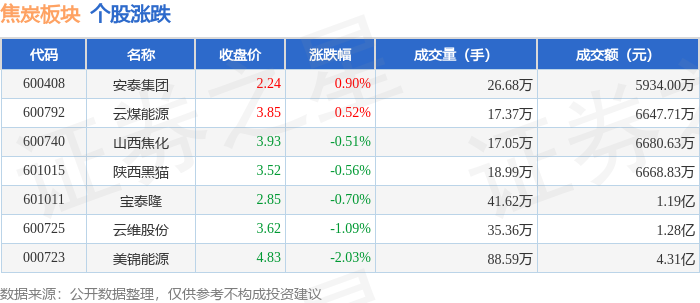
焦炭板块9月2日跌1.04%,美锦能源领跌,主力资金净流出1.15亿元
Zheng Xing Xing Ye Ri Bao· 2025-09-02 09:09
Group 1 - The coke sector experienced a decline of 1.04% on September 2, with Meijin Energy leading the drop [1] - The Shanghai Composite Index closed at 3858.13, down 0.45%, while the Shenzhen Component Index closed at 12553.84, down 2.14% [1] - Major stocks in the coke sector showed mixed performance, with Antai Group increasing by 0.90% and Meijin Energy decreasing by 2.03% [1] Group 2 - The net outflow of main funds in the coke sector was 115 million yuan, while retail investors saw a net inflow of 107 million yuan [1] - Detailed fund flow data indicates that Meijin Energy had a significant net outflow of 64.06 million yuan from main funds [2] - Retail investors showed a strong interest in several stocks, with Antai Group and Yunwei Co. seeing positive net inflows from retail investors [2]


中国旭阳集团“再出发”:有序扩产激发内生动力 外延式布局加速全球进击
Zhi Tong Cai Jing· 2025-09-02 08:14
Core Viewpoint - The report highlights that Xuyang Group is successfully navigating through an industry adjustment period while achieving resilient growth and business integration, marking a critical transition point as it approaches its seventh five-year development plan for 2026-2030 [1][2]. Financial Performance - In the first half of 2025, Xuyang Group reported a revenue of 20.549 billion yuan, with a gross profit of 1.686 billion yuan, resulting in a gross margin of 8.2% and a net profit of 86.908 million yuan [3]. - The fine chemicals segment generated a revenue of 9.096 billion yuan, accounting for 44.3% of total revenue, while the coke and coking segment reported a revenue of 6.358 billion yuan [3]. Business Segments Growth - The fine chemicals segment experienced a business volume of 2.9 million tons, up 11.5% year-on-year, while the coke segment's business volume reached 10.9 million tons, increasing by 25.3% [1]. - The hydrogen energy segment reported a business volume of 1.11 million cubic meters, reflecting a year-on-year growth of 16.8% [1]. Strategic Initiatives - Xuyang Group successfully acquired a controlling stake in Yihua Tong, marking the largest transaction in the hydrogen energy sector in recent years, and is progressing towards building a hydrogen energy ecosystem worth 10 billion yuan [1]. - The company has established a presence in Brazil and is preparing to set up trading offices in Europe, expanding its international footprint with 11 subsidiaries or offices across 41 countries and regions [2]. Future Outlook - The company is set to launch its seventh five-year development plan in 2026, with a clear path for future growth driven by acquisitions, external collaborations, and global market expansion [2][7]. - Upcoming projects include a 50,000-ton/year high-end polyamide new materials project expected to commence production in October 2025, alongside ongoing research into high-value fine chemical products [7]. Hydrogen Energy Development - Xuyang Group is actively involved in hydrogen industrialization projects in various regions and has completed the necessary licensing for hazardous chemicals, enhancing its competitive edge [4]. - The company is developing a 5-ton/day liquid hydrogen demonstration project, which is expected to be completed next year, positioning it as a leader in the domestic liquid hydrogen market [4][9]. Innovation and Product Development - The company has successfully built and put into operation the first domestic industrial-scale amino alcohol production facility, becoming the second company globally to produce amino alcohols industrially [5]. - The amino alcohols produced are widely applicable in various industries, with prices ranging from 60 to 150 yuan per kilogram based on purity, indicating high added value [5][6].
广发期货日评-20250902
Guang Fa Qi Huo· 2025-09-02 07:59
Report Summary 1. Investment Ratings The document does not provide an overall industry investment rating. 2. Core Views - The direction of monetary policy in the second half of 2025 is crucial for the equity market. After a significant increase in A-shares, they may enter a high-level shock pattern [2]. - In the short term, the 10-year treasury bond interest rate may fluctuate between 1.75% - 1.8%. Gold shows a strong shock trend, and copper prices are rising due to improved interest rate cut expectations [2]. - Many commodities such as steel, iron ore, coking coal, and coke are facing price - related challenges. Some suggest strategies like long steel - to - ore ratio and shorting at high prices [2]. 3. Summary by Categories Financial Futures - **Stock Index Futures**: After a large increase in A - shares, they may enter a high - level shock pattern. It is recommended to wait for the next direction decision [2]. - **Treasury Bond Futures**: The 10 - year treasury bond interest rate may fluctuate between 1.75% - 1.8%. It is recommended to use range - bound operations for unilateral strategies and pay attention to the basis convergence strategy of TL contracts for spot - futures strategies [2]. - **Precious Metals**: Gold is strongly fluctuating. It is advisable to be cautious when chasing long positions unilaterally. Buying at - the - money or in - the - money call options can be considered. Silver is affected by news and shows an upward shock [2][3]. Industrial Metals - **Copper**: Due to the improvement of interest rate cut expectations, the center of copper prices has risen, with the main contract reference range of 78500 - 80500 [2]. - **Aluminum and Related Products**: Aluminum oxide has a surplus pressure, and the disk is in a weak shock. Aluminum is in a high - level shock, and attention should be paid to whether the peak - season demand can be fulfilled. Aluminum alloy has a firm spot price [2]. - **Other Metals**: Nickel has an upward shock trend, and stainless steel has a strong disk due to improved spot trading, with cost support and weak demand in a game [3]. Energy and Chemicals - **Crude Oil**: Supported by geopolitical and supply risks, oil prices have rebounded. It is recommended to wait and see unilaterally in the short term and use a positive - spread strategy for arbitrage [2]. - **Other Chemicals**: Many chemicals have different market situations. For example, ethylene glycol is expected to have limited downward space, while PVC is in a weakening trend [2]. Agricultural Products - **Grains and Oils**: Corn futures are in a rebound adjustment, and palm oil may rise in the short term [2]. - **Other Agricultural Products**: Sugar has a relatively loose overseas supply outlook, and eggs have a weak peak - season performance [2]. Special and New Energy Commodities - **Special Commodities**: Glass has a high inventory, and it is recommended to short at high prices. Rubber has a strong fundamental situation and is in a high - level shock [2]. - **New Energy Commodities**: Polysilicon has risen significantly due to news stimulation, and lithium carbonate is in a wait - and - see state [2].
《黑色》日报-20250902
Guang Fa Qi Huo· 2025-09-02 07:23
Report on the Steel Industry Investment Rating - Not provided Core View - In August, the apparent demand for steel decreased month-on-month, the supply-demand gap widened, and inventory accumulation was obvious. In September - October, there is an expectation of seasonal strengthening in demand. If the apparent demand recovers, the supply-demand gap will narrow, and inventory accumulation will slow down, but high production still tests the demand - absorbing capacity during the peak season. Currently, steel prices have fallen from high levels. Unilateral short - selling space is limited, and selling out - of - the - money put options can be considered. With the obvious contraction of steel mill profits and considering the expected reduction in coking coal production, going long on the steel - iron ore ratio can be considered [1]. Summary by Directory Steel Prices and Spreads - The prices of various steel products such as rebar and hot - rolled coils in different regions and contracts have decreased, with rebar 10 - contract dropping by 51 yuan/ton and hot - rolled coil 01 - contract dropping by 43 yuan/ton [1]. Cost and Profit - The billet price decreased by 50 yuan/ton, and the slab price remained unchanged. The profits of hot - rolled coils in different regions showed different trends, with the profit in North China increasing by 22 yuan/ton and that in East China decreasing by 8 yuan/ton [1]. Supply - The daily average pig iron output decreased by 0.7 to 240.1, a decrease of 0.3%. The output of five major steel products increased by 6.5 to 884.6, an increase of 0.7%. Among them, the electric - furnace output increased by 1.5 to 31.3, an increase of 5.0%, and the converter output increased by 4.4 to 189.3, an increase of 2.4% [1]. Inventory - The rebar inventory increased by 16.4 to 623.4, an increase of 2.7%, and the hot - rolled coil inventory increased by 4.0 to 365.5, an increase of 1.1%. The inventory of five major steel products increased by 26.8 to 1467.9, an increase of 1.9% [1]. Transaction and Demand - The building materials trading volume increased by 0.6 to 8.9, an increase of 6.6%. The apparent demand for five major steel products increased by 4.8 to 857.8, an increase of 0.6%. The apparent demand for rebar increased by 9.4 to 204.2, an increase of 4.8%, and that for hot - rolled coils decreased by 0.5 to 320.7, a decrease of 0.2% [1]. Report on the Iron Ore Industry Investment Rating - Not provided Core View - The global iron ore shipping volume has increased significantly to a high for the year, and the arrival volume at 45 ports has risen. The demand side is affected by the high - level steel mill profit rate and the limited production during the military parade in Tangshan, with pig iron output slightly decreasing from a high level. The port inventory has decreased slightly, and the steel mill's equity iron ore inventory has decreased. In the future, pig iron output will slightly decline around the military parade, and the fundamentals are difficult to drive a sharp rise. The demand during the "Golden Nine and Silver Ten" is questionable. Unilateral short - selling at high levels is recommended, and the strategy of going long on iron ore and short on coking coal is recommended [3]. Summary by Directory Iron Ore - Related Prices and Spreads - The warehouse - receipt costs of various iron ore powders have decreased, with the warehouse - receipt cost of Carajás fines decreasing by 19.8 to 792.3, a decrease of 2.4%. The 01 - contract basis of various iron ore powders has increased, with the 01 - contract basis of Carajás fines increasing by 17.2 to 26.3, an increase of 188.8% [3]. Spot Prices and Price Indexes - The spot prices of various iron ore powders at Rizhao Port have decreased, with the price of Carajás fines at Rizhao Port decreasing by 18.0 to 873.0, a decrease of 2.0%. The prices of iron ore indexes such as the Singapore Exchange 62% Fe swap have also slightly decreased [3]. Supply - The 45 - port arrival volume (weekly) increased by 132.7 to 2526.0, an increase of 5.5%, and the global shipping volume (weekly) increased by 241.0 to 3556.8, an increase of 7.3%. The national monthly import volume decreased by 131.5 to 10462.3, a decrease of 1.2% [3]. Demand - The daily average pig iron output of 247 steel mills (weekly) decreased by 0.6 to 240.1, a decrease of 0.2%. The daily average port clearance volume of 45 ports (weekly) decreased by 7.1 to 318.6, a decrease of 2.2%. The national monthly pig iron output and crude steel output also decreased [3]. Inventory Changes - The 45 - port inventory decreased by 35.7 to 13763.02, a decrease of 0.3%. The imported iron ore inventory of 247 steel mills (weekly) decreased by 58.3 to 9007.2, a decrease of 0.6% [3]. Report on the Coke Industry Investment Rating - Not provided Core View - The coke futures have shown a volatile downward trend, and the spot price has stabilized after the increase. The supply side has a slight decrease in coking enterprise start - up due to limited production in some areas, and the demand side has a high - level decline in blast furnace pig iron. The inventory in various links has slightly increased, and the overall inventory is at a medium level. There is a possibility of a future price decline. Speculative short - selling at high levels is recommended, and the strategy of going long on iron ore and short on coke is recommended [5]. Summary by Directory Coke - Related Prices and Spreads - The prices of various coke contracts have decreased, with the coke 01 - contract dropping by 49 yuan/ton. The coking profit has decreased, with the weekly steel - union coking profit decreasing by 11 [5]. Supply - The daily average output of all - sample coking plants decreased by 0.9 to 64.5, a decrease of 1.4% [5]. Demand - The pig iron output of 247 steel mills decreased by 0.7 to 240.1, a decrease of 0.3% [5]. Inventory Changes - The total coke inventory decreased by 1.1 to 887.5, a decrease of 0.14%. The inventory of all - sample coking plants, 247 steel mills, and ports showed different trends [5]. Coke Supply - Demand Gap Changes - The coke supply - demand gap decreased by 1.3 to - 5.7, a decrease of 22.4% [5]. Report on the Coking Coal Industry Investment Rating - Not provided Core View - The coking coal futures have shown a volatile downward trend, and the spot market is generally weak and stable. The supply side has a slight decrease in coal mine start - up due to recent mine accidents and production suspension and rectification, and the demand side has a decrease in coking enterprise start - up and a high - level decline in pig iron output. The inventory in various links has a slight accumulation, and the overall inventory has slightly decreased. The coal price may continue to decline in September. Speculative short - selling of coking coal 01 at high levels is recommended, and the strategy of going long on iron ore and short on coking coal is recommended [5]. Summary by Directory Coking Coal - Related Prices and Spreads - The prices of various coking coal contracts have decreased, with the coking coal 01 - contract dropping by 33 yuan/ton. The profit of sample coal mines has decreased by 4, a decrease of 0.9% [5]. Supply - The raw coal output remained unchanged at 860.5, and the clean coal output increased by 1.8 to 444.5, an increase of 0.4% [5]. Demand - The coke output decreased, with the daily average output of all - sample coking plants decreasing by 0.9 to 64.5, a decrease of 1.4% [5]. Inventory Changes - The clean coal inventory of Fenwei coal mines decreased by 0.9 to 116.7, a decrease of 0.8%. The coking coal inventory of all - sample coking plants and 247 steel mills also showed different trends [5].
金融期货早评-20250902
Nan Hua Qi Huo· 2025-09-02 06:17
Group 1: Report Industry Investment Ratings - No industry investment ratings are provided in the report. Group 2: Report Core Views Macro and Financial Futures - Domestic supportive policies are gradually taking effect. In September, policies to promote service consumption will be the focus, which will support the growth of total retail sales of consumer goods to some extent, but the actual effect remains to be seen. Policies in the real - estate sector are advancing, but their impact on the overall market may be limited. The profitability of industrial enterprises has not been fundamentally improved. Overseas, the US economy and employment have shown resilience, and key economic data next week should be closely monitored [2]. - The core issue of the RMB exchange rate is the timing and pace of appreciation. In the short - term, the RMB is likely to appreciate, and the market may reach a "triple - price integration" pattern around 7.10. In the medium - term, the RMB needs a clear downward trend of the US dollar index and substantial positive changes in the domestic economy to achieve a trend - strengthening [4][5]. - As the 9.3 parade approaches, the stock index is expected to have increased volatility. The stock market is expected to be volatile and bullish in the short - term, while the bond market may expand its rebound space if the stock market experiences a high - level adjustment after September 3 [7][8]. Commodities Metals - Gold and silver are expected to be bullish in the medium - to - long - term and strong in the short - term. The focus should be on US economic data this week, and the strategy is to buy on dips [12][15]. - Copper is expected to oscillate before the Fed's next interest - rate decision on September 19, with a mid - term strategy of low - level procurement [16][17]. - Aluminum is expected to be volatile and bullish in the short - term, with a price range of 20,500 - 21,000. Alumina is expected to be weakly volatile, and cast aluminum alloy is expected to be volatile and bullish [20][21]. - Zinc is expected to be strongly oscillating at the bottom in the short - term [23][24]. - Nickel and stainless steel prices rose under the influence of the Indonesian riot and strike. The short - term trend remains to be seen, depending on the development of the situation in Indonesia [24][25]. - Tin is expected to be slightly bullish in the short - term due to tight supply [26]. - The lithium carbonate market is in an adjustment phase. If downstream demand is released, prices may be supported; otherwise, it may remain weakly volatile [26][28]. - Industrial silicon and polysilicon are expected to rise in an oscillatory manner. The rise of polysilicon is mainly affected by macro - sentiment and the expectation of a possible storage platform in September [29]. - Lead is expected to oscillate within a narrow range, with limited upside and downside [30]. Black Metals - Steel products continue to accumulate inventory beyond the seasonal norm. If demand does not improve, the downward space of the steel futures market depends on the tolerance of steel mills for profit shrinkage. Short - sellers can consider reducing positions to take profits [32][33]. - Iron ore prices have released risks. After the short - term risk release, short - sellers are advised to take phased profits [34][35]. - Coking coal may maintain a high - level wide - range oscillatory pattern in the short - term. Coke may face a price cut cycle after the parade. Unilateral speculation on short - selling coking coal is not recommended for now [37]. - Silicon iron and silicon manganese are expected to oscillate at the bottom. It is advisable to go long on the spread between the two when the spread reaches - 400 [38][40]. Energy and Chemicals - Crude oil is currently oscillating weakly. In September, the demand decline is a definite negative factor, and the market needs to wait for key events to clarify the direction. The overall outlook is bearish [42][43]. - Propylene's spot market is strong, and the futures market is oscillating. The northern market is tighter than the southern market [44][45]. - PX - TA's market is mainly characterized by structural contradictions. The overall pattern is "tight at the top and loose at the bottom," and the processing fee of PTA01 is recommended to be compressed when it is above 350 [46][49]. - Ethylene glycol is expected to oscillate between 4330 - 4550, and it is advisable to go long on dips [53]. - PP's supply is increasing, and the demand situation is unclear. Its future trend depends on whether downstream demand can maintain high - speed growth [54][55]. - PE is in a pattern of decreasing supply and increasing demand, but the demand recovery is not strong enough to drive the price up significantly. It is expected to oscillate for now [56][57]. - PVC's price has returned to the industrial fundamentals. With high inventory and weak demand, it is advisable to short - allocate it [58][59]. - Pure benzene is expected to be weakly oscillating, and for benzene - styrene, short - selling on the short - term single - side is not recommended. Wait for the end of the decline and then consider low - buying [60][61]. - Fuel oil has a weak rebound driven by cost, but the downward pressure remains. Low - sulfur fuel oil follows cost fluctuations, and it is recommended to wait for long - allocation opportunities [63][64]. - Asphalt is expected to oscillate and strengthen, mainly following cost fluctuations. The short - term peak season has no super - expected performance [65][66]. - Urea is in a stalemate. It is advisable to pay attention to the 1 - 5 reverse spread [67]. Group 3: Summaries by Relevant Catalogs Macro and Financial Futures Market Information - China's September 3 parade will last about 70 minutes. The Shanghai Cooperation Organization's Tianjin Summit has achieved eight results. There are various tariff - related news, including Trump's remarks on India's tariffs and possible US housing policies. There are also speculations about Fed officials' appointments [1]. RMB Exchange Rate - The previous trading day, the on - shore RMB against the US dollar closed at 7.1332, down 2 basis points, and the night - session was at 7.1375. The central parity rate was 7.1072, down 42 basis points. The eurozone's manufacturing PMI in August showed expansion [3]. Stock Index - The stock index rose with reduced volume yesterday. The Shanghai and Shenzhen 300 Index closed up 0.60%. The trading volume of the two markets decreased by 483.37 billion yuan. The futures of stock index also rose with reduced volume. The 9.3 parade is approaching, and key economic data have been released [7]. Bond - Bond futures opened low and closed high on Monday. The yields of medium - and long - term bonds declined. The funding situation was loose, and DR001 dropped to 1.31%. Relevant policies and the end of the summer travel season have been reported [8]. Container Shipping - The futures prices of the container shipping index (European line) opened high and then oscillated. Spot prices of some shipping companies have changed. The Houthi armed forces' remarks have affected the market sentiment. The current market is in the off - season, and the SCFIS European line index has continued to decline [10][11]. Commodities Metals Gold and Silver - On Monday, the precious metals market continued to be strong. COMEX gold closed up 0.84% at 3545.8 dollars per ounce, and silver closed up 2.46% at 41.725 dollars per ounce. The Fed's interest - rate cut expectations and fund positions are stable. Key US economic data and events this week should be monitored [12][15]. Copper - The Shanghai copper index was slightly bullish on Monday. Chile's copper production in July increased slightly. The collapse of a copper mine in July and the reduction of production guidance in August have affected the market. The key factors affecting copper prices are complex, with both bullish and bearish factors in the short - to - medium - term [16][17]. Aluminum and Related Products - The prices of aluminum, alumina, and cast aluminum alloy have changed. The macro - environment is favorable for aluminum prices. The fundamentals of alumina are weak, and the supply of cast aluminum alloy may be affected by tax policies [19][22]. Zinc - The zinc price opened high and closed low. The supply is in an oversupply state, and the demand is stable. The LME inventory is decreasing, and the trading strategy of selling the outer market and buying the inner market can be considered [23][24]. Nickel and Stainless Steel - The price of nickel rose, and stainless steel fell slightly. The spot prices of nickel - related products have changed. The market was affected by the Indonesian riot and strike, and the supply uncertainty has increased [24][25]. Tin - The Shanghai tin index slightly declined on Monday. Yunnan Tin's equipment maintenance and the decrease in refined tin production in August have affected the market. The short - term price may rise slightly due to tight supply [26]. Lithium Carbonate - The futures price of lithium carbonate fell on Monday. The prices of lithium - related products in the spot market have declined. The supply has no new news, and the demand has marginal improvement expectations, but the increase in warehouse receipts may suppress the short - term price [26]. Industrial Silicon and Polysilicon - The prices of industrial silicon and polysilicon rose on Monday. The prices of related products in the spot market are stable. The rise of polysilicon is affected by macro - sentiment and the expectation of a storage platform [26][29]. Lead - The lead price oscillated narrowly. The supply side is weak, and the demand is in a "peak - season not prosperous" situation. The domestic inventory is oscillating, and the LME inventory is high [30]. Black Metals Steel - The prices of rebar and hot - rolled coil decreased. The production of Tangshan's blast furnaces has been affected by inspections, and most are expected to resume production on September 4. The steel market is in a state of over - seasonal inventory accumulation, and the demand has not shown significant seasonal strength [32][33]. Iron Ore - The price of iron ore fell and then rebounded. The global iron ore shipment volume in late August increased. The market is worried about the insufficient demand in the peak season, and short - sellers are advised to take phased profits [34][35]. Coking Coal and Coke - The prices of coking coal and coke declined. The prices of coking coal in some regions have decreased. The downstream's replenishment of raw materials has slowed down, and the supply of coking coal and coke is relatively loose. Coke may face a price cut cycle after the parade [36][37]. Silicon Iron and Silicon Manganese - The production and demand of silicon iron and silicon manganese have changed. The market was affected by the pre - parade steel mill restrictions and the decline of the "anti - involution" hype. The prices have fallen back, and the bottom support exists, but the upside is also under pressure [38][40]. Energy and Chemicals Crude Oil - The prices of US and Brent crude oil rose. There are news about the suspension of oil sales to an Indian refinery, the change in Shandong refineries' crude oil arrivals, and the expectation of OPEC+ to maintain production. The oil market is currently oscillating weakly, and the September demand decline is a negative factor [41][43]. Propylene - The futures prices of propylene rose slightly. The spot prices in different regions have changed. The supply and demand of propylene and its downstream products have changed. The spot market is tight, and the price is affected by multiple factors [44][45]. PTA - PX - The load of PX and PTA plants has changed. The supply of PX in September is expected to increase, and the PTA supply has decreased. The polyester demand has a marginal improvement, but the peak - season performance is not super - expected [46][48]. MEG - Bottle Chip - The inventory of ethylene glycol in East China ports decreased. The supply and demand of ethylene glycol and related products have changed. The market is currently in a state of limited drive, and the price is expected to oscillate [50][53]. PP - The futures price of polypropylene decreased. The supply has increased, and the demand has shown a recovery trend. The inventory has decreased. The market is affected by new device production and the uncertainty of demand [54][55]. PE - The futures price of polyethylene decreased. The supply has decreased slightly, and the demand has increased. The inventory has decreased. The current demand recovery is not strong enough to drive the price up significantly [56][57]. PVC - The production of PVC in August and September is estimated. The demand is weak, and the export has changed. The inventory is accumulating, and the price has returned to the industrial fundamentals [58][59]. Pure Benzene and Styrene - The prices of pure benzene and styrene futures decreased. The inventory of pure benzene and styrene in ports has increased. The supply and demand of both have changed, and the prices are expected to be volatile [60][61]. Fuel Oil - The price of fuel oil rebounded weakly. The supply and demand of fuel oil have changed. The export in August decreased, and the demand is mixed. The market is still under pressure [62][63]. Low - Sulfur Fuel Oil - The price of low - sulfur fuel oil is mainly following cost fluctuations. The supply and demand and inventory of low - sulfur fuel oil have changed. The valuation is low, and it is advisable to wait for long - allocation opportunities [64]. Asphalt - The price of asphalt rose. The supply and demand and inventory of asphalt have changed. The short - term peak season has no super - expected performance, and it mainly follows cost fluctuations [65][66]. Urea - The futures price of urea is in a stalemate. The spot price is stable, and the demand is weak. The inventory has increased. It is advisable to pay attention to the 1 - 5 reverse spread [67].
广发期货《黑色》日报-20250902
Guang Fa Qi Huo· 2025-09-02 05:57
1. Report Industry Investment Ratings No industry investment ratings are provided in the reports. 2. Core Views Steel Industry - Yesterday, black commodities declined significantly, with iron ore and coking coal showing signs of catch - up decline. In August, steel apparent demand decreased month - on - month, and the supply - demand gap widened, leading to obvious inventory accumulation. The rebar market weakened first, and the spread between hot - rolled coils and rebar widened. - Entering September - October, there is an expectation of seasonal strengthening in demand. If the apparent demand recovers, the supply - demand gap will narrow, and inventory accumulation will slow down. However, high production levels still test the ability to absorb demand during the peak season. - Currently, steel prices have fallen from their highs. Rebar and hot - rolled coils have dropped to around 3100 yuan/ton and 3300 yuan/ton respectively, and the profit per ton of steel has declined significantly. - In terms of operations, the space for unilateral short - selling is limited. One can sell out - of - the - money put options. Considering the significant contraction of steel mill profits and the expected reduction in coking coal production, one can consider going long on the ratio of steel to iron ore [1]. Iron Ore Industry - The global shipment volume of iron ore has increased significantly month - on - month to a high for the year, and the arrival volume at 45 ports has risen. Based on recent shipment data, the average arrival volume will continue to increase gradually in the short term. - During the military parade in Tangshan, production restrictions and maintenance increased slightly, and the molten iron output decreased slightly from its high but remained at around 2.4 million tons per day. The impact of production restrictions this week will be reflected in molten iron output. - In terms of inventory, port inventory decreased slightly, the outbound shipment volume decreased month - on - month, and steel mills' equity iron ore inventory decreased month - on - month. - After the military parade, molten iron output will decline slightly from its high, but the impact is not significant. Currently, there is no strong driving force for a significant increase in the fundamentals. Since steel mills' profitability is still relatively high, molten iron output will remain at a high level in September. - On the 28th, the work plan for stabilizing growth in the steel industry was released, proposing to strictly prohibit new production capacity and implement production reduction to control the total volume. The demand during the "Golden Nine and Silver Ten" period is questionable. - In terms of strategies, it is recommended to short - sell on rallies in the short - term for unilateral trading, and for arbitrage, it is recommended to go long on iron ore and short on coking coal [3]. Coke and Coking Coal Industry Coke - Coke futures have been fluctuating and falling recently, with sharp price fluctuations. After the spot price increase, it has temporarily stabilized, and the port trade quotation has slightly declined following the futures. - On the supply side, after the price increase was implemented, coking profits improved, but due to production restrictions in Hebei, Henan, Shandong and other places, coking enterprise operations decreased slightly. - On the demand side, the molten iron output from blast furnaces has declined from its high. This week, molten iron output may continue to decline, but the impact is limited due to the short duration. - In terms of inventory, coking plants, ports, and steel mills have all seen slight inventory increases. The overall inventory is at a medium level. - The steel industry's work plan for stabilizing growth is negative for coke demand. It is recommended to short - sell on rallies for speculation, and for arbitrage, it is recommended to go long on iron ore and short on coke [5]. Coking Coal - Coking coal futures have been fluctuating and falling recently, with sharp price fluctuations. The spot auction price is stable with a weak trend, and the Mongolian coal quotation is running weakly. - On the supply side, due to recent mine accidents and coal mine shutdowns for rectification, coal mine operations have decreased slightly month - on - month, sales have slowed down, and some coal mines have started to accumulate inventory. In terms of imported coal, the price of Mongolian coal has fallen following the futures, and downstream users are cautious about restocking. - On the demand side, due to production restrictions on Tangshan steel and coking in Shandong and Henan before the military parade, coking operations have decreased slightly, and the molten iron output from downstream blast furnaces has declined slightly from its high. This week, operations may continue to decline. - In terms of inventory, coal mines, ports, and borders have seen slight inventory increases, while coal washing plants, coking plants, and steel mills have seen slight inventory decreases. The overall inventory has decreased slightly from a medium level. - The production restrictions caused by the shutdown of individual coal mines in Inner Mongolia, Shanxi, and Shaanxi are not enough to reverse the downward trend of the spot price. The coal price may continue to decline in September. It is recommended to short - sell the coking coal 01 contract on rallies for speculation, and for arbitrage, it is recommended to go long on iron ore and short on coking coal [5]. 3. Summary by Relevant Catalogs Steel Industry Steel Prices and Spreads - Rebar and hot - rolled coil prices in various regions and futures contracts have all declined. For example, the spot price of rebar in East China decreased from 3270 yuan/ton to 3250 yuan/ton, and the 05 contract price of rebar decreased from 3208 yuan/ton to 3165 yuan/ton [1]. Cost and Profit - The price of steel billets decreased by 50 yuan/ton to 2950 yuan/ton. The cost of Jiangsu electric - arc furnace rebar decreased by 1 yuan/ton to 3347 yuan/ton, and the cost of Jiangsu converter rebar decreased by 26 yuan/ton to 3173 yuan/ton. - The profit of hot - rolled coils in East China decreased by 8 yuan/ton to 121 yuan/ton, while the profit of hot - rolled coils in North China increased by 22 yuan/ton to 101 yuan/ton [1]. Supply - The daily average molten iron output decreased by 0.7 tons to 240.1 tons, a decrease of 0.3%. The output of five major steel products increased by 65,000 tons to 8.846 million tons, an increase of 0.7%. Among them, the electric - arc furnace output increased by 15,000 tons to 313,000 tons, an increase of 5.0%, and the converter output increased by 44,000 tons to 1.893 million tons, an increase of 2.4%. The output of hot - rolled coils decreased by 5,000 tons to 3.247 million tons, a decrease of 0.2% [1]. Inventory - Rebar inventory increased by 164,000 tons to 6.234 million tons, an increase of 2.7%. Hot - rolled coil inventory increased by 40,000 tons to 3.655 million tons, an increase of 1.1%. The inventory of five major steel products increased by 268,000 tons to 14.679 million tons, an increase of 1.9% [1]. Transaction and Demand - The building materials trading volume increased by 0.6 to 8.9, an increase of 6.6%. The apparent demand for five major steel products increased by 48,000 tons to 8.578 million tons, an increase of 0.6%. The apparent demand for rebar increased by 94,000 tons to 2.042 million tons, an increase of 4.8%. The apparent demand for hot - rolled coils decreased by 5,000 tons to 3.207 million tons, a decrease of 0.2% [1]. Iron Ore Industry Iron Ore - Related Prices and Spreads - The warehouse receipt costs of various iron ore powders have decreased. For example, the warehouse receipt cost of Carajás fines decreased by 19.8 yuan/ton to 792.3 yuan/ton, a decrease of 2.4%. The 01 - contract basis of various iron ore powders has increased, and the 5 - 9 spread has decreased by 19.0 to - 58.5, a decrease of 48.1% [3]. Spot Prices and Price Indexes - The spot prices of various iron ore powders at Rizhao Port have decreased. For example, the price of Carajás fines at Rizhao Port decreased by 18 yuan/ton to 873 yuan/ton, a decrease of 2.0%. The prices of the Singapore Exchange 62% Fe swap and the Jinshi 62% Fe index have also slightly decreased [3]. Supply - The arrival volume at 45 ports (weekly) increased by 1.327 million tons to 25.26 million tons, an increase of 5.5%. The global shipment volume (weekly) increased by 2.41 million tons to 35.568 million tons, an increase of 7.3%. The national monthly import volume decreased by 1.315 million tons to 104.623 million tons, a decrease of 1.2% [3]. Demand - The daily average molten iron output of 247 steel mills (weekly) decreased by 0.6 tons to 240.1 tons, a decrease of 0.2%. The daily average outbound shipment volume at 45 ports (weekly) decreased by 71,000 tons to 318,600 tons, a decrease of 2.2%. The national monthly pig iron output decreased by 1.108 million tons to 70.797 million tons, a decrease of 1.5%, and the national monthly crude steel output decreased by 3.526 million tons to 79.658 million tons, a decrease of 4.2% [3]. Inventory Changes - The port inventory decreased by 357,000 tons to 137.6302 million tons, a decrease of 0.3%. The imported iron ore inventory of 247 steel mills (weekly) decreased by 58,300 tons to 90.072 million tons, a decrease of 0.6% [3]. Coke and Coking Coal Industry Coke Coke - Related Prices and Spreads - The prices of various coke products and futures contracts have declined. For example, the 09 contract price of coke decreased by 14 yuan/ton to 1467 yuan/ton, a decrease of 0.9%, and the 01 contract price of coke decreased by 49 yuan/ton to 1595 yuan/ton, a decrease of 3.0% [5]. Supply - The daily average output of all - sample coking plants decreased by 0.9 tons to 64.5 tons, a decrease of 1.4% [5]. Demand - The molten iron output of 247 steel mills decreased by 0.7 tons to 240.1 tons, a decrease of 0.3% [5]. Inventory - The total coke inventory decreased by 11,000 tons to 8.875 million tons, a decrease of 0.14%. The coke inventory of all - sample coking plants increased by 9,000 tons to 653,000 tons, an increase of 1.5%, and the coke inventory of 247 steel mills increased by 5,000 tons to 6.101 million tons, an increase of 0.1% [5]. Supply - Demand Gap - The estimated supply - demand gap of coke decreased by 13,000 tons to - 57,000 tons, a decrease of 22.4% [5]. Coking Coal Coking Coal - Related Prices and Spreads - The prices of various coking coal products and futures contracts have declined. For example, the 09 contract price of coking coal decreased by 44 yuan/ton to 943 yuan/ton, a decrease of 4.4%, and the 01 contract price of coking coal decreased by 33 yuan/ton to 1119 yuan/ton, a decrease of 2.8% [5]. Supply - The raw coal output of Fenwei sample coal mines remained unchanged at 860,500 tons, and the clean coal output increased by 18,000 tons to 444,500 tons, an increase of 0.4% [5]. Demand - The coke output (weekly) decreased, which affected the demand for coking coal [5]. Inventory - The clean coal inventory of Fenwei coal mines decreased by 9,000 tons to 116,700 tons, a decrease of 0.8%. The coking coal inventory of all - sample coking plants decreased by 51,000 tons to 9.613 million tons, a decrease of 0.5% [5].
招商证券A股中报解读:收入端边际改善 关注中游制造业、医药生物业绩的回暖
Zhi Tong Cai Jing· 2025-09-01 22:44
Core Viewpoint - The overall profitability growth of A-share listed companies is slowing down due to continuous price declines and weak effective demand, despite some improvements in revenue [1][2] Profitability Analysis - The net profit growth of listed companies has narrowed, with quarterly net profit growth rates for 2024Q4, 2025Q1, and 2025Q2 being -15.7%, 3.2%, and 1.2% respectively [2] - Non-financial oil and petrochemical sectors show even more significant declines, with quarterly net profit growth rates of -50.2%, 4.5%, and -0.1% for the same periods [2] Revenue Trends - A-share companies have seen an improvement in quarterly revenue growth compared to 2025Q1, with growth rates of 1.4%, -0.3%, and 0.4% for 2024Q4, 2025Q1, and 2025Q2 respectively [2] - Non-financial oil and petrochemical sectors also show improved revenue growth rates of 1.2%, 0.5%, and 0.9% for the same quarters [2] Sector Performance - Key sectors showing improved profitability include healthcare, midstream manufacturing, and financial real estate, with information technology leading in profit growth [4] - The quarterly profit growth rates for 2025Q2 are ranked as follows: Information Technology > Midstream Manufacturing > Financial Real Estate > Healthcare > Utilities > Consumer Services > Resource Products [4] Cash Flow and Capital Expansion - Free cash flow as a percentage of market value and revenue is steadily increasing, with operating cash flow showing high growth, particularly from midstream manufacturing [5] - Capital expenditure growth has declined since reaching a peak in Q2 2023, with limited recovery in demand and low corporate capital expansion willingness [5] Focus Areas for Growth - Industries with high or improving profit growth in 2025Q2 include TMT (software development, gaming, components, communication devices, other electronics, semiconductors, consumer electronics), mid-to-high-end manufacturing, and certain resource products [6]
