
食品

Search documents
国盛证券:2026年白酒业有望迎来改善 大众品配置优选两条复苏与成长双主线
Zhi Tong Cai Jing· 2026-01-07 03:29
Group 1: Core Insights - The report from Guosheng Securities indicates that the liquor industry is expected to fully release risks by 2025, with improvements in supply and demand anticipated in 2026, characterized by a "supply-first, demand-gradual" recovery [1] - Current market conditions show a triple bottom in sales, pricing, and financial reports, with short-term improvements in sales expected during the Spring Festival, and mid-term recovery in sales, pricing, and financial reports anticipated [1] Group 2: Consumer Trends - The overall consumption landscape is stabilizing, but prices are under pressure, with structural growth changes continuing; the food and beverage sector saw a cumulative decline of 4% in 2025, with liquor significantly impacted, down 7% year-to-date [1] - High-end consumption is recovering first, with experiential consumption leading the way; product life cycles are shortening, and there is a clear trend towards health-oriented products and improved trust in channels [1] Group 3: Liquor Industry Analysis - The supply side is clearing, with leading companies like Kweichow Moutai and Wuliangye stabilizing prices and boosting channel confidence; the industry is expected to prioritize volume over price and focus on sales and market share in 2026 [2] - Demand is gradually recovering, with sales showing signs of improvement; the peak sales period around the Spring Festival is expected to see continued recovery, particularly for leading brands [2] Group 4: Beer and Beverage Sector - The beer sector is anticipated to benefit from restaurant recovery, with expectations for volume and price performance to exceed forecasts; key stocks include Beijing Beer and China Resources Beer [3] - The beverage industry is expanding steadily, with segments like sugar-free tea and energy drinks leading growth; companies with strong brand and channel capabilities are likely to stand out in a competitive landscape [3] Group 5: Food Sector Insights - The restaurant supply chain is seeing a recovery in demand, with price wars easing; leading companies like Anjijia are expected to navigate price pressures effectively [4] - The snack sector is focusing on retail transformation and product-driven growth, with opportunities for standout products; the dairy sector is expected to see a turning point in raw milk cycles in the second half of 2026 [4] - The health supplement market in China is still in a growth phase, with new ingredients and effects presenting explosive opportunities; companies like H&H International Holdings are highlighted for their resilience [4]



沪指13连阳创逾十年新高,这一轮牛市会挑战2015年高点吗?
Sou Hu Cai Jing· 2026-01-06 23:41
Market Performance - A-shares have significantly risen, reaching a new high of 4083 points, marking a bullish trend with increased trading volume of 2.8 trillion yuan [2] - The market has set two records: a closing point above 4000 for the first time in over a decade and a 13-day consecutive rise in the Shanghai Composite Index [2] Market Capitalization - As of the end of 2025, the total market capitalization of A-shares is approximately 123 trillion yuan (about 17.6 trillion USD), still significantly lower than the US market, which has a total market cap of around 67 trillion USD [3] - If A-share market capitalization reaches 150 trillion yuan, it could challenge the 5000-point mark, representing about one-third of the current US market cap [3] Valuation Metrics - As of January 6, the overall A-share price-to-earnings (P/E) ratio is approximately 17.95, and the price-to-book (P/B) ratio is about 1.88, indicating that current valuations are not excessively high compared to historical bull markets [3] - However, when considering the past decade's valuations, the current market valuation is near the upper limit of reasonable valuation [4] Future Earnings Growth - The potential for A-share market indices to rise further depends on the earnings growth of listed companies in 2026 and 2027, with a target growth rate of 10% to 12% [4] - The market has been driven by technology and rare metals sectors, while traditional sectors remain undervalued, suggesting potential for a rebound in these areas [4] Sector Analysis - Few sectors remain at historical valuation lows, with the consumer sector, particularly liquor, being a notable example. Other sectors with P/E ratios below 30% include home appliances, textiles, food, media, pharmaceuticals, and securities, indicating potential for future gains [5] - The 4000-point level, which has historically acted as a resistance, may now serve as a strong support level, potentially marking the beginning of a new bull market [5] Global Market Context - The global stock market may continue its bullish trend in 2026, influenced by loose liquidity conditions, with the potential for A-shares to increase in market capitalization [5] - If the A-share market capitalization exceeds 22 trillion USD, it could challenge the 5000-point level, still representing only a third of the US market cap [5] Liquidity Sources - The current margin financing balance in A-shares is approximately 2.55 trillion yuan, which is about 2.5% of the market's circulating value, indicating room for growth [6] - In a low-interest-rate environment, more deposit funds may flow into the stock market, providing additional liquidity for A-shares [6] Investor Sentiment - The A-share market is not lacking in funds but rather in investor confidence and the perception of profit-making opportunities [7] - A sustained profit-making effect could attract significant new capital into the A-share market, driving further upward momentum [7]


消费体察走进食品企业
Xin Lang Cai Jing· 2026-01-06 21:34
(来源:中国消费者报) 活动中,企业负责人表示将入驻全国消协智慧315平台,将消费投诉化解在源头。伊春市消协相关负责 人表示,食品企业要守牢责任底线,将"日管控、周排查、月调度"制度真正落地;接受社会监督,让消 费者的呼声成为提高产品质量和服务升级的信号;践行诚信承诺,严守食品安全法律法规,用诚信赢得 消费者信任。 本报哈尔滨讯(刘传江 记者李洪涛)近日,黑龙江省伊春市消费者协会组织人大代表、政协委员、协 会理事、媒体代表、消费维权 【下载黑猫投诉客户端】志愿者开展"食品安全我们监督"消费体察活 动,护航冬季旅游"百日行动"。 体察活动结束后,体察人员与企业代表进行座谈交流。消费者代表结合自身消费体验,就食品安全、服 务质量、包装标识等提出意见和建议,表示通过零距离了解食品生产加工全过程,增强了与企业的联系 和信任。企业针对消费者代表提出的问题现场予以解答,表示将积极采纳建议并认真整改。 体察人员分别走进蛋糕冷饮店、食品公司、酒店等食品生产和餐饮企业,近距离体察食品生产加工和质 量管理全流程,观摩厂区环境、车间布局、产品检验、仓储物流等。企业相关负责人解答了体察人员关 心的食品安全问题,并详细介绍了企业发展历 ...
专项检查旅游食品
Xin Lang Cai Jing· 2026-01-06 21:34
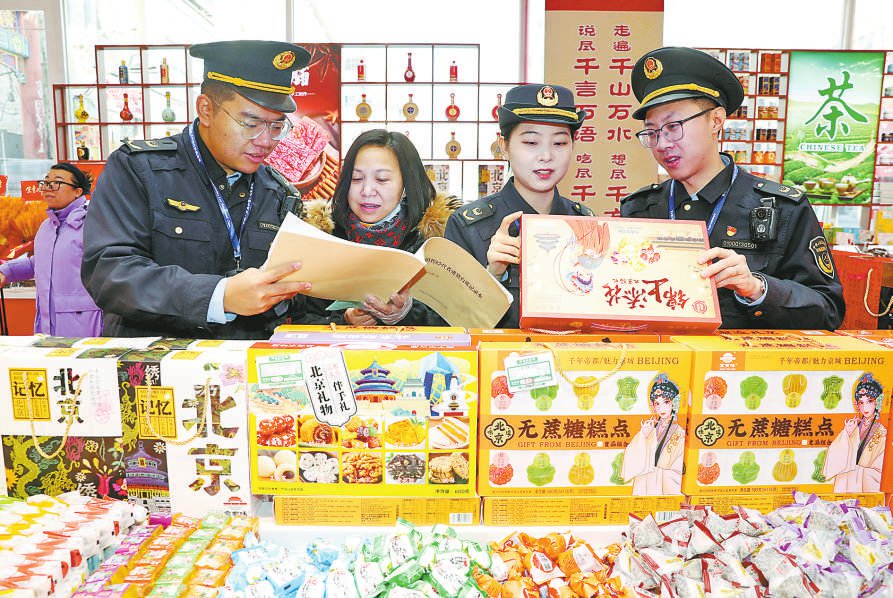
(来源:中国消费者报) 近日,北京市东城区市场监管局开展"北京特产"旅游食品安全监督检查,营造安全放心的旅游食品消费环境。执法人员查验北 京特色食品经营商户的营业执照、食品经营许可证等,核对经营范围与实际销售产品是否一致;查看进货查验台账、供货方资 质、产地溯源信息等材料,确保产品来源合法、源头可溯。 本报记者董芳忠摄影报道 ...
2026年生活成本最高的10个非洲国家
Shang Wu Bu Wang Zhan· 2026-01-06 16:44
Core Insights - The cost of living in African countries varies significantly due to factors such as import dependence, currency strength, urbanization, and consumer demand [1][2][3] Group 1: Highest Cost of Living Countries - Seychelles ranks as the highest in Africa with a cost of living index of 64.5, driven by high prices for groceries (74.8) and dining out (66.2) due to its isolation and reliance on imports [1] - The Democratic Republic of the Congo has a cost of living index of 50.2, with high food and dining prices exacerbated by rental costs in major cities like Kinshasa [2] - Senegal follows with an index of 48.5, where daily expenses, particularly for groceries and restaurant dining, elevate the overall cost of living despite relatively affordable housing [3] Group 2: Other Notable Countries - Cape Verde has a cost of living index of 46.3, reflecting financial pressures from high food prices due to import reliance, although rental costs are low [4] - Côte d'Ivoire's index stands at 44.8, with rising food and dining prices impacting the low local purchasing power [5] - Angola's cost of living index is 42.3, with high rental costs in cities like Luanda, despite slightly lower grocery and dining costs compared to Seychelles [6] Group 3: Additional Insights - Ethiopia's cost of living index is 41.8, driven by high food prices in major cities, while moderate rental and dining costs provide some balance [7] - Cameroon has an index of 40.7, where restaurant expenses exceed grocery costs, and low purchasing power makes it difficult for residents to cope with rising living costs [8] - Mauritius has a moderate cost of living index of 38.3, with strong purchasing power due to low rental costs offsetting higher food and dining prices [9] - South Africa ranks lowest on the list with a cost of living index of 37.1, where balanced expenses and strong local purchasing power provide residents with better management of their finances [10]
直通部委|去年药品抽检合格率保持在99%以上 我国成为全球第一航空人口大国
Xin Lang Cai Jing· 2026-01-06 10:13
Group 1: Drug Safety and Regulation - In 2025, China's drug inspection pass rate remained above 99%, with a total of 19,700 batches inspected [1] - The National Medical Products Administration (NMPA) handled 105,800 cases related to drugs, cosmetics, and medical devices, with a total value of 1.723 billion yuan [1] - The drug inspection pass rate improved from 97.75% during the 13th Five-Year Plan to 99.4% during the 14th Five-Year Plan, with no major drug safety incidents reported [1] Group 2: Aviation Industry Growth - In 2025, China's civil aviation completed a total transportation turnover of 1,640.8 billion ton-kilometers and transported 770 million passengers, marking year-on-year growth of 10.5% and 5.5% respectively [2] - The international flight operations recovered to over 90% of 2019 levels, with international passenger transport increasing by 21.6% [2] - China's aviation population exceeded 500 million, making it the world's largest aviation population country [2] Group 3: Financial Regulation and Fraud Prevention - Since the beginning of 2024, the China Securities Regulatory Commission (CSRC) has investigated 159 financial fraud cases, imposing administrative penalties in 111 cases with fines totaling 8.1 billion yuan [4] - The CSRC has emphasized accountability for major shareholders and actual controllers in 43 cases, and has referred 112 cases to public security for suspected financial fraud [4] Group 4: Climate Change Monitoring - In 2025, the global average surface temperature increased by 1.40°C compared to pre-industrial levels, making the past three years the warmest on record [6] - The Arctic region's average temperature was 1.17°C above the norm, ranking third historically, while the Third Pole region also recorded significant temperature increases [6] Group 5: Oil Price Regulation - As of January 6, 2026, domestic fuel prices were not adjusted due to international oil price fluctuations, with the adjustment amount being less than 50 yuan per ton [7] - The National Development and Reform Commission (NDRC) indicated that geopolitical uncertainties are the main factors affecting short-term international oil price volatility [7] Group 6: Healthcare Payment System - The Supreme People's Court issued a ruling on the conditions for advance payment from the basic medical insurance fund, effective from February 1, 2026 [8] - The ruling allows for advance payments for medical expenses caused by third-party infringement when the third party fails to pay [8] Group 7: Food Safety Monitoring - During the New Year period, the State Administration for Market Regulation conducted 21,425 food safety inspections, addressing 1,876 safety hazards and removing 556 batches of non-compliant food [9] - The inspections focused on popular food items and aimed to ensure consumer safety in key market areas [9] Group 8: Emergency Management Achievements - During the 14th Five-Year Plan, China achieved significant safety management milestones, with the number of fatalities from production safety accidents dropping below 20,000 for the first time [10] - The plan also aimed for a significant reduction in disaster-related casualties and economic losses by 2030 [10] Group 9: Green Consumption Initiatives - The "trade-in" policy led to sales of 3.92 trillion yuan in consumer goods, benefiting 494 million consumers [11] - The policy resulted in the trade-in of 18.3 million vehicles, with nearly 60% being new energy vehicles [11] Group 10: Export Control Regulations - The Ministry of Commerce announced strengthened export controls on dual-use items to Japan, prohibiting exports to military users and those enhancing Japan's military capabilities [12] - Violations of these regulations will result in legal accountability [12]

沪指劲升1.5%创逾10年新高!消费ETF(159928)涨近1%两连阳,近5亿元资金狂涌!i茅台普茅购买政策调整,限购量减半!
Xin Lang Cai Jing· 2026-01-06 09:59
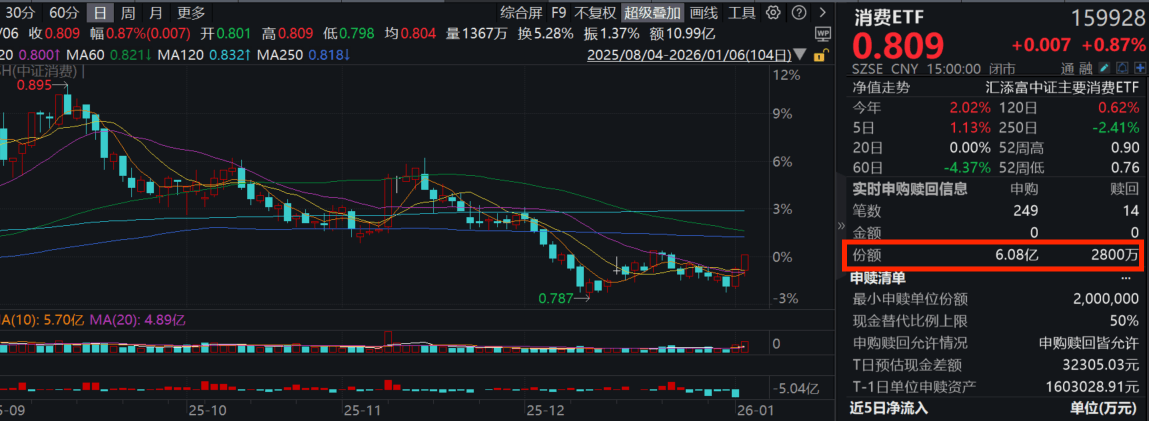
Group 1 - The Shanghai Composite Index rose by 1.5%, reaching a new high not seen in over 10 years, with significant inflows into the consumer sector, particularly the Consumption ETF (159928), which saw a net inflow of over 460 million yuan [1][3] - The Consumption ETF (159928) has a current scale exceeding 20.7 billion yuan, leading its peers in the same category [1][3] - Kweichow Moutai's digital marketing platform "i Moutai" launched a new product, which sold out quickly, indicating strong consumer demand [3][6] Group 2 - Goldman Sachs predicts that China's GDP growth rate in 2026 will exceed market consensus, recommending an overweight position in A-shares and Hong Kong stocks, with expected annual increases of 15% to 20% for the stock market in 2026 and 2027 [3] - The valuation of the Consumption ETF (159928) is attractive, with a TTM price-to-earnings ratio of 19.38, placing it in the 3.36% percentile over the past decade, indicating it is cheaper than 96% of the historical time [3][13] - The Hong Kong Stock Connect Consumption 50 ETF (159268) also saw a rise of 0.97%, with significant trading volume, highlighting investor interest in consumer stocks [5] Group 3 - Recent meetings among liquor distributors indicate a stable supply strategy for 2026, with a focus on adjusting product offerings to meet market demand [6][10] - The white liquor sector is experiencing a V-shaped recovery, with expectations for improved supply-demand dynamics compared to 2025 [6][10] - The dairy sector is anticipated to see a recovery in milk prices, with leading companies expected to benefit from improved performance and dividend support [6][10]
93 家成功突围!2025中企赴美上市总结:分化赛道中的机遇与底线坚守
Sou Hu Cai Jing· 2026-01-06 01:30
Group 1 - The core viewpoint of the article highlights the steady recovery of global capital markets in 2025, with US stock markets continuing to be a key platform for Chinese companies seeking cross-border financing, despite a notable structural differentiation in the number and scale of listings [3][17] - In 2025, a total of 93 Chinese companies successfully listed on US stock markets through various methods, marking a 7.8% increase from 64 companies in 2024, with 149 additional companies having publicly submitted applications for US listings, indicating strong future momentum [3][17] - The traditional IPO remains the dominant listing method, with 90.3% of the successful listings (84 out of 93) being through IPOs, while De-SPAC and OTC transfers accounted for 8.6% and 1.1% respectively, showcasing a clear preference for IPOs among Chinese companies [4][17] Group 2 - The fundraising characteristics of Chinese companies in the US IPO market are marked by a concentration of capital, with the top three companies (Smithfield, Bawang Chaji, and Yasheng Pharmaceutical) accounting for 33.9% of the total $2.822 billion raised, while over half (58.3%) of the companies raised less than $10 million [11][17] - The industry distribution of companies going public in the US is diverse, with significant representation from application software, traditional industries like construction and manufacturing, and modern service sectors such as pharmaceuticals and logistics, reflecting the dynamic nature of China's economic transformation [14][17] - The average listing cycle for Chinese companies in the US has improved, with an average duration of approximately 198 days and a median of 185 days, indicating enhanced efficiency in the listing process [16][17] Group 3 - The Nasdaq remains the most attractive exchange for Chinese companies, with 82 out of 93 companies choosing to list there, while one company opted for the NYSE and another for the AMEX, demonstrating the exchange's strong appeal for cross-border financing [8][17] - The structural characteristics of the 2025 US listings reflect the resilience and vitality of Chinese companies in their internationalization efforts, with a focus on compliance and strategic alignment with regulatory environments being crucial for future listings [17]

企业白牌爆品品牌营销怎么做?奇正沐古有方法
Sou Hu Cai Jing· 2026-01-06 00:57
Core Insights - The article emphasizes that the traditional low-cost and short-term profit strategies of white-label brands are unsustainable for long-term growth, highlighting the need for a shift towards a more strategic approach in product development and marketing [1][10]. Group 1: Product Development Strategies - White-label brands have achieved rapid growth through a "private label + traffic operation" model, but many face the fate of becoming "short-lived internet celebrities" due to a lack of core competitiveness and reliance on low prices [1][3]. - Successful case studies, such as "Yang Xiaoguai Snacks," demonstrate the importance of capturing real consumer needs and avoiding blind trend-chasing by focusing on health and convenience [4][5]. - The article suggests that value reconstruction is essential to break the cycle of price competition, advocating for a shift from extreme price cuts to value-based competition [5][6]. Group 2: Marketing and Operational Efficiency - The article critiques the traditional approach of heavy investment in traffic without precision, leading to high conversion costs, and proposes a "full-channel collaboration" strategy to maximize traffic efficiency [7][8]. - Successful examples include "Qibeile," which improved its market position by focusing on a specific product category and optimizing its marketing strategies across various platforms [8][9]. Group 3: Long-term Brand Development - The article stresses the importance of long-term planning to extend the lifecycle of products and transition from white-label to brand status, highlighting the need for a long-term mindset and comprehensive capabilities [9][10]. - Case studies, such as "Dongdong Bao," illustrate how establishing a strong brand identity and enhancing user engagement can lead to significant growth and customer loyalty [9][11].

沈阳发布产业急需紧缺人才需求目录
Xin Lang Cai Jing· 2026-01-05 19:46
Core Insights - The demand for high-level, skilled, and composite talents in Shenyang is accelerating due to the ongoing adjustment of the industrial structure, particularly in key industries such as high-end equipment, automotive parts, aerospace, and new-generation information technology [1][2] Group 1: Talent Demand Overview - A total of 266 urgent talent positions have been identified, with nearly 60% concentrated in strategic industry clusters like high-end equipment, integrated circuits, biomedicine, and new-generation information technology [2] - There are 82 five-star urgent positions primarily in integrated circuits, biomedicine, and high-end equipment, indicating significant talent shortages in core technologies and key areas [2] - Four-star positions total 112, covering a wide range of fields including new-generation information technology and aerospace, while three-star positions number 72, focusing on more general vocational skills [2] Group 2: Industry-Specific Talent Needs - The highest demand for positions is in the biomedicine and medical equipment (46 positions), high-end equipment (43 positions), integrated circuits (43 positions), and new-generation information technology (38 positions), all of which are characterized by high technology intensity and innovation [2] - Each industry cluster shows a concentrated demand for specific professional types, with traditional engineering fields like mechanical, electrical, and materials sciences being prominent in manufacturing sectors [3] - The new-generation information technology and integrated circuit clusters have a strong demand for computer science, software engineering, and electronic information professionals, reflecting the technical requirements of digital industry positions [3]