TMT

Search documents
四大维度对比三轮行情 科技股能走多远?
Zheng Quan Shi Bao· 2025-09-22 18:14
Group 1 - The current technology bull market has been ongoing for a period, with leading stocks continuously reaching new highs, raising questions about its sustainability and potential for further growth [1] - Historical references from previous technology bull markets (2013-2015 and 2019-2021) provide valuable insights into the current market dynamics [1] Group 2 - In previous bull markets, the maximum gains for the ChiNext Index were 589.73% and 201.81%, while the CSI Technology 100 Index saw maximum gains of 457.03% and 156.04%. As of September 18, 2024, the current maximum gains for these indices are 113.67% and 110.35% respectively, indicating potential for further increases [2] - In the "Internet Bull" market, 31 industry indices saw maximum gains exceeding 100%, with the computer index soaring nearly 8 times. In the "Track Bull" market, 19 industry indices also exceeded 100%, with the power equipment industry index increasing over 3 times. Currently, only 6 industries have doubled, with the communication index rising over 180% [2] Group 3 - The duration of the current bull market has been approximately 1.5 years since the low point in 2024, while previous bull markets lasted around 3 years [3] Group 4 - Trading congestion is at historical highs, with the TMT sector's cumulative trading volume reaching nearly 95 trillion yuan since 2025, a nearly 20% increase from 2024 [4] - The TMT sector's trading volume accounted for over 46% of A-shares at one point this year, surpassing previous bull market peaks [4] - The weighted turnover rate for the TMT sector reached nearly 5.8%, exceeding previous bull market highs, indicating a high concentration of trading activity [4] Group 5 - Despite high trading volumes, much of it is driven by quantitative high-frequency trading, and the margin financing balance has exceeded the peak in 2015, but its market value ratio is still 50% lower than that year [5] - The sentiment indicator for A-share retail investors shows that while sentiment has increased, it has not reached the exuberant levels seen in mid-2015 or late 2020 [5] Group 6 - The TMT sector's high valuations are a concern, with the computer industry index's rolling P/E ratio exceeding 93 times, electronics over 70 times, media over 49 times, and communications over 47 times as of September 19, 2025 [6] - However, these P/E ratios are not at historical highs, with the computer, electronics, and communications sectors around the 50th percentile historically [7] Group 7 - The TMT sector's total market capitalization has surpassed 23 trillion yuan, accounting for over 22% of the total A-share market, marking a historical high [7] - The number of TMT stocks with a market capitalization exceeding 100 billion yuan has reached 34, the highest on record [7] Group 8 - The disparity between the performance of the real economy and financial markets is a global phenomenon, with the correlation between macroeconomic indicators and capital markets in China and the U.S. at a five-year low [8] - The current technology bull market is characterized by high-quality fundamentals and performance-driven characteristics, particularly in the AI computing industry, with companies like New Yisheng and Zhongji Xuchuang experiencing explosive growth in revenue and net profit [8] Group 9 - Institutional allocation in the TMT sector remains below historical peak levels, with public funds holding over 1.6 trillion yuan in TMT stocks, indicating potential for further investment [9] - The average holding ratio of public funds in the TMT sector is currently 5.73%, about 70% of the peak level during the last technology bull market, suggesting room for increased allocations [9]
A股四季度策略展望:慢牛进行时
Huajin Securities· 2025-09-22 11:11
Core Views - The A-share market is expected to continue a slow bull trend in the fourth quarter, with increased volatility, following a strong performance in the third quarter led by technology stocks [3][4] - The market is likely to experience a structural recovery in earnings and continued credit repair, supported by a resilient export environment and steady growth in manufacturing and infrastructure investment [3][4][19] - Key sectors to focus on include technology, cyclical industries, and consumer sectors, with a balanced style favoring both large and small-cap stocks [4][5] Market Trends - The third quarter saw a bull market with the ChiNext Index and STAR Market leading gains, driven by liquidity easing and improved risk appetite [10][14] - The fourth quarter is anticipated to maintain a low-level recovery in earnings, with potential inflows from foreign investment and new funds, although IPOs and sell-offs may increase [4][5] - The overall market valuation is currently neutral to high, with supportive policies likely to sustain risk appetite [4] Industry Allocation - Technology remains the main focus for investment in the fourth quarter, with significant opportunities in core assets and cyclical sectors [5] - Recommended sectors for attention include TMT (Technology, Media, Telecommunications), machinery, electric new energy, pharmaceuticals, military industry, non-ferrous metals, chemicals, and non-bank financials [5][19] - The market style is expected to be balanced, with large-cap and small-cap stocks performing well during periods of structural recovery in earnings and credit [5][54]
成交量能回暖,关注日历效应:可转债周报20250922-20250922
Huachuang Securities· 2025-09-22 07:43
1. Report Industry Investment Rating No relevant content provided. 2. Core Viewpoints of the Report - The main line remains in the technology sector, with the turnover rate increasing rapidly and the valuation of high - parity convertible bonds being relatively strong. The TMT sector has been continuously catalyzed, and technology may still be the main line during the non - earnings disclosure period. The high - parity convertible bonds are more favored by the market, and the premium rate of 130 - 150 parity convertible bonds increased by 0.24pct last week [6][10]. - Attention should be paid to the calendar effect around the National Day. Due to the long National Day holiday, pre - holiday risk aversion leads to financing net selling and trading slowdown. After the holiday, the index is more likely to recover, and different industries may have different performances. The probability of an increase in margin trading balances in November is 80%. Industries such as communication, electronics, and computers have a relatively high probability of rising after the National Day [2]. 3. Summary According to the Directory 3.1. Positive Stock and Valuation Adjustment, Main Line in the Technology Sector - Last week, the equity market fluctuated and corrected, and the convertible bond market was still in a weak range. The 100 - yuan fitted premium rate decreased by 1.66pct month - on - month. Although the trading volume recovered compared with early September, the convertible bond index's weekly trading volume was 40.9009 billion yuan, a month - on - month increase of 6.42%. The weak performance of micro - cap stocks dragged down the underlying stocks of convertible bonds, and the CSI Convertible Bond Index corrected more significantly [6][9]. 3.2. Pay Attention to the Calendar Effect around the National Day - Pre - holiday capital outflows may be replenished in October. From 2015 - 2024, margin trading balances at the beginning of October mostly decreased compared with those at the beginning of September, and the probability of an increase in margin trading balances in November was 80%. - After the holiday, the index is more likely to recover. From 2015 - 2024, the probability of the Wande All - A Index correcting before the National Day was 60%, and the probability of recovery after the holiday was 70%. Industries with a high probability of rising include communication, electronics, and computers [2]. 3.3. Market Review: Convertible Bonds Corrected Weekly, and Valuation Compressed 3.3.1. Weekly Market Quotes - Last week, major stock indices showed different performances, and the convertible bond market declined. The Shanghai Composite Index decreased by 1.30%, the Shenzhen Component Index increased by 1.14%, the ChiNext Index increased by 2.34%, the SSE 50 Index decreased by 1.98%, the CSI 1000 Index increased by 0.21%, and the CSI Convertible Bond Index decreased by 1.55%. There are 438 issued and unexpired convertible bonds with a balance of 604.505 billion yuan [28]. - In the equity market, most industries were weak. In the convertible bond market, home appliances, communication, and other sectors had the highest increases, while non - bank finance, building decoration, and other sectors had the highest declines [30]. 3.3.2. Valuation Performance - The weighted average closing price of convertible bonds was 129.22 yuan, a decrease of 1.61% from the previous Friday. The closing price of equity - biased convertible bonds increased by 3.72%, while that of debt - biased and balanced convertible bonds decreased. The 100 - yuan parity fitted conversion premium rate decreased by 1.66pct. High - rated and large - scale convertible bonds had a relatively large increase in premium rates, with AAA - rated bonds increasing by 2.44pct and bonds over 5 billion yuan increasing by 2.92pct [36]. 3.4. Terms and Supply 3.4.1. Terms - As of September 19, 4 convertible bonds, including Lushan, Keda, Jiuzhouzhuan 2, and Sanyang Convertible Bonds, announced early redemption; no convertible bonds announced non - early redemption; Jingxing and Fuli Convertible Bonds announced that they were expected to meet the early redemption conditions. - As of September 19, Huitong and Zhengchuan Convertible Bonds proposed downward revisions; Jiayuan Convertible Bond announced the downward revision result; 5 convertible bonds announced no downward revision; Kangyi, Jinggong, and other convertible bonds were expected to trigger downward revisions [3][57]. 3.4.2. Primary Market - Last week, Yingliu Convertible Bond was issued with a scale of 1.5 billion yuan, and there were no convertible bonds to be listed or issued. - Last week, Huaxiang Co., Ltd., Shangluo Electronics, and Huichuangda added board proposals, 4 companies passed the general meeting, 2 companies passed the CSRC review committee, and no new companies were approved by the CSRC. As of September 19, 3 listed companies obtained convertible bond issuance approvals with a proposed issuance scale of 6.802 billion yuan, 7 companies passed the CSRC review committee with a total scale of 6.176 billion yuan, and the total scale of the 3 new board proposals was 2.958 billion yuan [4][60][70].
9月LPR将公布;全国国庆文旅消费月将启动丨一周前瞻
2 1 Shi Ji Jing Ji Bao Dao· 2025-09-22 00:49
Group 1 - The upcoming week (September 22 to September 28) will see the release of key economic data in China, including the September LPR rates and the unlocking of nearly 60 billion yuan in market value from restricted stocks in the Shanghai and Shenzhen markets [1][12] - A total of 44 stocks will face the unlocking of restricted shares, amounting to 2.821 billion shares, with a total market value of 596.86 billion yuan based on the closing price on September 19 [1][3] - The top three stocks by unlocking market value are Hehe Information (10.835 billion yuan), Ziyan Food (7.126 billion yuan), and Wireless Media (5.521 billion yuan) [1][4] Group 2 - The "High-Quality Completion of the 14th Five-Year Plan" press conference will be held, featuring key financial leaders discussing achievements in the financial sector during the 14th Five-Year Plan period [6] - A new round of fuel price adjustments will take place, with potential increases in gasoline and diesel prices based on recent crude oil price trends [6] - The National Day cultural tourism consumption month will be launched, with over 330 million yuan in consumption subsidies to stimulate tourism during the holiday period [7] Group 3 - The 2025 Eurasian Economic Forum will be held from September 23 to 25 in Xi'an, focusing on sustainable development and cooperation among Eurasian countries [8] - The Fourth Global Digital Trade Expo will take place from September 25 to 29 in Hangzhou, showcasing advancements in digital trade [9] - The 2025 World New Energy Vehicle Conference will be held from September 27 to 29 in Haikou, discussing future transportation and sustainable development [10]


国庆前后市场怎么走?十大券商最新研判
Ge Long Hui A P P· 2025-09-21 23:58
Market Overview - The market experienced fluctuations last week, with the Shanghai Composite Index falling by 1.30%, while sectors like power equipment, electronics, and communications continued to lead in gains, contrasting with the underperforming banking, non-banking, and food and beverage sectors [1] Broker Strategies - Guotai Junan Securities believes that the recent market adjustment presents an opportunity, asserting that the Chinese stock market will not stop here. They highlight the positive implications of the recent US-China talks and the potential for capital market reforms to accelerate, suggesting that the A/H share indices may reach new highs [2] - Guojin Securities indicates that a bull market is in the making, with a focus on cyclical opportunities in manufacturing and a shift from technology-driven growth to export-oriented growth as liquidity constraints ease [2] - Zheshang Securities anticipates continued consolidation in the Shanghai Composite Index, recommending a cautious approach and suggesting adjustments in sector allocations, particularly reducing exposure to technology and media while increasing positions in real estate and infrastructure [3] - Everbright Securities expects the A-share market to maintain a volatile pattern leading up to the National Day holiday, with a focus on structural balance amid potential profit-taking [4] - China Merchants Securities notes a historical pattern of financing trends around the National Day holiday, suggesting a potential rebound in market sentiment post-holiday, with a focus on sectors like solid-state batteries and AI [5] - Industrial Securities emphasizes a rotational investment strategy to navigate market volatility, advocating for a diversified approach across multiple sectors [6][7] - CITIC Securities highlights the clarity in market trading themes following the Fed's interest rate cut, with a focus on AI and domestic demand recovery as key drivers [8] - Huaxia Securities maintains a positive long-term outlook despite short-term fluctuations, emphasizing the importance of structural support from policies aimed at stabilizing the stock market [9] - Galaxy Securities recommends four main investment themes in the construction sector during the 14th Five-Year Plan period, focusing on urban renewal and digital transformation in construction [11]
A股行业轮动速度放缓,意味什么?机构:把握基本面 享受资金面
Feng Huang Wang· 2025-09-21 22:39
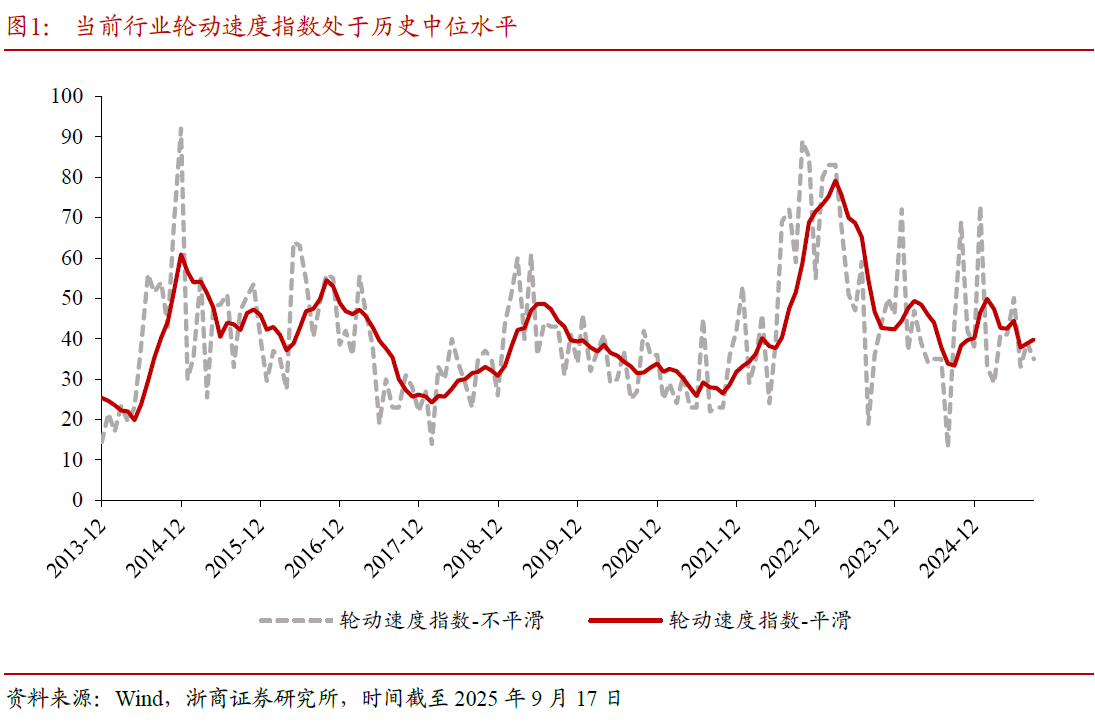
Core Viewpoint - The A-share market has entered a new phase of industry rotation, characterized by a slowdown in rotation speed but an increase in market differentiation [1][2][5] Group 1: Market Rotation Characteristics - The industry rotation speed has decreased since July, following a technology-led market rally, and is currently at the historical median over the past decade [2][5] - Despite the slowdown in rotation speed, the intensity of market differentiation has reached a new high for the year, indicating a significant structural divergence [5][6] Group 2: Driving Forces Behind Market Rotation - The core logic driving the current rotation is the interplay between liquidity and fundamentals, with liquidity being a major factor in the short term [6][7] - Different market phases are identified: liquidity-driven phases favor sectors like advanced manufacturing and TMT, while fundamental-driven phases benefit consumption, cyclical, and financial sectors [6][8] Group 3: Investment Strategies - Investment strategies should focus on balanced allocation to cope with moderate rotation speeds, while also identifying key opportunities in leading sectors [8][9] - Specific recommendations include focusing on the TMT sector due to strong catalysts and considering a shift to financial sectors as the market evolves [8][9] - The "dumbbell strategy" is suggested for long-term investors, emphasizing a tilt towards technology growth sectors while maintaining some exposure to dividend-paying stocks [9]
美联储降息25个基点内外资机构看好中国资产前景
Shang Hai Zheng Quan Bao· 2025-09-21 15:28
Group 1 - The Federal Reserve has lowered the federal funds rate target range by 25 basis points to between 4.00% and 4.25%, which is expected to create a more favorable external environment for Chinese assets, enhancing their attractiveness [2] - Multiple institutions, including Invesco and Fidelity International, express optimism about investment opportunities in non-US markets, particularly in China, Japan, and Europe, following the Fed's rate cut [2] - Emerging market equities are viewed as having good investment value, with current valuations being only one-third of developed markets, supported by a weaker dollar and easing monetary policies in the Asia-Pacific region [2] Group 2 - The easing of external constraints is expected to enhance the People's Bank of China's operational flexibility in monetary policy tools, such as MLF/LPR and structural instruments [3] - As the US economy shows signs of weakening and the Fed's independence comes under scrutiny, a gradual shift to a rate-cutting cycle is anticipated, which may lead to a significant increase in foreign capital inflow into A-shares and Hong Kong stocks [4] - Key investment themes identified by Manulife include high-growth sectors like AI and robotics, sectors benefiting directly from liquidity easing, and industries with improving fundamentals due to policy changes, such as power equipment and chemicals [4]

渤海证券研究所晨会纪要(2025.09.19)-20250919
BOHAI SECURITIES· 2025-09-19 01:58
Market Overview - In the recent trading period from September 12 to September 18, major indices showed mixed performance, with the Shanghai Composite Index declining by 1.13% and the ChiNext Index increasing by 1.38% [2] - The trading volume increased, with a total of 12.65 trillion yuan traded, averaging 2.53 trillion yuan per day, which is an increase of 278.79 billion yuan compared to the previous five trading days [2] Economic Data - From January to August, fixed asset investment grew by 0.5% year-on-year, reflecting a marginal decline of 1.1 percentage points [3] - The total retail sales of consumer goods from January to August increased by 4.6% year-on-year, which is a decrease of 0.2 percentage points compared to July [3] Policy Developments - Recently, the Ministry of Commerce and eight other departments issued measures to expand service consumption, proposing 19 measures focused on promoting consumption and expanding domestic demand [3] - The policy measures indicate a proactive approach to stimulate service consumption in light of the need to boost consumer demand [3] International Developments - On September 18, the Federal Reserve lowered the federal funds rate by 25 basis points, bringing the target range to 4.00% to 4.25%, aligning with market expectations [3] - The Fed's forecast for the policy rate in 2025 has been adjusted down to 3.6%, suggesting a potential for an additional 50 basis points of rate cuts within the year, indicating a trend towards further easing of overseas liquidity [3] Investment Strategy - The A-share market is exhibiting strong structural characteristics, with a focus on stabilizing the overall market while the technology-driven sectors are showing active performance [3] - The continuation of liquidity inflow will be crucial for maintaining the current structural market trends [3] Industry Focus - Investment opportunities are identified in the TMT sector due to the promotion of domestic alternatives in computing power and the upcoming peak season for smart terminal releases [4] - Other sectors with potential investment opportunities include pharmaceuticals, power equipment, non-ferrous metals, and machinery, driven by factors such as innovative drug exports, high demand for energy storage, and the anticipated mass production of robots [4]
港股通科技指数这么多,到底该怎么选?
Xin Lang Cai Jing· 2025-09-18 23:37
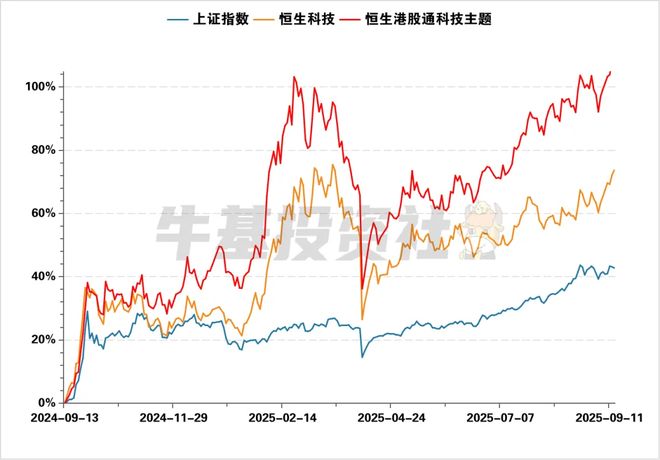
Core Viewpoint - The Hong Kong stock market has experienced a significant rebound over the past year, particularly in the technology sector, with notable index performances [1][4]. Group 1: Index Performance - The Shanghai Composite Index increased by 42.77%, while the Hang Seng Technology Index rose by 73.68%, and the Hang Seng Hong Kong Stock Connect Technology Theme Index surged by 109.25% [1][4]. - Investors are eager to invest in Hong Kong technology through index products, but there are many similar-sounding indices with varying performances [4]. Group 2: Index Compilation - Differences in index compilation methodologies lead to varying characteristics among the indices. Most indices consist of 30 constituent stocks, except for the CSI Hong Kong Stock Connect Technology Index, which has 50 [5][6]. - The Hang Seng Hong Kong Stock Connect Technology Theme Index and the National Index have a higher individual stock weight limit of 15%, resulting in greater concentration of leading stocks [5][6]. Group 3: Industry Distribution - The Hang Seng Hong Kong Stock Connect Technology Theme Index excludes industries such as pharmaceuticals, automobiles, and home appliances, focusing more on pure technology sectors [5][7]. - The CSI and National indices include a broader range of industries, which affects the "purity" of the technology focus [5][9]. Group 4: Historical Performance - Over the past year, the Hang Seng Hong Kong Stock Connect Technology Theme Index achieved the highest increase of 109%, confirming that higher purity leads to better performance [12][15]. - Over three years, the Hang Seng Hong Kong Stock Connect Technology Theme Index has shown a cumulative increase of over 92%, with an annualized return of nearly 25% [15][16].
规模速递 | 港股通科技30ETF(520980)最新规模超40亿元
Xin Lang Cai Jing· 2025-09-18 06:42
Core Viewpoint - The $港股通科技30ETF (520980) has reached a new high with a scale exceeding 41 billion, focusing on the TMT industry and excluding sectors like pharmaceuticals, home appliances, and automobiles, making it a more "pure" technology investment option [1] Group 1: ETF Characteristics - The ETF supports T+0 trading and does not occupy QDII quotas, providing an efficient and convenient choice for investing in the Hong Kong technology sector [1] - The top ten constituent stocks account for 82% of the total weight, indicating a higher concentration of leading companies [1] Group 2: Market Positioning - Compared to other indices in the Hong Kong technology sector, this ETF is less affected by declines in the pharmaceutical sector [1] - The ETF is less impacted by the struggles of the food delivery sector compared to the Hong Kong internet sector, and it includes high-quality hardware such as domestic computing power [1] Group 3: AI Focus - The index has a higher proportion of AI-related stocks, aligning well with the current technology market trends [1] - The recent index adjustment has added Dianshi Robot-W to the top ten constituents, further enhancing its high-tech attributes [1]