
工业企业

Search documents
信用利差周报2025年第28期:“股债跷跷板”效应下债市回调,政治局会议影响几何?-20250812
Zhong Cheng Xin Guo Ji· 2025-08-12 11:03
Report Industry Investment Rating - Not provided in the document Core Viewpoints - In the context of the "stock-bond seesaw" effect, the bond market adjusted due to the stock market's rise. However, the bond market still has support from fundamentals and capital, and the yield center may remain low. The Politburo meeting's policies may boost stock market activity, causing short-term disturbances to the bond market [4][11][12] - The Central Bank and the Ministry of Agriculture and Rural Affairs issued a document encouraging the issuance of rural revitalization bonds, which may lead to the expansion of such bonds [5][14][15] - Industrial enterprise profits declined in the first half of the year, with industrial product prices dragging down revenue and profits, while "volume" remained an important support factor for profit recovery [6][17] Summary by Directory Market Hotspots - **Stock-Bond Seesaw Effect and Bond Market Adjustment**: The stock market rose significantly last week, with the Shanghai Composite Index breaking through 3600 points, triggering the "stock-bond seesaw" effect. The bond market adjusted, with most major bond market indices falling and bond yields rising. The 10-year Treasury yield reached 1.73%. The Politburo meeting's policies may increase stock market activity, causing short-term disturbances to the bond market, but the bond market still has support [4][11][12] - **Policy Encouragement for Rural Revitalization Bonds**: The Central Bank and the Ministry of Agriculture and Rural Affairs jointly issued a document encouraging the issuance of rural revitalization bonds. This policy aims to provide comprehensive financial support for rural revitalization, and rural revitalization bonds may expand in the future [5][14][15] Macroeconomic Data - Industrial enterprise profits declined by 1.8% year-on-year from January to June, with the decline widening compared to the previous period. In June, the profit decline narrowed, indicating marginal improvement but overall weakness. Industrial product prices continued to drag down profits, while industrial production was supported by factors such as the "export rush" effect and the "618" shopping festival [6][17] Money Market - The central bank's net capital injection decreased last week, leading to a marginal tightening of liquidity. Most interbank repurchase rates rose, except for a slight decline in the DR1m rate. The spread between the 3-month and 1-year Shibor widened [20] Primary Market of Credit Bonds - The issuance scale of credit bonds increased last week, reaching 3243.17 billion yuan, an increase of 418.72 billion yuan from the previous period. Different bond types showed varying trends, with ultra-short-term financing bonds and corporate bonds increasing significantly. The infrastructure investment and financing industry had a net outflow of financing, while most industries in the industrial bond sector had a net inflow. The issuance cost of credit bonds mostly increased [23][25][31] Secondary Market of Credit Bonds - The trading volume in the secondary bond market increased last week, with the daily average trading volume reaching 19682.03 billion yuan. Bond yields generally rose, with interest rate bonds and credit bonds both showing significant increases. Most credit spreads widened, while rating spreads showed mixed trends with small changes [33][36][40]
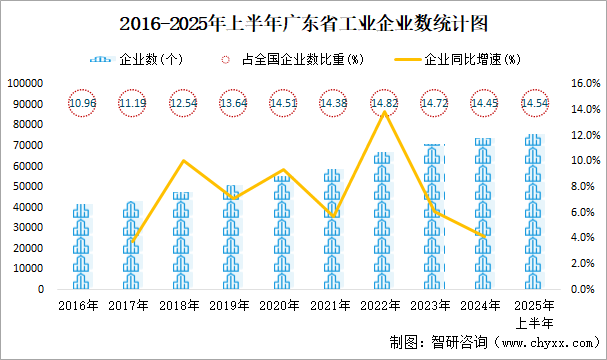
2025年上半年广东省工业企业有75646个,同比增长3.37%
Chan Ye Xin Xi Wang· 2025-08-12 03:23
Group 1 - The core viewpoint of the article highlights the growth of industrial enterprises in Guangdong Province, with a total of 75,646 enterprises reported in the first half of 2025, marking an increase of 2,465 enterprises or a year-on-year growth of 3.37% [1] - The report indicates that the number of industrial enterprises in Guangdong accounts for 14.54% of the national total [1] - The data referenced in the article is sourced from the National Bureau of Statistics and organized by Zhiyan Consulting [3] Group 2 - The article mentions several listed companies related to the industrial sector, including Foshan Plastics Technology, Xinlun New Materials, and Water Holdings, among others [1] - Zhiyan Consulting is identified as a leading industry consulting firm in China, specializing in in-depth industry research and providing comprehensive consulting services [2]

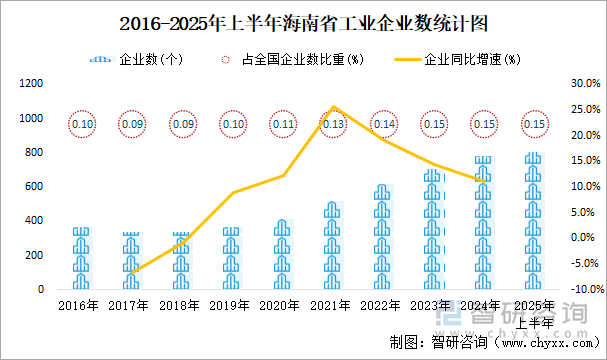
2025年上半年海南省工业企业有803个,同比增长9.85%
Chan Ye Xin Xi Wang· 2025-08-12 03:23
Group 1 - The core viewpoint of the article highlights the growth of industrial enterprises in Hainan Province, with a total of 803 enterprises reported in the first half of 2025, marking an increase of 72 enterprises compared to the same period last year, representing a year-on-year growth of 9.85% [1] - The report indicates that the number of industrial enterprises in Hainan accounts for 0.15% of the national total [1] - The data referenced in the article is sourced from the National Bureau of Statistics and organized by Zhiyan Consulting [3] Group 2 - The article mentions several listed companies related to the industrial sector, including Xindazhou A (000571), *ST Zhōngjì (600759), and others [1] - Zhiyan Consulting is described as a leading industry consulting firm in China, specializing in in-depth industry research reports and providing comprehensive consulting services [2]
本轮美股牛市要暂停了吗?
Hua Er Jie Jian Wen· 2025-08-06 12:28
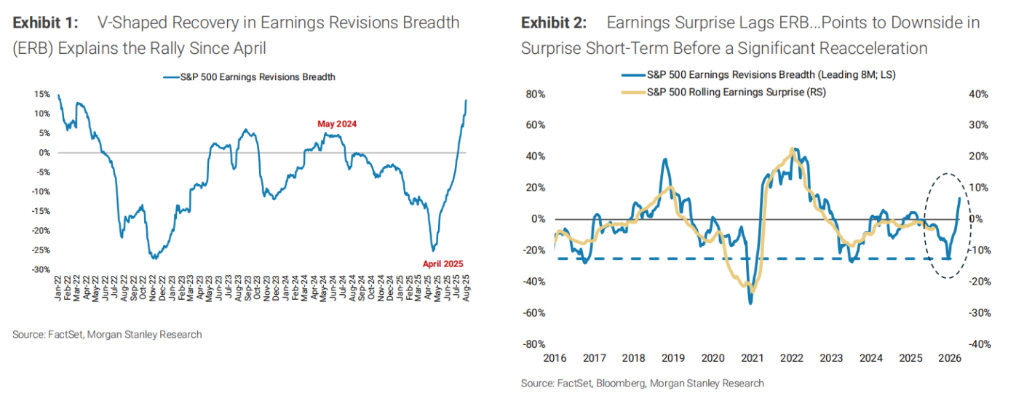
Core Viewpoint - The S&P 500 index has rebounded over 26% since the low in April, but concerns about weak non-farm payroll data and inflation fears due to tariffs may lead to a pause in the bull market during the third quarter [1][8] Group 1: Market Dynamics - Morgan Stanley's latest report suggests a potential phase adjustment in the U.S. stock market in Q3, driven by the lagging effects of tariffs and the Federal Reserve's policy uncertainty [1][8] - Despite the potential for a pullback, Morgan Stanley believes the current bull market is not over, viewing any adjustments as opportunities for buying on dips [1][8] Group 2: Earnings and Economic Indicators - The core driver of the bull market is the V-shaped recovery in Earnings Revision Breadth (ERB), which has rebounded from -25% in April to +10% currently, indicating a confirmation of the market bottom [5] - The "rolling earnings recession" that began in early 2022 is nearing its end, with companies cutting costs and labor to pave the way for profit margin expansion [5] Group 3: Tariff and Labor Market Impact - The impact of tariffs is expected to reflect in corporate earnings reports in Q3, particularly affecting industries with weak pricing power, while industrial companies that can pass on costs will be less affected [8] - Recent labor market data has heightened policy uncertainty, with the latest non-farm payroll data showing the worst revisions since the onset of the COVID-19 pandemic [9] Group 4: Future Outlook - Despite short-term risks, Morgan Stanley maintains a bullish outlook for the next 12 months, supported by enhanced earnings growth certainty, with consensus expectations for S&P 500 EPS growth of 9% in 2025 and 14% in 2026 [11] - The Federal Reserve is expected to eventually shift its policy, with a high probability of entering a rate-cutting cycle by 2026 as inflation pressures ease and the labor market cools [11] - The current dynamic P/E ratio of the S&P 500 remains high, but the 10-year Treasury yield is stable below 4.5%, indicating resilience in equity risk premiums without clear signs of a bubble [11]
“内卷”压力下工业企业的增与减
Jing Ji Guan Cha Wang· 2025-08-05 10:25
Core Insights - The overall industrial economy in China showed stable improvement in the first half of the year, with industrial production maintaining rapid growth and the industrial added value for large-scale enterprises increasing by 6.4% year-on-year [1] - Despite the growth in revenue, industrial enterprises faced high operational costs and tightening financial conditions, leading to a decline in profit margins [1][4] Revenue Growth - In the first half of the year, large-scale industrial enterprises achieved a total revenue of 6,677.919 billion yuan, reflecting a year-on-year growth of 2.5% [2] - Private industrial enterprises reported the highest revenue growth at 2.6%, while state-owned enterprises experienced a decline of 0.7%, marking four consecutive months of negative growth [2] Profit Trends - The total profit of large-scale industrial enterprises in the first half of the year was 34,365 billion yuan, representing a year-on-year decrease of 1.8% [4] - State-owned enterprises saw a significant profit decline of 7.6%, while foreign-invested enterprises reported a profit increase of 2.5%, indicating better performance compared to domestic counterparts [4] Operational Challenges - Private industrial enterprises faced substantial operational pressures, with key performance indicators such as revenue profit margin and asset profit margin remaining low [7] - The average accounts receivable collection period for private enterprises was 70.7 days, significantly higher than that of state-owned enterprises at 55.6 days [7] Financial Ratios - As of June 2025, the asset-liability ratio for large-scale industrial enterprises was 57.9%, with private enterprises at 59.4%, indicating higher financial leverage [8] - The revenue profit margin for large-scale industrial enterprises was 5.2%, with private enterprises having the lowest margin at 3.8% [9]

财政专题分析报告:财政数据背后的宏观线索
SINOLINK SECURITIES· 2025-07-29 15:17
Group 1: Tax Revenue Insights - Personal income tax (PIT) increased by 8% year-on-year in the first half of the year, despite overall tax revenue declining by 1.2%[3] - Value-added tax (VAT) grew by 2.8%, while corporate income tax (CIT) saw a decline of 1.9%[7] - Non-tax revenue turned negative, with a 3.7% year-on-year decrease in June, primarily due to reduced contributions from state-owned assets and improved business environment leading to lower fees and penalties[28] Group 2: Fiscal Expenditure and Investment Trends - General fiscal expenditure rose by 17.6% year-on-year in June, significantly up from 5.3% for infrastructure investment, which fell by 3.9% compared to the previous month[4] - The acceleration in fiscal spending is largely attributed to a one-time injection of special bonds into commercial banks, with actual growth being slower when excluding this factor[34] - Special bonds are increasingly being used for debt repayment, with 46.7% of newly issued bonds in July allocated for this purpose, compared to only 41.7% for project construction[51] Group 3: Future Fiscal Outlook - The fiscal revenue and expenditure are expected to face pressure in the second half, with projected year-on-year growth rates of -4.5% for revenue and 1.5% for expenditure[5] - The anticipated budget gap for the year is estimated at 516.6 billion yuan for revenue and 547.2 billion yuan for expenditure, with limited necessity for additional deficits[5] - The government plans to utilize fiscal reserves, including the budget stabilization fund and profits from central financial enterprises, to cover a projected 120 billion yuan shortfall due to new subsidies[69]
渤海证券研究所晨会纪要(2025.07.29)-20250729
BOHAI SECURITIES· 2025-07-29 02:30
Macro and Strategy Research - In the first half of 2025, the profits of industrial enterprises above designated size decreased by 1.8% year-on-year, with a narrowing decline of 4.3% in June [2][3] - The industrial added value increased by 6.4% year-on-year in the first half of 2025, supported by increased working days and the delayed effect of tariff suspension on exports [3][4] - The operating income grew by 2.5% year-on-year, while the profit margin decreased to 5.15%, down 4.8% year-on-year, indicating pressure on enterprise profits [3][4] Fiscal Data Analysis - In the first half of 2025, the national general public budget revenue was 115,566 billion yuan, a decrease of 0.3% year-on-year, while expenditure increased by 3.4% to 141,271 billion yuan [6][9] - Government fund budget revenue fell by 2.4% to 19,442 billion yuan, but expenditure surged by 30% to 46,273 billion yuan, indicating a strong push in fiscal spending [6][10] - The overall fiscal expenditure (public fiscal expenditure + government fund expenditure) increased by 8.9% year-on-year, reflecting a robust fiscal support environment [10] Fund Research - All major indices in the equity market were raised, with public fund scale surpassing 34 trillion yuan, indicating a positive market sentiment [12][14] - The week saw a net inflow of 19.22 billion yuan into the ETF market, with significant inflows into cross-border ETFs, while stock ETFs experienced net outflows [14][15] - The issuance of new funds decreased, with 23 new funds launched, raising 276.61 billion yuan, reflecting a slight contraction in market activity [14][15] Industry Research - The paper industry is experiencing a rebound driven by "anti-involution" sentiments, with a 5.07% increase in the paper sector from July 1 to 25, 2025 [16][20] - The third batch of national subsidies amounting to 69 billion yuan has been allocated to support the consumption of old goods, which is expected to stabilize furniture product sales [20] - The light industry manufacturing sector outperformed the market, while the textile and apparel sector lagged behind, indicating sector-specific performance variations [16][20]
【更新】2024-2000年上市公司企业绿色全要素生产率数据、工业
Sou Hu Cai Jing· 2025-07-21 09:27
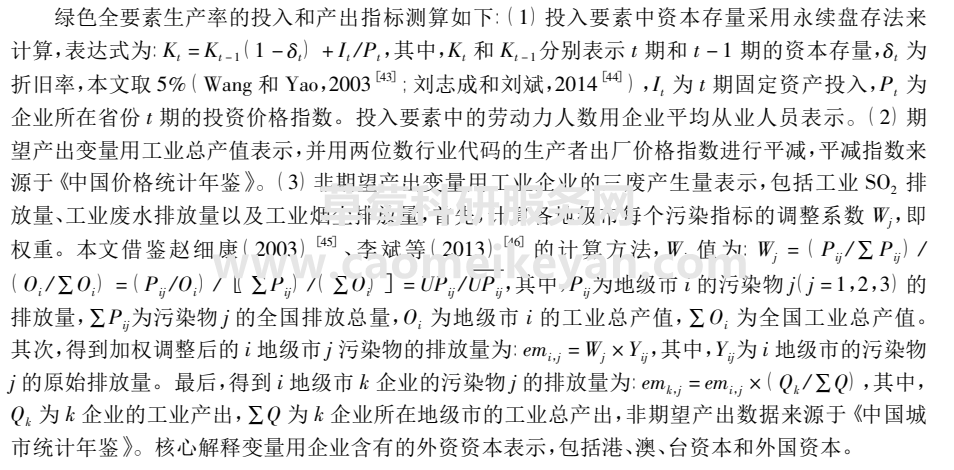
Core Viewpoint - The article discusses the measurement of green total factor productivity (GTFP) for listed companies in China from 2000 to 2024, emphasizing the integration of environmental pollution into the evaluation system and the complexity of data processing involved in this research [1][2][3]. Measurement Methodology - The GTFP is measured using a non-radial SBM index, incorporating labor, capital, and energy inputs, as well as expected and non-expected outputs [1][4]. - Labor input is represented by the number of employees, capital input by the net fixed assets, and energy input is derived from the standard coal consumption adjusted for regional factors [1][4]. - Expected output is measured by the company's operating revenue, while non-expected output is calculated based on the employment ratio and emissions of industrial pollutants [2][5]. Data Scope and Sources - The study includes over 60,000 samples from more than 5,000 companies, with data sourced from various statistical yearbooks and company annual reports [2][3]. - The original data processing involved complex methodologies, including interpolation for missing data and the use of software for calculations [2][3]. Variable Definitions - The explained variable is GTFP, measured using MaxDEA software, which combines both radial and non-radial distance functions [4]. - The input indicators include capital, labor, and energy, while the output indicators consist of expected and non-expected outputs, reflecting the company's performance in terms of productivity and environmental impact [4][5]. Results Overview - The results of the GTFP calculations for various companies are presented, showing the productivity scores over the years, indicating fluctuations and trends in green productivity [6].
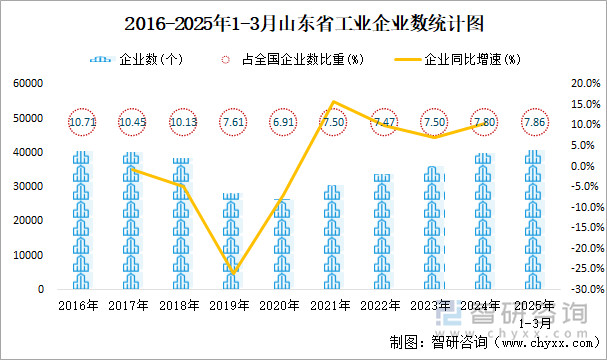
2025年1-3月山东省工业企业有40800个,同比增长3.74%
Chan Ye Xin Xi Wang· 2025-07-01 02:45
Group 1 - The core viewpoint of the news highlights the growth of industrial enterprises in Shandong Province, with a total of 40,800 enterprises reported in the first quarter of 2025, marking an increase of 1,470 enterprises compared to the same period last year, representing a year-on-year growth of 3.74% and accounting for 7.86% of the national total [1][3] - The report mentions various listed companies in the industrial sector, including Yanzhou Coal Mining Company (600188), New Trend Energy (600777), and others, indicating a focus on potential investment opportunities within these firms [1] - The data is sourced from the National Bureau of Statistics and organized by Zhiyan Consulting, emphasizing the credibility of the information presented [3] Group 2 - Zhiyan Consulting is recognized as a leading industry consulting firm in China, specializing in in-depth industry research reports, business plans, feasibility studies, and customized services, which are essential for informed investment decisions [2] - The report titled "2025-2031 China Industrial Cloud Industry Market Deep Assessment and Investment Opportunity Forecast" suggests a forward-looking analysis of the industrial cloud sector, indicating potential growth areas for investors [1]
渤海证券研究所晨会纪要(2025.06.30)-20250630
BOHAI SECURITIES· 2025-06-30 08:16
Group 1: Industrial Enterprises Profit Analysis - In the first five months of 2025, profits of industrial enterprises above designated size decreased by 1.1% year-on-year, with a significant drop of 9.1% in May [3][4] - The decline in profits is attributed to multiple factors including reduced working days, tariff adjustments causing delays in orders and production, and a decrease in both volume and price, leading to a 2.7% increase in operating income [4][5] - The profit margin for the first five months was 4.97%, down 4.2% year-on-year, indicating a worsening profitability situation for industrial enterprises [4][5] Group 2: Macroeconomic Outlook - The macroeconomic report indicates that the Chinese economy has maintained stable growth despite external pressures, with a GDP growth of 5.4% in Q1 2025, surpassing market expectations [8] - The report anticipates a gradual slowdown in economic growth in the latter half of 2025 due to declining export momentum and diminishing policy effects, with infrastructure investment being crucial for achieving annual GDP growth targets [8][9] - The fiscal policy is expected to remain proactive, with potential measures including the issuance of government bonds to support economic growth [9] Group 3: Fixed Income Market Strategy - The fixed income market saw a significant increase in the issuance of government bonds in the first half of 2025, with net financing close to 3.4 trillion yuan, double that of the same period in 2024 [10][11] - The report suggests that the bond market will remain in a volatile state, with limited opportunities for significant trends, emphasizing the importance of tactical trading strategies [16] - The anticipated monetary policy adjustments, including potential rate cuts, are expected to influence the bond market dynamics positively [16] Group 4: Metal Industry Investment Strategy - The metal industry report highlights strong price trends for copper, aluminum, gold, cobalt, and rare earth elements, with gold expected to maintain upward momentum due to ongoing geopolitical tensions and anticipated interest rate cuts [23][25] - The report notes a recovery in rare earth export demand, driven by the growth in the new energy and robotics sectors, following recent adjustments in export controls [25][26] - Investment strategies recommend focusing on companies with strong resource bases and cost control capabilities in the gold and rare earth sectors [27] Group 5: Pharmaceutical and Biotechnology Sector - The pharmaceutical sector is experiencing positive momentum, with significant developments in high-end medical device innovation and new drug approvals [28][29] - The report indicates a rebound in the pharmaceutical market, driven by improved policies and a reduction in negative impacts from previous regulations [30] - Investment opportunities are suggested in sectors benefiting from policy optimization and improving performance metrics, particularly in the CXO and medical device segments [30]