
房地产业

Search documents
所有人速看,年内首次,下调25个基点,房贷利率下周马上降?
Sou Hu Cai Jing· 2025-09-20 16:33
Core Viewpoint - The Federal Reserve has quietly lowered the federal funds rate by 25 basis points to a target range of 4.25% to 4.50%, marking the first interest rate cut since December 2024, driven by persistent weakness in U.S. employment data and a focus on maximizing employment over price stability [1][3]. Group 1: Impact on Global Financial Markets - The Fed's rate cut is interpreted as a "preventive rate cut," indicating a cautious outlook on future economic growth [3]. - The decision is expected to influence global capital flows and the value of the Chinese yuan, potentially leading to reduced depreciation pressure on the yuan and affecting the attractiveness of dollar-denominated Chinese assets [5][13]. - Historical data shows that adjustments in China's Loan Prime Rate (LPR) typically lag behind Fed policy changes by 3-6 months, although recent actions have demonstrated the People's Bank of China's flexibility in responding to global monetary policy shifts [5][7]. Group 2: Differences in Mortgage Systems - The U.S. mortgage market primarily features 30-year fixed-rate loans, meaning the Fed's rate cut will directly benefit new homebuyers by locking in lower monthly payments [6]. - In contrast, China's housing credit system relies on floating rates based on LPR, which means existing mortgage rates will not be immediately affected by the Fed's actions and will only adjust at the beginning of the following year [6][12]. Group 3: Potential Effects on Chinese Housing Market - The anticipated reduction in LPR could significantly lower mortgage costs, thereby boosting market confidence and stimulating housing demand [13][15]. - A specific example illustrates that a 25 basis point reduction in LPR could save a borrower approximately 9 million yuan in interest over 30 years, highlighting the importance of such adjustments for household financial planning [16][20]. Group 4: Market Expectations and Future Outlook - There is a growing expectation for a downward adjustment in LPR, driven by recent policy signals indicating a shift towards a more accommodative monetary policy [14][15]. - The upcoming LPR announcement on September 22 is highly anticipated, with predictions that some cities may see first-time home loan rates drop below 3% [15].


美联储降息对中国的三重机遇与双向冲击
Sou Hu Cai Jing· 2025-09-20 00:54
Group 1 - The potential interest rate cut by the Federal Reserve in September 2025 is a key external factor influencing the Chinese economy, with a 92% probability of a rate cut reflected in the U.S. interest rate futures market [1] - The U.S. labor market shows signs of weakness, with a 0.8 percentage point decline in GDP growth from the first to the second quarter, and the core PCE price index year-on-year growth falling to 2.3%, creating room for the Fed to ease monetary policy [1] Group 2 - The narrowing of the China-U.S. 10-year government bond yield spread from 2.1 percentage points in 2023 to 0.3 percentage points is a significant positive development, potentially allowing for a 150 basis point reduction in China's reserve requirement ratio [3] - The aviation and real estate sectors are expected to benefit first, with the former holding $38.7 billion in dollar-denominated debt and the latter having approximately $52.6 billion in outstanding dollar debt, alleviating financial cost pressures from exchange rate fluctuations [3] Group 3 - Over the past 12 months, northbound capital has net flowed into the A-share market by 243 billion yuan, with the consumer electronics, new energy vehicles, and high-end equipment manufacturing sectors accounting for 62% of this inflow [3] - In the MSCI China index, stocks with foreign ownership exceeding 5% have an average valuation below the central value of the past five years by 23%, indicating potential for value reassessment during the Fed's rate cut cycle [3] Group 4 - The CFETS RMB exchange rate index, if it rises to the 101-103 range, could reduce the average procurement cost of basic imported goods by 6.3%, significantly impacting strategic materials like iron ore and crude oil [4] - The apparel and textile sectors may face pressure, with a 1% appreciation in the RMB potentially eroding profit margins by 4.7%, affecting over 120,000 export enterprises [4] Group 5 - The manufacturing PMI has remained above the threshold for four consecutive months, with the new export orders index rising to 51.6, indicating effective structural adjustments [4] - The recent 9.2% increase in the global commodity price index may offset some benefits from alleviating input deflationary pressures [4]

所有人注意!年内首次!下调25个基点!房贷利率下周马上降?
Sou Hu Cai Jing· 2025-09-19 12:55
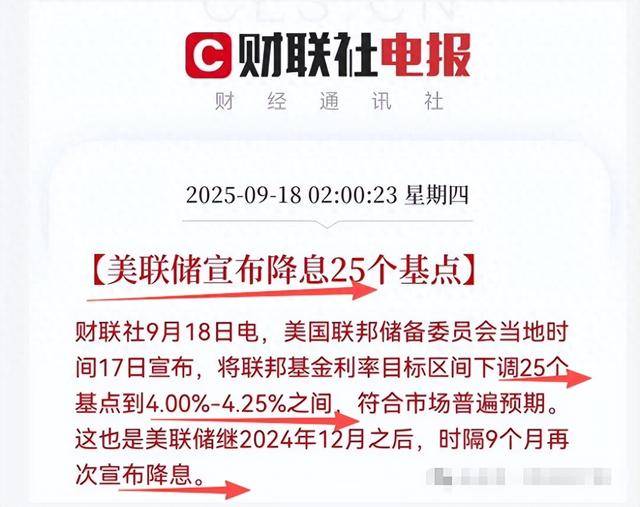
Group 1 - The Federal Reserve announced a 25 basis point rate cut, bringing the target range to 4.00%-4.25%, marking the fourth cut since September 2024 and the first in 2025 [1][4] - The cumulative rate cuts in 2024 reached 100 basis points, injecting significant liquidity into the market, with potential for an additional 50 basis points in the next three months [4][5] - The rate cut is a response to economic pressures, including a cooling job market, weakened factory activity, and slow consumer recovery, necessitating measures to stimulate economic growth [5][6] Group 2 - The rate cut creates a favorable external environment for China's monetary policy adjustments, potentially reducing the pressure on the RMB exchange rate and foreign capital outflows [5][6] - Recent signals from Chinese authorities indicate a trend towards a more accommodative monetary policy, particularly in the real estate sector, which is crucial for economic stability [6][7] - The market anticipates a reduction in the Loan Prime Rate (LPR), which directly affects financing costs for businesses and consumers, especially in the housing market [6][7] Group 3 - A potential LPR cut could significantly lower mortgage rates, with expectations that rates may drop below 3%, alleviating repayment burdens for homebuyers [7][8] - For example, a 25 basis point reduction in LPR from 3.6% to 3.35% could save a borrower approximately 250 yuan per month on a 1 million yuan loan over 30 years, totaling a reduction of about 90,000 yuan in interest payments [8][11] - Lower mortgage rates are expected to boost consumer confidence and stimulate housing demand, aiding in inventory reduction and stabilizing home prices [11] Group 4 - The anticipated reduction in mortgage rates is seen as a timely boost for the real estate market, enhancing purchasing intentions and stimulating consumption [11] - The stability and growth of the real estate market are expected to positively impact related industries, such as construction and home appliances, contributing to overall economic growth [11] - However, banks must balance rate adjustments with their funding costs and market competition, while policymakers need to navigate between stimulating growth and managing financial risks [11]
不肯降息的鲍威尔为什么松口了?
Sou Hu Cai Jing· 2025-09-19 06:41
为什么鲍威尔现在对降息这个事儿终于松口了,因为他发现了两个事儿: 问题又来了,美联储降息跟我们有什么关系?先说结论,将打开中国央行大幅降息的空间! 最近两三年,中国的降息幅度一直比较小。尤其是今年降息了1次不说,还只降了10个基点,根本原因 就是中美两国的利差倒挂太严重了,目前美国当前的利率之锚,10年期国债收益率在4.30%左右,而中 国在1.65%左右,全球资金当然更倾向于往利率高的国家流动。 为了防止利差进一步拉开,造成资金加速外流,人民币贬值压力加大,中国央行在降息这件事上,就只 能尽量保持克制了。 也就是说,在鲍威尔转变思想之后,不仅美国新一轮降息周期即将开启,更打开了中国央行连续降息的 空间。 第一个事儿,川普之前搞稳定币、推大而美法案等一系列财政创新后,美债扩大基本停不下来。全球央 行一看这形势,都会跟着买黄金,加速去美元化。 这个时候美国如果还坚持强硬货币政策,其实很难给美元信心支撑,还不如现在赶紧降息,至少能让今 年经济数据看起来好看点。 第二,川普已经把明年鲍威尔继任者的候选人名单都列出来了,大概率下一任美联储主席会是个很听话 的鸽派。那鲍威尔剩下不到一年任期里,再坚守强硬政策也没太大实际 ...
“2025年中国上市公司治理指数”显示:上市公司治理水平稳步提升 金融行业表现突出
Shang Hai Zheng Quan Bao· 2025-09-18 19:05
Core Insights - The average governance index for Chinese listed companies in 2025 is 64.94, showing a slight increase from 64.87 in 2024, indicating a steady improvement in governance quality [1][2][3] - Financial sector companies exhibit the highest governance levels, with an average index of 67.32, while the main board companies require further improvement [4][5][17] Governance Index Overview - The governance index has increased by 0.07 from 2024 to 2025, with improvements in shareholder governance, board governance, and stakeholder governance, while supervisory board governance, management governance, and information disclosure have declined [1][3][6] - The distribution of governance ratings shows that 84.43% of companies fall into the B, C, and D categories, with no companies rated AAA or AA [2][3] Industry and Sector Analysis - The governance index varies significantly across industries, with financial companies leading, followed by sectors like scientific research, accommodation, and manufacturing [4][5] - The governance index for private-controlled companies continues to outperform state-owned companies, with companies without actual controllers showing the best governance performance [4][5] Regional Governance Characteristics - Governance levels show a gradient improvement from coastal to inland regions, with 32 regions having an average index above 62.00, indicating a reduction in regional disparities [5] Detailed Dimension Analysis - Shareholder governance index increased from 69.42 to 69.73, driven by improvements in dividend continuity and protection of minority shareholders [7][8] - Board governance index rose to 65.26, reflecting better operational efficiency and structure [8] - Supervisory board governance index slightly decreased to 59.12, indicating a decline in the competency of supervisory board members [9] - Management governance index fell to 60.39, with a slight improvement in appointment systems but a decline in incentive mechanisms [9] - Information disclosure index slightly decreased to 66.19, although relevance and timeliness improved [10] - Stakeholder governance index increased to 69.70, despite a decrease in stakeholder participation [12] Recommendations for Improvement - Establish a mechanism for the audit committee to prevent governance risks during transitional periods [18][19] - Encourage the participation of actual controllers in governance while establishing accountability mechanisms [19][20] - Leverage digital tools to enhance governance efficiency and reduce costs [20][21] - Develop tailored governance guidelines for private-controlled companies to address recent declines in governance quality [20] - Promote differentiated governance standards based on industry characteristics [21] - Create a governance-oriented market value management system to enhance governance premiums [21] - Expand investor litigation channels to strengthen market oversight and protect shareholder rights [22] - Encourage institutional investors to actively participate in governance activities [22]
中国五矿在江西成立能源科技公司,注册资本5000万
Qi Cha Cha· 2025-09-17 13:57
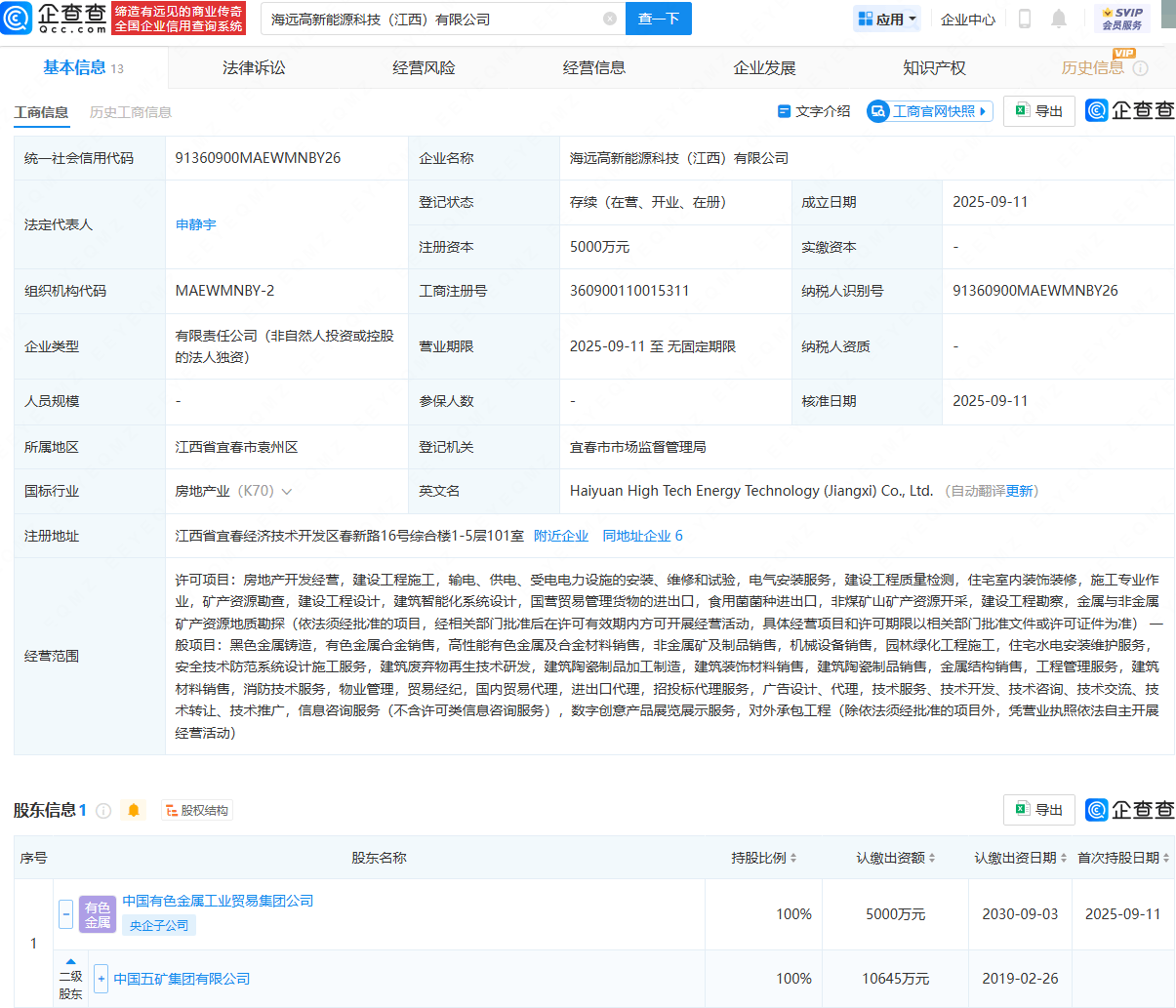
Group 1 - Haiyuan High Tech Energy Technology (Jiangxi) Co., Ltd. has been established with a registered capital of 50 million yuan [1] - The company is wholly owned by China Minmetals Corporation indirectly [1] - The business scope includes real estate development, mineral resource exploration, construction engineering design, and sales of non-ferrous metal alloys [1][2] Group 2 - The legal representative of the company is Shen Jingyu [2] - The company is registered in Yichun Economic and Technological Development Zone, Jiangxi Province [2] - The business operations are set to continue indefinitely from the establishment date [2]

新昌县高新园区投资集团因采取欺骗手段骗取批准非法占用土地被罚
Qi Lu Wan Bao· 2025-09-17 12:06
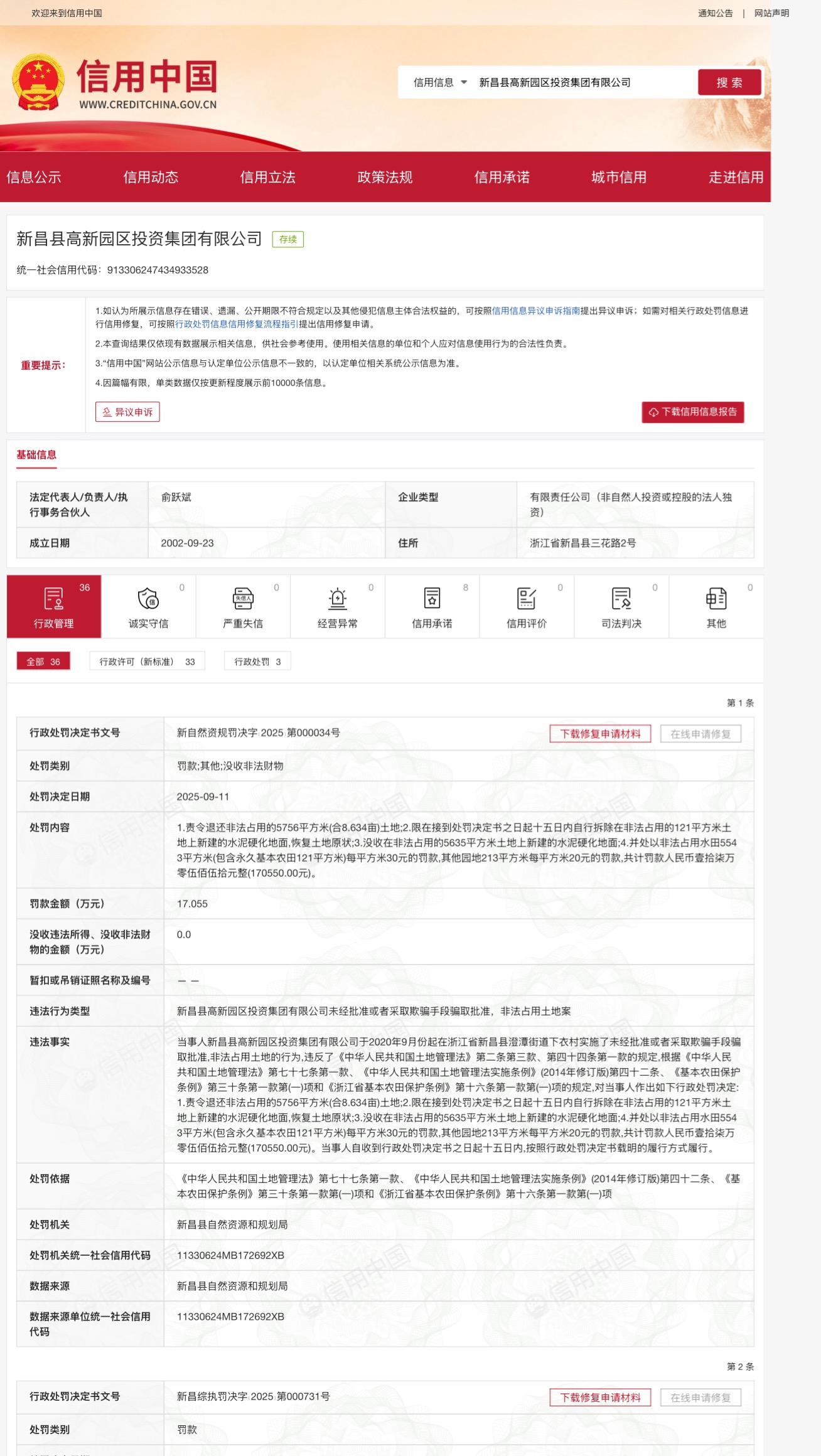
Core Points - The New Changshan Natural Resources and Planning Bureau imposed an administrative penalty on New Changshan High-tech Zone Investment Group Co., Ltd. for illegal land occupation, resulting in a fine of 170,550 yuan [1][2][3] Summary by Sections Penalty Details - The company was ordered to return the illegally occupied land of 5,756 square meters (approximately 8.634 acres) and to remove a newly constructed cement surface on 121 square meters of permanent basic farmland within 15 days [2][3] - A total fine of 170,550 yuan was calculated based on the type of land occupied: 30 yuan per square meter for 5,543 square meters of rice fields (including 121 square meters of permanent basic farmland) and 20 yuan per square meter for 213 square meters of other garden land [2][3] Legal Basis - The actions of the company violated multiple regulations, including Article 2, Clause 3, and Article 44, Clause 1 of the Land Management Law of the People's Republic of China [2][3] - The penalty was based on the Land Management Law, its implementation regulations, and the Basic Farmland Protection Regulations [2][3] Company Information - New Changshan High-tech Zone Investment Group Co., Ltd. was established on September 23, 2002, with a registered capital of 300 million yuan and is a wholly-owned subsidiary of New Changshan High-tech Holdings Group Co., Ltd. [2]
外资购房政策新变化,释放什么信号
Di Yi Cai Jing Zi Xun· 2025-09-16 15:04
Core Viewpoint - The State Administration of Foreign Exchange (SAFE) has issued a notice to deepen the reform of cross-border investment and financing foreign exchange management, which includes measures to facilitate foreign individuals' home purchases in China and optimize the foreign exchange payment process for capital project income [2][3][6]. Group 1: Policy Changes - The negative list for the use of foreign exchange income and its converted RMB for domestic payments has been reduced, specifically removing restrictions on purchasing non-self-occupied residential properties [3][6]. - The policy aims to enhance the convenience of cross-border investment and financing, allowing banks to determine the frequency and proportion of random checks based on clients' compliance and risk levels [3][6]. - The facilitation of foreign individuals' home purchase payments will be expanded from the Guangdong-Hong Kong-Macao Greater Bay Area to nationwide implementation [3][5]. Group 2: Implementation Details - Previously, foreign individuals needed to provide a purchase registration certificate from the real estate authority to process foreign exchange payment for home purchases, which often required upfront payment to the seller [3][5]. - The new policy allows foreign individuals to process foreign exchange payments based on the purchase contract before obtaining the registration certificate, streamlining the payment process [5][6]. - As of January 2025, the People's Bank of China in Guangdong has facilitated 2,603 transactions for Hong Kong and Macao residents purchasing properties in the Greater Bay Area, amounting to approximately RMB 2.993 billion [5]. Group 3: Market Context - The adjustments in foreign exchange management measures are in response to changes in the domestic real estate market and aim to support stable development in the sector [6][7]. - The removal of restrictions on purchasing non-self-occupied residential properties is intended to encourage foreign investment in the domestic real estate market while maintaining existing policies for foreign individuals [7].

登报催债34亿元 渤海信托“拼”了!
Jing Ji Guan Cha Wang· 2025-09-16 07:00
Core Viewpoint - Bohai International Trust Co., Ltd. is facing significant collection challenges, with two loan projects involving over 3.4 billion yuan in principal and interest, indicating potential risks in its asset management and loan recovery processes [1][4]. Loan Projects Overview - The first loan project involves Beijing Jiutai Group Co., Ltd. as the borrower, with a loan amount of 2.2 billion yuan issued on September 29, 2017. As of the announcement date, only 982,800 yuan has been received, leaving 2.791 billion yuan in principal, interest, and penalties unpaid [2]. - The second loan project involves Beijing Dongfang Media Real Estate Co., Ltd. as the borrower, with a loan amount of 500 million yuan issued on the same date. Only 201,720 yuan has been received, leaving 633 million yuan in principal, interest, and penalties unpaid [3]. Borrower and Guarantor Details - Both loan projects are interconnected, with mutual guarantees among the borrowers and guarantors, totaling over 3.4 billion yuan in loans. The legal representative for both Jiutai Group and Dongfang Media Real Estate is Li Yuguo [4]. - Multiple guarantors are involved in both projects, including various companies and individuals, indicating a complex network of financial obligations [3][4]. Company Background - Bohai Trust was established in 1983, registered in Shijiazhuang, with a registered capital of 3.6 billion yuan. It is the only trust institution in Hebei Province, with a net profit of 37.1 million yuan and total trust assets of 543.6 billion yuan in 2024 [4]. - The company is controlled by HNA Capital Group, which holds a 51.23% stake, with no actual controller identified [4]. Industry Context - The trust industry has been experiencing frequent default events, leading to challenges in debt collection. The use of public notices for debt collection is relatively rare, highlighting the severity of the situation [6]. - When borrowers default, trust companies typically initiate a tiered disposal mechanism, starting with negotiations and potentially escalating to legal actions if no resolution is reached [6].
中国2025年8月经济数据图景:8月生产改善,投资放缓
Hua Tai Qi Huo· 2025-09-16 02:40
Report Industry Investment Rating No relevant content provided. Core Viewpoints - In August, industrial production improved with the national above - scale industrial added value growing 5.2% year - on - year and 0.37% month - on - month, and 6.2% year - on - year from January to August. The decline of PPI narrowed, and CPI decreased year - on - year but was flat month - on - month. Core CPI increased for four consecutive months. Domestic consumption is expected to continue to recover in Q3 [3]. - From January to August, national fixed - asset investment (excluding rural households) was 326111 billion yuan, with a year - on - year growth of 0.5%, and a month - on - month decline of 0.20% in August. The third - industry investment was dragged down by real estate, but the investment structure continued to optimize [4]. - From January to August, the total retail sales of consumer goods was 323906 billion yuan, with a year - on - year growth of 4.6%, and 39668 billion yuan in August, with a year - on - year growth of 3.4%. The consumer market is recovering, but the demand foundation needs to be consolidated. In the real estate market, both investment and sales were under pressure from January to August [5]. Summary by Directory Growth: Steady Uptick - In August, the national above - scale industrial added value grew 5.2% year - on - year and 0.37% month - on - month, and 6.2% year - on - year from January to August. The equipment and high - tech manufacturing industries outperformed the overall level. Some product outputs increased significantly. However, external uncertainties remain [11]. Inflation: Month - on - Month Recovery - In August 2025, the national PPI decreased 2.9% year - on - year, with the decline narrowing. The pressure on energy and raw material supply and demand eased marginally, some external - demand industries improved, and new - quality productivity industries and consumption - upgrade demand supported price increases. However, factors such as weak downstream demand and international input still restrict the full recovery of PPI, which is expected to continue a mild recovery [21]. - In August, CPI decreased 0.4% year - on - year and was flat month - on - month. Core CPI increased 0.9% year - on - year, with the increase expanding for four consecutive months. Food prices were the main drag, while non - food prices and service consumption showed positive trends. Domestic consumption is expected to continue to recover in Q3 [45]. Investment: Marginal Slowdown - From January to August 2025, national fixed - asset investment (excluding rural households) was 326111 billion yuan, with a year - on - year growth of 0.5%, and a month - on - month decline of 0.20% in August. The second - industry investment grew rapidly, while the third - industry investment was dragged down by real estate. Investment growth varied by region. Overall, the investment structure is optimizing, but the real estate market still drags down the overall investment [59]. Production: Continued Growth - From January to August 2025, the national above - scale industrial added value grew 6.2% year - on - year, with a 5.2% year - on - year and 0.37% month - on - month growth in August. The manufacturing industry maintained growth, and high - tech manufacturing outperformed. New kinetic energy products grew rapidly, and foreign trade also increased. However, the foundation for the continuous recovery of the industrial economy needs to be consolidated [63]. Consumption: Slowing Growth - From January to August 2025, the total retail sales of consumer goods was 323906 billion yuan, with a year - on - year growth of 4.6%, and 39668 billion yuan in August, with a year - on - year growth of 3.4%. The consumer market showed the characteristics of stable growth in commodity consumption and resilience in service consumption. Online consumption grew rapidly. Overall, the consumer market is recovering, but the demand foundation needs to be consolidated [74]. Real Estate: Both Investment and Demand Under Pressure - From January to August, national real estate development investment was 60309 billion yuan, with a year - on - year decline of 12.9%. The funds in place for real estate development enterprises decreased, and sales were weak. The real estate market still faced downward pressure, but inventory reduction policies had some effects. The demand - side confidence needs to be restored [86]. Appendix - In August, the national economy maintained a stable and progressive development trend. Industrial production, services, market sales, fixed - asset investment, foreign trade, etc. all showed certain growth, and employment and prices were generally stable. However, there were still many external uncertainties, and the economy faced challenges [103].