
电子

Search documents
源达调研策略周报
Xin Lang Cai Jing· 2026-02-27 10:07
Industry Research Highlights - The most researched industries this week (2026/2/23-2026/2/27) include electronics, machinery, automotive, and light manufacturing, with electronics and light manufacturing seeing increased attention compared to the week before the Spring Festival, likely benefiting from export recovery or domestic demand policy expectations [5][20] - Over the past 30 days (2026/1/28-2026/2/27), the most researched industries were machinery, electronics, pharmaceutical biology, and basic chemicals, with a notable increase in the number of research institutions focusing on electronics and machinery [5][21] Company Research Highlights - The companies with the highest number of institutional research visits in the past week include Jerry Holdings, Tin Industry Co., and BOE Technology Group, with Jerry Holdings receiving 14 visits and 22 ratings from institutions [6][24] - Over the past 30 days, the most researched companies include Dazhu Laser, Jerry Holdings, and Hangzhou Bank, with Ninebot, JinkoSolar, and Zhongji Xuchuang also receiving significant attention [2][25] Key Company Insights 1. **Jerry Holdings** - Jerry Holdings is transitioning into a diversified technology-driven industrial group, expanding its core growth areas from traditional oil and gas equipment to gas turbine power generation, focusing on data centers, industrial energy, and new power systems, with over 3.4 billion yuan in gas turbine generator orders from North America [3][18] - The company has established long-term partnerships with Siemens, Baker Hughes, and Kawasaki Heavy Industries, and is enhancing its capabilities in power generation, storage, and distribution [10][29] - Jerry Holdings has completed capacity construction for electric drive/turbine fracturing equipment and gas turbine power generation equipment in North America, with ongoing expansion in Dubai [30][29] 2. **Tin Industry Co.** - Tin Industry Co. is the only A-share listed company with a complete tin industry chain, holding the largest global reserves of tin and indium, with a production capacity of 80,000 tons/year for tin smelting and 12,500 tons/year for cathode copper [11][31] - The company achieved significant revenue and net profit growth in the first three quarters of 2025, with revenues of 34.42 billion yuan and a net profit of 1.745 billion yuan, marking a year-on-year increase of 17.81% and 35.99%, respectively [14][32] - The global tin market is currently characterized by a tight supply-demand balance, with strong demand from emerging sectors such as renewable energy and semiconductor packaging, providing long-term opportunities for the company [18][32]


热点追踪周报:由创新高个股看市场投资热点(第232期)-20260227
Guoxin Securities· 2026-02-27 09:58
- Model Name: 250-Day New High Distance Model - Model Construction Idea: The model tracks stocks that have reached new highs over a 250-day period to identify market trends and hotspots[11] - Model Construction Process: - Calculate the 250-day new high distance using the formula: $ 250 \text{ Day New High Distance} = 1 - \frac{Close_t}{ts\_max(Close, 250)} $ where $ Close_t $ is the latest closing price and $ ts\_max(Close, 250) $ is the maximum closing price over the past 250 trading days[11] - If the latest closing price reaches a new high, the 250-day new high distance is 0; if the latest closing price falls from the new high, the 250-day new high distance is positive, indicating the extent of the decline[11] - Model Evaluation: The model is effective in identifying stocks that are leading the market and can be used to track market trends and hotspots[11] - Factor Name: Stable New High Stocks - Factor Construction Idea: The factor identifies stocks that have reached new highs in a stable manner, considering aspects such as analyst attention, relative strength, trend continuity, price path stability, and new high sustainability[23] - Factor Construction Process: - Select stocks that have reached a 250-day new high in the past 20 trading days[19] - Filter stocks based on the following criteria: - Analyst attention: At least 5 buy or hold ratings in the past 3 months[27] - Relative strength: Top 20% in market performance over the past 250 days[27] - Price path stability: Use the following indicators to score and select the top 50% of stocks: - Price path smoothness: Stock price displacement ratio - New high sustainability: Average 250-day new high distance over the past 120 days - Trend continuity: Average 250-day new high distance over the past 5 days[27] - Factor Evaluation: The factor is effective in identifying stocks with strong and stable momentum, which can generate higher returns compared to stocks with jumpy price paths[23] Model Backtest Results - 250-Day New High Distance Model: - Shanghai Composite Index: 0.06%[12] - Shenzhen Component Index: 0.06%[12] - CSI 300 Index: 1.67%[12] - CSI 500 Index: 0.00%[12] - CSI 1000 Index: 0.00%[12] - CSI 2000 Index: 0.00%[12] - ChiNext Index: 2.30%[12] - STAR 50 Index: 4.37%[12] Factor Backtest Results - Stable New High Stocks: - Number of stocks selected: 37[28] - Distribution by sector: Technology (16 stocks), Manufacturing (11 stocks)[28] - Top-performing sectors: Electronics in Technology, Machinery in Manufacturing[28]



热点追踪周报:由创新高个股看市场投资热点(第 232 期)-20260227
Guoxin Securities· 2026-02-27 09:55
- The report introduces a quantitative model based on the "250-day new high distance" to track market trends and identify investment hotspots. The model calculates the distance of the latest closing price from the highest closing price in the past 250 trading days using the formula: $ 250\text{-day new high distance} = 1 - \frac{Close_t}{ts\_max(Close, 250)} $ where $ Close_t $ represents the latest closing price, and $ ts\_max(Close, 250) $ is the maximum closing price over the past 250 trading days. A value of 0 indicates a new high, while positive values indicate the degree of pullback from the high[11][19][23] - The model evaluates the effectiveness of momentum and trend-following strategies, referencing prior research such as George (2004) and William O'Neil's CANSLIM system, which emphasize the importance of stocks reaching new highs as potential leaders in market uptrends[11][18][21] - A secondary screening process identifies "stable new high stocks" by incorporating factors such as analyst attention, relative stock strength, price path smoothness, and the sustainability of new highs. Specific criteria include: 1. At least five "buy" or "overweight" ratings in the past three months 2. 250-day price performance in the top 20% of the market 3. Price path smoothness measured by the ratio of price displacement to total price movement over 120 days 4. Consistency of new highs over the past 120 days 5. Trend continuation based on the average 250-day new high distance over the past five days[23][27][28] - Backtesting results show that as of February 27, 2026, 1,370 stocks reached 250-day new highs in the past 20 trading days. The sectors with the highest number of such stocks include machinery, basic chemicals, and electronics. The highest proportions of new high stocks are found in non-ferrous metals, petrochemicals, and steel industries[19][20][33] - The "stable new high stocks" screening process identified 37 stocks, with the technology and manufacturing sectors contributing the most, at 16 and 11 stocks, respectively. Within these sectors, electronics and machinery were the leading industries[28][33]


由创新高个股看市场投资热点
量化藏经阁· 2026-02-27 09:28
Group 1 - The report tracks stocks, industries, and sectors that are reaching new highs, indicating market trends and hotspots [1][4] - As of February 27, 2026, the distance to the 250-day new high for major indices is as follows: Shanghai Composite Index 0.06%, Shenzhen Component Index 0.06%, CSI 300 1.67%, CSI 500 0.00%, CSI 1000 0.00%, CSI 2000 0.00%, ChiNext Index 2.30%, and STAR 50 Index 4.37% [5][24] - The industries closest to their 250-day new highs include machinery, electric power and utilities, steel, basic chemicals, and construction, while food and beverage, banking, pharmaceuticals, non-bank financials, and comprehensive finance are further away [8][24] Group 2 - A total of 1,370 stocks reached a 250-day new high in the past 20 trading days, with the most significant numbers in the machinery, basic chemicals, and electronics sectors [2][13] - The highest proportion of new high stocks is found in the non-ferrous metals, oil and petrochemicals, and steel industries, with respective proportions of 68.00%, 60.78%, and 45.28% [13][16] - The manufacturing and cyclical sectors had the most new high stocks this week, with 431 and 402 stocks respectively [16] Group 3 - The report identifies 37 stocks that are considered stable new highs based on analyst attention, relative strength, price path stability, and continuity of new highs [19][21] - The technology and manufacturing sectors had the most stocks identified as stable new highs, with 16 and 11 stocks respectively, and the electronics industry had the highest number within the technology sector [21][25]

87位头部“公奔私”基金经理最新观点、动向出炉!
Sou Hu Cai Jing· 2026-02-27 09:27
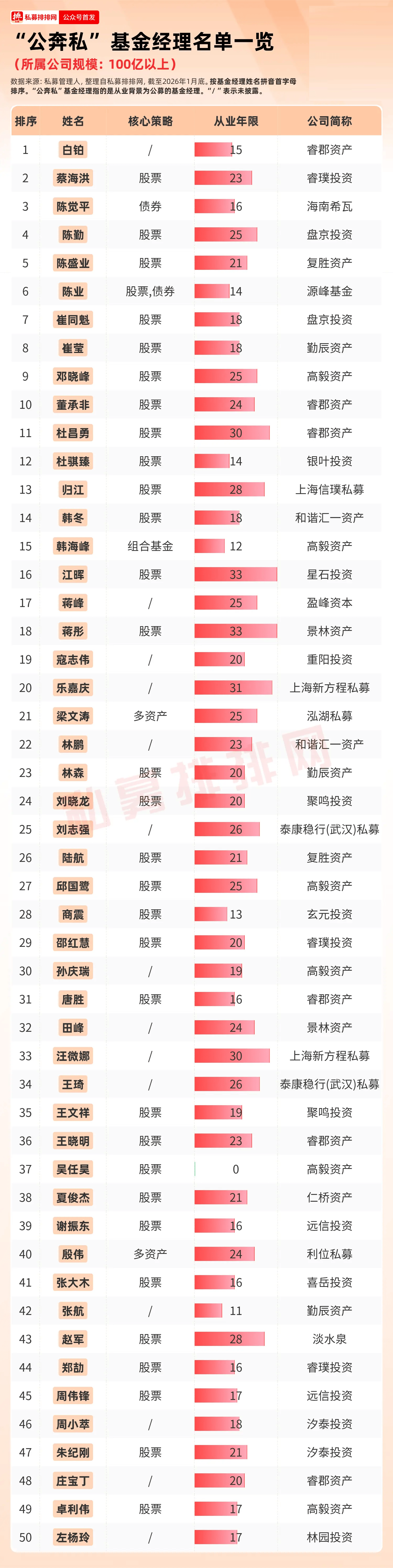
Core Insights - The trend of public fund managers transitioning to private equity ("公奔私") has become a significant faction within the private equity industry, driven by personal career advancement and changes in platform dynamics [1] - As of January 2026, there are 859 public fund managers who have transitioned to private equity, with 87 of them (10.13%) being from leading private equity firms [1] Group 1: Billion-Level Private Equity Managers - There are 50 "公奔私" fund managers under billion-level private equity firms, with the majority (31) focusing on stock strategies [2] - Among these managers, 29 have at least 20 years of experience, and 5 have over 30 years, including notable figures from various firms [2] - High Yi Asset and Rui Jun Asset each have 6 "公奔私" fund managers, while Qin Chen Asset and Rui Pu Investment have 3 each [2] Group 2: High Yi Asset Insights - High Yi Asset is a well-known private equity firm established in 2013, with a strong founding team [8] - The firm has 6 fund managers who previously held significant positions in public funds, including founder Qiu Guolu and CIO Deng Xiaofeng [8] - Deng Xiaofeng's investment in Zijin Mining is highlighted as a successful long-term case, with the stock price increasing approximately 12 times from around 3 yuan to 37.78 yuan by February 2026 [8] Group 3: Research and Performance - In January 2026, High Yi Asset conducted research on 24 A-share stocks, with 17 showing price increases, the highest being Wangsu Science and Technology with over 60% growth [9] - Jinglin Asset also has a strong presence of former public fund managers, with notable figures like Jiang Tong, who has over 30 years of experience [11] - In January 2026, 5 out of 8 stocks researched by Jinglin Asset saw price increases of over 10% [11] Group 4: Insights from Other Managers - In the准百亿 private equity sector, there are 37 "公奔私" fund managers, with 18 focusing on stock strategies [14] - Notable managers include Yuan Wei from Hua'an Hexin and Li Bei from Banxia Investment, both of whom have extensive experience in the industry [19] - Li Bei has expressed a shift in investment focus, predicting a significant opportunity in the real estate sector within the next six months [19]
百利好丨美伊谈判入技术阶段,全球资金涌新兴
Sou Hu Cai Jing· 2026-02-27 09:14
Group 1: Iran-US Negotiations - The third round of indirect negotiations between Iran and the US concluded in Geneva, with Iran's Foreign Minister stating that "good progress" was made, and both sides are close to consensus in some areas [1] - The negotiations have entered a "technical phase," indicating a shift from political exploration to specific parameter discussions, with both parties recognizing the feasibility of managing risks through an agreement [1] - Historical experience suggests that technical discussions remain highly dependent on focused topics and external conditions, indicating that there is still distance to cover before a final agreement is reached [1] Group 2: US Federal Reserve Signals - The Federal Reserve's Goolsbee reiterated that interest rates could be lowered, but premature action is not advisable until inflation shows clear signs of easing [3] - Goolsbee's comments reflect the decision-makers' vigilance regarding persistent inflation, despite a stable job market and robust economic performance [3] Group 3: Emerging Markets Investment - Global asset management institutions are increasingly favoring emerging markets, with allocations reaching a five-year high as they "flee Wall Street" and heavily invest in Asia [4] - In the first two months of 2026, the South Korean stock market led globally with over 50% gains, and its composite index surged 175% from last April's low, with Samsung Electronics' stock nearly doubling this year [4] - Citigroup reports that institutions managing over $20 trillion in assets are optimistic about emerging market stocks, currencies, and bonds, while Bloomberg confirms that US ETFs investing in emerging markets have seen a net inflow of $32.7 billion this year [4] - BCA Research warns that the current market is still dominated by geopolitical factors, with prices fluctuating based on negotiation news, and emphasizes that fundamental factors will regain pricing power only after diplomatic situations clarify [4] Group 4: Precious Metals Market - Precious metals are experiencing narrow fluctuations, with gold trading between $5,120 and $5,220, and silver rebounding slightly after a dip to $85 [5] - The market for precious metals is expected to remain in a state of consolidation in the short term due to unclear geopolitical risks and pending monetary policy decisions [5]
公司问答丨昀冢科技:MLCC业务为公司中长期策略发展方向
Ge Long Hui A P P· 2026-02-27 08:58
Core Viewpoint - The company is actively developing its MLCC (Multi-Layer Ceramic Capacitor) business as part of its long-term strategic direction while focusing on its core consumer electronics operations [1] Group 1: Company Strategy - The company is committed to advancing its business in the electronic ceramics sector in response to market trends and industry changes [1] - MLCC is identified as a key area for the company's medium to long-term strategic development [1] - The company is continuously enhancing the research, production, and technical capabilities of its MLCC products [1]

中银量化多策略行业轮动周报–20260226-20260227
Bank of China Securities· 2026-02-27 08:52
Core Insights - The report highlights the current industry allocation of the Bank of China’s multi-strategy system, with the highest allocations in basic chemicals (22.8%), telecommunications (10.2%), and home appliances (10.1) [1] - The report tracks the performance of various strategies, indicating that the S1 industry profitability tracking strategy has outperformed the benchmark by 3.3%, while the S2 implied sentiment momentum strategy has outperformed by 4.3% [2][3] - The report identifies the top three industries based on profitability expectations as telecommunications, basic chemicals, and home appliances [14][19] Recent Industry Performance Review - The average weekly return for the CITIC primary industries was 0.8%, with the best-performing sectors being steel (5.7%), defense and military (5.3%), and electronics (4.4%) [10][11] - The worst-performing sectors included media (-6.4%), consumer services (-5.8%), and non-bank financials (-2.6%) [10][11] Industry Valuation Risk Warning - The report employs a valuation warning system based on the past six years of PB ratios, identifying industries with PB ratios above the 95th percentile as overvalued. Currently, industries such as retail, computers, non-ferrous metals, and defense are flagged for high valuation risk [12][13] Single Strategy Performance - The S1 high profitability industry rotation strategy currently has the highest weight at 21.7%, while the S3 macro style industry rotation strategy has the lowest weight at 17.9% [3] - The top three industries based on the S1 strategy are telecommunications, basic chemicals, and home appliances [14][15] Macro Style Rotation Strategy - The macro style rotation strategy identifies the top six industries based on macroeconomic indicators as banking, telecommunications, oil and petrochemicals, construction, home appliances, and coal [23][24] Long-term Reversal Strategy - The long-term reversal strategy recommends industries such as comprehensive, pharmaceuticals, basic chemicals, electric equipment and new energy, and consumer services for investment [27]
粤开市场日报-20260227
Yuekai Securities· 2026-02-27 08:09
Market Overview - The A-share market showed mixed performance today, with the Shanghai Composite Index rising by 0.39% to close at 4162.88 points, while the Shenzhen Component Index fell by 0.06% to 14495.09 points. The ChiNext Index decreased by 1.04% to 3310.3 points, and the Sci-Tech 50 Index increased by 0.15% to 1488.02 points. Overall, 3267 stocks rose, 2066 fell, and 146 remained unchanged, with a total trading volume of 248.8 billion yuan, down by 50.4 billion yuan from the previous trading day [1][2]. Industry Performance - Among the Shenwan first-level industries, sectors such as steel, coal, non-ferrous metals, public utilities, and agriculture led the gains, with increases of 3.37%, 3.20%, 3.10%, 2.27%, and 2.06% respectively. Conversely, industries like building materials, telecommunications, electronics, automotive, and home appliances experienced declines, with decreases of 1.45%, 1.38%, 0.71%, 0.41%, and 0.39% respectively [1][2].
联想集团(00992):FY3Q26业绩点评:供应链管理能力彰显,业绩稳健增长
Guolian Minsheng Securities· 2026-02-27 08:03
Investment Rating - The report maintains a "Buy" rating for Lenovo Group [4][6] Core Insights - Lenovo Group demonstrated strong resilience in the face of supply chain challenges, achieving a record revenue of $22.204 billion for FY3Q26, representing an 18% year-over-year growth. Adjusted net profit reached $589 million, up 36% year-over-year [1][4] - All business segments reported double-digit year-over-year growth, with AI-related revenue increasing by 72%, accounting for nearly one-third of total revenue [1] - The company is expected to expand its leadership in AI PCs and benefit from the strategic restructuring of its ISG business, leading to profit recovery [4] Summary by Relevant Sections IDG (Intelligent Devices Group) - Achieved revenue of $15.8 billion in FY3Q26, a 14% year-over-year increase. The PC market share reached a historic high of 24.9% for 2025, with a quarterly market share increase of 1 percentage point to 25.2% [2] - The AI PC segment saw high double-digit revenue growth, while Motorola's smartphone business set historical highs in sales and activations [2] ISG (Infrastructure Solutions Group) - Revenue for FY3Q26 was $5.2 billion, marking a 31% year-over-year increase and a historical high. The AI server business experienced high double-digit revenue growth, with a backlog of orders amounting to $15.5 billion [3] - The company implemented a strategic restructuring, incurring a one-time restructuring cost of $285 million, which is expected to yield annual cost savings of over $200 million for the next three years [3] SSG (Solutions and Services Group) - Reported revenue of $2.7 billion in FY3Q26, an 18% year-over-year increase, achieving growth for the 19th consecutive quarter. The operating profit margin improved by 1 percentage point, exceeding 22% [3] - The growth rate in digital office and AI-related sustainable development areas is twice that of the market, contributing to sustainable revenue growth [3] Financial Forecast - Projected net profits for FY26, FY27, and FY28 are $1.757 billion, $2.011 billion, and $2.390 billion, respectively, with corresponding PE ratios of 9, 8, and 6 times [5][4]
