服务业

Search documents
11月PMI数据点评:制造业PMI边际改善,复苏持续性仍需夯实
Mai Gao Zheng Quan· 2025-12-01 07:32
Manufacturing Sector - In November 2025, the Manufacturing PMI recorded 49.2%, a marginal increase of 0.2 percentage points from the previous month, indicating slight improvement in manufacturing activity[1] - The production index rose to 50.0%, reflecting stable production levels, with notable activity in food processing and non-ferrous metal industries[12] - New orders index increased by 0.4 percentage points to 49.2%, suggesting marginal recovery in market demand[12] - The raw material inventory index remained low at 47.3%, indicating cautious inventory strategies among enterprises[12] - Small enterprises' PMI rose to 49.1%, the highest in six months, while large enterprises' PMI fell to 49.3%, indicating greater pressure on larger firms[17] Non-Manufacturing Sector - The Non-Manufacturing PMI fell to 49.5%, a decrease of 0.6 percentage points from the previous month, reflecting a decline in service sector activity[2] - The new orders index for non-manufacturing recorded 45.7%, indicating weak demand in the sector[22] - The business activity expectation index rose to 56.2%, suggesting optimism about medium to long-term market prospects driven by policy support and seasonal factors[3] Economic Outlook - Overall, the manufacturing sector remains below the 50% threshold, indicating ongoing contraction and economic downward pressure[5] - Rising raw material prices may increase cost pressures for mid and small-sized enterprises, necessitating caution regarding rapid cost increases[5] - Future recovery in manufacturing is anticipated to be supported by year-end policy implementations and improved external trade conditions[5]
构建人才梯队 北京老字号工匠队伍扩容至150名
Bei Jing Shang Bao· 2025-12-01 06:00
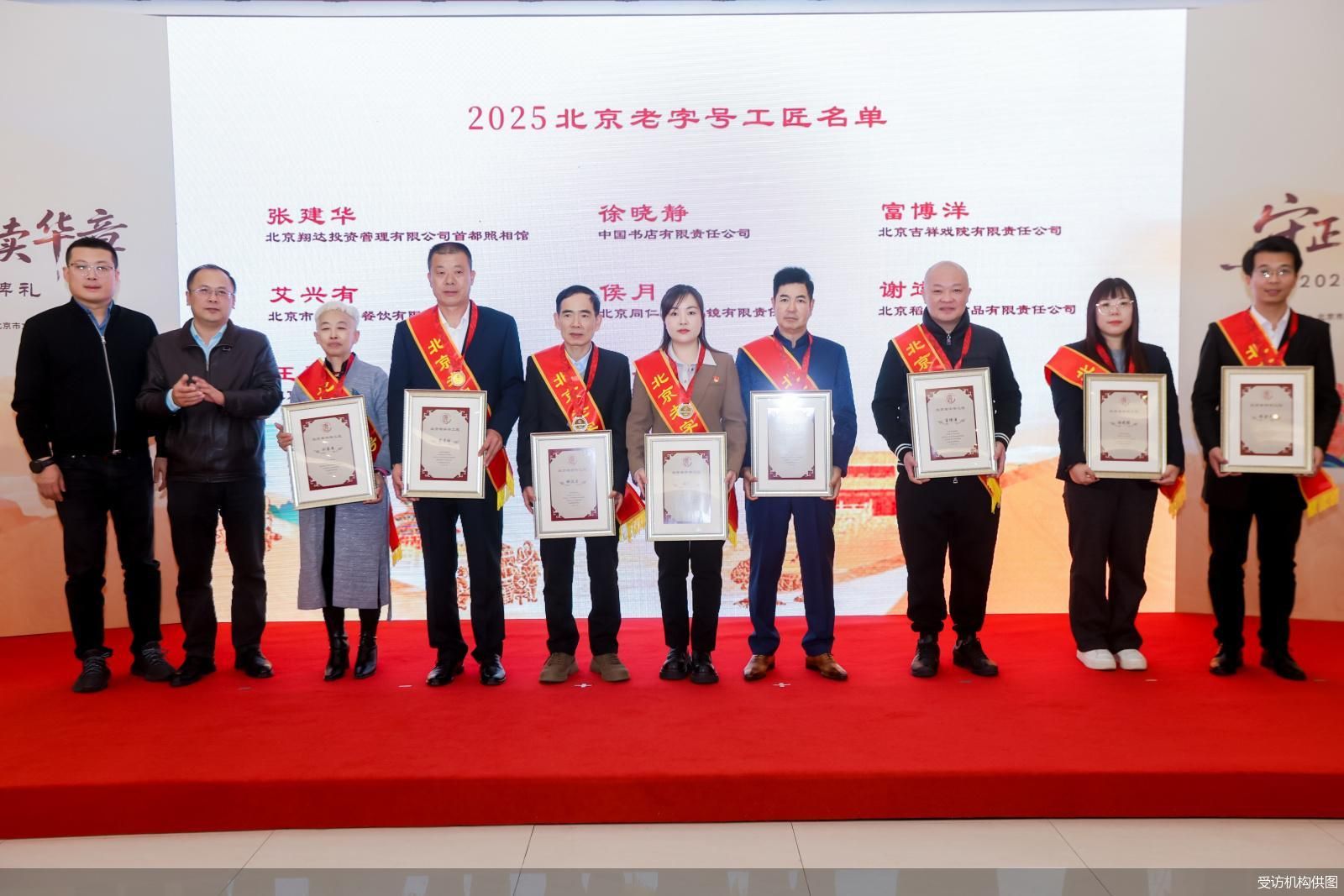
Core Insights - The event "Guarding Tradition and Continuing Craftsmanship: 2025 Beijing Time-honored Craftsmen Award Ceremony" was successfully held, recognizing 25 new craftsmen, bringing the total to 150 craftsmen in Beijing's time-honored brands [1][3] - The recognition process for Beijing time-honored craftsmen began in 2019, establishing a standardized mechanism that includes "enterprise recommendation, expert review, and public announcement" [3] - The craftsmen come from over a hundred time-honored enterprises and span various industries, showcasing a diverse talent pool that includes both seasoned experts and innovative young designers [3] Industry Overview - The craftsmen recognized include individuals from sectors such as catering, food processing, cultural arts, commerce, services, pharmaceuticals, performance venues, clothing manufacturing, and industrial production [3] - The age range of the craftsmen varies significantly, with the oldest being 82 years old and the youngest only 31, indicating a well-structured talent pipeline across generations [3] - The event featured a showcase of new products from several enterprises, highlighting the blend of tradition and modern trends [3] Future Outlook - Beijing plans to continue improving the innovation and development policy system for time-honored brands, aiming to integrate craftsmanship with modern consumer demands [4] - The government is committed to supporting the inheritance and development of time-honored brands through various measures, including policy support, platform establishment, and market guidance [3][4]

2025年11月中国采购经理指数为49.2%
Guo Jia Tong Ji Ju· 2025-12-01 03:14
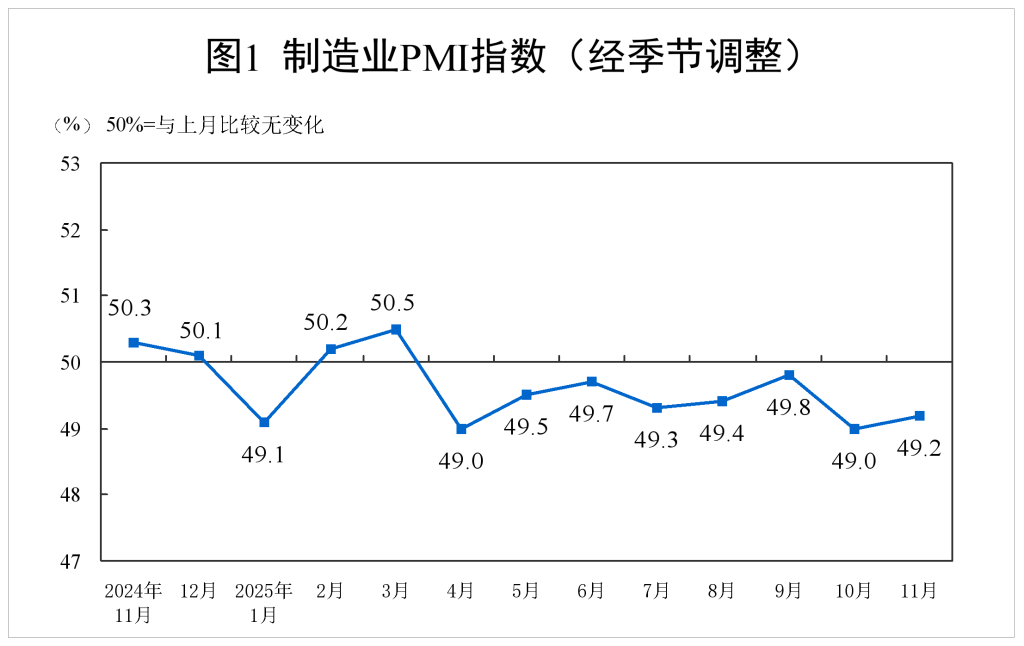
一、中国制造业采购经理指数运行情况 11月份,制造业采购经理指数(PMI)为49.2%,比上月上升0.2个百分点,景气水平有所改善。 从企业规模看,大型企业PMI为49.3%,比上月下降0.6个百分点,低于临界点;中、小型企业PMI分别 为48.9%和49.1%,比上月上升0.2个和2.0个百分点,均低于临界点。 从分类指数看,在构成制造业PMI的5个分类指数中,供应商配送时间指数高于临界点,生产指数位于 临界点,新订单指数、原材料库存指数和从业人员指数均低于临界点。 生产指数为50.0%,比上月上升0.3个百分点,位于临界点,表明制造业生产总体稳定。 11月份,非制造业商务活动指数为49.5%,比上月下降0.6个百分点。 分行业看,建筑业商务活动指数为49.6%,比上月上升0.5个百分点;服务业商务活动指数为49.5%,比 上月下降0.7个百分点。从服务业行业看,铁路运输、电信广播电视及卫星传输服务、货币金融服务等 行业商务活动指数均位于55.0%以上较高景气区间;房地产、居民服务等行业商务活动指数均低于临界 点。 新订单指数为45.7%,比上月下降0.3个百分点,表明非制造业市场需求回落。分行业看,建筑业 ...

产需两端均有所改善 11月制造业PMI小幅回升 下阶段走势如何?
Xin Lang Cai Jing· 2025-11-30 23:52
Group 1: Manufacturing Sector - The manufacturing Purchasing Managers' Index (PMI) for November is reported at 49.2%, showing a slight increase of 0.2 percentage points from the previous month, indicating a modest improvement in economic conditions [7][8] - The production index stands at 50.0%, up by 0.3 percentage points, while the new orders index is at 49.2%, increasing by 0.4 percentage points, suggesting a recovery in production and demand [8] - The new export orders index rose by 1.7 percentage points to 47.6%, driven by improved expectations from US-China trade negotiations and seasonal demand from overseas shopping [8] Group 2: Non-Manufacturing Sector - The non-manufacturing business activity index decreased to 49.5%, down by 0.6 percentage points, marking the first entry into contraction territory this year [11] - The service sector's business activity index fell to 49.5%, influenced by the end of holiday effects, while the construction sector's index improved to 49.6%, reflecting better conditions in construction activities [11] - The construction new orders index increased by 0.2 percentage points to 46.1%, indicating a gradual recovery in demand [11] Group 3: Economic Outlook - Analysts predict that the manufacturing PMI may decline to around 49.1% in December, based on historical trends, but there is potential for new growth measures to be introduced before year-end [13] - The service sector is expected to see a slight recovery in December due to upcoming holidays and the impact of consumption policies, although improvements in real estate and employment may be gradual [13] - Infrastructure investment is anticipated to rebound, providing support for the construction PMI, with increased funding from policy financial tools and local government bonds expected to enhance economic activity [13]
11月份制造业PMI小幅回升——我国经济景气水平总体平稳
Jing Ji Ri Bao· 2025-11-30 22:33
Core Insights - The manufacturing Purchasing Managers' Index (PMI) for November is 49.2%, showing a slight increase of 0.2 percentage points from the previous month, indicating a modest improvement in manufacturing sentiment [1][2] - The non-manufacturing business activity index decreased to 49.5%, down 0.6 percentage points from last month, reflecting a decline in non-manufacturing sentiment [1][4] - The comprehensive PMI output index fell to 49.7%, a decrease of 0.3 percentage points from the previous month, suggesting overall economic stability [1] Manufacturing Sector - The manufacturing PMI increased to 49.2%, with most sub-indices showing improvement, indicating a stabilization in production activities and a recovery in demand [2] - The production index and new orders index for manufacturing are at 50.0% and 49.2%, respectively, both up by 0.3 and 0.4 percentage points from last month [2] - The new export orders index rose to 47.6%, an increase of 1.7 percentage points, suggesting a stabilization in export demand [2] - The purchasing price index for raw materials increased to 53.6%, up 1.1 percentage points, indicating rising input costs [2] - High-tech manufacturing PMI remains above the critical point at 50.1%, continuing to show growth for ten consecutive months [2] Non-Manufacturing Sector - The non-manufacturing business activity index decreased to 49.5%, reflecting a slowdown primarily due to high base effects from the previous holiday season [4] - The service sector index fell to 49.5%, down 0.7 percentage points, indicating a decline in service-related activities [4] - Financial services and information services showed strong performance, with indices above 55%, indicating robust activity in these sectors [4] Enterprise Size Analysis - Small enterprises showed a significant recovery with a PMI of 49.1%, up 2.0 percentage points, marking a six-month high [3] - Medium-sized enterprises' PMI increased to 48.9%, up 0.2 percentage points, indicating slight improvement [3] - Large enterprises' PMI decreased to 49.3%, down 0.6 percentage points, reflecting a decline in sentiment [3] Policy and Economic Outlook - Experts suggest that the slight recovery in manufacturing PMI indicates improved market confidence, but caution that the index remains below the neutral line, highlighting ongoing economic pressures [5] - There is a call for enhanced macroeconomic policy measures to stimulate demand and support economic growth [5][6] - Anticipated policy support and year-end demand are expected to release investment and consumption-related needs, contributing to a stable economic finish for the year [6]
国家统计局:11月中小型企业PMI回升
Zhong Guo Zheng Quan Bao· 2025-11-30 20:21
具体来看,产需两端有所改善。11月份,生产指数和新订单指数分别为50.0%和49.2%,比上月上升0.3 个和0.4个百分点,其中生产指数升至临界点,制造业产需两端均有改善。 "海外节日购物季备货需求带动出口趋稳,推动市场需求整体回暖。需求端恢复对企业的生产意愿有所 提振,制造业生产活动平稳运行。"中国民生银行首席经济学家温彬表示。 小型企业PMI明显回升。11月份,大型企业PMI为49.3%,比上月下降0.6个百分点,景气水平回落;中 型企业PMI为48.9%,比上月上升0.2个百分点,景气度有所改善;小型企业PMI为49.1%,比上月上升 2.0个百分点,为近6个月高点,景气水平显著回升。 高技术制造业保持扩张。11月份,高技术制造业PMI为50.1%,连续10个月位于临界点以上,相关行业 继续保持增长。装备制造业和消费品行业PMI分别为49.8%和49.4%,比上月下降0.4个和0.7个百分点。 高耗能行业PMI为48.4%,比上月上升1.1个百分点,景气水平低位回升。 市场预期稳中有升。霍丽慧表示,11月份,生产经营活动预期指数为53.1%,比上月上升0.3个百分点, (下转A02版) (上接A01版 ...
数据点评 | PMI修复的“短期掣肘”?(申万宏观·赵伟团队)
赵伟宏观探索· 2025-11-30 16:35
Core Viewpoints - The PMI for November shows limited recovery, primarily influenced by high inventory levels and the fading effects of holidays [2][4][88] - In the manufacturing sector, the PMI increased slightly to 49.2%, reflecting weak overall performance despite a low base [2][10][44] - The production index remains weak, with only a minor increase to the threshold line of 50%, indicating ongoing production challenges [2][10][19] Manufacturing Sector - The manufacturing PMI rose by 0.2 percentage points to 49.2%, with production and new orders indices showing slight improvements of 0.3 and 0.4 percentage points, respectively [5][44][89] - High inventory levels from previous months continue to constrain current production, with the finished goods inventory index decreasing to 47.3% [2][19][87] - Key industries such as high-tech manufacturing and consumer goods have seen their PMIs fall into contraction territory, while energy-intensive industries have shown some improvement [3][22][88] Non-Manufacturing Sector - The non-manufacturing PMI decreased to 49.5%, primarily due to a high base from the previous month and the impact of holiday effects [3][36][59] - Service industries, including retail and hospitality, experienced declines in their PMIs, while sectors like telecommunications and financial services remained in a high growth zone [3][36][88] - The construction sector's PMI improved to 49.6%, with significant increases in new orders and employment indices, indicating a potential recovery in this area [30][36][76] Economic Outlook - The short-term disturbances from high inventory levels are expected to dissipate, and with supportive fiscal policies being implemented, economic growth is anticipated to remain resilient [4][42][88] - The easing of debt-related investment constraints is reflected in the improvements seen in energy-intensive and construction sectors [4][42][88] - Overall, the combination of external demand stability and the rollout of fiscal measures is projected to support economic resilience through the end of the year [4][42][88]
——11月PMI数据点评:PMI反弹仍偏弱,政策谋定而后动
Changjiang Securities· 2025-11-30 15:24
Group 1: PMI Overview - In November, the manufacturing PMI rebounded slightly to 49.2%, remaining below the expansion threshold and lower than Bloomberg's consensus estimate of 49.4%[2] - The new orders index and production index hit their lowest levels since 2013, excluding 2022, indicating insufficient rebound strength[2] - The manufacturing PMI has been below the expansion threshold for eight consecutive months, marking the longest period of contraction historically[7] Group 2: Demand and Production Insights - The rebound in manufacturing PMI was primarily driven by a recovery in export orders, with the new orders index contributing 60% and the production index contributing 37.5% to the overall PMI increase[7] - The new orders index rose to 49.2%, with new export orders increasing by 1.7 percentage points to 47.6%[7] - Despite improvements in demand, the production index only slightly increased to 50.0%, indicating a lack of robust production growth[7] Group 3: Price Trends - The main raw material purchase price index rose to 53.6%, reaching a five-year high for the same period, while the factory price index increased to 48.2%[7] - The rise in raw material prices suggests that the "anti-involution" policy effects may be becoming evident, potentially leading to a rise in PPI month-on-month[7] Group 4: Policy Outlook - The "14th Five-Year Plan" draft emphasizes increasing household consumption rates and public service spending, indicating that consumption may become a key driver of economic growth next year[2] - The necessity for incremental policy measures is expected to be discussed in the upcoming December Politburo and economic work meetings[2]
【财经分析】墨西哥三季度GDP重回负区间 三重夹击下经济下行压力凸显
Xin Hua Cai Jing· 2025-11-30 14:52
新华财经墨西哥城11月30日电(记者翟淑睿吴昊) 墨西哥最新经济数据显示,下行压力正在快速积 聚。2025年第三季度经济增速由正转负,工业下滑拉低整体经济表现。11月26日,墨西哥央行将全年经 济增长预期由0.6%降至0.3%,并对短期通胀预期上调。综合来看,墨西哥经济当前面临"增长疲软、通 胀阻力、政策不确定"三重夹击。 三季度GDP重回负区间,工业低迷拖累整体经济 根据墨西哥国家地理统计局发布的经季节调整数据,墨西哥2025年第三季度GDP同比下降0.19%,环比 下降0.3%,年度增速为自2021年第四季度以来首次转负,也终结了此前连续17个季度的正增长。 墨央行将下调增长预期归因于三季度经济表现"明显差于预期",尤其是工业生产下滑以及在美国关税战 背景下,对美汽车出口疲弱的影响。 墨央行也对通胀前景作出调整。其报告显示,2025年11月上半月全国年化总体通胀率为3.61%,核心通 胀率达4.32%。墨西哥央行行长维多利亚·罗德里格斯表示,鉴于经济出现产出缺口,维持当前降息周期 是符合通胀与经济走势的政策选择。 不过,并非所有经济官员对此判断认同。墨央行副行长乔纳森·希思曾公开表达异议,他指出央行长期 ...
周末突发!稳定币,央行定调了!
Zhong Guo Ji Jin Bao· 2025-11-30 14:32
Group 1: Monetary Policy and Regulations - The People's Bank of China continues to enforce a prohibitive policy on virtual currencies, emphasizing that they do not hold the same legal status as fiat currencies and are considered illegal financial activities [1] - A new regulation has been introduced that eliminates the requirement for individuals to register the source of funds when withdrawing more than 50,000 yuan, allowing banks to assess risk before questioning clients [5] Group 2: Economic Indicators - In November, the Manufacturing Purchasing Managers' Index (PMI) was reported at 49.2%, a slight increase of 0.2 percentage points from the previous month, indicating a modest improvement in economic conditions [2] - The Non-Manufacturing Business Activity Index for November was recorded at 49.5%, a decrease of 0.6 percentage points from the previous month, suggesting a contraction in the non-manufacturing sector [2] Group 3: Market Trends and Strategies - Major securities firms suggest that the market is experiencing a low-volatility slow bull trend, with a need for significant changes in domestic demand to unlock market potential [9] - Analysts recommend positioning for a potential year-end rally, focusing on sectors such as technology, resources, and consumer services, while also monitoring upcoming policy announcements [10][14] - The market is expected to maintain a cautious optimism ahead of the Central Economic Work Conference, which may set the tone for future economic policies [18]