量子科技

Search documents
金元证券周晔:立根基而强寰宇 从“高水平自立”迈向“高质量自强”的“十五五”征程
Zheng Quan Shi Bao Wang· 2025-11-04 08:16
Core Viewpoint - The transition from the "14th Five-Year Plan" to the "15th Five-Year Plan" represents a significant leap in China's modernization, focusing on enhancing technological self-reliance and quality self-strengthening [1][5]. Summary by Sections 14th Five-Year Plan Achievements - The "14th Five-Year Plan" positioned innovation at the core of China's modernization, emphasizing technological self-reliance as a strategic support for national development [2]. - It recognized the profound changes in international circumstances and technological landscapes, necessitating the mastery of key technologies and core capabilities through independent innovation [2][3]. - Major achievements in various fields such as manned spaceflight, lunar exploration, and quantum information reflect a significant enhancement in China's technological capabilities [4]. Transition to the 15th Five-Year Plan - The "15th Five-Year Plan" aims to significantly improve the level of technological self-reliance and self-strengthening, enhancing the overall effectiveness of the national innovation system [5][6]. - The focus will shift from merely having capabilities to evaluating the quality and strength of these capabilities, aiming for leadership in more sectors [5][6]. - The plan emphasizes the need for a new growth model driven by original innovation and high-value-added technologies, moving away from traditional resource inputs [6][10]. Key Areas of Focus - Quantum technology is highlighted as a critical area for observing the transition from self-reliance to self-strengthening, with significant investments and advancements in quantum computing and communication [7][8]. - The plan outlines the need to explore future industries such as quantum technology, biomanufacturing, and hydrogen energy, aiming to transform cutting-edge technologies into new economic growth points [8][9]. Collaborative Mechanisms - A comprehensive mechanism integrating education, technology, and talent is proposed to cultivate high-level talent aligned with national strategic needs [9]. - The role of enterprises in technological innovation will be strengthened, encouraging them to lead national technological challenges and enhance their investment in basic research [9][10]. Future Directions - The "15th Five-Year Plan" is seen as a new chapter in China's modernization, requiring a balance between maintaining safety through self-reliance and enhancing global competitiveness through quality self-strengthening [10][11]. - The plan aims to transform foundational achievements from the "14th Five-Year Plan" into comprehensive national competitiveness, focusing on controllable key areas and autonomous core technologies [11].
关键词读懂“十五五”|未来产业,如何塑造中国发展新未来
Yang Guang Wang· 2025-11-04 02:55
Core Insights - The 20th Central Committee's Fourth Plenary Session approved the "Suggestions on Formulating the 15th Five-Year Plan for National Economic and Social Development," emphasizing the exploration of diverse technological routes and business models to drive economic growth through future industries such as quantum technology, biomanufacturing, hydrogen energy, nuclear fusion, brain-computer interfaces, embodied intelligence, and 6G mobile communication [1][2] Group 1: Future Industries and Economic Growth - Future industries are seen as crucial for reshaping China's economic landscape and enhancing its innovation capabilities, with a focus on building a modern industrial system and strengthening the real economy [2][3] - The "three new" economy's contribution to GDP is projected to exceed 18% in 2024, with significant breakthroughs in biomanufacturing and quantum technology indicating strong growth potential for future industries [2] Group 2: Policy and Urban Development - The growth of future industries is supported by policies and urban planning, with the Ministry of Industry and Information Technology proposing mechanisms for investment growth in sectors like brain-computer interfaces and quantum information [4] - Local governments are actively implementing policies to foster future industries, with cities like Beijing, Shanghai, and Guangzhou developing tailored strategies to leverage their unique advantages [4] Group 3: Technological Advancements and Education - Breakthroughs in 6G technology, such as the establishment of the world's first 6G test network, highlight China's leading position in future communication technologies [5] - The development of future industries is transforming the "industry-university-research" model, with universities adjusting their research focus to align with emerging technologies like brain-computer interfaces [6][7] - The demand for interdisciplinary talent that combines technical skills with social understanding is increasing, reflecting the broader impact of future industries on education and daily life [7]
竞价看龙头 平潭发展(12天9板)高开6.68%
Mei Ri Jing Ji Xin Wen· 2025-11-04 01:39
Group 1 - Pingtan Development opened up 6.68% after 12 consecutive days of gains [1] - Yingxin Development, involved in mergers and acquisitions, opened up 8.06% after 11 days of gains [1] - Antai Group, a low-priced coal stock, opened up 2.05% after 13 days of gains [1] Group 2 - Hezhong China, a cross-strait concept stock, opened up 10.03% after 5 days of gains [1] - Shenzhou Information, a quantum technology concept stock, opened down 4.12% after 8 days of gains [1] - Kangsheng Co., involved in liquid cooling servers, opened down 0.76% after 4 days of gains [1] Group 3 - Chunzong Technology opened up 3.07% after 4 days of gains [1] - Yue Media, a short drama concept stock, opened up 9.92% after 5 days of gains [1] - Huanrui Century opened up 1.66% after 2 days of gains [1] Group 4 - Haima Automobile, a local Hainan stock, opened up 9.50% after 2 days of gains [1] - Xinlong Holdings opened up 7.04% after 2 days of gains [1]


中信证券:从“十五五”规划建议稿看科技产业投资机遇 重点关注六大前沿方向
智通财经网· 2025-11-04 01:12
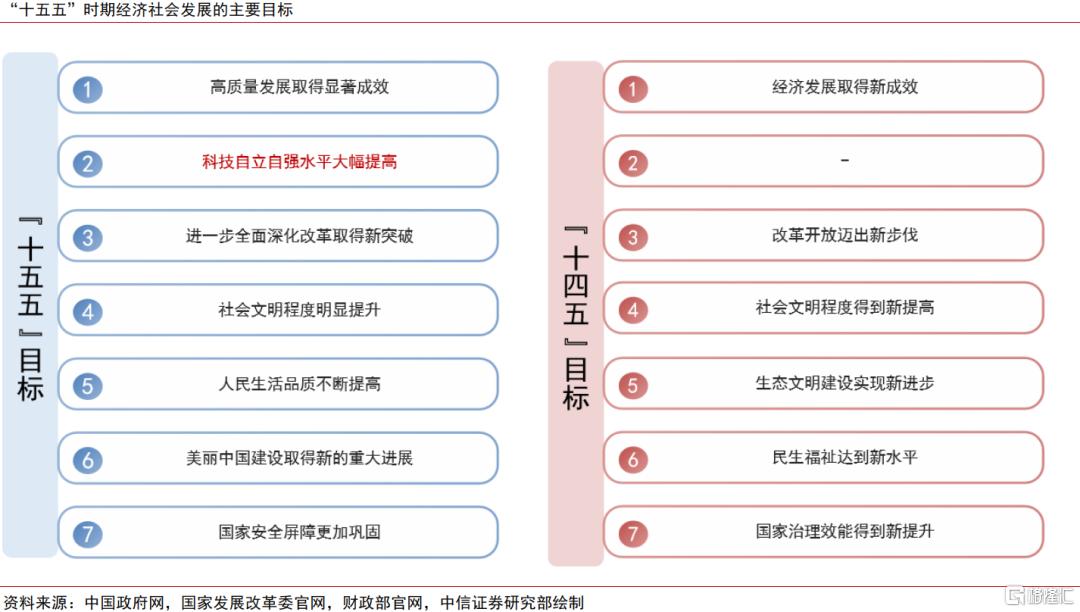
Core Viewpoint - The "14th Five-Year Plan" emphasizes significantly enhancing the level of technological self-reliance and self-improvement, highlighting the importance of technological development during this period [1] Group 1: Semiconductor Manufacturing - The demand for advanced semiconductor manufacturing, particularly for processes at 7nm and below, is expected to grow significantly in the AI era, with current domestic capacity accounting for less than 2% of total wafer foundry capacity [1] - Domestic wafer manufacturers are making progress in equipment supply, yield improvement, and customer expansion, with potential for rapid growth alongside the domestic AI industry [1] - The ongoing tightening of U.S. semiconductor restrictions is driving the domestic replacement of semiconductor equipment and components, with a projected 3-5 times growth potential for domestic equipment [1] Group 2: New Energy System - The construction of a new energy system is a key future direction, focusing on increasing the share of renewable energy and ensuring a reliable transition from fossil fuels [2] - The new energy system will see significant investment opportunities, particularly in new energy storage, with a projected installed capacity of over 180GW by 2027, leading to direct investments of approximately 250 billion yuan [2] - The nuclear fusion sector is also highlighted as a forward-looking investment area, with private sector investments in fusion companies reaching approximately 9.9 billion euros by mid-2025 [2] Group 3: Quantum Technology - Quantum computing offers significant advantages over classical information tools, with applications in computing, communication, and measurement [3] - The industry is expected to see rapid development, with quantum communication already being industrialized, and quantum computing anticipated to experience market growth between 2028 and 2030 [3] Group 4: Artificial Intelligence and Domestic Control - The urgency for domestic hardware and software localization is emphasized, with significant improvements expected in foundational hardware and software during the "14th Five-Year Plan" [4][5] - The government aims for AI to be integrated into six key sectors by 2027, with a target of over 70% penetration of new intelligent terminals and agents by 2030 [5] Group 5: Consumer Electronics - Consumer electronics, particularly hardware with both consumption and technological attributes, are expected to become a significant investment direction in the next 2-3 years [6] - The market for AI-enabled consumer electronics is projected to grow, with significant demand anticipated for products like AI glasses and smart imaging devices [6] Group 6: AI in Cultural Content Creation - The "14th Five-Year Plan" supports the integration of AI in creative industries, enhancing efficiency and product development in sectors like film and gaming [7] - The commercialization of high-quality domestic content is expected to grow, with increasing competitiveness in international markets for Chinese IPs and cultural products [7]

从“十五五”规划建议稿看科技产业投资机遇
Ge Long Hui· 2025-11-04 00:44
Core Viewpoint - The "14th Five-Year Plan" emphasizes the importance of technological self-reliance and innovation, highlighting six key investment areas for future growth in the economy [1][16]. Group 1: Semiconductor Manufacturing and Equipment - The demand for advanced semiconductor manufacturing processes (7nm and below) is expected to grow significantly, with current domestic capacity accounting for less than 2% of total wafer foundry capacity, indicating over five times potential for expansion [6]. - Domestic wafer manufacturers are making progress in equipment supply, yield improvement, and customer expansion, with a global market share of 10% and a current equipment localization rate of about 20%, suggesting a 3-5 times growth potential for domestic equipment [6]. Group 2: New Energy System Construction - The construction of a new energy system is a critical future direction, focusing on increasing the share of renewable energy and enhancing the resilience of the power system [8]. - The new energy storage market is expected to grow rapidly, with a target of 180GW+ installed capacity by 2027, leading to direct investments of approximately 250 billion yuan [8]. Group 3: Quantum Technology Development - Quantum computing offers significant advantages in specific applications, with the industry expected to see rapid growth by 2028-2030, particularly in quantum communication [10]. - China is prioritizing quantum technology in its future industrial layout, with leading companies already making strides in quantum communication [10]. Group 4: AI and Autonomous Control - The push for domestic hardware and software development is crucial, with significant improvements expected in foundational hardware and software capabilities during the "14th Five-Year Plan" period [11]. - The integration of AI across various sectors is anticipated to accelerate, with a goal of achieving over 70% application penetration by 2027 [11]. Group 5: Consumer Electronics and Domestic Demand Expansion - Consumer electronics, particularly those incorporating AI capabilities, are projected to become a significant investment focus in the next 2-3 years, with products like smartphones and AI glasses expected to see substantial demand growth [12][13]. - The market for AI-enabled consumer electronics is expected to expand, driven by innovations in product features and consumer engagement [12]. Group 6: AI and Cultural Content Creation - The integration of AI in creative industries is expected to enhance efficiency and lead to new product developments, with significant market opportunities for high-quality domestic content [14]. - The cultural sector is poised for growth, supported by government policies aimed at promoting cultural exports and the commercialization of AI-driven content [15].

中信证券:科技产业投资建议重点关注六大前沿方向
Zheng Quan Shi Bao Wang· 2025-11-04 00:33
Core Viewpoint - The "14th Five-Year Plan" draft emphasizes significantly enhancing the level of technological self-reliance and self-improvement as a major goal for economic and social development during this period, highlighting the importance of technological advancement [1] Group 1: Strategic Focus Areas - The plan outlines a strategic mission to accelerate high-level technological self-reliance and self-improvement, leading to the development of new quality productivity [1] - It emphasizes the construction of a modern industrial system centered on advanced manufacturing, focusing on the development of new quality productivity and taking extraordinary measures to strengthen original innovation and tackle key core technologies [1] Group 2: Investment Recommendations - Investors are advised to pay close attention to six frontier areas: upstream semiconductor advanced manufacturing and equipment, new energy system construction, accelerated development of quantum technology, deepening self-control while promoting AI+, expanding domestic demand in consumer electronics, and AI+ cultural content creation [1]
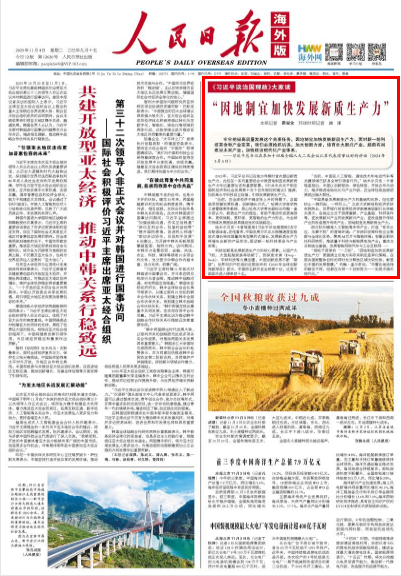
“因地制宜加快发展新质生产力”(《习近平谈治国理政》大家读)
Ren Min Ri Bao Hai Wai Ban· 2025-11-03 22:46
Core Viewpoint - The emphasis on high-quality development and the need to accelerate the development of new productive forces tailored to local conditions is highlighted by Xi Jinping's remarks during the 14th National People's Congress [1]. Group 1: Development of New Productive Forces - The concept of "new productive forces" was first introduced by Xi Jinping in 2023, emphasizing the need for innovation and the cultivation of emerging industries to build a modern industrial system [1]. - The Central Committee's proposal for the 15th Five-Year Plan stresses the importance of high-level technological self-reliance to lead the development of new productive forces [1]. Group 2: Global Context and Innovation - In the context of rising global economic uncertainty, countries must seize development opportunities and innovate growth methods, with new productive forces contributing to more efficient, lower-consumption, environmentally friendly, and intelligent production forms [1]. - The World Intellectual Property Organization's 2025 Global Innovation Index Report shows China has risen to 10th place, marking its first entry into the top ten [2]. Group 3: Regional Strategies and Implementation - Different regions in China are adopting tailored strategies to develop new productive forces based on local resources, industrial foundations, and research conditions, avoiding a one-size-fits-all approach [2]. - Examples include Hangzhou focusing on artificial intelligence, Shenzhen on AI chips and smart terminals, Hefei on quantum technology and new energy batteries, and Chongqing on smart connected vehicles and industrial internet [2].
21评论丨为何要保持制造业合理比重?
2 1 Shi Ji Jing Ji Bao Dao· 2025-11-03 22:35
Core Insights - The recent proposal by the Central Committee emphasizes the importance of a modern industrial system as the material and technological foundation for Chinese-style modernization, focusing on the real economy and aiming for intelligent, green, and integrated development [2][3] Group 1: Strategic Focus - The primary strategic task for the 15th Five-Year Plan has shifted from technological innovation to industrial system construction and real economy development, with technology now serving as a supporting role [2][3] - The dual motivations for this strategic shift include the transition of development stages and the evolution of competitive paradigms, highlighting the need for innovation to be rooted in the industrial context to enhance economic resilience and competitiveness [3] Group 2: Manufacturing Sector Importance - The proposal underscores the critical role of maintaining a reasonable proportion of manufacturing in the economy, which is essential for strengthening the foundation of the real economy [3][4] - Historical data indicates that countries like Japan and Germany maintain a stable manufacturing value-added ratio of around 20% of GDP, which supports their international competitiveness [4] Group 3: Development Pathways - The construction of a modern industrial system should focus on four key areas: optimizing the manufacturing tier, promoting service industry development, solidifying infrastructure, and enhancing the market environment [5][6] - Specific actions include upgrading traditional industries, fostering new industries as core pillars, and innovating regulatory frameworks to support future industries [5][6] - The service sector is to be expanded and improved, integrating with advanced manufacturing and modern agriculture to enhance overall economic efficiency [6]
“十五五”提到的量子科技,商业化落地到哪一步了?
3 6 Ke· 2025-11-03 10:45
Core Insights - The "15th Five-Year Plan" emphasizes the importance of quantum technology as a new economic growth point, marking a shift from basic research to industrial application and economic empowerment [1][9] - China aims to enhance its position in the global technology competition by focusing on original innovation and creating a conducive environment for disruptive innovation in quantum technology [2][8] - The plan indicates a significant increase in investment and support for quantum technology, including funding, talent acquisition, and infrastructure development [2][8] Quantum Communication - China has achieved several "world firsts" in quantum communication, including the launch of the world's first quantum science satellite, "Mozi," and the establishment of the "Beijing-Shanghai" quantum communication backbone network [3][4] - Pilot applications of quantum key distribution (QKD) have been initiated in various sectors, including government, finance, and power, demonstrating superior security compared to traditional encryption methods [3][6] Quantum Computing - Breakthroughs in quantum computing have been made, with the "Nine Chapters" quantum computer achieving quantum supremacy in specific tasks, outperforming classical supercomputers by several orders of magnitude [3][4] - Major tech companies like Baidu, Huawei, and Alibaba are developing quantum computing cloud platforms, making quantum computing more accessible to businesses and researchers [6][9] Quantum Precision Measurement - Significant advancements in quantum precision measurement technologies, such as atomic clocks and quantum radars, have been made, showcasing their potential in various applications, including navigation and resource exploration [4][7] - Commercial quantum sensors are being developed and utilized in academic and industrial settings, indicating a growing market for quantum measurement technologies [7] Commercialization Trends - Quantum communication is currently the most commercially advanced area, with companies like Guoshun Quantum and China Telecom promoting quantum key distribution solutions nationwide [6][8] - Quantum computing is still in the early stages of commercialization, but its potential applications in finance, pharmaceuticals, and logistics are attracting interest from various enterprises [6][9] Future Outlook - The "15th Five-Year Plan" is expected to accelerate the industrialization of quantum technology, with national projects focusing on overcoming key technological challenges [8][9] - The formation of industry clusters around major cities and increased capital investment in quantum startups are anticipated, fostering a complete industrial chain [8][9] - The integration of quantum technology with AI, blockchain, and IoT is expected to create new business models and enhance technological capabilities [8][9]
弱势盘整,热点切换加速,成交额明显缩减
Ge Long Hui· 2025-11-03 05:17
Market Overview - The Shanghai Composite Index increased by 0.05%, while the Shenzhen Component Index and the ChiNext Index decreased by 1.06% and 1.37% respectively, indicating a weak market sentiment [1] - Over 2,500 stocks rose in the two markets, with a total trading volume of 1.38 trillion [1] Sector Performance - Battery concept stocks experienced a significant decline, dropping by 3.07% at midday, with Haike New Energy falling over 15% and Shanghai Washba hitting the daily limit down [3] - Gold concept stocks showed weak performance, with Chao Hong Ji hitting the daily limit down and Hunan Gold decreasing by 3.91% [3] - Other sectors such as jewelry, non-ferrous metals, and semiconductors also faced notable declines [3] - Conversely, thorium-based molten salt concept stocks surged, with Baose Co. and Hailu Heavy Industry reaching the daily limit up [3] - AI application stocks remained active, with companies like Jishi Media and 37 Interactive Entertainment hitting the daily limit up [3] - The coal sector strengthened again, with Antai Group achieving 7 consecutive limit up days in 13 days [3] - The Hainan Free Trade Zone sector continued its strong performance, with multiple stocks like Roniu Mountain hitting the daily limit up [3] - Quantum technology concept stocks experienced fluctuations but ultimately rose, with companies like Shenzhou Information reaching the daily limit up [3] Industry Insights - In the first three quarters, the revenue of listed companies in the storage chip industry grew by 16.08%, while net profit increased by 26.44% [3] - The Ministry of Industry and Information Technology is promoting the upgrade of consumer terminals such as AI phones and AI computers, and accelerating the research and application of new-generation intelligent terminals like humanoid robots and brain-computer interfaces [3]