
债券

Search documents
河南发文规范国企境外债:违反规定将被终身追责
Sou Hu Cai Jing· 2026-01-10 21:18
Core Viewpoint - The Henan Provincial Government has introduced the "Management Measures for Overseas Bond Issuance by State-owned Enterprises" to regulate the issuance and use of overseas bonds by state-owned enterprises, promoting healthy cross-border financing and effectively preventing external debt risks [1] Group 1: Issuance Management - State-owned enterprises are designated as the primary responsible entities for managing overseas bond issuance, required to establish management systems covering issuance principles, processes, and risk prevention [2] - Enterprises must prepare a responsible team, develop service institution management systems, complete feasibility studies, and have risk emergency plans in place before issuing bonds [2] - The decision-making process for bond issuance will vary based on the type of equity held by the state-owned enterprises, with diversified equity enterprises needing to submit relevant materials to all shareholders for approval [2] Group 2: Fund Utilization - The measures provide a clear "roadmap" for the use of funds raised through overseas bonds, emphasizing investment in major national and provincial projects, approved overseas investment projects, and other specified areas [4] - Funds raised through overseas bonds are generally required to be returned to China for use, with exceptions only for approved overseas investment activities [4] - Issuing enterprises must report detailed issuance information to the funding institutions within 10 working days after fund delivery, including details about custodial banks and foreign investor proportions [4] Group 3: Risk Control - Risk prevention is integrated throughout the entire bond management cycle, requiring enterprises to regularly assess bond risks and report any potential issues affecting principal and interest payments [5] - In case of emergencies, enterprises must report to funding institutions 30 working days before bond maturity or immediately if issues arise [5] - Commercial banks acting as bond trustees must fulfill their responsibilities regarding fund reception, transfer, and payment, and report accurately to funding institutions [5] Group 4: Incentives and Penalties - A dual mechanism of rewards and penalties is established, supporting the issuance of green bonds and allowing for favorable asset-liability ratio assessments for state-owned enterprises [6] - Enterprises with high credit ratings will benefit from streamlined procedures for bond issuance [6] - Individuals responsible for approving non-compliant bond issuances will face lifelong accountability under the principle of "whoever approves is responsible" [6]


As U.S. debt soars past $38 trillion, the flood of corporate bonds is a growing threat to the Treasury supply
Yahoo Finance· 2026-01-10 19:58
Core Insights - The Treasury Department is facing challenges in ensuring investor absorption of new debt supply due to increasing competition from corporate bond issuances, which could lead to higher rates [1][2] - The anticipated volume of investment-grade debt for this year is estimated to reach up to $2.25 trillion, driven by the AI boom and significant investments in infrastructure by hyperscalers and related firms [1][2] - The U.S. federal debt has surpassed $38 trillion, with $601 billion borrowed in the first three months of the 2026 fiscal year, indicating a substantial fiscal position [2][3] Group 1 - The increase in corporate bond issuance raises concerns about the marginal buyers of investment-grade paper, potentially leading to upward pressure on rates and mortgage spreads [2] - The federal government has seen a reduction in the deficit by $110 billion compared to the same period last year, aided by tariffs that have helped revenue exceed spending [3] - Despite recent Federal Reserve rate cuts, Treasury yields have remained stable, suggesting limited relief on debt-servicing costs, which contribute to the overall budget deficit [4] Group 2 - To maintain sufficient demand among bond investors, Treasury yields must remain competitive; failure to attract investors could lead to fiscal dominance, where the central bank may need to finance widening deficits [5] - The conditions for fiscal dominance are strengthening, with debt projected to rise to 150% of GDP over the next three decades [6]
规范国有企业境外债券管理!河南最新发文
Sou Hu Cai Jing· 2026-01-10 07:11
Core Viewpoint - The Henan Provincial Government has introduced the "Management Measures for the Issuance of Overseas Bonds by State-owned Enterprises" to regulate the issuance and use of overseas bonds by state-owned enterprises, promote healthy cross-border financing, and effectively prevent foreign debt risks [1][2]. Group 1: General Principles - The measures aim to standardize the issuance and use of overseas bonds by state-owned enterprises, ensuring compliance with relevant laws and regulations [2][3]. - State-owned enterprises are defined as those representing the government in investment responsibilities [2]. Group 2: Issuance Management - State-owned enterprises are responsible for establishing their own management systems for overseas bond issuance, which must include principles, processes, and risk prevention measures [5][6]. - The issuance of overseas bonds must focus on core business and align with national strategies and support for the real economy [4][19]. - A classification decision-making process is established based on the type of investment by the state-owned enterprises [8][19]. Group 3: Fund Utilization - Funds raised from overseas bonds must be included in the annual financial budget and detailed in terms of existing bond situations, annual issuance limits, and repayment plans [9][10]. - The funds should primarily be directed towards major projects, approved overseas investments, and other specified areas [10][23]. - Companies must report the details of bond issuance to the investment authority within 10 working days after fund delivery [18][23]. Group 4: Risk Control - Continuous risk assessment is required, with obligations to report potential risks affecting bond repayment [11][24]. - Commercial banks acting as bond trustees must comply with regulations regarding fund management and reporting [11][24]. - Companies must report on the progress of debt repayment preparations and funding sources at critical milestones [14][24]. Group 5: Incentives and Penalties - The measures encourage the issuance of green bonds and provide benefits for companies with high credit ratings [25][26]. - A dual mechanism of rewards and penalties is established to ensure compliance and accountability among enterprises and their management [25][26].

【UNFX财经事件】就业放缓但失业率回落 市场维持宽松判断
Sou Hu Cai Jing· 2026-01-10 04:40
Group 1 - The latest U.S. non-farm employment data shows a slowdown in job growth with 50,000 new jobs added in December, below the market expectation of 60,000, indicating a continued deceleration in hiring [1] - The unemployment rate decreased from 4.6% to 4.4%, which is better than market expectations, alleviating some concerns about a rapid weakening of the labor market [1] - Average hourly wage growth met expectations, not causing new disturbances to inflation outlook, characterizing the employment report as "moderate deceleration rather than significant imbalance" [1] Group 2 - Despite some economic indicators showing resilience, the employment data did not alter the market's core pricing for the policy direction for the year, with the rate market still anticipating about 50 basis points of rate cuts by the Federal Reserve in 2026 [2] - Gold continues to attract funds as a hedge against policy uncertainty, with prices breaking through the $4,500 mark and reaching a high of $4,517, approaching historical highs [2] - The U.S. dollar index briefly weakened after the data release but stabilized around 99.16, with the limited fluctuation in U.S. Treasury yields providing a relatively favorable macro environment for gold [2] Group 3 - Geopolitical factors are also providing marginal support for gold, with recent comments from Trump regarding Greenland raising concerns about long-term uncertainties, indirectly strengthening the demand for safe-haven assets [3] - Overall, the non-farm data did not shake the market's core expectations for a loose monetary path this year, with gold continuing to be supported by policy expectations and geopolitical risks [3] - The market will focus on upcoming U.S. inflation, retail sales, and Federal Reserve officials' statements, as the continuity of these data performances will be crucial for determining whether gold can further break into higher price ranges [3]
全球关注!特朗普加征关税是否合法?美国最高法院:暂缓!
Zheng Quan Shi Bao Wang· 2026-01-10 00:47
Core Viewpoint - The upcoming ruling by the U.S. Supreme Court on the legality of the Trump administration's tariff policy is highly anticipated, as it could significantly impact U.S. trade policy and the global market [1][2]. Group 1: Legal Implications - The Supreme Court's decision will determine the legality of tariffs imposed by the Trump administration under the International Emergency Economic Powers Act, marking a critical legal test for presidential authority [2]. - The court's ruling will clarify the boundaries between executive and legislative powers in the context of trade, influencing how future U.S. presidents exercise trade authority [2][3]. Group 2: Market Reactions - If the court upholds the tariffs, it may lead to increased uncertainty in global trade, potentially raising commodity prices and trade costs [3]. - Conversely, if the tariffs are deemed illegal, affected product prices may decrease, and importers could seek refunds, potentially leading to a boost in international trade [3][4]. - The S&P 500 index has risen approximately 40% since its low in April of the previous year, driven by factors including the AI boom and the partial rollback of tariffs [4]. Group 3: Economic Impact - Analysts predict that if the court rules against the tariffs, S&P 500 companies could see a 2.4% increase in earnings in 2026, which may catalyze a rebound in stock prices [4]. - The removal of tariffs could reignite fiscal concerns, leading to a potential rise in long-term yields and a steeper yield curve, although the impact is expected to be limited [5]. - Investors are closely monitoring the potential need for the government to refund tariffs to importers, which could affect the issuance of government treasury securities [5].
债市开年持续调整 公募基金销售新规如何影响后市走势?
Zhong Guo Jing Ying Bao· 2026-01-09 12:57
Core Viewpoint - The bond market has been under pressure since 2026, with the recent implementation of new regulations affecting market sentiment and presenting potential investment opportunities for 2026 [1][2]. Group 1: Market Pressure Factors - The bond market is facing pressure due to lower-than-expected bond purchases by the central bank and a cautious outlook on interest rate cuts, leading to a correction in expectations for monetary easing [1][2]. - The "spring market" has increased risk appetite, with a strong stock market performance causing a "see-saw effect" between stocks and bonds, contributing to the bond market's adjustment [1]. - Additional factors include concentrated government bond issuance, rising inflation expectations, and key levels being breached in ultra-long bonds [1]. Group 2: Impact of New Regulations - The new regulations have alleviated concerns regarding short-term redemption pressures on bond funds, which is expected to help restore market sentiment [2][3]. - The regulations support long-term holding, enhancing the stability of bond fund liabilities, and may gradually repair the widening credit spreads seen in medium to long-term credit bonds [2][3]. - There is a potential shift in institutional investor funds towards money market funds or bond ETFs due to increased thresholds for short-term bond funds, which could lead to an expansion of bond ETFs [2][3]. Group 3: Investment Opportunities for 2026 - The economic outlook for 2026 suggests stable growth with low inflation, and monetary policy will remain supportive but cautious regarding rate cuts, leading to a weak and fluctuating bond yield environment [4][5]. - The overall strategy for government bonds will focus on defensive positioning, with opportunities to increase allocations during periods of easing monetary expectations and to reduce during inflationary pressures [4]. - Credit spreads are expected to remain low, with opportunities to explore long-end credit bonds after adjustments, and convertible bonds may present structural opportunities as supply becomes limited [4][5].
离岸观澜 | 2026年熊猫债市场拉开帷幕 开年首周发行70亿元
Xin Hua Cai Jing· 2026-01-09 12:53
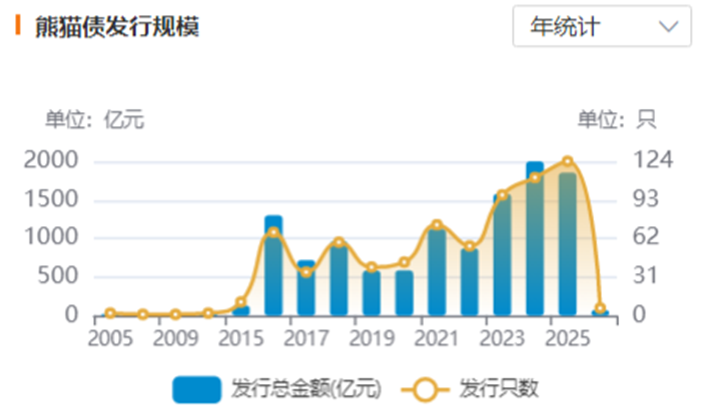
新华财经上海1月9日电 2026年熊猫债市场本周正式拉开帷幕。据新华财经熊猫债数据库显示,开年首周的发行额已达70亿元。 中证鹏元分析师梁欣华表示,2022年以来,受益于监管政策持续释放利好、人民币融资成本优势愈发突出、人民币汇率趋稳等因素,熊 猫债券发行规模持续增长。随着监管部门接连发布熊猫债券资金管理新政,熊猫债券资金用途便利性持续提升,预计将进一步刺激熊猫 债券的发行增长以及熊猫债券市场的深度发展。 多重因素利好熊猫债市场 多位业内人士指出,受益于政策利好、人民币成本优势及汇率趋稳。以及熊猫债本身资金用途便利性提升进一步刺激了市场需求的快速 增长。 中国银行最新报告表示,自2014年梅赛德斯-奔驰集团开启跨国公司熊猫债先河以来,以威立雅、宝马、大众、巴斯夫、汉高等为代表的 二十余家国际巨头相继入场。随着美联储降息通道的开启,近年来熊猫债以其融资成本优势正越来越受外资发行人的青睐。 1月9日,德国工业巨头汉高集团发行的15亿元熊猫债于正式上市起息, 该笔熊猫债是2026年首只纯境外熊猫债,也是汉高集团首次亮相 熊猫债市场,对进一步提升熊猫债市场国际影响力具有积极意义。此前,1月6日,中国燃气控股有限公司率 ...
2025年贵州资本市场高质量发展 赋能区域经济与产业升级新实践
Zheng Quan Shi Bao Wang· 2026-01-09 11:54
Group 1 - The capital market in Guizhou is guided by Xi Jinping's thoughts and aims to support regional economic development through various reforms and initiatives [1] - The provincial government has approved a plan to enhance the capital market's role in building a modern industrial system, focusing on nurturing enterprises for public listing and promoting direct financing [1] - Guizhou's capital market tools are integrated into the industrial system layout, providing a solid foundation for capital market functions [1] Group 2 - The Guizhou Securities Regulatory Bureau and other departments have improved the financial knowledge of local leaders, enhancing their ability to utilize and develop the capital market [2] - The establishment of the "Listing Company Home" in Guiyang offers comprehensive government services to listed companies, while the Capital Market Service Center has created a one-stop service hub [2] - Direct financing in Guizhou has steadily increased, with a total of 77.546 billion yuan raised to support industrial upgrades and public welfare [2] Group 3 - The average interest rate for corporate bonds has decreased to 3.31%, providing tangible support for enterprises [3] - Securities firms have facilitated 48.572 billion yuan in financing for Guizhou enterprises, while private equity fund management has reached 194 billion yuan [3] - Listed companies in Guizhou have distributed over 68 billion yuan in dividends, ranking first in the western region [3] Group 4 - The capital market in Guizhou has made breakthroughs in supporting technology finance, green finance, inclusive finance, pension finance, and digital finance [4] - Innovative financial products have been introduced, including the first technology innovation corporate bond and the first "intellectual property + technology innovation" asset securitization product [4] - The establishment of futures delivery warehouses for agricultural products has enhanced the effectiveness of financial services in rural areas [4] Group 5 - The capital market in Guizhou is committed to supporting rural revitalization, with 31 securities companies signing assistance agreements with 56 counties [5] - The "Zhen Ai Guizhou" charitable trust plan has provided scholarships and financial support to students and teachers in impoverished areas [5] - The capital market has actively participated in disaster relief efforts and has contributed to the development of carbon finance in rural areas [5]
国债期货周报:利空持续释放,债市仍待企稳-20260109
Rui Da Qi Huo· 2026-01-09 09:15
1. Report Industry Investment Rating - No information provided regarding the industry investment rating in the given report. 2. Core Viewpoints of the Report - The bond market is gradually digesting potential negative factors, and sentiment is easing. In Q1, the issuance scale of government bonds is expected to be roughly the same as in the same period of 2025, but the specific proportion of ultra - long bonds remains to be confirmed. The strong performance of the equity market at the beginning of the year has increased short - term profit - taking needs, and the market may enter a consolidation phase, which is expected to relieve liquidity pressure. However, the fundamental support may weaken, as the manufacturing PMI in December exceeded expectations and the economic data of that month may improve marginally, reducing the need for further loose monetary policies in the short term. With multiple factors at play, interest rates are expected to continue their weak and volatile trend in the short term [103]. 3. Summary by Directory 3.1. Market Review - **Weekly Data**: The 2 - year, 5 - year, 10 - year, and 30 - year Treasury bond futures' main contracts (TS2603, TF2603, T2603, TL2603) fell by 0.12%, 0.18%, 0.09%, and 0.48% respectively. The trading volumes of the TS, TF, and TL main contracts increased, while that of the T main contract decreased. The open interests of the TF, T, and TS main contracts decreased, and that of the TL main contract increased [14][29]. 3.2. News Review and Analysis - **Key News**: On January 6, the People's Bank of China planned to use various monetary policy tools flexibly and efficiently in 2026, and strengthen financial market supervision. The same day, China banned the export of dual - use items to Japanese military users. On January 7, eight ministries including the Ministry of Industry and Information Technology issued the "Implementation Opinions on the Special Action of 'Artificial Intelligence + Manufacturing'". On January 8, the central bank conducted a 1.1 - trillion - yuan repurchase operation. The US initial jobless claims last week rose to 208,000, and the US President Trump expected to "manage" Venezuela for many years and increase the military budget [35][36]. 3.3. Chart Analysis - **Spread Changes** - **Treasury Yield Spreads**: The spreads between 10 - year and 5 - year yields, and 10 - year and 1 - year yields widened. The spreads between 2 - year and 5 - year, and 5 - year and 10 - year main contract yields narrowed. The spreads between the current and next quarters of the 10 - year and 30 - year Treasury bond futures contracts widened, while those of the 2 - year and 5 - year contracts narrowed [44][50][56]. - **Treasury Bond Futures Main Position Changes**: The net short positions of the top 20 holders in the T Treasury bond futures main contract decreased significantly [67]. - **Interest Rate Changes** - Shibor rates for overnight and 1 - week terms increased, while those for 2 - week and 1 - month terms decreased. The weighted - average DR007 rate fell to around 1.47%. Most Treasury bond spot yields increased, with the 10 - year and 30 - year yields rising by about 3.75bp and 5.45bp to 1.88% and 2.31% respectively [71]. - The spreads between Chinese and US 10 - year and 30 - year Treasury bond yields fluctuated [76]. - **Central Bank's Open - Market Operations**: The central bank conducted 102.2 billion yuan of reverse repurchases in the open market, with 1.3236 trillion yuan due. The 1.1 - trillion - yuan repurchase was rolled over, and the treasury cash fixed - term deposit of 6 billion yuan matured, resulting in a net withdrawal of 1.2449 trillion yuan. The weighted - average DR007 rate fell to around 1.47% [81]. - **Bond Issuance and Maturity**: This week, bonds worth 976.86 billion yuan were issued, with a total repayment of 412.35 billion yuan, resulting in a net financing of 564.51 billion yuan [86]. - **Market Sentiment** - The central parity rate of the RMB against the US dollar was 7.0128, up 160 basis points this week. The spread between the offshore and onshore RMB narrowed. - The yield of the 10 - year US Treasury bond fluctuated, and the VIX index increased. - The yield of the 10 - year Chinese Treasury bond increased slightly, and the A - share risk premium decreased [91][94][99]. 3.4. Market Outlook and Strategy - **Domestic Fundamentals**: In December, macro - policies continued to take effect, inflation moderately rebounded, the CPI year - on - year increase continued to expand, and the PPI decline narrowed to 1.9%. For the whole year, the CPI was flat compared with the previous year, and the PPI was still in the negative range. In December, the official manufacturing and non - manufacturing PMIs both improved and returned above the boom - bust line. The central bank will continue to implement a moderately loose monetary policy in 2026 [102]. - **Overseas Situation**: The US job market continued to cool down. The ADP employment in December increased to 41,000 but was still lower than expected. The number of job openings in November dropped to a 14 - month low. The US ISM manufacturing PMI in December unexpectedly fell to 47.9, the lowest since 2024, while the non - manufacturing PMI rebounded, indicating the resilience of the service industry. The US raid on Venezuela caused geopolitical shocks [102].
2026年Q1可转债投资策略:淡化仓位择时,深挖板块个券
Shenwan Hongyuan Securities· 2026-01-09 08:48
Group 1 - The report indicates a shift in the convertible bond market from a positioning mindset to a trading mindset since Q4 2025, with pricing anchors transitioning from derivative pricing to "underlying stock" pricing, leading to increased demand for convertible bonds [4][41] - The outlook for Q1 2026 suggests that the divergence in positions has ended, and investors should focus on deepening their analysis of sectors and individual bonds rather than timing their positions [4][41] - The report emphasizes the need for a solid allocation strategy, recommending a mix of low-priced and high-priced convertible bonds to enhance returns, with expected returns of 4%-8% for low-priced bonds and around 17% for high-priced bonds [4][41] Group 2 - The report highlights that since Q4 2025, the performance of convertible bonds has been relatively stable compared to underlying stocks, with a noted lower risk of decline [8][39] - It is observed that the convertible bond market has experienced a bull market positioning, with high-priced and small-cap convertible bonds showing significant excess returns, although this trend has diminished post-September 2025 [11][39] - The report identifies specific convertible bonds for different strategies, including low volatility, stable, and flexible combinations, indicating a diverse approach to investment in the convertible bond market [4][39] Group 3 - The report notes that the convertible bond market is currently facing high redemption risks, particularly for equity-type convertible bonds, which are trading at historically low valuations [33][39] - It discusses the performance of convertible bonds based on their remaining duration, indicating that bonds with less than two years remaining typically perform poorly, while new and recently issued bonds have shown better performance [20][39] - The report also mentions that the market is experiencing a significant outflow of funds from convertible bond ETFs, while public funds are increasing their holdings, indicating a shift in investment strategies [38][39]