
光伏

Search documents
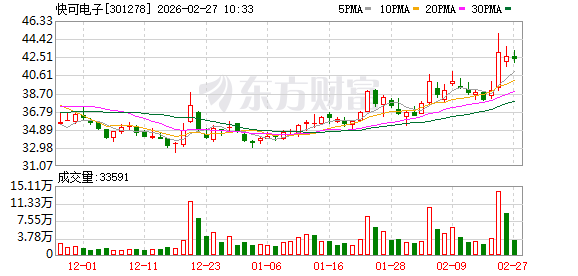
快可电子:公司通用性光伏接线盒、光伏连接器主流产品性能已通过TUV和UL等检测机构认证
Mei Ri Jing Ji Xin Wen· 2026-02-27 02:32
Group 1 - The company has technology reserves for materials that can operate in extreme environments, including high temperatures and radiation [2] - The company's photovoltaic junction boxes and connectors can operate in a temperature range of -40 to +85 degrees Celsius and have passed certifications from TUV and UL [2] - Current mainstream products do not involve high radiation environments [2]

中来股份股价涨5.03%,南方基金旗下1只基金位居十大流通股东,持有796.39万股浮盈赚取382.27万元
Xin Lang Cai Jing· 2026-02-27 02:30
Group 1 - The core viewpoint of the news is that Zhonglai Co., Ltd. has seen a significant increase in its stock price, rising by 5.03% to reach 10.03 yuan per share, with a total market capitalization of 10.929 billion yuan [1] - Zhonglai Co., Ltd. has experienced a continuous stock price increase for three consecutive days, with a cumulative increase of 3.8% during this period [1] - The company, established on March 7, 2008, specializes in the research, production, and sales of solar cell back sheets, with its main business revenue composition being 55.36% from photovoltaic application systems, 24.10% from components, 12.81% from photovoltaic auxiliary materials, 5.46% from other sources, and 2.27% from batteries [1] Group 2 - Among the top ten circulating shareholders of Zhonglai Co., Ltd., a fund under Southern Fund holds a position, specifically the Southern CSI 1000 ETF (512100), which reduced its holdings by 99,300 shares in the third quarter, now holding 7.9639 million shares, accounting for 0.83% of circulating shares [2] - The Southern CSI 1000 ETF (512100) has achieved a year-to-date return of 11.77%, ranking 1341 out of 5574 in its category, and a one-year return of 31.9%, ranking 1823 out of 4326 [2] - The fund manager of Southern CSI 1000 ETF (512100), Cui Lei, has a total fund asset scale of 137.02 billion yuan, with the best fund return during her tenure being 250.66% and the worst being -15.93% [2]

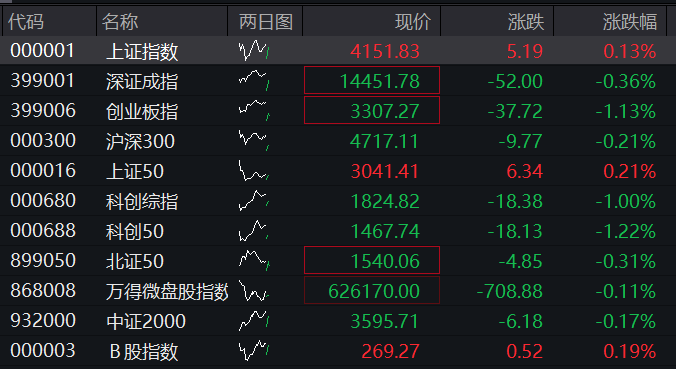
创业板跌超1%,算力硬件集体调整,稀土拉升,恒科指反弹,生物医药活跃
Hua Er Jie Jian Wen· 2026-02-27 02:16
Group 1 - Nvidia's stock experienced a significant drop of 5.7%, marking its largest intraday decline in three months, despite a 73% year-over-year revenue increase and first-quarter guidance exceeding market expectations, raising concerns about the sustainability of AI spending [1] - The A-share market saw a collective decline, with the ChiNext index dropping over 1%, influenced by Nvidia's downturn, while sectors like non-ferrous metals and rare earths saw price increases [1] - The Hong Kong stock market rebounded, with the Hang Seng Index and Hang Seng Tech Index both rising, driven by gains in biotech stocks, particularly WuXi Biologics, which rose over 4% [1][2] Group 2 - Domestic commodity futures experienced widespread declines, with aluminum oxide falling over 3%, and other commodities like coking coal and lithium carbonate also decreasing by more than 2% [5][6] - The rare earth permanent magnet sector showed strength, with Baotou Steel hitting the daily limit, and several related companies, including Zhongxi Rare Earth and Northern Rare Earth, also seeing significant gains [7][8] - The space photovoltaic sector rebounded, with JunDa Co. hitting the daily limit, and other companies like Jiawei New Energy and Oriental Sunrise also experiencing gains, supported by a report from GF Securities highlighting the potential market space for photovoltaic equipment driven by AI [9][10]

周期轮回,老将归巢:通威与段雍的光伏并购棋局
Jin Rong Jie· 2026-02-27 02:13
Core Viewpoint - The photovoltaic industry is witnessing a significant business reunion, with Tongwei Co., Ltd. acquiring Qinghai Lihau, a company founded by former Tongwei executive Duan Yong, despite Tongwei's current losses. This acquisition reflects a strategic move to consolidate resources and enhance competitive advantage in a challenging market environment [2][5]. Group 1: Historical Context - Duan Yong joined Tongwei in 2014 during a downturn in the silicon material industry, where he implemented significant technological improvements and cost controls, leading to Tongwei's rise as a global leader in silicon production [2][3]. - After leaving Tongwei in May 2021, Duan Yong founded Qinghai Lihau, which quickly became a competitor by achieving rapid production scale and focusing on high-purity N-type silicon materials [3][4]. Group 2: Market Dynamics - The photovoltaic industry has shifted from a period of high profitability to one characterized by overcapacity and falling silicon prices, creating significant challenges for companies like Qinghai Lihau [5]. - The acquisition by Tongwei is seen as a strategic "counter-cyclical" move, allowing it to acquire high-quality assets at a low price during a market downturn [5][6]. Group 3: Acquisition Strategy - Tongwei's acquisition of Qinghai Lihau is expected to enhance its market share in the global silicon market, leveraging the existing synergies due to the shared history and operational similarities between the two companies [6][7]. - The deal's success hinges on the negotiation of terms, particularly the valuation of Qinghai Lihau amidst declining silicon prices, and the structure of the payment, which involves both cash and stock issuance [8][9]. Group 4: Industry Implications - This acquisition is viewed as a pivotal moment for the photovoltaic industry, marking a transition from chaotic growth to a more rational consolidation phase, as companies seek to address overcapacity through mergers and acquisitions [8][9].

工业硅:关注上游复产情况,多晶硅:关注节后现货成交
Guo Tai Jun An Qi Huo· 2026-02-27 02:11
Group 1: Report Industry Investment Rating - No information provided Group 2: Core Viewpoints of the Report - For industrial silicon, focus on the resumption of production in the upstream [2] - For polysilicon, focus on spot transactions after the holiday [2] Group 3: Summary by Relevant Catalogs 1. Fundamental Tracking - **Futures Market Data**: Si2605 closing price is 8,335 yuan/ton, with a change of -95 yuan compared to T - 1; PS2605 closing price is 46,315 yuan/ton, with a change of -1,315 yuan compared to T - 1 [1] - **Basis Data**: Industrial silicon spot premium (against East China Si5530) is +915 yuan/ton, with a change of 95 yuan compared to T - 1 [1] - **Price Data**: Xinjiang 99 - silicon is 8700 yuan/ton, remaining unchanged compared to T - 1; polysilicon - N - type re - feedstock is 52000 yuan/ton, with a change of -1000 yuan compared to T - 1 [1] - **Profit Data**: Silicon plant profit (Xinjiang new standard 553) is -2796.5 yuan/ton, with a change of -95 yuan compared to T - 1; polysilicon enterprise profit is 7.7 yuan/kg, with a change of -0.6 yuan compared to T - 1 [1] - **Inventory Data**: Industrial silicon - social inventory (including warehouse receipt inventory) is 560,000 tons, with an increase of 3,000 tons compared to T - 5; polysilicon - manufacturer inventory is 344,000 tons, with a decrease of 5,000 tons compared to T - 5 [1] - **Raw Material Cost Data**: Xinjiang silicon ore is 320 yuan/ton, remaining unchanged compared to T - 1; Yunnan silicon ore is 230 yuan/ton, remaining unchanged compared to T - 1 [1] 2. Macro and Industry News - The US Department of Commerce will impose counter - subsidy duties on crystalline silicon solar cell components imported from India, Indonesia, and Laos. The general subsidy rates for Indian producers/exports are set at 125.87%, 104.38% for Indonesia, and 80.67% for Laos [3] 3. Trend Intensity - Industrial silicon trend intensity is 0; polysilicon trend intensity is 0. The trend intensity ranges from -2 to 2, where -2 means most bearish and 2 means most bullish [3]
未知机构:天风电新太空光伏节后将迎订单StarshipV3发射密集催化看好新-20260227
未知机构· 2026-02-27 02:10
Summary of Conference Call Notes Company and Industry Involved - **Company**: 高测股份 (High Measurement Co., Ltd.) - **Industry**: Solar Photovoltaics and Space Photovoltaics Core Points and Arguments - 高测股份 is set to launch its first phase of 10GW capacity within the next 1-2 weeks, with a second phase of 40GW also progressing rapidly, indicating strong growth potential for the company [1] - The company has demonstrated its capability to deliver 50GW of slicing machines, which positions it well in the market [1] - A significant technological advancement was achieved with the successful production of 50μm ultra-thin silicon wafers at the Yibin base, aimed at meeting the lightweight power system requirements of commercial aerospace [1] - The investment value of this technological breakthrough lies in its leading-edge capabilities, which are not merely equipment advantages but are built on a self-research closed-loop system integrating "equipment + consumables + processes," creating systemic barriers [1] - The current market environment shows a reversal in the fundamentals of the photovoltaic industry, providing a clear opportunity for 高测股份 to enter the high-value space photovoltaic sector [1] Other Important but Potentially Overlooked Content - The company is currently in discussions with S customers, indicating ongoing business development and potential future orders [1] - The mention of other companies such as 迈为股份 (Maiwei Co.), 奥特维 (Aotewei), and 帝尔激光 (Dier Laser) suggests a competitive landscape in the space photovoltaic equipment sector, with expectations for orders [2] - The focus on P-HJT batteries and components from companies like 钧达股份 (Junda Co.) and 东方日升 (Dongfang Rising) highlights the broader industry trends and key players in advanced solar technologies [2] - 帝科股份 (Dike Co.) is noted for its high-reliability conductive pastes, which may play a critical role in the overall supply chain for solar technologies [2]

未知机构:申万北交所连城数控坚定强推从高赔率走向胜率赔率兼具这-20260227
未知机构· 2026-02-27 02:10
Summary of Conference Call Notes Company and Industry Involved - The discussion revolves around the company "Liancheng" and the broader space photovoltaic sector, which is currently experiencing significant market fluctuations and information discrepancies [1][2]. Core Points and Arguments - **Order Status and Market Confusion**: There is confusion in the space photovoltaic sector regarding the status of orders. Currently, agreements are at the verbal and memorandum stage, with no formal contracts signed. The urgency of T/S's requirements makes the signing status less critical, as it is expected to be resolved within a week or two [2][3]. - **Competitive Dynamics**: GC has secured an order for T's slicing machine, raising questions about whether a leading company will take away the furnace orders from Liancheng. However, there are many misleading rumors, and the information gathered suggests the opposite, indicating that Liancheng's business negotiation team is actively engaged in final negotiations with T and will proceed to S shortly [3]. - **Optimistic Outlook**: There is a strong optimism regarding Liancheng's transition from high odds to a balance of both winning probability and odds, indicating a positive shift in the company's market position [4]. - **Industry Competition**: Concerns were raised about a low-priced competitor entering the market, potentially leading to industry saturation. However, it was noted that one company cannot represent the entire market, and even if T and S are different, Liancheng's value in the S chain is significantly higher [5]. Other Important but Possibly Overlooked Content - The emphasis on the urgency of negotiations and the potential for rapid developments in the coming weeks highlights the dynamic nature of the industry and the importance of staying informed about ongoing discussions and agreements [2][3].
光伏概念反复活跃 双良节能等涨停
Xin Lang Cai Jing· 2026-02-27 02:07
Group 1 - The photovoltaic sector is experiencing renewed activity, with companies like Jiawei New Energy seeing a rise of over 15% [1] - Shuangliang Energy and Huashengchang have reached their daily limit up, indicating strong market interest [1] - JunDa Co. hit its daily limit up during trading, while Yijing Photovoltaic, Dier Laser, and Jinlang Co. all increased by over 5% [1]

港股异动 | 钧达股份(02865)一度涨超14% 机构看好太空光伏打造新增长空间
智通财经网· 2026-02-27 01:57
Group 1 - The core viewpoint of the article highlights the significant rise in the stock price of JunDa Co., which increased by over 14% and is currently trading at 35.86 HKD, with a transaction volume of 329 million HKD [1] - SpaceX is reportedly building a 100GW-level photovoltaic capacity in the United States, expected to be completed in 3-4 years, with major players like Blue Origin, Google, and companies from China, Japan, and Europe also entering the market [1] - GF Securities indicates that the consensus on "computing power in space" is driving the space photovoltaic sector, which is expected to benefit significantly, potentially creating a market space worth hundreds of billions for photovoltaic equipment [1] Group 2 - Shenwan Hongyuan believes that the global construction of low-orbit satellite constellations and the space computing power industry are in an explosive growth phase, leading to a pressing demand for low-cost, high-efficiency, and lightweight energy solutions [1] - The company has previously collaborated with Shanghai Institute of Optics and Fine Mechanics, now known as Xingyi Chip Energy, to develop core technologies such as silicon/calcium titanate stacked batteries and CPI films, which are expected to replace the current mainstream gallium arsenide solutions and break through cost barriers [1] - This sector has high technical barriers and clear market space, independent of the terrestrial photovoltaic industry cycle, which is expected to open new high-margin growth opportunities for the company [1]

钧达股份一度涨超14% 机构看好太空光伏打造新增长空间
Zhi Tong Cai Jing· 2026-02-27 01:51
Group 1 - JunDa Co., Ltd. (002865) saw its stock price rise over 14%, currently up 10.34% at HKD 35.86, with a trading volume of HKD 329 million [1] - SpaceX is reportedly building a 100GW solar power capacity in the U.S., expected to be completed in 3-4 years, with major players like Blue Origin, Google, and companies from Japan and Europe entering the market [1] - GF Securities indicates that the consensus on "computing power in space" is driving significant interest in space solar power, which is expected to create a market space worth hundreds of billions for solar equipment [1] Group 2 - Shenwan Hongyuan believes that the construction of global low-orbit satellite constellations and the space computing power industry is at a tipping point, with urgent demand for low-cost, high-efficiency, and lightweight energy solutions [1] - The company has previously collaborated with Shanghai Institute of Optics and Fine Mechanics, now known as Starwing Energy, to develop core technologies such as silicon/perovskite tandem batteries and CPI films, which may replace the current mainstream gallium arsenide solutions and break through cost barriers [1] - This sector has high technical barriers and clear market potential, independent of the terrestrial solar industry cycle, which is expected to open new high-margin growth opportunities for the company [1]