
机械设备

Search documents
48家科创板公司提前预告2025年业绩
Zheng Quan Shi Bao· 2026-01-19 02:14
Core Viewpoint - 48 companies on the Sci-Tech Innovation Board have provided earnings forecasts for 2025, with 18 companies expecting losses, 16 expecting profit increases, 9 expecting reduced losses, 4 expecting profit declines, and 1 expecting profits [1] Group 1: Earnings Forecasts - 35.42% of the companies forecast positive earnings, with 16 companies expecting profit increases and 1 company expecting profits [1] - Among the companies forecasting profit increases, 6 companies expect a net profit growth of over 100%, while 5 companies expect growth between 50% and 100% [1] - The company with the highest expected net profit growth is Baiwei Storage, with a median increase of 473.71% [1] - Other notable companies include Zhongke Lanyun and Baiaosaitu, with expected net profit growths of 371.51% and 303.57% respectively [1] Group 2: Industry Performance - Companies expecting net profit growth of over 50% are primarily in the electronics, pharmaceutical, and machinery sectors, with 6, 3, and 2 companies respectively [1] - The average increase in stock prices for high-growth companies this year is 21.33%, with Baiwei Storage leading at a 60.29% increase [1] Group 3: Capital Flow - In terms of capital flow, the stocks with significant net inflows over the past 5 days include Baiwei Storage (¥4.81 billion), Lankai Technology (¥3.06 billion), and Qiangyi Co. (¥855.97 million) [2] - Conversely, companies with high net outflows include Zhongke Lanyun (¥1.85 billion), Xinpengwei (¥1.07 billion), and Nami Technology (¥630.19 million) [2] Group 4: Detailed Earnings Forecasts - Detailed earnings forecasts for specific companies include: - Baiwei Storage: 473.71% increase [3] - Zhongke Lanyun: 371.51% increase [3] - Baiaosaitu: 303.57% increase [3] - Shengnuo Biological: 242.48% increase [3] - KJ Intelligent: 154.16% increase [3] - Companies expecting reduced losses include: - Daqian Energy: 57.69% reduction [4] - Muxi Co.: 54.22% reduction [4] - Companies forecasting losses include: - Rongbai Technology: -157.45 million [5] - JY Intelligent: -173.14 million [5]


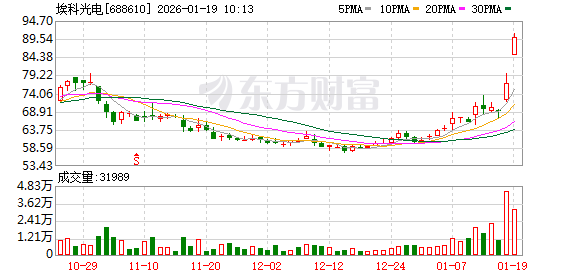
埃科光电涨11.72%,股价创历史新高
Zheng Quan Shi Bao Wang· 2026-01-19 02:12
埃科光电股价创出历史新高,截至9:32,该股上涨11.72%,股价报86.00元,成交量92.05万股,成交金 额8015.99万元,换手率2.25%,该股最新A股总市值达58.48亿元,该股A股流通市值35.20亿元。 两融数据显示,该股最新(1月16日)两融余额为1.69亿元,其中,融资余额为1.69亿元,近10日增加 726.26万元,环比增长4.49%。 公司发布的三季报数据显示,前三季度公司共实现营业收入3.34亿元,同比增长82.26%,实现净利润 5655.54万元,同比增长253.13%,基本每股收益为0.8500元,加权平均净资产收益率3.82%。(数据 宝) (文章来源:证券时报网) 证券时报·数据宝统计显示,埃科光电所属的机械设备行业,目前整体涨幅为0.32%,行业内,目前股价 上涨的有335只,涨幅居前的有欧科亿、埃科光电、锋龙股份等,涨幅分别为15.17%、11.72%、 10.00%。股价下跌的有236只,跌幅居前的有航天动力、巨力索具、天元智能等,跌幅分别为10.00%、 9.96%、9.57%。 ...


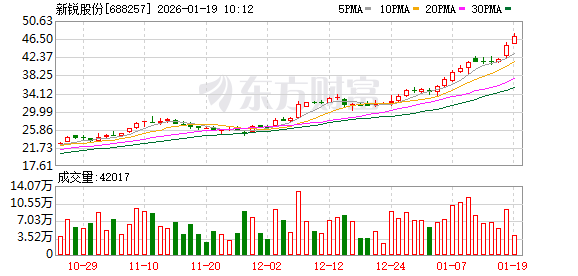
新锐股份股价又创新高,今日涨4.55%
Zheng Quan Shi Bao Wang· 2026-01-19 02:11
Group 1 - The stock price of Xinrui Co., Ltd. has reached a historical high, with 11 trading days in the past month where the stock price set new records [2] - As of 09:32, the stock is up 4.55%, priced at 47.10 yuan, with a trading volume of 509,900 shares and a transaction amount of 23.61 million yuan, resulting in a turnover rate of 0.20% [2] - The latest total market capitalization of the stock in the A-share market is 11.888 billion yuan, with the circulating market capitalization also at 11.888 billion yuan [2] Group 2 - The mechanical equipment industry, to which Xinrui Co., Ltd. belongs, has an overall increase of 0.32%, with 335 stocks in the industry rising, including Oukeyi, Aike Optoelectronics, and Fenglong Co., Ltd., which have increased by 15.17%, 11.72%, and 10.00% respectively [2] - Conversely, 236 stocks in the industry have declined, with Aerospace Power, Juyi Rigging, and Tianyuan Intelligent showing declines of 10.00%, 9.96%, and 9.57% respectively [2] Group 3 - The latest margin trading data shows that as of January 16, the margin balance for Xinrui Co., Ltd. is 415 million yuan, with a financing balance of 415 million yuan, reflecting an increase of 33.57 million yuan over the past 10 days, which is an 8.80% increase [2] - The company's third-quarter report indicates that for the first three quarters, it achieved operating revenue of 1.789 billion yuan, a year-on-year increase of 32.11%, and a net profit of 165 million yuan, a year-on-year increase of 22.68% [2] - The basic earnings per share are 0.6613 yuan, with a weighted average return on equity of 7.33% [2]

117只北交所股票获融资净买入
Zheng Quan Shi Bao Wang· 2026-01-19 01:58
Summary of Key Points Core Viewpoint - As of January 16, the total margin financing and securities lending balance on the Beijing Stock Exchange (BSE) was 8.981 billion yuan, a decrease of 157 million yuan from the previous trading day, marking a continuous decline for two consecutive trading days [1]. Financing and Margin Data - The margin balance on January 16 was 8.981 billion yuan, down by 157 million yuan from the previous day, while the securities lending balance was 84.6 thousand yuan, an increase of 0.08 thousand yuan [1]. - The stocks with the highest margin balances included Jinbo Biological (4.08 billion yuan), Better Ray (3.28 billion yuan), and Shuguang Shuchuang (2.95 billion yuan), with an average margin balance to market capitalization ratio of 1.44% [1]. Net Buying and Selling Trends - On January 16, 117 stocks had net margin purchases, with 32 stocks having net purchases exceeding 1 million yuan. The top net purchase was for Hengdongguang at 34.8645 million yuan, followed by Naconoer and Guangxin Technology with net purchases of 13.9741 million yuan and 12.1128 million yuan, respectively [1]. - The stocks with the highest net margin sales included Meideng Technology, Xingtou Measurement Control, and Kaihua Materials, with net sales of 44.2609 million yuan, 18.6269 million yuan, and 17.1534 million yuan, respectively [1]. Industry Performance - In terms of industry statistics, the sectors with the most stocks exceeding 1 million yuan in net margin purchases were power equipment, machinery, and computers, with 9, 7, and 2 stocks respectively [2]. - The average increase for stocks with net margin purchases exceeding 1 million yuan on January 16 was 11.28%, with notable increases from Kema Materials (371.27%), Tietuo Machinery (10.16%), and Hualing Co. (5.76%) [2]. Trading Activity - The weighted average turnover rate for stocks with net margin purchases exceeding 1 million yuan was 7.95%, with Kema Materials, Tietuo Machinery, and Caneng Power leading in turnover rates at 96.14%, 34.91%, and 29.65% respectively [2]. - The average daily turnover rate for BSE stocks on January 16 was 4.73% [2].
每周研选|“稳市”信号落地后,谁将接棒主线?
Xin Lang Cai Jing· 2026-01-19 01:21
Core Viewpoint - The A-share market is experiencing high volatility with a cooling market sentiment, as indicated by the recent adjustments in financing margin ratios and the focus on performance indicators as the annual report forecast period approaches [1][8]. Group 1: Market Trends - The A-share market has shown a high-level oscillation pattern, with previous leading sectors experiencing increased volatility [1][8]. - The China Securities Regulatory Commission emphasized the need for timely counter-cyclical adjustments to prevent significant market fluctuations [1][8]. - The market is expected to shift focus from narrative-driven trends to performance-based evaluations as annual report forecasts are released [9][10]. Group 2: Investment Strategies - Citic Securities suggests constructing portfolios based on "resources + traditional manufacturing pricing weight estimation," focusing on sectors like chemicals, non-ferrous metals, power equipment, and new energy [9]. - Investors are advised to increase allocations in non-bank sectors (securities, insurance) and consider high-growth sectors such as semiconductor equipment to enhance returns [9]. - Guotai Junan highlights the importance of focusing on sectors with high growth or recovery potential, particularly in technology and industries benefiting from price increases due to policy changes [15][16]. Group 3: Market Outlook - Multiple securities firms, including GF Securities and Industrial Securities, predict that the market will see opportunities from late January to mid-March, coinciding with the annual report forecast disclosures [10][11]. - The spring market rally is expected to continue, with structural adjustments rather than systemic risks being the primary concern [11][12]. - The market is anticipated to enter a phase of "spring excitement," focusing on companies with solid fundamentals and performance exceeding expectations [12][13]. Group 4: Sector Focus - The technology sector, particularly AI applications, is expected to shift from broad-based gains to a more focused performance on companies with strong fundamentals [16]. - The rise in commodity prices is seen as a significant trend, driven by global supply chain changes and resource revaluation, with sectors like non-ferrous metals and new energy materials being highlighted [16][15].
20+图看2025年出口结构
一瑜中的· 2026-01-18 14:59
Core Viewpoint - The article analyzes the export structure of China in 2025, highlighting the significant contributions from emerging markets and the contrasting performance of developed markets, particularly the U.S. and non-U.S. regions [2][16]. Group 1: Regional Structure Characteristics - Emerging markets are showing significant contributions, while the internal dynamics of developed markets, particularly between the U.S. and non-U.S. regions, are largely offsetting each other [5][17]. - In 2025, the share of exports to emerging markets is projected to be 49.1%, an increase of approximately 2.5 percentage points from 2024. Exports to the U.S. are expected to decline to 11.1%, down about 3.5 percentage points, while exports to non-U.S. developed markets will rise to 39.8%, up about 1 percentage point [17][18]. Group 2: Commodity Structure Characteristics By Usage - Intermediate goods are expected to contribute significantly, while consumer goods are projected to have a negative contribution, and capital goods are expected to remain stable. From 2017 to the first 11 months of 2025, the share of intermediate goods in exports is expected to rise from 41.9% to 47.4%, while consumer goods will decline from 36.6% to 28.7% [6][22]. - The contribution rate of intermediate goods to export growth is expected to increase from 55.8% in 2018 to 85% in 2025, while consumer goods' contribution will drop from 24.7% to -34% [6][22]. By Category - Four types of goods are identified based on economic conditions: 1. **Sustained Growth Goods**: High export growth over the past two years, including transportation equipment, pharmaceuticals, and machinery [7][25]. 2. **Reversal Goods**: Poor performance in 2024 but better in 2025, such as non-metallic products and chemicals [7][26]. 3. **Weak Sustained Goods**: Consistently low growth, including umbrellas and toys [7][26]. 4. **Diminishing Momentum Goods**: Good performance in 2024 but poor in 2025, including furniture and textiles [7][26]. Group 3: Key Regional Export Commodity Structure - The analysis focuses on the export commodity structure to developed markets (U.S. and Europe) and emerging markets. In 2024, exports to these regions accounted for about 67% of China's total exports [28]. - In the U.S., there is an overall decline, with intermediate goods showing some resilience [29]. - In the EU, intermediate and capital goods are expected to balance each other, while consumer goods will negatively impact growth [35]. - In ASEAN, intermediate goods are expected to see significant growth, while consumer goods will contribute negatively [39]. - In Africa, there is expected to be overall growth, with capital and intermediate goods each contributing about 40% [43]. - In the Middle East, growth is expected to be balanced across all types of goods [49]. - In Latin America, intermediate goods are projected to grow by over 60%, with consumer and capital goods showing slight growth [54]. - In Central Asia (excluding Russia), the contribution of intermediate and capital goods is expected to be 7:4, with consumer goods negatively impacting growth [59].

转债市场周报:上涨共识支撑转债估值:-20260118
Guoxin Securities· 2026-01-18 14:57
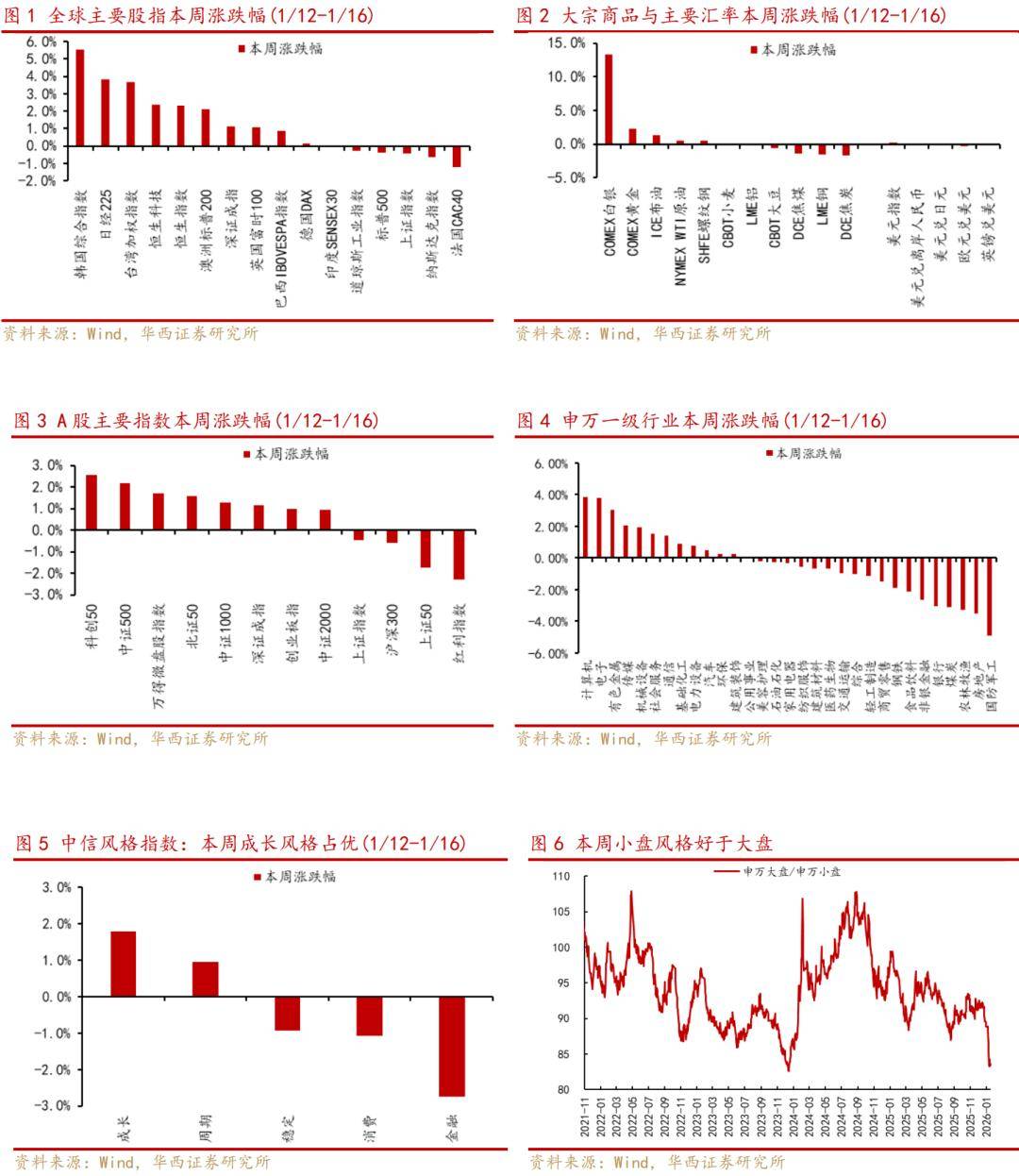
1. Report Industry Investment Rating No relevant content provided. 2. Core Viewpoints of the Report - Last week, the A - share market first rose and then declined. The daily trading volume of the whole market reached a record high of 3.99 trillion yuan on Wednesday. After the exchange adjusted the margin ratio for margin trading, market sentiment cooled down. The commercial aerospace sector retreated from its high, and the market focus shifted to AI applications, semiconductors, etc. The bond market yield declined, and the 10 - year Treasury bond rate closed at 1.84% on Friday, down 3.58bp from the previous week [1][8][9]. - In the convertible bond market, most individual convertible bonds rose last week. The CSI Convertible Bond Index increased by 1.08% for the whole week, the median price increased by 0.63%, and the arithmetic average parity increased by 1.39%. The conversion premium rate of the whole market decreased by 0.64% compared with the previous week [2][9]. - Although the current market price and the valuation of convertible bonds in each parity range are close to the 100% quantile position in history, the equity market is in a clear upward trend. Institutions are more worried about missing out on the upward trend than about market declines, which strongly supports the valuation of convertible bonds. Currently, it is the stage with the strongest certainty of upward market momentum [3][19]. - For relative returns, it is recommended to focus on lithium - battery, semiconductor equipment and materials, chemical industry, and securities brokerage sectors. For absolute - return funds, attention should be paid to the undervalued leading companies in the still - stagnant industries [4][20]. 3. Summary According to Relevant Catalogs Market Focus (January 12 - January 16, 2026) Stock Market - The A - share market first rose and then declined. The daily trading volume reached a record high on Wednesday. After the adjustment of the margin ratio for margin trading, market sentiment cooled down. The commercial aerospace sector retreated from its high, and the market focus shifted to AI applications, semiconductors, etc. The dividend - paying sector still underperformed. Most Shenwan primary industries declined, with computer, electronics, non - ferrous metals, media, and machinery leading the gains, and national defense and military industry, real estate, agriculture, forestry, animal husbandry, and coal performing poorly [1][8][9]. Bond Market - Although the equity market continued to rise at the beginning of the week, the impact on the bond market weakened significantly. Due to the increasing expectation of an equity market adjustment after a rapid rise, the bond market yield declined. After the central bank cut the interest rate of structural monetary policy tools on Thursday, the yield fluctuated and remained stable overall. The 10 - year Treasury bond rate closed at 1.84% on Friday, down 3.58bp from the previous week [1][9]. Convertible Bond Market - Most individual convertible bonds rose. The CSI Convertible Bond Index increased by 1.08% for the whole week, the median price increased by 0.63%, and the arithmetic average parity increased by 1.39%. The conversion premium rate of the whole market decreased by 0.64% compared with the previous week. Most industries in the convertible bond market rose, with computer, electronics, media, and machinery leading the gains, and national defense and military industry, building materials, coal, and transportation performing poorly. The top - rising individual bonds were related to semiconductors and AI applications, while the top - falling ones were mainly from the commercial aerospace sector [2][9][13]. Views and Strategies (January 19 - January 23, 2026) - The consensus on the upward trend supports the valuation of convertible bonds. The equity market first rose and then declined last week, and the theme shifted from aerospace to AI applications and semiconductor equipment. The relevant convertible bonds performed well, the average parity increased further, and the median market price rose to 139 yuan. The premium rate of equity - biased convertible bonds in the high - parity range increased significantly, and the convertible bond ETF still showed a significant net inflow trend. Newly - listed bonds were still strong [3][19]. - For relative returns, focus on high - probability equity - biased sectors such as lithium - battery (price increases are gradually implemented, and domestic and overseas demand is booming), semiconductor equipment and materials (expansion of Changxin and Changcun, and increasing localization rate), chemical industry (anti - involution in the polyester industry chain), and securities brokerage (benefiting from the booming stock market trading volume and previous underperformance). For absolute - return funds, pay attention to the undervalued leading companies in the still - stagnant industries, including two - wheeled vehicles, beauty and personal care, architectural design, and pig farming [4][20]. Valuation Overview - As of January 16, 2026, for equity - biased convertible bonds, the average conversion premium rates in different parity ranges are at high quantile positions in history. For debt - biased convertible bonds, the average YTM of bonds with a parity below 70 yuan is in the lower quantile position. The average implied volatility of all convertible bonds and the difference between the implied volatility of convertible bonds and the long - term actual volatility of the underlying stocks are also at high quantile positions [21]. Primary Market Tracking - Last week (January 12 - January 16, 2026), Shangtai Convertible Bond and Naipu Convertible Bond 02 announced their issuance, and Aohong, Shuangle, and Jin 05 Convertible Bonds were listed. In the future week (January 19 - January 23, 2026), there are no announcements of convertible bond issuance and listing. Last week, 4 companies got the exchange's approval for registration, 1 company's application was accepted by the exchange, 2 companies' plans passed the shareholders' meeting, and 4 companies released board proposals. Currently, there are 99 convertible bonds to be issued, with a total scale of 155.14 billion yuan [28][34].




李立峰、张海燕:再论当前“春季行情”下的三条投资主线
Sou Hu Cai Jing· 2026-01-18 14:18
Market Review - The A-share market experienced a significant increase followed by a period of volatility, driven by a rapid rise in risk appetite among investors, particularly in small-cap and growth sectors. On January 14, the total trading volume across all A-shares reached a historic high of 3.99 trillion yuan, with margin financing balances hitting new records. However, regulatory adjustments to margin requirements led to a cooling off in trading activity, and the previously strong momentum in technology indices began to slow down. Commodities such as precious metals and crude oil saw price increases, while copper prices fluctuated at high levels and domestic coking coal prices declined. The US dollar index rose, and the offshore yuan appreciated against the dollar [1][2]. Market Outlook - Regulatory measures aimed at "counter-cyclical adjustment" are expected to support a "slow bull" market for A-shares. Following a surge in trading activity and margin financing, regulators signaled a need to mitigate risks by increasing the minimum margin requirement from 80% to 100%. This is part of a broader strategy to maintain market stability and prevent excessive volatility. Despite these measures, the overall valuation of A-shares remains reasonable, supported by macroeconomic policies, long-term capital inflows, and a moderate recovery in corporate earnings. As the end of January approaches, the focus will shift to earnings forecasts, particularly in technology sectors and areas experiencing price increases [2][3]. Key Focus Areas - The spring market rally has seen a rapid increase in trading activity, but regulatory signals have shifted the Shanghai Composite Index from a one-sided rise to high-level fluctuations. Since the rally began on December 17, various sources of capital have entered the market, including institutional funds and foreign investments, leading to a peak trading volume of nearly 4 trillion yuan. The margin financing balance surpassed 2.7 trillion yuan, indicating potential overheating risks. Regulatory interventions have prompted a transition to a more stable trading environment, while the overall trading volume remains high, reflecting sustained investor confidence [1][2]. Risk Premium and Valuation - As of January 16, the equity risk premium (ERP) for the CSI 300 index stood at 5.2%, close to the median level over the past decade. Compared to previous peaks in January 2018 and February 2021, the current ERP suggests that A-share valuations are relatively reasonable, although some sectors may be experiencing overheating. The sectors with the highest margin buying activity include electronics, power equipment, computers, military, and communications. Attention should be paid to the potential impact of reduced financing in high-volatility sectors [3][4]. Earnings Forecasts - The trend of a slow bull market for A-shares is expected to continue, with a focus on earnings forecasts as companies prepare to disclose their annual results. Macroeconomic policies are expected to support risk appetite, with the central bank implementing targeted monetary policies. The anticipated recovery in corporate earnings, particularly as the Producer Price Index (PPI) declines, will be crucial for market support. Key sectors to watch include technology, chemicals, and healthcare, especially those with high growth or turnaround potential in their earnings forecasts [4].
行情结束还是结构转向?
Huaan Securities· 2026-01-18 13:56
Market Insights - The report indicates that the increase in financing margin ratios is gradually being digested by the market, with the impact nearing its end. The central bank's structural interest rate cuts are expected to boost policy expectations, and additional policies may be introduced following the release of macroeconomic data for 2025, which could enhance market risk appetite [3][4] - The upcoming release of 2025 macroeconomic data on January 19 is anticipated to show a significant decline in GDP growth for Q4 compared to Q3. This, combined with various policy measures, suggests an increased probability of a "good start" for Q1, which is likely to uplift market risk appetite [4][11] Industry Allocation - The report asserts that the acceleration in market trends has not ended, but the structure of the upward trend is shifting towards computing power. The previous leading sectors, such as military and AI applications, have seen declines, raising investor concerns about the end of the current market phase. However, the report suggests that the current market phase may still extend with potential acceleration in sectors related to computing power [5][20] - As of January 12, 2026, the electric equipment sector has not yet reached new highs, indicating that the growth style and six major growth industries have not simultaneously achieved new highs. The report highlights that the electric equipment index has room for approximately 3% growth to meet this condition [20][23] - The report identifies that the communication and electronic sectors, which were previously strong, may experience a rapid rebound, with potential upward space of no less than 10%. The report emphasizes that the current market conditions do not satisfy the "stronger gets stronger" characteristic, as the leading sectors have not maintained their strength [20][24] - The report also notes that the turnover rates for the growth style and the communication sector are approaching their respective highs, but the communication sector still has a significant gap to close. This suggests that the current market phase has not yet concluded, and a rapid increase in turnover rates may accompany a rebound in the communication sector [27][31] Key Investment Themes - The report suggests two main investment themes: 1. The AI industry chain, particularly in computing power (CPO/PCB), supporting components (fiber optics/liquid cooling/power equipment), and applications (robots/games/software), is expected to continue its upward trend. The report anticipates that applications may experience high volatility, while computing power is likely to see accelerated growth [32][33] 2. Areas supported by favorable market conditions or significant events, such as storage and energy storage chains, military industry, and machinery, are also highlighted. The storage sector is expected to benefit from supply disruptions and increased AI demand, while the military sector may gain from commercial aerospace and geopolitical events [33]
再论当前“春季行情”下的三条投资主线
HUAXI Securities· 2026-01-18 12:29
Market Review - The A-share market experienced a significant increase followed by a period of volatility, with a notable rise in trading volume driven by a strong profit-making effect, particularly in small-cap and growth styles. On January 14, the total trading volume reached a historical high of 3.99 trillion yuan, with margin financing balances hitting new records. However, following regulatory adjustments to margin requirements, market activity showed signs of cooling, and the previously strong technology index began to stabilize [1][2]. Market Outlook - Regulatory measures aimed at "counter-cyclical adjustment" are expected to support a "slow bull" market for A-shares. The recent surge in trading activity has prompted regulators to signal a need for cooling, leading to a shift from a one-sided increase to high-level fluctuations in the Shanghai Composite Index. Despite this, the overall valuation of A-shares remains reasonable, supported by macro policies, medium to long-term capital inflows, and a mild recovery in corporate earnings. The upcoming earnings announcements in late January are likely to refocus investor attention on performance-driven sectors, particularly in technology and industries benefiting from price increases [2][3]. Counter-Cyclical Adjustment Policies - The recent increase in the minimum margin requirement for financing from 80% to 100% is part of a broader strategy to prevent systemic risks in the market. The regulatory emphasis on maintaining market stability and preventing extreme fluctuations is evident, as seen in the significant net outflow of 142.3 billion yuan from equity ETFs in January, marking the largest monthly outflow since 2021. This counter-cyclical adjustment is viewed as a necessary measure to sustain the bull market trend while mitigating overheating risks [3][4]. Risk Premium and Sector Focus - As of January 16, the equity risk premium (ERP) for the CSI 300 index stands at 5.2%, which is near the median level for the past decade. Compared to previous peaks in January 2018 and February 2021, the current risk premium indicates that A-share valuations are relatively reasonable, although some sectors may experience capital withdrawal due to overheating. Key sectors attracting financing include electronics, power equipment, computers, military, and communications, with a need to monitor the impact of reduced financing on high-volatility stocks in these areas [4][5]. Investment Strategy - The slow bull trend in A-shares is expected to continue, with a focus on sectors showing high growth or improving conditions as companies prepare to announce their 2025 earnings. Key factors supporting this outlook include proactive macro policies, the influx of medium to long-term capital, and a narrowing decline in the Producer Price Index (PPI), which suggests a mild recovery in corporate earnings. Investors should pay attention to sectors such as technology (AI applications, robotics), commodities benefiting from price increases, and industries with anticipated high earnings growth [5].