
贵金属

Search documents
英大证券晨会纪要-20260212
British Securities· 2026-02-12 02:50
Group 1 - The core viewpoint of the report indicates that the A-share market is currently in a phase of consolidation with expectations for a positive post-holiday market driven by liquidity improvements and policy expectations [3][10] - The report highlights that the market is experiencing cautious sentiment ahead of the holiday, with a notable focus on cyclical stocks such as chemicals and non-ferrous metals, which have shown strength [5][9] - It is noted that the trading volume has been around 2 trillion yuan, reflecting a prevailing wait-and-see attitude among investors, indicating that there is still uncertainty in the market [3][10] Group 2 - The report emphasizes that post-holiday, there is an expectation for increased liquidity and potential policy benefits from upcoming important meetings, which could stimulate investment opportunities in related sectors [3][10] - Specific sectors such as solid-state batteries, chemicals, and non-ferrous metals are identified as key areas to watch for potential growth, particularly as economic recovery signals strengthen [7][9] - The report advises investors to adopt a strategy of buying on dips rather than chasing high prices, suggesting a focus on small-cap growth stocks and sectors with clear industrial catalysts [3][10]
FT中文网精选——展望2026:黄金的高度,美元的深度
日经中文网· 2026-02-12 02:50
Core Viewpoint - The price of gold has been rising sharply, indicating a decline in the international status of the US dollar. The future trajectory of gold prices remains unpredictable as the international monetary landscape undergoes significant changes [5][6]. Group 1: Gold Price Dynamics - Each significant surge in gold prices corresponds with a decline in the US dollar's international standing, suggesting a deep-rooted transformation in the market [6]. - Following a brief correction at the beginning of the year, gold prices have entered a new upward trend, with predictions that the important psychological level of $5000 per ounce may soon be breached [6]. - Despite the ongoing bullish trend in the gold market, there has not been a corresponding increase in gold consumption, indicating a disconnection between price movements and market fundamentals [6].

得州打响“抢黄金”第一枪:州版金银开卖,居民直存金库,绕开美联储
Xin Lang Cai Jing· 2026-02-12 02:20
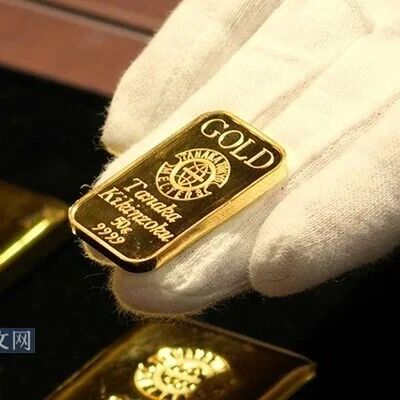
"得克萨斯州是第一个打通贵金属从制造、金库到直面消费者销售完整闭环的美国州份,"斯科茨代尔铸 币局(Scottsdale Mint)首席执行官乔什·菲尔(Josh Phair)在接受Kitco News独家采访时表示。"通过官 方'点政府'商城推出自有品牌铸币和金钞,该州正在打造一个传统金融体系之外的实体替代方案。" 主权分销商模式 虽然怀俄明州和犹他州等州份因承认黄金和白银为法定货币而登上头条,但得州的计划确立了一种新 型"主权分销商"基础设施。该计划包括2026年版得克萨斯孤星币(Lone Star Coins)——有1盎司金版和 银版——以及官方得克萨斯州金钞,这是一种纤薄耐用的钞券,内含可验证的24K金层。 这些产品不仅仅是纪念性质。它们与得克萨斯金银存放处深度整合,这是全美唯一由州政府管理并接受 审计的金库设施。投资者现可通过主计长官网购买贵金属,并选择将其托管在该州的安全基础设施内, 从而有效绕开传统商业银行体系。 "这是一种新范式,"菲尔告Kitco News。"由于货币基础被稀释、联邦预算支离破碎,各州正越来越多 地将实体金属视为必要的国库资产。" 稳健货币之争:得州对阵怀俄明 热点栏目 自选 ...

钨价大幅上涨,贵金属短期迎方向选择 | 投研报告
Sou Hu Cai Jing· 2026-02-12 01:43
Group 1 - The non-ferrous metal industry index decreased by 5.42% over the past two weeks, underperforming the CSI 300 index and ranking 28th among 31 Shenwan first-level industries [1] - Precious metals, energy metals, minor metals, industrial metals, and new metal materials all experienced varying degrees of decline, with energy metals dropping the most at 11.47% [1] Group 2 - As of February 6, COMEX gold closed at $4,988.60 per ounce, showing a slight increase of 0.11% over the past two weeks, while COMEX silver fell by 24.92% to $77.53 per ounce [2] - LME copper settled at $12,840.00 per ton, down 0.62%, and domestic copper averaged 99,560 yuan per ton, down 1.68% [2] - The price of black tungsten concentrate increased by 25.09% to 673,000 yuan per ton, while lithium carbonate dropped by 21.35% to 134,500 yuan per ton [2] Group 3 - The Shanghai Futures Exchange is seeking public opinion on the revision of lead futures contract rules, proposing to include recycled lead ingots as alternative delivery products, aligning with the green and low-carbon transition of the non-ferrous metal industry [3] - The new national standard for recycled lead will be implemented on March 1, 2026, enhancing risk management capabilities and promoting the development of a circular economy in the industry [3]
浩通科技拟出售回购股份并调整套期保值额度
Jing Ji Guan Cha Wang· 2026-02-12 01:41
Group 1 - The company plans to sell up to 981,700 shares of repurchased stock, accounting for 0.62% of total share capital, with the sale period from January 22, 2026, to July 21, 2026 [2] - Proceeds from the share sale will be used to supplement working capital, and the plan is currently in the implementation stage [2] - The company intends to increase the maximum holding balance for hedging business from 150 million yuan to 300 million yuan, pending approval from a temporary shareholders' meeting on January 15, 2026 [2] Group 2 - Recent stock price fluctuations include a notable increase of 9.54% on February 11, 2026, indicating volatility influenced by market sentiment and industry factors [3] - The changes in stock price and capital flow reflect the impact of the company's recent events and the overall performance of the precious metals sector [3]
中泰国际:美股方面,美国1月非农就业人数增加13.5%
ZHONGTAI INTERNATIONAL SECURITIES· 2026-02-12 01:40
Market Overview - On February 11, Hong Kong stocks opened higher and expanded gains, with the Hang Seng Index closing up 83 points (0.3%) at 27,266 points[1] - The Hang Seng Tech Index rose by 48 points (0.9%) to close at 5,499 points, with total market turnover reaching HKD 217.2 billion[1] - Southbound capital saw a net inflow of HKD 4.82 billion, compared to a previous day's net inflow of HKD 84.66 million[1] Key Stock Movements - Semiconductor company SMIC reported a 61% year-on-year increase in Q4 net profit, but its Q1 gross margin guidance fell short of expectations, leading to a 2.1% drop in its stock price[1] - Precious metal stocks saw gains, with Zijin Mining up 2.8%, Shandong Gold up 4.4%, and Zijin Gold International up 9.1%[1] - Xiaomi's stock rose 4.3% after it invested in a humanoid robot parts supplier, while other automotive stocks like BYD and Geely also saw increases of 2.7% to 3.9%[4] Economic Indicators - In the U.S., January non-farm payrolls increased by 130,000, significantly above the expected 65,000, with the unemployment rate dropping to 4.3% from 4.4% in December[2] - China's January PPI fell by 1.4% year-on-year, slightly better than the expected 1.5% decline, while CPI rose by 0.2% year-on-year, below the expected 0.4%[3] Sector Performance - The healthcare sector saw a 0.7% increase in the Hang Seng Healthcare Index, with WuXi Biologics forecasting a 16.7% revenue growth to HKD 21.79 billion for 2025[4] - The renewable energy and utilities sector generally rose, with Huaneng International and Datang Power increasing by 1.7% to 2.4%[5]
白银供应短缺伴随强劲投资需求,银价或仍将保持坚挺
Huan Qiu Wang· 2026-02-12 01:01
Group 1 - The international precious metals futures experienced a general increase, with COMEX gold futures rising by 1.53% to $5107.80 per ounce and COMEX silver futures increasing by 4.60% to $84.08 per ounce [1] - Analysts attribute the rise in silver prices to expectations of supply shortages and strong investment demand, alongside delayed expectations for Federal Reserve interest rate cuts and inflation concerns enhancing the anti-inflation properties of precious metals [1] - The U.S. labor market showed strength with a non-farm payroll increase of 130,000 in January, significantly exceeding the market expectation of 70,000, and the unemployment rate fell to 4.3%, the lowest since August 2025 [1] Group 2 - The Kansas City Fed President indicated that inflation remains above target levels, suggesting a need to maintain a "slightly restrictive" interest rate stance, leading traders to push back their bets on Fed rate cuts from June to July [1] - Recent market behavior showed a notable inverse volatility in the gold and silver markets, with individual investors strongly buying during price declines; data from "Vanda Research" indicated a net inflow of approximately $4.3 billion into silver tracking index funds over just six trading days [1] - The World Silver Association forecasts that global silver demand will remain stable in 2026, with total supply expected to grow by 1.5% to 1.05 billion ounces, marking a ten-year high, yet the silver market is projected to experience structural shortages for the sixth consecutive year [4]
商品板块轮动 现在到哪个阶段了?
Qi Huo Ri Bao· 2026-02-12 00:20
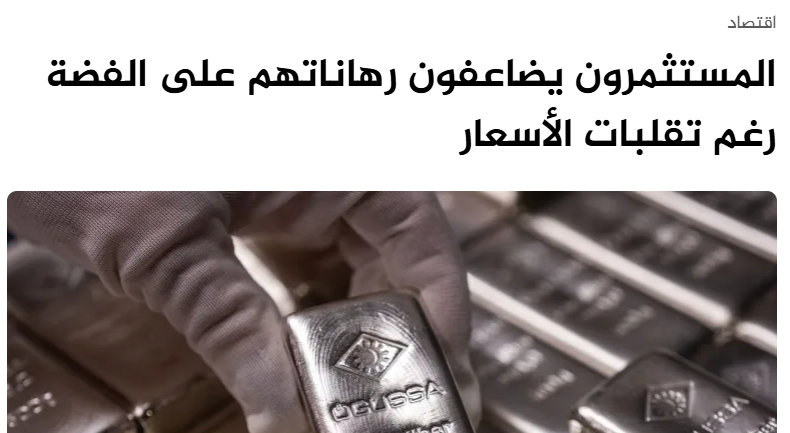
Core Insights - The commodity market is transitioning from a "broad increase" to "structural differentiation," with funds shifting towards undervalued sectors with solid fundamentals [1][3] - The historical divergence between "green metals" (copper, lithium, nickel) and traditional energy (crude oil, coal) has become a defining feature of the current market [3][4] - The current commodity cycle is characterized by a unique combination of financial and strategic attributes, driven by structural narratives rather than traditional economic growth [7][12] Market Dynamics - The supply-demand relationship for green metals is tight due to rigid supply and explosive demand, while traditional energy faces relaxed supply and slowing demand [3][4] - The global supply chain is shifting from "efficiency-first" globalization to "security-first" regionalization, impacting commodity pricing and availability [4][20] - Recent price movements, such as a 30% increase in LME copper prices in January 2026, reflect the new characteristics of the market [4] Historical Context - The current commodity cycle shows similarities to the 1970s, with a focus on the restructuring of the global monetary system and ongoing supply chain disruptions [11][12] - The previous commodity supercycle was driven by China's industrialization and urbanization, while the current cycle is influenced by AI infrastructure and green transitions [7][12] Investment Opportunities - Investors are advised to focus on the fundamental differences among commodities to identify structural opportunities [4][13] - Key commodities to watch include zinc, wheat, iron ore, and platinum, which are expected to perform well in the current market environment [15][24] - The chemical sector is anticipated to see growth due to domestic policy changes and supply optimization, with specific attention to products with strong export expectations [14] Future Outlook - The commodity market is expected to continue exhibiting significant differentiation, with traditional rotation patterns being disrupted [13][24] - The focus on strategic resources like gold, silver, copper, and tin is likely to lead to a scenario where these commodities experience upward price pressure while others may lag [24]
中信建投:贵金属高位震荡消化波动率 价格上行趋势不改
智通财经网· 2026-02-12 00:13
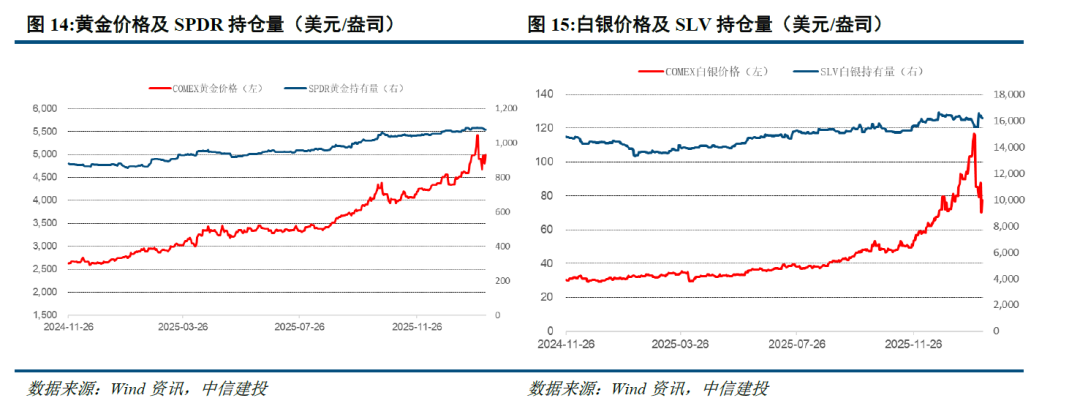
Group 1: Precious Metals - Precious metals experienced significant volatility this week due to panic triggered by Kevin Warsh's nomination, but the upward trend remains intact due to rising sovereign credit risks and geopolitical tensions [1][2] - The main silver futures price dropped from 32,000 CNY/kg to a low of 17,900 CNY/kg, with implied volatility remaining high despite a slight decline [2] - The World Gold Council reported that global physical gold ETF inflows reached $18.7 billion in January 2026, marking a record high for a single month, with total ETF holdings increasing by 120 tons to 4,145 tons [2] Group 2: Industrial Metals - Basic industrial metals are showing a positive trend supported by real demand from downstream buyers, despite a temporary adjustment following the precious metals' volatility [1][6] - Copper prices are testing the key support level of 100,000 CNY/ton, with global copper inventories rising to 1.11 million tons, indicating a potential inventory replenishment after the Lunar New Year [6] - Aluminum prices are supported at 23,500 CNY/ton, with global inventories at historical lows and high operating rates for electrolytic aluminum, suggesting potential for new highs post-holiday [6]

A股三大指数涨跌不一 玻璃玻纤与能源金属等板块大涨
Xin Lang Cai Jing· 2026-02-11 17:44
Group 1 - The A-share market showed mixed performance with the Shanghai Composite Index up by 0.09% closing at 4131.99 points, while the Shenzhen Component Index fell by 0.35% to 14160.93 points, and the ChiNext Index decreased by 1.08% to 3284.74 points [1] - The trading volume in the Shanghai and Shenzhen markets was 200.12 billion yuan, a decrease of 123.7 billion yuan compared to the previous trading day [1] - Various industry sectors experienced mixed results, with glass fiber, energy metals, and precious metals leading in gains, while cultural media, education, and tourism sectors faced declines [1] Group 2 - Tianfeng Securities reported that in 2025, the consumption of gold bars and coins in China is expected to surpass that of gold jewelry for the first time, indicating a structural shift in the gold market [2] - The gross profit margins of gold jewelry companies may benefit from rising gold prices, although the overall market scale and future sales expectations may weaken [2] - CITIC Securities highlighted the release of the Seedance 2.0 video model by ByteDance, which is expected to revolutionize the film and television sector, particularly benefiting AI comic drama production companies [2]