
建筑业

Search documents
上海率先破局,引领建筑市场改革
HTSC· 2025-10-22 10:46
Investment Rating - The industry investment rating is "Overweight" [6][24]. Core Viewpoints - The Shanghai government has initiated a comprehensive action plan to promote high-quality development in the construction industry, focusing on demand stimulation, supply optimization, and transformation cultivation towards green, industrial, and digital advancements [2][5]. - The plan aims to address growth bottlenecks in Shanghai's construction sector, providing clear transformation paths for enterprises and optimizing the industrial ecosystem, which is expected to benefit leading construction groups and specialized small and medium enterprises [2][3]. - The action plan is seen as a potential model for nationwide construction industry reforms, offering insights into demand exploration, market integration, and innovation-driven growth [5]. Supply Summary - The plan encourages the formation of a differentiated market structure by promoting "large and strong" and "small and refined" enterprises, while also addressing issues of internal competition and payment mechanisms [3]. - It emphasizes the establishment of construction groups with full industry chain capabilities and aims to cultivate specialized small and medium enterprises focusing on niche markets [3]. Demand Summary - The action plan seeks to stabilize the traditional market by enhancing real estate investment and accelerating urban renewal projects [4]. - It encourages innovative project participation models, such as "value-added investment + operational sharing" and "general contracting + operational investment" [4]. - The plan also supports enterprises in expanding into international markets through a comprehensive service platform [4]. Recommended Companies - The report recommends focusing on leading state-owned enterprises in Shanghai, such as Shanghai Construction Group and Tunnel Shares, as well as other construction companies with significant business in the Shanghai region [2][8].


北新路桥(002307) - 2025年第三季度建筑业经营情况简报
2025-10-22 09:45
证券代码:002307 证券简称:北新路桥 公告编号:2025-58 | 项目名称 | 业务 | 签订日 | | 工期 | 合同价款 | 履行情况 | | --- | --- | --- | --- | --- | --- | --- | | | 模式 | 期 | | | (万元) | | | | | | | | | 截至 年 月 日,项目 2025 9 30 | | 合川双槐 | 施工 | 2020 | 年 | | | 已完成项目施工的 100%,对 | | 至钱塘高 | 总承 | 月 2 | 28 | 年 3 | 324,900.00 | 上计量 32 期。不存在未按合 | | 速公路项 | | | | | | 同约定及时结算与回款的情 | | 目 | 包 | 日 | | | | 况,交易对手方的履约能力不 | | | | | | | | 存在重大变化。 | | | | | | | | 截至 年 月 日,项目 2025 6 30 | | G3 京 台 | | | | | | 已完成项目施工的 100%,对 | | | 施工 | 2022 | 年 | | | | | 高速复线 | | | | | | 上计量 ...

申银万国期货早间策略-20251022
Shen Yin Wan Guo Qi Huo· 2025-10-22 06:31
1. Report Industry Investment Rating - No relevant content provided 2. Core Viewpoints of the Report - After a high - level oscillation in September, the stock index is expected to enter a direction - selection phase again. The domestic liquidity environment is likely to remain loose, and domestic residents may increase their allocation of equity assets. With the Fed's interest rate cuts and RMB appreciation, external funds are also expected to flow into the domestic market. In terms of market style, although technology growth has been the core theme of the current upward market trend, considering the possible intensification of Q4 growth - stabilization policies and the potential resonance of global monetary and fiscal policies, the market style in Q4 may shift towards value and become more balanced compared to Q3 [2] 3. Summary by Relevant Catalogs 3.1 Stock Index Futures Market - **IF Contracts**: The previous two - day closing prices of IF contracts (current month, next month, next quarter, and far - quarter) were 4519.80, 4506.80, 4482.00, and 4447.20 respectively, and the previous day's closing prices were 4588.60, 4577.60, 4550.20, and 4515.00 respectively. The price increases were 71.00, 73.40, 71.20, and 71.00 respectively, and the corresponding price increase rates of the CSI 300 were 1.57, 1.63, 1.59, and 1.60. The trading volumes were 29776.00, 77133.00, 12638.00, and 2919.00 respectively, and the open interests were 41688.00, 157558.00, 56187.00, and 3333.00 respectively. The changes in open interests were 1009.00, 1159.00, - 780.00, and - 73.00 respectively [1] - **IH Contracts**: The previous two - day closing prices of IH contracts were 2972.00, 2970.40, 2972.00, and 2969.80 respectively, and the previous day's closing prices were 3004.20, 3004.80, 3005.60, and 3004.00 respectively. The price increases were 33.00, 35.20, 35.20, and 35.20 respectively, and the corresponding price increase rates of the SSE 50 were 1.11, 1.19, 1.19, and 1.19. The trading volumes were 12905.00, 35150.00, 4265.00, and 1113.00 respectively, and the open interests were 14510.00, 62330.00, 13436.00, and 1032.00 respectively. The changes in open interests were - 484.00, 1866.00, - 42.00, and 76.00 respectively [1] - **IC Contracts**: The previous two - day closing prices of IC contracts were 6972.00, 6909.20, 6747.40, and 6567.00 respectively, and the previous day's closing prices were 7108.80, 7052.80, 6886.20, and 6709.80 respectively. The price increases were 138.40, 144.00, 140.40, and 145.40 respectively, and the corresponding price increase rates of the CSI 500 were 1.99, 2.08, 2.08, and 2.22. The trading volumes were 33289.00, 89215.00, 17433.00, and 5710.00 respectively, and the open interests were 50505.00, 139981.00, 52019.00, and 6571.00 respectively. The changes in open interests were 1557.00, 4488.00, - 549.00, and 364.00 respectively [1] - **IM Contracts**: The previous two - day closing prices of IM contracts were 7137.60, 7059.20, 6841.60, and 6637.40 respectively, and the previous day's closing prices were 7261.00, 7182.80, 6966.80, and 6753.60 respectively. The price increases were 126.40, 129.40, 130.20, and 126.40 respectively, and the corresponding price increase rates of the CSI 1000 were 1.77, 1.83, 1.90, and 1.91. The trading volumes were 44744.00, 151318.00, 26613.00, and 10398.00 respectively, and the open interests were 72051.00, 190486.00, 80131.00, and 12634.00 respectively. The changes in open interests were 985.00, 832.00, - 2419.00, and 1567.00 respectively [1] - **Inter - month Spreads**: The current inter - month spreads of IF (next month - current month), IH (next month - current month), IC (next month - current month), and IM (next month - current month) were - 11.00, 0.60, - 56.00, and - 78.20 respectively, while the previous values were - 13.00, - 1.60, - 62.80, and - 78.40 respectively [1] 3.2 Stock Index Spot Market - **CSI 300 Index**: The previous value of the CSI 300 index was 4607.87, with a trading volume of 215.71 billion lots and a total trading value of 5513.90 billion yuan. The previous two - day value was 4538.22, with a trading volume of 218.42 billion lots and a total trading value of 5057.99 billion yuan. The price increase rate was 1.53 [1] - **SSE 50 Index**: The previous value of the SSE 50 index was 3007.26, with a trading volume of 55.30 billion lots and a total trading value of 1472.70 billion yuan. The previous two - day value was 2974.86, with a trading volume of 53.18 billion lots and a total trading value of 1283.62 billion yuan. The price increase rate was 1.09 [1] - **CSI 500 Index**: The previous value of the CSI 500 index was 7185.62, with a trading volume of 205.97 billion lots and a total trading value of 3449.91 billion yuan. The previous two - day value was 7069.64, with a trading volume of 176.83 billion lots and a total trading value of 3146.75 billion yuan. The price increase rate was 1.64 [1] - **CSI 1000 Index**: The previous value of the CSI 1000 index was 7344.05, with a trading volume of 237.25 billion lots and a total trading value of 3481.59 billion yuan. The previous two - day value was 7239.18, with a trading volume of 218.58 billion lots and a total trading value of 3284.45 billion yuan. The price increase rate was 1.45 [1] - **Industry Indexes**: Different industries in the CSI 300 had different price increase rates. For example, the price increase rates of energy, raw materials, industry, and optional consumption were - 0.58%, 1.10%, 1.53%, and 0.60% respectively; the price increase rates of major consumption, medical and health, real - estate and finance, and information technology were 0.16%, 0.97%, 0.52%, and 3.74% respectively; the price increase rates of telecommunications services and public utilities were 5.72% and - 0.36% respectively [1] 3.3 Basis between Futures and Spot - **CSI 300 - related Basis**: The previous values of the basis between IF contracts (current month, next month, next quarter, far - quarter) and the CSI 300 were - 19.27, - 30.27, - 57.67, and - 92.87 respectively, and the previous two - day values were - 18.42, - 31.42, - 56.22, and - 91.02 respectively [1] - **SSE 50 - related Basis**: The previous values of the basis between IH contracts (current month, next month, next quarter, far - quarter) and the SSE 50 were - 3.06, - 2.46, - 1.66, and - 3.26 respectively, and the previous two - day values were - 2.86, - 4.46, - 2.86, and - 5.06 respectively [1] - **CSI 500 - related Basis**: The previous values of the basis between IC contracts (current month, next month, next quarter, far - quarter) and the CSI 500 were - 76.82, - 132.82, - 299.42, and - 475.82 respectively, and the previous two - day values were - 97.64, - 160.44, - 322.24, and - 502.64 respectively [1] - **CSI 1000 - related Basis**: The previous values of the basis between IM contracts (current month, next month, next quarter, far - quarter) and the CSI 1000 were - 83.05, - 161.25, - 377.25, and - 590.45 respectively, and the previous two - day values were - 101.58, - 179.98, - 397.58, and - 601.78 respectively [1] 3.4 Other Domestic and Overseas Indexes - **Domestic Main Indexes**: The previous values of the Shanghai Composite Index, Shenzhen Component Index, Small and Medium - sized Board Index, and ChiNext Index were 3916.33, 13077.32, 8038.31, and 3083.72 respectively. The previous two - day values were 3863.89, 12813.21, 7870.96, and 2993.45 respectively. The price increase rates were 1.36%, 2.06%, 2.13%, and 3.02% respectively [1] - **Overseas Indexes**: The previous values of the Hang Seng Index, Nikkei 225, S&P 500, and DAX Index were 26027.55, 49185.50, 6735.35, and 24330.03 respectively. The previous two - day values were 25858.83, 47582.15, 6735.13, and 24258.80 respectively. The price increase rates were 0.65%, 3.37%, 0.00%, and 0.29% respectively [1] 3.5 Macroeconomic Information - US President Trump said he would visit China early next year. The Chinese Foreign Ministry spokesman responded that no information could be provided for the time being [2] - Chinese Minister of Commerce Wang Wentao held a video conference with EU Commissioner for Trade and Economic Security Valdis Dombrovskis, discussing key China - EU economic and trade issues such as export controls and the EU's anti - subsidy case against Chinese electric vehicles. He also had a phone call with Dutch Minister of Economic Affairs Micky Adriaansens, discussing issues related to Nexperia. Wang stated that China's recent measures on rare - earth export controls were normal actions to improve the export control system in accordance with laws and regulations, and urged the Dutch side to resolve issues related to Nexperia properly [2] - The Ministry of Commerce held a policy - interpretation round - table meeting for foreign - invested enterprises, with over 170 representatives of foreign - invested enterprises and foreign business associations in China attending. Deputy Minister of Commerce Ling Ji emphasized that China's export controls were responsible actions to maintain world peace and regional security and stability and fulfill non - proliferation obligations, while also approving compliant trade in accordance with laws to maintain the stability of the global industrial and supply chains [2] - The Ministry of Culture and Tourism released data showing that in the first three quarters, the number of domestic tourist trips was 4.998 billion, an increase of 0.761 billion year - on - year, representing a growth rate of 18%. The domestic tourism consumption was 4.85 trillion yuan, a year - on - year increase of 11.5% [2] 3.6 Industry Information - The National Medical Products Administration will further improve the legal and standard systems, increase support for R & D innovation, improve the quality and efficiency of review and approval, strengthen the safety bottom - line for high - level medical devices, accelerate the launch of innovative products, and promote the innovative and high - quality development of the medical device industry [2] - As of the end of June 2025, the total asset management scale of China's trust industry reached 32.43 trillion yuan, a year - on - year increase of 20.11%. This was the first time that China's trust scale exceeded 30 trillion yuan, ranking third after insurance asset management and public funds in terms of asset scale [2] - Guangzhou announced a new blueprint for future industries, planning to develop six core future industries, including intelligent unmanned systems, embodied intelligence, cell and gene technology, future networks and quantum technology, advanced new materials, and deep - sea and deep - space exploration [2] - Shanghai issued an action plan to promote the high - quality development of the construction industry, proposing 21 specific measures in eight aspects, such as encouraging the integration of homogeneous businesses of construction enterprises, building a new model for real - estate development, and accelerating urban renewal [2] 3.7 Stock Index Views - The three major US stock indexes showed mixed performance. In the previous trading day, the stock index rose significantly, with the communication and electronics sectors leading the gains and the coal sector leading the losses. The market trading volume was 1.89 trillion yuan. On October 20, the margin trading balance increased by 396 million yuan to 2.413231 trillion yuan. The volatile situation of China - US tariffs has led to frequent shifts between long and short positions in the stock index. Meanwhile, during the Fourth Plenary Session of the 20th CPC Central Committee from October 20th to 23rd, market funds were relatively cautious [2]
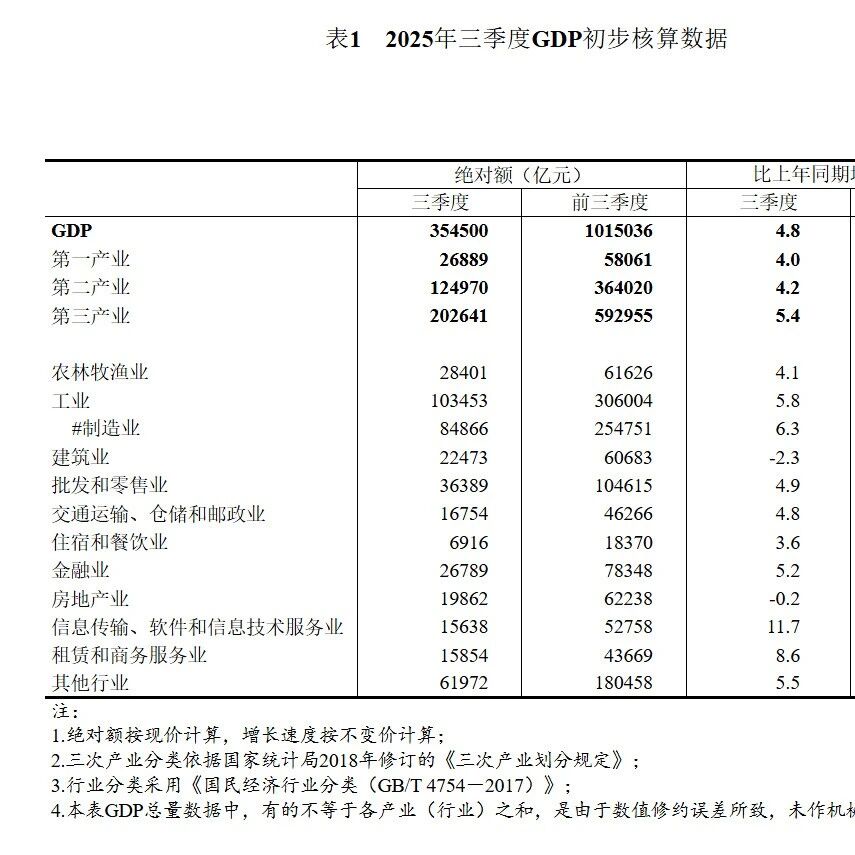
【数据发布】2025年三季度国内生产总值初步核算结果
中汽协会数据· 2025-10-22 03:35
Core Viewpoint - The article provides an overview of China's GDP calculations for the third quarter of 2025, highlighting growth rates across various sectors and the overall economic performance compared to previous periods [2][4]. GDP Overview - China's GDP for Q3 2025 is estimated at 35,450 billion yuan, with a year-on-year growth of 4.8% and a growth of 5.2% for the first three quarters [2]. - The primary industry shows a growth of 4.0%, while the secondary industry grows at 4.2%, and the tertiary industry leads with a growth of 5.4% [2]. Sector Performance - The agricultural sector (including agriculture, forestry, animal husbandry, and fishery) has a GDP of 28,401 billion yuan, growing by 4.1% year-on-year [2]. - The manufacturing sector shows a robust growth of 6.3%, with a GDP of 84,866 billion yuan [2]. - The construction industry, however, faces a decline with a growth rate of -2.3% [2]. - The financial sector grows by 5.2%, contributing 26,789 billion yuan to the GDP [2]. - The information transmission, software, and IT services sector exhibits significant growth at 11.7% [2]. Historical Context - The article compares the current GDP growth rates with historical data, indicating a recovery trend from the pandemic lows in 2020, where Q1 saw a decline of -6.8% [4][6]. - The GDP growth rates for 2023 are projected to be 4.7% in Q1, 6.5% in Q2, and 5.0% in Q3, indicating a stable economic recovery [4]. Calculation Methodology - The GDP is calculated using the production method, which reflects the value added by various sectors after deducting intermediate consumption [8][9]. - The article outlines the three methods of GDP calculation: production, income, and expenditure, emphasizing the production method as the basis for the quarterly GDP data [8][9]. Data Quality and Release - The article discusses the importance of data quality in GDP calculations, ensuring that the statistics accurately reflect economic conditions [35][36]. - Quarterly GDP data is released approximately 15 days after the end of the quarter, with final revisions published in January of the following year [39][41].

利好来了!刚刚,上海重磅发布!
券商中国· 2025-10-21 12:48
Core Viewpoint - The Shanghai government has released an action plan to promote high-quality development in the construction industry, focusing on enterprise integration, international expansion, and digital transformation [1][3][7]. Group 1: Enterprise Integration and Upgrading - The action plan encourages construction companies to integrate similar businesses, achieve differentiated competition, and complement each other in the supply chain [1][3]. - It aims to establish construction groups with full industry chain capabilities, targeting the consolidation of at least three groups comparable to the ENR Top 250 global contractors [3]. Group 2: Real Estate and Infrastructure Development - The plan emphasizes stabilizing real estate investment and promoting the construction of high-quality housing, including the development of high-performance components [3][4]. - It outlines the need to accelerate major engineering projects, focusing on those that can drive growth, investment, and improve living standards [3][4]. Group 3: Digital Transformation and Industrialization - The action plan promotes the digitalization and smart transformation of the construction industry, advocating for the extensive use of BIM technology throughout the project lifecycle [4]. - It encourages the industrialization of construction methods, particularly through prefabricated buildings and smart construction, with financial support for qualifying projects [4]. Group 4: Urban Renewal and Innovation - The plan accelerates urban renewal initiatives, enhancing the sustainability of urban development and optimizing project generation mechanisms [6]. - It supports innovative revenue models for construction companies, promoting collaborative platforms and shared risk models in urban renewal projects [6]. Group 5: International Expansion - The action plan aims to optimize services for foreign engineering contracts, providing comprehensive support for companies looking to expand internationally [7]. - It encourages state-owned enterprises to lead international market expansion in collaboration with small and private construction firms [7]. Group 6: Market Outlook - Analysts predict that the construction industry will see marginal improvements due to the commencement of key national projects and the implementation of debt policies [1][7]. - Investment opportunities are expected to arise in urban renewal, high-quality construction, and new infrastructure, particularly in western regions of China [7].

上海:支持传统建筑企业拓展能源、水利、环境等基建市场
Zheng Quan Shi Bao Wang· 2025-10-21 11:16
人民财讯10月21日电,上海市人民政府办公厅印发《上海市促进建筑业高质量发展加快培育增长新动能 行动方案》,其中提出,推动城市运营赋能建筑企业发展。推进城市老化管道更新改造。提升房屋修 缮、城市基础设施(路桥隧)运维、城市安全(水电气)运维三类队伍能力,推行政企合作的运维管理服务 模式。支持传统建筑企业拓展能源、水利、环境等基建市场。鼓励参与长三角新型能源体系建设,支持 进入固废资源化利用、海绵城市建设、生态修复等细分市场。 ...
9月宏观数据分析:9月数据有喜有忧,PPI、M1增速持续回升
Xi Nan Qi Huo· 2025-10-21 08:23
Report Industry Investment Rating No information provided. Core Viewpoints of the Report - The macro - data in September were mixed, and the recovery momentum needed to be strengthened. The domestic economic recovery couldn't be achieved overnight, and the economy showed a state of having a bottom but lacking upward momentum. Macroeconomic policies should increase support to boost market confidence. "Promoting domestic demand and combating involution" would be important long - term policy focuses. The financial market was in a state of "weak reality, strong expectation", and in 2025, the macro - economy and asset prices were expected to continue the upward - repair trend [3][38]. Summary by Relevant Catalogs 1. Manufacturing PMI Rebounded Month - on - Month but Remained Below the Threshold - In September, the manufacturing PMI was 49.8%, up 0.4 percentage points from the previous month. Large - scale enterprises' PMI was 51.0%, up 0.2 percentage points; medium - sized enterprises' PMI was 48.8%, down 0.1 percentage points; small - sized enterprises' PMI was 48.2%, up 1.6 percentage points. Among the 5 sub - indexes, the production index and supplier delivery time index were above the threshold, while the new order index, raw material inventory index, and employment index were below it [4]. - The non - manufacturing business activity index in September was 50.0%, down 0.3 percentage points from the previous month. The construction industry's business activity index was 49.3%, up 0.2 percentage points, and the service industry's was 50.1%, down 0.4 percentage points. Overall, the manufacturing was still below the threshold, indicating low prosperity, significant demand contraction, and insufficient economic recovery momentum [7]. 2. In September, CPI Declined 0.3% Year - on - Year and PPI Fell 2.9% Year - on - Year, Both Showing Improvement - In September 2025, the national CPI decreased 0.3% year - on - year. The average CPI from January to September was 0.1% lower than the same period last year. The CPI increased 0.1% month - on - month. Food prices decreased 4.4% year - on - year and increased 0.7% month - on - month [8][9]. - In September, the national PPI decreased 2.3% year - on - year, with the decline narrowing by 0.6 percentage points compared to the previous month, and remained flat month - on - month. The average PPI from January to September was 2.8% lower than the same period last year. Industries such as coal, ferrous metals, and petrochemicals had large year - on - year declines, dragging down the PPI [11]. 3. In September, Imports and Exports Maintained High Growth Rates - In September, China's total import and export volume was $566.68 billion, a year - on - year increase of 7.9%. Exports were $328.57 billion, up 8.3% year - on - year, and imports were $238.12 billion, up 7.4% year - on - year. The trade surplus was $90.45 billion, an increase of $8.69 billion compared to the same period last year [13]. - In terms of countries, in September, China's exports to the US were $34.308 billion, with a year - on - year growth rate of - 16.1%; exports to the EU were $49.22 billion, with a growth rate of 7.6%; exports to ASEAN countries were $58.235 billion, up 16.9% year - on - year; and exports to Japan were $13.435 billion, with a year - on - year growth rate of 6.6%. Exports to ASEAN were gradually replacing those to the US [15]. - Since the second quarter, exports have been stronger than expected, showing strong resilience. In 2025, exports were likely to remain strong. The real risk for China's foreign trade was the potential decline in demand due to the increased risk of a US economic recession and the slowdown of the global economy [16]. 4. Credit Demand was Weak, and the Growth Rates of M1 and M2 Further Increased - At the end of September 2025, the stock of social financing scale was 437.08 trillion yuan, a year - on - year increase of 8.7%. The balance of RMB loans to the real economy was 267.03 trillion yuan, up 6.4% year - on - year. The balance of foreign - currency loans to the real economy was 1.18 trillion yuan, down 18% year - on - year [18]. - In the first three quarters of 2025, the cumulative increase in social financing scale was 30.09 trillion yuan, 4.42 trillion yuan more than the same period last year. The increase in RMB loans to the real economy was 14.54 trillion yuan, 851.2 billion yuan less than the same period last year [18]. - In terms of residents' credit in September, short - term loans increased by 142.1 billion yuan, 127.9 billion yuan less than the same period last year; medium - and long - term loans increased by 250 billion yuan, 20 billion yuan more than the same period last year. In terms of enterprises' credit, short - term loans increased by 710 billion yuan, 250 billion yuan more than the same period last year; medium - and long - term loans increased by 910 billion yuan, 50 billion yuan less than the same period last year; bill financing decreased by 402.6 billion yuan, 471.2 billion yuan less than the same period last year [19][21]. - At the end of September, the balance of broad - money (M2) was 335.38 trillion yuan, a year - on - year increase of 8.4%. The balance of narrow - money (M1) was 113.15 trillion yuan, a year - on - year increase of 7.2%. The M1 - M2 gap narrowed to - 1.2%, indicating an improvement in macro - liquidity [22]. 5. Industrial Production Accelerated, while Consumption and Investment Growth Rates Continued to Decline - In September, the value - added of industrial enterprises above the designated size increased by 6.5% year - on - year, and 0.64% month - on - month. From January to September, it increased by 6.2% year - on - year [25]. - In September, the total retail sales of consumer goods were 4,197.1 billion yuan, a year - on - year increase of 3.0%. From January to September, the total retail sales of consumer goods were 36,587.7 billion yuan, a year - on - year increase of 4.5%. The consumption growth rate further declined in September, affected by policies and subsidy withdrawal, as well as the drop in oil prices [25][26]. - From January to September 2025, the national fixed - asset investment (excluding rural households) was 37,153.5 billion yuan, a year - on - year decrease of 0.5%. Private fixed - asset investment decreased by 3.1% year - on - year. The growth rates of manufacturing investment, infrastructure investment, and real - estate development investment continued to decline [28]. 6. The Growth Rate of Real - Estate Sales Continued to Decline and was Moving Towards Stabilization - From January to September, the sales area of newly - built commercial housing was 658.35 million square meters, a year - on - year decrease of 5.5%; the sales volume was 6,304 billion yuan, a year - on - year decrease of 7.9%. In September, the growth rates of real - estate sales volume and area continued to decline, and the real - estate market was still in the adjustment stage [30]. - From January to September, the construction area of real - estate development enterprises was 6.4858 billion square meters, a year - on - year decrease of 9.4%. The new - construction area was 453.99 million square meters, a year - on - year decrease of 18.9%. The completed area was 311.29 million square meters, a year - on - year decrease of 15.3% [32]. - In September, the real - estate market continued the downward trend since the second and third quarters. However, the year - on - year decline in the sales area and volume of commercial housing was narrowing, and the inventory - reduction effect was emerging. The real - estate market was moving towards stabilization. The year - on - year decline in the sales area and volume of commercial housing would further narrow as the base decreased [34]. - At the end of September, the unsold area of commercial housing was 759.28 million square meters, 2.41 million square meters less than at the end of August. The real - estate development climate index in September was 92.78, showing a slight decline month - on - month. There was still room for further strengthening of real - estate policies, and the "market bottom" of this real - estate downward cycle was emerging. The first half of 2026 was expected to be a critical period for the real - estate market to stabilize [35][36][37].
国家统计局公布2025年三季度国内生产总值初步核算结果
Mei Ri Jing Ji Xin Wen· 2025-10-21 01:49
Core Insights - The National Bureau of Statistics reported a preliminary calculation of GDP for Q3 2025, indicating a year-on-year growth of 4.8% [1] - The information transmission, software, and information technology services industry experienced a significant growth of 11.7% year-on-year in Q3 [1] GDP Overview - Q3 GDP reached 354,500 billion, with a cumulative total of 1,015,036 billion for the first three quarters [3] - The growth rates for various sectors in Q3 include: - Primary industry: 4.0% - Secondary industry: 4.2% - Tertiary industry: 5.4% [3] Sector Performance - Information transmission, software, and information technology services industry: - Q3 revenue: 15,638 billion - Year-on-year growth: 11.7% - First three quarters revenue: 52,758 billion [3] - Other notable sectors: - Manufacturing: 6.3% growth - Wholesale and retail: 4.0% growth - Real estate: -0.2% growth [3]
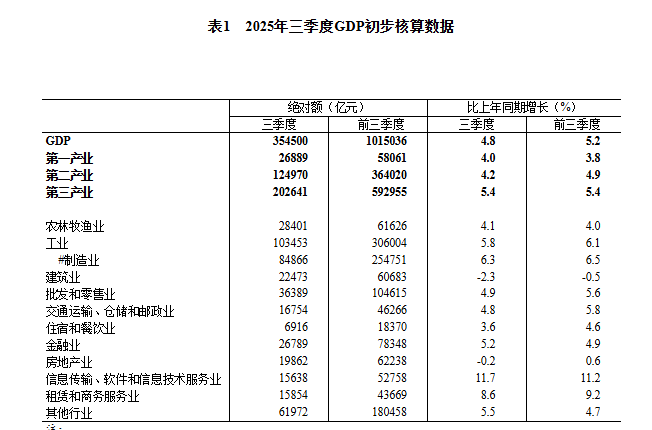
2025年三季度国内生产总值初步核算结果
Guo Jia Tong Ji Ju· 2025-10-21 01:30
Core Points - The preliminary GDP results for the third quarter of 2025 indicate a GDP of 354,500 billion with a year-on-year growth of 4.8% and a growth of 5.2% for the first three quarters [8][5][4] - The primary industry grew by 4.0%, the secondary industry by 4.2%, and the tertiary industry by 5.4% in the third quarter [8][5] - The manufacturing sector showed a robust growth of 6.3%, while the construction industry faced a decline of 2.3% [8][5] GDP Growth Rates - Year-on-year growth rates for GDP from 2020 to 2025 show fluctuations, with 2025 projected to have a growth of 5.4% in Q1, 5.2% in Q2, and 4.8% in Q3 [5][4] - The quarterly growth rates indicate a consistent recovery post-pandemic, with 2023 showing a growth of 4.7% in Q1 and 6.5% in Q2 [5][4] Industry Performance - The agricultural sector (including forestry, animal husbandry, and fishery) reported a growth of 4.1% in Q3 2025 [8] - The industrial sector, particularly manufacturing, continues to be a strong contributor to GDP, with a growth rate of 6.3% [8] - The financial sector also showed positive growth at 5.2%, while the real estate sector faced challenges with a slight decline of 0.2% [8] Data Sources and Methodology - The GDP data is calculated using the production method, which reflects the value added by various industries [12][11] - The classification of industries follows the national standards set by the National Bureau of Statistics, ensuring consistency in reporting [22][23] - The GDP figures are subject to revisions as more comprehensive data becomes available, ensuring accuracy in reflecting economic conditions [33][34]
富达国际:高市早苗任日本首相几成定局,日股仍有上升潜力
2 1 Shi Ji Jing Ji Bao Dao· 2025-10-20 13:43
Group 1: Political and Economic Context - The new leader of Japan's ruling Liberal Democratic Party, Sanae Takaichi, supports fiscal stimulus and loose monetary policy, which is expected to benefit the Japanese stock market and pose a downside risk to the yen [1] - Following a period of uncertainty, Takaichi is likely to become Japan's first female Prime Minister, which has reignited market enthusiasm for the "Takaichi trade," leading to a significant rise in the Nikkei 225 index by 3.37% [1] - Despite political changes, the framework supporting Japan's economic growth remains solid, and the country is unlikely to revert to deflation [2] Group 2: Inflation and Economic Growth - Japan is transitioning from a deflationary environment to a moderate inflation scenario, with core inflation expected to exceed 3% by early 2025 and decline to around 2% by the end of next year [2] - The shift towards inflation is increasingly driven by wage growth and coordinated policies between the government and the central bank, rather than solely by rising costs [2][3] Group 3: Corporate Governance and Shareholder Returns - Corporate governance reforms are reshaping Japanese companies' capital allocation and shareholder return attitudes, with a significant increase in share buybacks projected for the 2024 fiscal year, up nearly 90% year-on-year [6] - Japanese companies are increasingly focusing on improving capital efficiency and enhancing communication with investors, leading to a structural growth theme in the stock market [6][7] - The average return on equity for Japanese companies is expected to rise from 6%-8% in the 2000s to 10% by the 2026 fiscal year and potentially 11% by the 2028 fiscal year [7] Group 4: Sector-Specific Opportunities - The banking sector is benefiting from a favorable environment characterized by strong net interest margins and low borrowing costs, leading to improved profitability and return on equity [8] - The construction industry is also showing promising investment prospects, with contractors focusing on high-margin projects and improving profit margins due to a tight labor market [8] - Digital transformation remains a key structural growth theme, with Japanese companies accelerating automation to address labor challenges posed by an aging population [9]