
能源

Search documents
年末通胀加速回升,什么信号?
HUAXI Securities· 2026-01-09 12:05
Inflation Data Summary - December 2025 CPI year-on-year increased to 0.8%, matching expectations and up from 0.7% in the previous month[1] - Month-on-month CPI rose by 0.2%, a significant improvement from -0.1% in the prior month, marking the largest increase for December since 2021[1] - Core CPI, excluding food and energy, remained stable at 1.2% year-on-year, with a month-on-month increase of 0.2%[1] Core CPI Analysis - Core CPI has shown resilience, supported mainly by industrial consumer goods, maintaining a 1.2% increase for four consecutive months[2] - Prices of industrial consumer goods rose by 0.6%, contributing approximately 0.16 percentage points to the CPI increase[2] - Notable contributors include household appliances (1.4% increase), other goods and services (2.8% increase), and communication tools (3.0% increase) in December[2] Food Price Trends - Food prices increased by 0.3% month-on-month, contributing about 0.05 percentage points to the CPI, slightly above the 2021-2024 average of 0.1%[3] - Fresh vegetables and fruits saw significant increases of 0.8% and 2.6%, respectively, while pork prices continued to decline by 1.2%[3] - As of January 8, 2026, pork wholesale prices have risen by 1.9% compared to December 2025, indicating potential stabilization[3] Housing and Energy Impact - Housing prices decreased by 0.1% month-on-month, negatively impacting CPI due to its high weight of approximately 22%[4] - Fuel prices for transportation fell by 1.1%, contributing to a 0.04 percentage point decrease in CPI[4] PPI Insights - December PPI increased by 0.2% month-on-month, indicating a recovery in industrial prices after a low period[4] - The mining sector saw a 0.8% increase, while raw materials rose by 0.6%, marking a 19-month high[5] - The overall PPI remains under pressure from declining oil prices, with the oil and gas extraction sector experiencing a 1.3% drop[6] Market Implications - Current inflation levels are moderate, suggesting no immediate constraints on "loose monetary policy" but limiting the downward space for long-term interest rates[8] - Industrial price recovery is a positive signal for improving profit expectations, although a broad-based price increase has not yet materialized[8] Risk Factors - Potential unexpected adjustments in monetary policy could arise from economic slowdowns or changes in overseas monetary policies[9] - Liquidity may also experience unexpected changes if domestic economic data continues to exceed expectations[9]
工业智能化进入新时期,西半球地缘博弈加剧
Southwest Securities· 2026-01-09 10:32
Domestic Developments - The People's Bank of China (PBOC) maintains a "moderately loose" monetary policy for 2026, focusing on precision and coordination to support economic growth and structural transformation[10] - The Ministry of Industry and Information Technology (MIIT) has launched an action plan for the integration of industrial internet and artificial intelligence, marking a new phase in industrial intelligence development[12] - A green consumption promotion plan was issued, aiming to stimulate domestic demand and support the transition to a circular economy[9] International Developments - The U.S. ISM Manufacturing PMI fell to 47.9 in December, marking the largest contraction since 2024, with inventory reduction being a major drag[18] - The Eurozone's harmonized CPI fell to 2% in December, indicating a return to target levels, while core inflation remains resilient[20] - The U.S. has initiated a global sale of Venezuelan oil, which may disrupt global energy trade and escalate geopolitical tensions[22] Market Trends - Brent crude oil prices increased by 0.94% week-on-week, while iron ore and copper prices rose by 1.88% and 3.60%, respectively[24] - Domestic real estate sales saw a significant decline of 62% week-on-week, indicating ongoing challenges in the sector[24] - The DXI index for storage DRAM prices rose by 7.45% week-on-week, reflecting positive trends in emerging industries[33]
胜通能源龙虎榜数据(1月9日)
Zheng Quan Shi Bao Wang· 2026-01-09 09:35
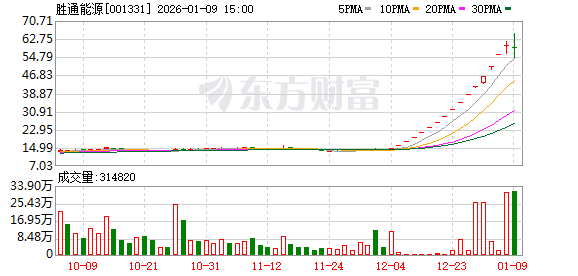
Group 1 - The stock of Victory Energy declined by 2.48% with a turnover rate of 15.97% and a transaction amount of 1.81 billion yuan, showing a volatility of 20.15% throughout the day [2] - Institutional investors net bought 39.45 million yuan while brokerage seats collectively net sold 40.34 million yuan [2] - The stock has appeared on the daily trading list 14 times in the past six months, with an average price increase of 3.45% the day after being listed and an average increase of 18.33% over the following five days [2] Group 2 - The main capital outflow for the stock today was 84.03 million yuan, with large orders contributing to a net outflow of 49.89 million yuan and 34.14 million yuan from big orders [2] - The top five brokerage seats accounted for a total transaction amount of 251 million yuan, with a buying amount of 125 million yuan and a selling amount of 126 million yuan, resulting in a net selling of 0.89 million yuan [2] - Specific institutional buying included 38.24 million yuan and 33.24 million yuan from two specialized seats, while selling from the same seats amounted to 13.58 million yuan and 18.45 million yuan respectively [2]

加拿大2025年10月商品贸易逆差5.83亿加元 由顺差逆转
Xin Lang Cai Jing· 2026-01-09 09:24
Core Insights - Canada's global merchandise trade deficit reached 583 million CAD in October 2025, shifting from a surplus in September 2025 due to increased import growth [1] - The import value in October 2025 was 66.2 billion CAD, a month-on-month increase of 3.4%, while exports were 65.6 billion CAD, rising by 2.1% [1] - The trade balance shifted from a surplus of 24.3 million CAD in September 2025 to a deficit of 583 million CAD in October 2025 [1] Import Dynamics - The import of electronic and electrical equipment components surged by 10.2%, with computer and peripheral equipment imports increasing by 32.2%, reaching a historical high due to a rise in processors imported from Ireland [1] - Imports of telecommunications and audio-video equipment also increased significantly, driven by a substantial rise in smartphone imports from China and the United States [1] - The import of metal and non-metal mineral products grew by 9.5%, with unrefined gold, silver, and platinum group metals imports soaring by 55.3% [1] Export Trends - In October 2025, exports of metal and non-metal mineral products increased by 27.3%, marking a new high [1] - Exports of automobiles and parts rose by 4.1%, while energy product exports fell by 8.4%, which limited the overall growth in export value [1] Trade with the United States - Canada's trade surplus with the United States significantly narrowed, with exports to the U.S. declining by 3.4% and imports increasing by 5.3%, resulting in a surplus reduction from 8.4 billion CAD in September 2025 to 4.8 billion CAD in October 2025 [2] - For the first ten months of 2025, total exports to the U.S. decreased by 4.1% year-on-year [2] - The fluctuations in Canadian exports are attributed to high tariffs imposed by the U.S. on key sectors such as steel, aluminum, automobiles, and lumber [2] Diversification of Trade Partners - In October 2025, exports to countries outside the U.S. increased by 15.6%, reaching a historical high, indicating Canada's efforts to diversify its trade partners [2] - Imports from countries outside the U.S. also saw a slight increase of 0.6% [2]
法国11月家庭消费意外环比下降0.3% 能源支出成主要拖累
Xin Hua Cai Jing· 2026-01-09 09:10
Core Insights - In November 2025, French household consumption unexpectedly declined by 0.3% month-on-month, contrary to market expectations of a 0.2% increase, marking the first monthly negative growth since July 2025 [1] Consumption Breakdown - The decline in consumption was primarily driven by a significant reduction in energy expenditures, which fell by 2.0% month-on-month due to decreased natural gas and electricity usage, as well as a drop in oil product purchases [1] - Food expenditures also saw a 0.2% month-on-month decrease, with some agricultural product consumption rising but being offset by a sharp decline in processed food products [1] - In contrast, spending on manufactured goods showed relative strength, increasing by 0.4% month-on-month, supported by higher expenditures on durable goods and a rebound in textiles and clothing [1] Yearly Perspective - Year-on-year, household consumption remained flat, indicating a stagnation in overall consumption momentum for the year [1] - Analysts noted that the cautious spending behavior of French households is influenced by ongoing inflationary pressures and limited real wage growth, particularly affecting non-essential categories in energy and food [1] Economic Implications - The unexpected decline in consumption data may pose downside risks to France's economic growth in the fourth quarter and has prompted a reassessment of the resilience of domestic demand [1]
宏观经济专题研究:十张图看大宗品开年狂欢
Guoxin Securities· 2026-01-09 08:01
Group 1: Commodity Market Trends - The global commodity market has experienced a structural uptrend since late 2025, led by industrial and precious metals, while traditional cyclical products have shown lackluster performance[1] - LME copper prices surged from below $8,000/ton to over $13,000/ton, marking a cumulative increase of over 60%, despite the US manufacturing PMI remaining in a contraction zone of 48.2%-48.3%[2] - The divergence between commodity prices and manufacturing demand indicates a decoupling from traditional manufacturing cycles, driven by rising geopolitical uncertainties and trade protectionism[2][14] Group 2: Demand Dynamics and Economic Shifts - The current market is characterized by extreme differentiation among commodities, with indicators like the copper-oil ratio exceeding two standard deviations, reflecting a fundamental shift in global economic growth models[3][27] - The transition from a traditional growth model centered on real estate and infrastructure to a digital economy model focused on "computing power + electricity" is reshaping demand for commodities[3][31] - Major tech companies are expected to maintain over 20% capital expenditure growth in AI infrastructure, significantly impacting demand for conductive materials like copper and silver[31][33] Group 3: Future Outlook and Risks - The commodity market is entering a new phase driven by "computing power + security," where geopolitical risks create a safety premium, enhancing the financial attributes of commodities[4][34] - Short-term risks include potential price corrections for certain commodities that have surged too quickly, possibly overshooting future demand expectations[4][37] - Ongoing volatility in overseas markets and declining economic growth rates pose additional risks to the commodity landscape[5][38]
年报预告折射冷暖,A股业绩大分化
Huan Qiu Wang· 2026-01-09 07:54
Core Viewpoint - The A-share market is experiencing a mixed performance in the 2025 earnings forecast period, with over 60% of companies showing growth resilience, while a clear divergence in performance is emerging among listed companies [1][2]. Group 1: Earnings Forecasts - Since January 2026, at least 35 A-share companies have disclosed their 2025 earnings forecasts, with a significant portion indicating positive growth [1]. - A wave of pre-loss announcements was made on January 8, with eight companies, including Guo New Energy and Jiyou Co., indicating expected losses due to industry cycle fluctuations and market environment changes [2]. Group 2: Industry Performance - Traditional industries, particularly in energy and chemicals, are facing significant challenges, with companies like Zhonghua International reporting a net loss of 1.331 billion yuan for the first three quarters of 2025 due to falling product prices [2]. - In contrast, leading companies in high-growth sectors such as military, gold, high-end manufacturing, and new energy are experiencing substantial earnings growth, with firms like Huayou Cobalt expecting a net profit of 5.85 billion to 6.45 billion yuan, a year-on-year increase of 40.80% to 55.24% [4][5]. Group 3: Sector Highlights - The new energy and non-ferrous metals sectors are identified as the main drivers of earnings growth, with companies like Zhongcai Technology projecting a net profit increase of 73.79% to 118.64% [4]. - The military and gold sectors are also seeing significant growth, with Beifang Navigation estimating a net profit of 110 million to 140 million yuan, reflecting an increase of 86.32% to 137.14% [4][5]. - High-end manufacturing is showing positive trends, with companies like Ding Tai High-Tech expecting a net profit growth of 80.72% to 102.76% due to increased demand in the server and data center markets [5].
当今有四个国家最危险,一是印度,二是土耳其,另外两个才是重点
Sou Hu Cai Jing· 2026-01-09 06:05
Group 1 - The global situation is increasingly complex, with major powers pulling in different directions, leaving smaller countries like India and Turkey in difficult positions [1] - India faces economic challenges due to increased tariffs from the US on key exports, particularly textiles and pharmaceuticals, which are critical to its economy [3] - The relationship between India and Pakistan remains tense, with border conflicts exacerbating India's economic woes and leading to a rising unemployment rate of 14% [3] - Turkey's geopolitical position is precarious, as it attempts to mediate in the Russia-Ukraine conflict while facing internal challenges such as high inflation and the aftermath of a recent earthquake [5] - Japan's defense budget has reached a record 9 trillion yen (approximately 58 billion USD) in response to perceived threats from China, indicating a shift towards militarization [7] - Germany's economy is severely impacted by the loss of cheap Russian gas, with GDP growth projected at only 0.2% in 2025, leading to industrial decline and rising unemployment [9] Group 2 - The underlying risks for these countries stem from their inability to find a stable position amid great power competition, with India and Turkey struggling to maintain neutrality [11] - Japan's increased military spending and strategic reforms are seen as direct responses to threats from China, raising concerns about potential military conflict [7][11] - Germany's energy crisis and manufacturing exodus highlight its vulnerability in the current geopolitical landscape, affecting not only its economy but also the stability of the EU [9][11]

太原市阳曲县市场监督管理局2025年工业品质量抽检第二期结果公示
Zhong Guo Zhi Liang Xin Wen Wang· 2026-01-09 05:23
Core Insights - The second phase of product quality inspection in Yangqu County, Taiyuan, was conducted in 2025, involving 70 batches of various products, including automotive fuels, electric bicycle batteries, and clothing, with 67 batches passing and 3 failing the quality tests [2][3][4] Group 1: Inspection Results - A total of 70 batches were tested, with 67 passing and 3 failing [2][3] - The failed products included a heating pad and a knitted underwear product, indicating potential quality control issues in these categories [4] Group 2: Product Categories - The inspected products included automotive gasoline, diesel, electric bicycle batteries, heating pads, reading glasses, clothing, gas stoves, and building insulation materials [2][3] - Specific products that passed the inspection included various types of cement, safety helmets, and food-grade plastic wrap, showcasing compliance in essential consumer goods [2][3][4]
五部门联合印发《工业绿色微电网建设与应用指南(2026—2030年)》
Xin Lang Cai Jing· 2026-01-09 03:15
Core Viewpoint - The article discusses the release of the "Guidelines for the Construction and Application of Industrial Green Microgrids (2026-2030)" by five Chinese government departments, aimed at promoting the construction and application of industrial green microgrids to enhance green electricity usage and reduce carbon emissions in key industrial sectors [1][2]. Group 1: Guidelines Overview - The guidelines are designed to guide industrial enterprises and parks in advancing the construction and application of industrial green microgrids, focusing on energy conservation and carbon reduction in key industrial sectors [1]. - The guidelines emphasize the integration of renewable energy sources such as solar, wind, and hydrogen, along with advanced energy management systems, to create a comprehensive energy system that interacts positively with industrial production processes [1][2]. Group 2: Key Principles and Application Scenarios - The guidelines outline five fundamental principles: promoting efficient multi-energy complementary use, enhancing local renewable energy consumption, improving interaction with the power grid, ensuring industrial load regulation capabilities, and advancing intelligent system management [2]. - Different application scenarios for industrial green microgrids are categorized into four types based on energy consumption characteristics: high energy load, flexibility, adjustability, and high reliability, with specific load characteristics and functional requirements provided for each scenario [2]. Group 3: Technical Guidance and Implementation - The guidelines serve as a technical directive to help industrial enterprises and parks understand the construction content, models, and application scenarios of industrial green microgrids, encouraging market participants to engage in project implementation [3]. - It is emphasized that project construction and operation must adhere to safety regulations and standards, ensuring compliance with existing policies related to microgrids and green electricity connections [3].