
文体娱乐

Search documents
三部门:完善“1+N”政策措施体系,加大服务消费政策支持力度
Sou Hu Cai Jing· 2025-12-14 07:50
Core Viewpoint - The Ministry of Commerce and two other departments have issued a notice to strengthen the collaboration between commerce and finance, aiming to boost consumption more effectively, particularly in the service sector [1] Group 1: Policy Measures - The notice emphasizes the expansion of service consumption and the improvement of the "1+N" policy measures system, increasing support for service consumption policies [1] - It highlights the need to innovate financial products and services that are more integrated into consumption scenarios and ecosystems, particularly in key service areas such as housekeeping, accommodation, dining, entertainment, education, tourism, and elderly care [1] Group 2: Financial Support - Financial institutions are encouraged to strengthen connections with service consumption and elderly care sectors, actively providing loans to businesses in these areas under the premise of independent decision-making [1] - The establishment of a mechanism to promote key enterprises, projects, and activities to financial institutions is proposed, aiming to facilitate better financing opportunities [1] Group 3: Financing Innovations - The notice calls for the expansion of financing services based on intangible assets like intellectual property and technological achievements, enhancing the variety of financial products suitable for small and micro enterprises [1] - It also suggests the development of commercial insurance products, including annuities, health insurance, and accident insurance, to improve the adaptability of finance to service consumption and optimize service supply [1]
4只当代系鄂股“历史遗留问题”落地,易主后业绩变化如何
第一财经· 2025-12-13 09:47
Core Viewpoint - Renfu Pharmaceutical (600079.SH) is facing a fine of 17.5 million yuan due to violations associated with its former controlling shareholder, Dongdai Group, marking a significant step towards resolving its historical issues and enabling the company to pursue a "third entrepreneurship" under the control of China Merchants Group [3][4][10]. Group 1: Company Developments - Renfu Pharmaceutical will be suspended from trading for one day on December 15, 2025, and will be subject to risk warnings starting December 16, 2025, with its A-share name changing to "ST Renfu" [3]. - The company has reported a revenue of 17.883 billion yuan for the first three quarters of the year, with a year-on-year net profit growth of 6.22%, ending a two-year decline [10]. - The company has successfully rectified the violations mentioned in the administrative penalty notice, ensuring that future operations will not be affected [10]. Group 2: Historical Context and Debt Crisis - Dongdai Group, once the largest private enterprise group in Hubei, controlled four A-share listed companies and had total assets exceeding 100 billion yuan at its peak in 2015 [6]. - The group faced a debt crisis, leading to a bankruptcy restructuring application in September of the previous year, with debts exceeding 80 billion yuan involving over 1,100 creditors [8]. - The restructuring process has seen the transfer of control of its listed companies to state-owned enterprises, with Renfu Pharmaceutical being a key asset in this transition [7][8]. Group 3: Performance of Related Companies - After the change in control, Santai Cable (002159.SZ) turned from a significant loss to a profit exceeding 100 million yuan, while ST Mingcheng (600136.SH) experienced a dramatic increase in revenue post-restructuring [4][10]. - Tianfeng Securities has shown volatility in its revenue, with a drop to 1.721 billion yuan in 2022, followed by a recovery to 3.427 billion yuan in 2023, and fluctuations expected in the coming years [11].



借力资本市场 多地加码金融支持扩消费
Zhong Guo Zheng Quan Bao· 2025-11-24 20:13
Core Insights - Recent policies in multiple regions focus on financial support to expand consumption, particularly emphasizing the listing of consumer enterprises and guiding financial institutions to utilize consumption and elderly re-loan services effectively [1][2] Group 1: Support for Quality Consumer Enterprises - Supporting the listing of quality consumer enterprises is a key focus of financial policies in various regions, which aims to enhance corporate credibility, expand quality supply, and optimize consumption structure to meet diverse demands [1][2] - As of November 24, 2023, 18 consumer enterprises have been listed domestically this year, including 13 automotive companies, 2 light manufacturing companies, 1 machinery equipment company, 1 textile and apparel company, and 1 electronics company [2] Group 2: Increased Credit Support - In addition to leveraging capital markets, regions are increasing credit support for consumer enterprises, with initiatives encouraging financial institutions to enhance credit allocation in key consumption sectors such as accommodation, dining, cultural and entertainment, and tourism [2][3] - Experts believe that increasing credit support for consumer enterprises will promote healthy development in service consumption and elderly re-loan sectors, injecting momentum into the recovery of the consumption market [3] Group 3: Tailored Financial Strategies - The financing needs of consumer enterprises are diverse, necessitating precise financial support strategies tailored to different types of enterprises, such as enhancing trade-in financing services for goods consumption enterprises and increasing credit support for service consumption enterprises [3] - Recommendations include expanding the scale of service consumption re-loans, focusing on sectors like cultural tourism and elderly care, and adjusting subsidy structures to favor upgraded consumption such as smart terminals and green appliances [4]
展示消费新动能 华熙LIVE·重庆亮相文旅贸促活动
Sou Hu Cai Jing· 2025-11-24 08:43
Core Insights - The "Colorful China, Good Festival Goods" cultural and tourism trade promotion event was held in Chongqing, showcasing new consumption dynamics in the fashion sector [1][3] - The event aims to integrate foreign trade enterprises, merchants, cross-border e-commerce, and media resources to promote high-quality cultural and tourism products [1][3] Group 1: Event Overview - The event is themed "Art Appreciation in Bayu, Fashion Life" and aligns with the 14th China Arts Festival, connecting fashion consumption with cultural trade and inbound tourism [3] - It featured a fashion consumption release and roadshow, presenting the "2025 China Fashion Consumption Report" and promoting various cultural products and services [3][5] Group 2: Business Impact - The general manager of Huaxi LIVE, Wen Wen, emphasized the importance of five ecological synergies in driving international urban development, with cultural sports as a core engine [5] - The Huaxi LIVE project has attracted over 10 million annual visitors, with 25% being international tourists, generating over 10 billion in related industry consumption [5] Group 3: Future Plans - Huaxi LIVE plans to continue attracting top-tier global events while enhancing local intellectual property incubation and output, facilitating a dual empowerment strategy for international urban development [6]
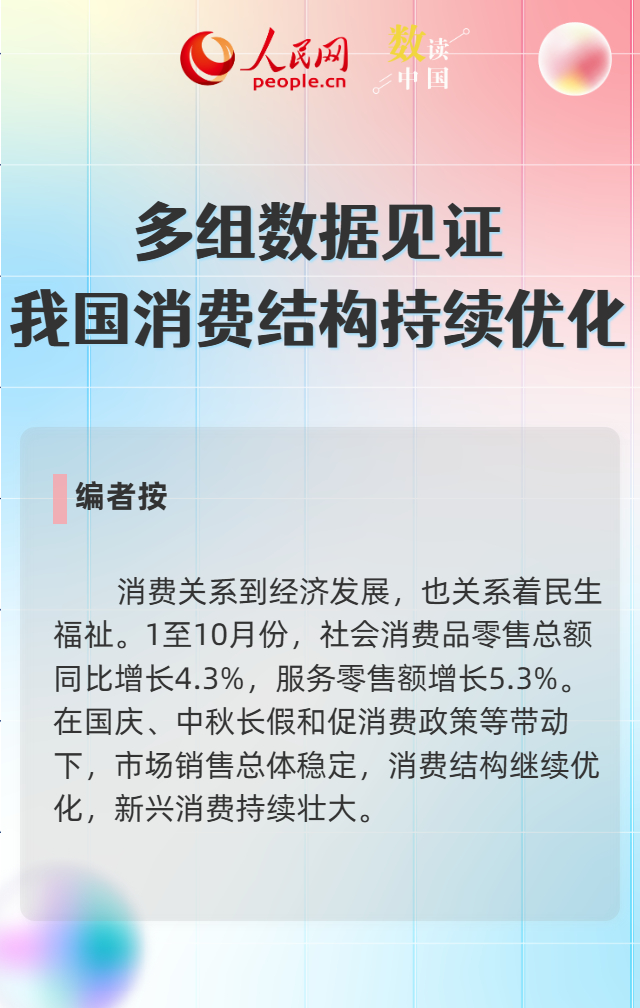
数读中国 多组数据见证我国消费结构持续优化
Ren Min Wang· 2025-11-22 01:02
Core Insights - China's consumption structure continues to optimize, with a retail sales growth of 4.3% year-on-year from January to October, and service retail sales increasing by 5.3% [1][5]. Group 1: Service Retail Growth - Service retail sales have accelerated, with a year-on-year growth of 5.3% from January to October, which is 0.1 percentage points faster than the previous period and 0.9 percentage points higher than goods retail sales growth [2]. - Travel-related consumption showed positive momentum, with restaurant income growing by 3.8% in October, an increase of 2.9 percentage points compared to September [3]. Group 2: Consumption Trends - Various service categories, including cultural, recreational, transportation, and tourism consulting, maintained a growth rate of over 10% [4]. - The consumption upgrade policy has positively impacted sales, with communication equipment retail sales increasing by 23.2% and cultural office supplies by 13.5% in October [5]. Group 3: Regional Sales Performance - County and rural markets outperformed urban areas, with rural retail sales growing by 4.1% in October, reflecting the popularity of rural tourism [6]. - From January to October, retail sales in counties and rural areas grew by 4.6%, surpassing urban growth rates [6]. Group 4: Basic Goods Sales - Basic living goods showed strong sales, with over 70% of categories in large retail units experiencing growth. Food retail sales increased by 8.0%, clothing by 6.3%, and daily necessities by 7.4% in October [7]. Group 5: Upgraded Consumption Demand - There is an increasing demand for upgraded products, with sports and entertainment goods retail sales growing by 10.1% and cosmetics by 9.6% in October [8]. Group 6: E-commerce Growth - Online retail sales grew by 9.6% from January to October, with physical goods online retail sales increasing by 6.3%, outpacing overall retail sales growth by 2.0 percentage points [9].
“十五五”开局之年,北京朝阳地区生产总值预计将破万亿元
Xin Jing Bao· 2025-11-20 13:27
Core Insights - Chaoyang District is projected to surpass a GDP of 1 trillion yuan by 2026, marking a significant milestone in its economic development [1][3] - The district has shown robust growth, with GDP increasing from 736.48 billion yuan at the end of the 13th Five-Year Plan to an estimated 923.01 billion yuan in 2024, accounting for nearly 20% of Beijing's total GDP [1][2] - Chaoyang District is a leader in various sectors, particularly in finance, which contributes around 20% to the district's GDP, and has seen a growth rate 6 percentage points higher than the city average in the first half of the year [2][3] Economic Performance - Fixed asset investment in Chaoyang has consistently remained above 100 billion yuan, with retail sales and local public budget revenues each accounting for about 20% of the city's totals [1] - The district hosts over 1,800 financial institutions, including nearly 400 foreign-funded entities, which represent 65% of the city's total [2] - The information and technology service sectors have increased their GDP contribution to 24.9%, up by 3.7 percentage points since the end of the 13th Five-Year Plan [2] Industry Development - Chaoyang District has focused on enhancing its leading industries, particularly in international finance, digital economy, and business services, resulting in 87 institutional innovations and 15 original reform measures that are being promoted nationwide [3] - The district has established itself as a hub for international business, hosting over 50% of the city's international conferences and more than one-third of international exhibitions [3] - Future development plans include over 16 million square meters of available space for urban integration and diverse functional areas to support business growth [3] Strategic Focus - During the 14th Five-Year Plan, Chaoyang aims to elevate its international development capabilities, leveraging technological innovation to enhance productivity and modernize its industrial system [3] - The district will continue to prioritize expanding domestic demand and promoting cultural prosperity while improving social welfare services [3]
“巨好看”“巨能玩”“巨划算”!宝安“湾区聚宝季”打造全域消费新体验
Sou Hu Cai Jing· 2025-11-09 10:38
Core Viewpoint - The "Bay Area Gathering Season" in Bao'an aims to promote consumption through a series of cultural, sports, and tourism activities from October to December, coinciding with the 15th National Games and the Special Olympics [1][3]. Group 1: Event Highlights - The "Bay Area Gathering Season" features three main segments: "Great to See," "Great to Play," and "Great Value," focusing on sports events, cultural performances, and consumer promotions [3][12]. - The "Great to See" segment includes various sports events such as men's U20 football, boxing, and marathons, alongside cultural performances and exhibitions [5][7]. - The "Great to Play" segment emphasizes landmark visits and creative experiences, integrating activities like cycling and water sports along with themed events [9][11]. Group 2: Consumer Engagement - The "Great Value" segment offers discounts and promotions linked to event tickets, including deals at popular attractions, hotels, and restaurants, encouraging visitors to enjoy both sports and local experiences [14][16]. - New store openings and themed activities in major shopping districts are part of the promotional strategy, enhancing the shopping experience for visitors [16][18]. - Food festivals and night markets will showcase local culinary delights, further attracting visitors to the area [18][20]. Group 3: Cultural and Economic Impact - The initiative aims to create a vibrant atmosphere in Bao'an, enhancing the city's cultural identity and economic vitality through diverse events and activities [21]. - The integration of sports, culture, and tourism is expected to foster a sense of community and boost local consumption, positioning Bao'an as a key destination in the Greater Bay Area [21].

美国服务业回暖但就业亮红灯 价格指数触及三年新高
智通财经网· 2025-11-05 15:42
Core Insights - The US services sector activity returned to expansion in October, with the ISM services PMI recorded at 52.4%, up from 50% in September, marking the eighth consecutive month above the threshold [1] - The business activity index rose significantly to 54.3%, a 4.4 percentage point increase from September's 49.9%, indicating a return to expansion [1] - The new orders index surged to 56.2%, a rise of 5.8 percentage points, reflecting improved demand in the services sector [1] Industry Performance - Eleven industries experienced growth in October, including accommodation and food services, retail, wholesale, real estate, healthcare, and transportation and warehousing [2] - Six industries faced contraction, including arts and entertainment, management services, finance and insurance, public administration, and construction [2] Employment and Inventory Trends - The employment index remained in contraction at 48.2%, indicating weak hiring intentions despite a slight improvement from September [1] - The inventory index recorded at 49.5%, still in contraction, as businesses generally reduced inventory levels to manage demand and cost uncertainties [2] Price and Supply Chain Dynamics - The prices index rose to 70%, the highest level since October 2022, indicating persistent inflationary pressures in the services sector, driven by tariffs affecting material and service costs [1] - The supplier deliveries index stood at 50.8%, indicating a continued slowdown in delivery speeds, which is typically associated with improved demand or supply chain constraints [1] Order Backlog and Economic Signals - The backlog of orders index dropped significantly to 40.8%, the second-lowest level since 2009, suggesting that businesses can manage current orders without significant delivery delays [2] - Feedback from industries indicated mixed economic signals, with some sectors experiencing seasonal demand improvements while others faced challenges from import restrictions and rising prices [2]
2025会议明牌:未来5年钱往哪流,都在这13个领域
Sou Hu Cai Jing· 2025-10-25 18:33
Core Viewpoint - The era of land finance is officially over, and the next five years will see a shift in wealth towards technology and green innovation, with a target to increase per capita GDP from $13,000 to $20,000 by 2035 [1][3] Group 1: Economic Transition - The focus of economic growth has shifted from investment and real estate to high-quality development, emphasizing self-controlled industrial chains, particularly in chips and artificial intelligence [3][5] - Significant investments are expected in high-end manufacturing, aerospace, and comprehensive transportation networks, indicating a strong capital flow into these sectors [5] Group 2: Emerging Opportunities - The AI sector is moving from concept to practical integration across various industries, while quantum technology is being pushed from laboratories to applications [5] - The domestic market is identified as a new growth area, with sectors like specialty dining, healthcare, and cultural entertainment poised for rapid development, especially in central and rural regions [5][6] Group 3: Policy Support and Market Trends - The "Three Guarantees" policy aims to support employment, consumption, and livelihood, benefiting businesses related to basic living needs, such as community services and affordable consumption [6] - The silver economy is projected to reach ¥30 trillion by 2035, creating a vast industry around elderly care and related services [8] Group 4: Infrastructure and Digital Trade - Urban development will shift from expansion to internal renewal, with over 700,000 kilometers of underground pipeline renovations expected, generating nearly ¥5 trillion in new investment demand [6] - The digital trade sector is expanding, with a current scale exceeding ¥3 trillion and 165 cross-border e-commerce pilot zones, allowing even small companies to engage in global trade [6] Group 5: Regional Development and Financial Market - Key regional developments are focused on the Yangtze River Delta and the Guangdong-Hong Kong-Macao Greater Bay Area, with specific attention to integrated circuits and biomedicine [10] - Financial market reforms are optimizing channels for long-term funds, enhancing market stability and potentially increasing foreign investment in A-shares [10]

前三季度GDP同比增长5.2%,国家统计局权威解读
Zheng Quan Shi Bao· 2025-10-20 04:20
Economic Growth - The GDP for the first three quarters reached 10,150.36 billion yuan, with a year-on-year growth of 5.2% [1] - The GDP growth rate for the third quarter was 4.8%, a decrease of 0.4 percentage points from the second quarter [2] - The total economic output in the third quarter was 35.5 trillion yuan, surpassing the projected total for the world's third-largest economy in 2024 [1] Investment Trends - Fixed asset investment (excluding rural households) for the first three quarters was 3,715.35 billion yuan, a year-on-year decrease of 0.5% [3] - Excluding real estate development, fixed asset investment grew by 3.0% [3] - Industrial investment increased by 6.4%, contributing 2.1 percentage points to overall investment growth [3] Employment and Income - The average urban survey unemployment rate for the first three quarters was 5.2%, with a slight decrease in September [5] - The per capita disposable income for residents was 32,509 yuan, reflecting a nominal growth of 5.1% year-on-year [6] - The growth rate of rural residents' income continued to outpace that of urban residents [6] Policy and Economic Support - The government has implemented supportive macroeconomic policies to stabilize economic performance [8] - New quality productivity is being cultivated, contributing to high-quality development and innovation [7] - Positive indicators, such as the manufacturing purchasing managers' index rebounding for two consecutive months, suggest accumulating favorable conditions for the economy [8]