
公用事业

Search documents
周期论剑|解读重要会议对周期的方向指引
2025-12-15 01:55
Summary of Key Points from Conference Call Records Industry Overview - **Market Outlook**: The Chinese market is expected to enter a transformation bull market, with a forecasted peak before the Spring Festival, driven by improved market liquidity due to reallocation and institutional fund inflows [1][3] - **Fiscal Policy**: Anticipated fiscal deficit rate for next year is around 4%, with a total scale of approximately 5.9 trillion RMB, including local government special bonds estimated at 4.6-4.8 trillion RMB [1][6] - **Monetary Policy**: The People's Bank of China is likely to cut interest rates early next year to stabilize the economy and support price recovery [1][7] Key Sectors and Investment Recommendations - **Technology and Growth Sectors**: Strong recommendations for emerging technology sectors, including internet, media, computing, and AI-related fields, as well as financial sectors like brokerage and insurance [1][10] - **Cyclical Industries**: Positive outlook on cyclical products such as non-ferrous metals, chemicals, steel, and building materials [1][11] - **Aviation Industry**: Recovery in demand for the aviation sector with rising ticket prices; expected continued growth in demand next year, with low fleet growth on the supply side [1][13] - **Shipping Industry**: The oil shipping sector is projected to reach a ten-year high in Q4, driven by unexpected demand growth from increased crude oil production [2][14] Specific Company Insights - **Aviation Companies**: Positive outlook on companies like Air China, Juneyao Airlines, and China Eastern Airlines due to expected demand growth and improved profitability [1][13] - **Shipping Companies**: Recommendations for COSCO Shipping Energy, China Merchants Energy Shipping, and China Ship Leasing based on favorable market conditions [2][14] - **Chemical Sector**: Companies with cost advantages and improving bottom-line performance, such as Hualu Hengsheng and Huafon Chemical, are recommended [2][19] Additional Insights - **Consumer Behavior**: The expansion of the "old-for-new" policy is expected to stimulate durable goods consumption, with an increase in the budget from 300 billion to 350 billion RMB [1][6] - **Market Dynamics**: Historical data suggests that early adjustments in December can lead to an earlier start for the spring market rally [1][8] - **Investment Strategy**: Focus on sectors with strong fundamentals and potential for valuation shifts, particularly in export, global manufacturing expansion, and AI [1][9] Conclusion - The overall sentiment is optimistic for the Chinese market in 2026, with a focus on technology and cyclical sectors as key investment opportunities. The anticipated policy changes and market dynamics are expected to support growth across various industries, particularly aviation and shipping.
【光大研究每日速递】20251215
光大证券研究· 2025-12-14 23:03
(张宇生/郭磊)2025-12-14 您可点击今日推送内容的第1条查看 点击注册小程序 查看完整报告 特别申明: 本订阅号中所涉及的证券研究信息由光大证券研究所编写,仅面向光大证券专业投资者客户,用作新媒体形势下研究 信息和研究观点的沟通交流。非光大证券专业投资者客户,请勿订阅、接收或使用本订阅号中的任何信息。本订阅号 难以设置访问权限,若给您造成不便,敬请谅解。光大证券研究所不会因关注、收到或阅读本订阅号推送内容而视相 关人员为光大证券的客户。 今 日 聚 焦 【策略】新一轮政策部署护航,A股跨年行情可期——策略周专题(2025年12月第2期) 新一轮政策部署护航,A股跨年行情可期。一方面,未来国内经济政策有望持续发力,经济增长有望保持在合 理区间,进一步夯实资本市场繁荣发展的基础;另一方面,政策红利释放,有望提振市场信心,进一步吸引各 类资金积极流入;此外,历史来看,"十三五"和"十四五"开局之年A股市场均有不错的表现,历史上开局之年 的积极表现有望在2026年得到延续。 您可点击今日推送内容的第3条查看 【房地产】11月核心15城二手房成交面积环比+15%——光大核心城市房地产销售跟踪(2025年11月 ...


【公用事业】26年“双碳”定调,关注绿电消纳及固废板块——公用事业行业周报(20251214)(殷中枢/宋黎超)
光大证券研究· 2025-12-14 23:03
点击注册小程序 本周数据更新: 本周动力煤价格加速下跌。其中,秦皇岛港5500大卡动力煤(中国北方,平仓价)周环比下跌39元/吨;防 城港5500大卡动力煤(印度尼西亚,场地价)本周周环比下跌10元/吨;广州港5500大卡动力煤(澳洲优 混,场地价)本周周环比下跌10元/吨。 本周重点事件: 1.各地陆续发布"136"号文增量项目竞价结果。竞价结果中:浙江光伏机制电量规模13.57亿千瓦时,机制 电价0.3929元/千瓦时;重庆光伏/风电机制电量规模分别为17.02/20.75亿千瓦时,机制电价分别为 0.3963/0.3961元/千瓦时;青海(第二批)光伏/风电机制电量规模分别为7.81/6.69亿千瓦时,机制电价分 别为0.227/0.24元/千瓦时(其中光伏竞价水平较第一批0.24元/千瓦时有所下降);云南(第二批)光伏/风 电机制电价分别为0.329/0.335元/千瓦时(第一批光伏/风电分别为0.33/0.332元/千瓦时);湖南光伏/风电 机制电量规模分别为7.58/25.18亿千瓦时,机制电价分别为0.375/0.33元/千瓦时;江苏光伏机制电量规模 131.35亿千瓦时,机制电价0.36元/千 ...

资金行为研究双周报(2025/12/01-2025/12/12):杠杆资金多头力量抬升-20251213
ZHONGTAI SECURITIES· 2025-12-13 13:12
Market Fund Flow Overview - Institutional funds have shown a net outflow from major indices, while retail funds have stabilized after a brief outflow, indicating a shift towards net inflow [3][10] - The net inflow rate difference between retail and institutional funds for the ChiNext index fell into negative territory from December 4 to 8, suggesting stronger institutional support for the index during this period [3][10] Market Capitalization and Valuation Style - Institutional funds are accelerating their outflow from high valuation indices and the CSI 300, reflecting a profit-taking tendency, while retail funds continue to flow into high valuation and large-cap styles [3][22] - The net inflow rate difference between retail and institutional funds has narrowed significantly after December 11, indicating a potential increase in institutional support for small-cap stocks [3][22] Major Industry Style - Both institutional and retail funds have consistently flowed into the consumer sector, while there is a divergence in the technology and cyclical manufacturing sectors [4][27] - Institutional outflows from the technology sector have increased again after a brief slowdown, while outflows from the cyclical sector have shown a converging trend [4][27] Primary Industry Fund Flow - In the upstream resources sector, there is a strong consensus on non-ferrous metals and basic chemicals, with institutional outflows from non-ferrous metals no longer significantly increasing [5][40] - The midstream materials and manufacturing sector has seen high trading activity in electrical equipment, while the downstream essential consumption sector has seen increased institutional investment in agriculture, forestry, animal husbandry, and fishery [5][40] Leverage Fund Situation - The margin trading balance remains high at approximately 2.51 trillion yuan, with the average collateral ratio slightly fluctuating [5][77] - The trading activity of margin financing has stabilized, with the trading volume accounting for 9.89% of total market transactions, indicating sustained market risk appetite [5][79] - The net buying amount of margin trading in the electronics sector has significantly increased, indicating a shift from bearish to bullish sentiment [5][84]
因“低级错误”被警示!这家险资举牌先锋,什么情况?
Xin Lang Cai Jing· 2025-12-12 13:07
决定书显示,9月23日,长城人寿增持新天绿能股票100万股,增持后合计持有新天绿能股票21040万 股,占新天绿能总股本的5.0027%。9月24日,长城人寿公司披露《简式权益变动报告书》,披露上述 交易行为。 河北证监局指出,长城人寿在持有新天绿能股份达到5%时,未停止买卖新天绿能股份,违反《证券 法》第三十六条第二款、第六十三条第一款规定。 据券商中国记者查询,其中,第六十三条第一款规定为:通过证券交易所的证券交易,投资者持有或者 通过协议、其他安排与他人共同持有一个上市公司已发行的有表决权股份达到百分之五时,应当在该事 实发生之日起三日内,向国务院证券监督管理机构、证券交易所作出书面报告,通知该上市公司,并予 公告,在上述期限内不得再行买卖该上市公司的股票,但国务院证券监督管理机构规定的情形除外。 简单理解,这一规定即,当对一家上市公司持股达到5%时,应该在三日内停止交易相关股票,并向有 关方进行报告和信息披露。 登录新浪财经APP 搜索【信披】查看更多考评等级 近日,被称做"险资举牌先锋"的长城人寿,因一个"低级错误"——持股达到5%而未停止交易,被出具 警示函。 针对这一较少见到的案例,券商中国记者 ...
因“低级错误”被警示!这家险资举牌先锋,什么情况?
券商中国· 2025-12-12 12:53
Core Viewpoint - The article discusses a regulatory warning issued to Great Wall Life Insurance for failing to halt trading after its shareholding in Xintian Green Energy exceeded 5%, highlighting the importance of compliance with securities regulations [3][4][9]. Group 1: Regulatory Action - On December 9, the Hebei Securities Regulatory Bureau issued a warning letter to Great Wall Life Insurance for not stopping trading after its shareholding in Xintian Green Energy reached 5% [3][4]. - The warning was based on violations of the Securities Law, specifically regarding the requirement to report and cease trading within three days upon reaching a 5% stake [4][6]. - The regulatory action is not classified as a formal punishment but serves as a cautionary measure to prevent future violations [4][5]. Group 2: Incident Details - On September 23, Great Wall Life Insurance increased its holdings in Xintian Green Energy by 1 million shares, bringing its total to 21.04 million shares, which represented 5.0027% of the company's total shares [3][5]. - The total share capital of Xintian Green Energy was approximately 4.206 billion shares at that time, meaning the 5% threshold was around 21.028 million shares [6]. - The company acknowledged that the violation was due to an operational error rather than a lack of understanding of the regulations [7]. Group 3: Company Response and Future Actions - Great Wall Life Insurance stated it would enhance its internal controls and risk management processes to prevent similar issues in the future [7][9]. - The company emphasized the importance of compliance in maintaining market order and protecting investor rights [9]. - As of June 30, 2025, Great Wall Life Insurance reported total assets of 150.532 billion yuan and a solvency ratio of 163.74% [9]. Group 4: Investment Activity - Great Wall Life Insurance has been active in the market, holding over 5% stakes in more than 10 listed companies, including Xintian Green Energy, and has been recognized for its significant investments in various sectors [8]. - The company aims to leverage its long-term investment strategy to support the real economy and industry development [8].

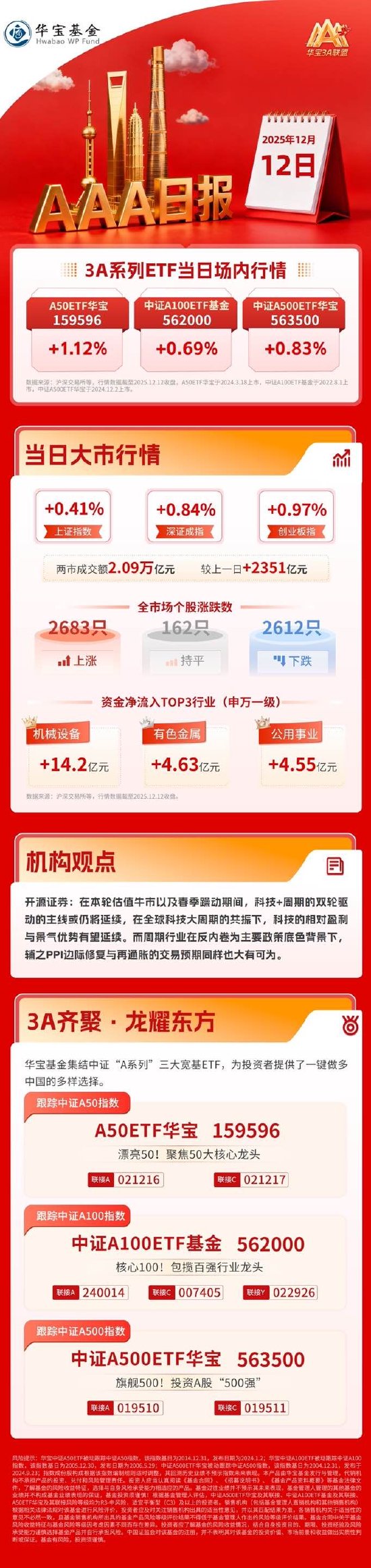
A股三大指数放量上涨,开源证券:科技+周期主线或仍将延续 | 华宝3A日报(2025.12.12)
Xin Lang Cai Jing· 2025-12-12 11:54
Group 1 - The core viewpoint highlights the ongoing valuation bull market and spring rally, driven by a dual focus on technology and cyclical sectors, with expectations for continued relative profitability and economic advantages in technology [2][5] - The total trading volume in the two markets reached 2.09 trillion yuan, an increase of 235.1 billion yuan compared to the previous day, with 2,612 stocks rising and 2,683 falling [5] - The top three sectors for net capital inflow were machinery equipment, non-ferrous metals, and public utilities, indicating strong investor interest in these areas [5] Group 2 - Huabao Fund has launched three major broad-based ETFs tracking the CSI A-series indices, providing investors with diverse options to invest in China [2][5] - The A50 ETF focuses on the top 50 core leading companies, while the A100 ETF encompasses the top 100 industry leaders, and the A500 ETF targets the top 500 companies in the A-share market [2][5]
险资举牌创10年新高,举牌大户收监管警示函
21世纪经济报道· 2025-12-12 10:38
Core Viewpoint - The enthusiasm for insurance capital to acquire listed companies has surged, reaching 37 instances this year, marking a near 10-year high and the second highest in history, only behind 62 instances in 2015 [1][5]. Group 1: Regulatory Actions - The Hebei Securities Regulatory Bureau issued a warning letter to Great Wall Life Insurance for failing to disclose timely information regarding its acquisition of shares in Xintian Green Energy, violating the Securities Law of the People's Republic of China [3]. - Great Wall Life Insurance increased its stake in Xintian Green Energy to 5.0027% by acquiring 1 million shares, but did not halt trading upon reaching the 5% threshold, which is a regulatory requirement [3][4]. Group 2: Company Performance - Great Wall Life Insurance's insurance business revenue for the first three quarters of 2025 was 21.455 billion yuan, a decrease of 5.92% compared to 22.806 billion yuan in the same period last year [4]. - The net profit for Great Wall Life Insurance in the first three quarters of 2025 was 872 million yuan, down 70.92% from 2.972 billion yuan in the same period of 2024, with a quarterly net loss of 122 million yuan [4]. Group 3: Market Trends - The current year has seen a significant increase in insurance capital acquisitions, with a notable focus on high-quality equity investments, particularly in sectors like banking, public utilities, and environmental protection [7]. - The insurance capital's preference for high ROE and high dividend stocks indicates a strategic shift towards stable investment returns, with various insurance companies participating in the acquisition trend [7][8]. - The asset allocation of insurance funds in stocks and funds has risen to 15.5%, creating more room for acquisitions and signaling a positive outlook for the market [8].

港股异动 | 长江基建集团(01038)现涨超4% 自由现金流稳健有望带来更佳股东回报
Zhi Tong Cai Jing· 2025-12-12 08:00
Group 1 - The core viewpoint of the article highlights that Changjiang Infrastructure Group (01038) has shown a strong market performance, with a current increase of 4.17% to HKD 55, and a trading volume of HKD 240 million [1] - HSBC's report indicates that the Hong Kong utility sector demonstrates strong resilience against market volatility, with Changjiang Infrastructure being selected as the top pick due to its robust free cash flow expected to yield better shareholder returns and stronger merger and acquisition potential by 2026 [1] - Morningstar has raised the fair value of Changjiang Infrastructure Group by 3% to HKD 65, benefiting from a slight increase in earnings expectations, indicating that the stock is currently undervalued with a projected price-to-earnings ratio of 15 times and a dividend yield of 4.8%, while forecasting a compound annual growth rate of 6.3% in earnings per share over the next five years due to increased regulated returns reflecting significant capital cost rises since the last adjustment [1]

长江基建集团现涨超4% 自由现金流稳健有望带来更佳股东回报
Zhi Tong Cai Jing· 2025-12-12 07:57
汇丰发布研报称,香港公用事业板块展现出其较强的抗市场波动能力。盖好选择长江基建作为香港公用 事业板块中的首选,因为其稳健的自由现金流有望带来更好的股东回报,并预计在2026年将有更强劲的 并购增值潜力。 晨星此前表示,上调长江基建集团公允价值3%至65港元,受惠于盈利预期微增。该股目前被低估,预 测市盈率15倍及股息率4.8%,中期前景稳健。晨星表示,未来五年每股盈利复合年增长6.3%,原因是 受监管的回报率将提高,以反映自上一轮调整以来资本成本的显著上升。 长江基建集团(01038)现涨超4%,截至发稿,涨4.17%,报55港元,成交额2.4亿港元。 ...