外汇

Search documents
【UNFX课堂】外汇市场一周回顾与展望:全球市场风险偏好强势回归,风险不容小觑
Sou Hu Cai Jing· 2025-06-30 03:59
Core Viewpoint - The global financial market experienced a significant return of risk appetite during the week of June 20 to 27, 2025, driven by the easing of geopolitical tensions and dovish signals from the Federal Reserve [1][2]. Geopolitical Factors - The notable easing of geopolitical tensions in the Middle East, particularly the ceasefire agreement between Israel and Iran, alleviated concerns about escalating conflicts, leading to a sharp decline in oil prices from nearly $80 to $66, marking the largest weekly drop since March 2023 [1]. - The reduction in geopolitical risk premium also diminished the appeal of traditional safe-haven assets like gold, which saw a consecutive decline for two weeks [1]. Monetary Policy Signals - The Federal Reserve's dovish signals, particularly from Vice Chair Bowman, who unexpectedly supported the possibility of rate cuts in the summer, indicated a shift in the Fed's internal assessment of inflation and economic outlook [3]. - Market expectations for rate cuts in 2025 have risen to 2-3 times, with an increased probability of a cut in July, leading to a significant decline in U.S. Treasury yields [3]. Market Performance - Global stock markets experienced a broad rally, with major U.S. indices like the S&P 500, Nasdaq, and Dow Jones reaching historical highs, reflecting restored market confidence and a shift towards growth-oriented assets [4]. - Technology stocks, sensitive to interest rate changes, benefited significantly from the rising rate cut expectations [4]. Regional Market Trends - Asian markets, particularly Japan, showed strong performance, reflecting improved global risk sentiment and optimism regarding trade prospects [5]. - The cryptocurrency market also thrived, with Bitcoin surpassing $107,000, indicating strong institutional interest in crypto assets [5]. Currency Movements - The U.S. dollar index experienced its worst week in years, dropping to a three-year low due to reduced demand for the dollar as a safe-haven currency and narrowing interest rate differentials [6][7]. - Other major currencies, such as the euro and British pound, strengthened against the dollar, reflecting improved economic outlooks [7]. Commodity Market Dynamics - The commodity market showed clear differentiation, with oil and gold prices declining due to reduced geopolitical risk and safe-haven demand, while industrial metals like copper rose nearly 6% to a two-month high [8]. - The performance of different commodities was influenced by unique fundamental factors, despite an overall improvement in risk appetite [8]. Upcoming Economic Indicators - The upcoming week is expected to bring significant economic data releases, including global PMI, CPI, and U.S. non-farm payroll reports, which will provide insights into global economic health and inflation pressures [8].
2025年6月30日银行间外汇市场人民币汇率中间价
news flash· 2025-06-30 01:18
Core Points - The central exchange rate of the Renminbi (RMB) against various currencies has shown fluctuations, indicating a mixed performance in the foreign exchange market as of June 30, 2025 [1] Currency Exchange Rate Summary - The USD/RMB rate is reported at 7.1586, reflecting a depreciation of 41 points for the RMB [1] - The EUR/RMB rate is at 8.4024, showing an appreciation of 256 points for the RMB [1] - The HKD/RMB rate stands at 0.91195, with a decrease of 5.5 points for the RMB [1] - The GBP/RMB rate is recorded at 9.8300, indicating a decline of 45 points for the RMB [1] - The AUD/RMB rate is at 4.6817, down by 104 points for the RMB [1] - The CAD/RMB rate is reported at 5.2358, reflecting a decrease of 161 points for the RMB [1] - The JPY/RMB rate is at 4.9594, with an increase of 12 points for the RMB [1] - The RMB/RUB rate is reported at 10.9558, showing a decline of 228 points for the RMB [1] - The NZD/RMB rate is at 4.3475, indicating an appreciation of 30 points for the RMB [1] - The RMB/MYR rate is at 0.58996, with a slight increase of 0.1 points for the RMB [1] - The CHF/RMB rate is reported at 8.9721, reflecting an appreciation of 274 points for the RMB [1] - The SGD/RMB rate stands at 5.6179, showing a decrease of 22 points for the RMB [1]
地缘震荡下的资产配置迁移:透视全球资金增持外汇黄金的逻辑
Sou Hu Cai Jing· 2025-06-30 01:07
Core Insights - Central banks globally have net purchased gold for 16 consecutive quarters, with an annual increase of 1,297 tons, marking the highest level since the decoupling of the dollar from gold in 1971 [1] Group 1: Structural Advantages of the Forex Gold Market - The international mainstream trading market offers three key characteristics for XAU/USD products compared to traditional gold investment channels [3] - Continuous trading across markets allows investors to respond in real-time to sudden events, exemplified by a 3.5% price fluctuation on the night of the Russia-Ukraine conflict in 2022 [5] - The correlation coefficient between the dollar index and gold prices has remained above -0.8, making dual-direction trading tools effective for hedging against currency depreciation during the Federal Reserve's rate hike cycle [5] - The average daily trading volume in the forex market exceeds $7.5 trillion, with precious metal-related currency pairs accounting for 12.7%, ensuring liquidity even during market sell-offs [5] Group 2: Risk Management for Individual Participation - It is crucial to ensure regulatory compliance by choosing brokers regulated by multiple authorities such as the UK's FCA and Australia's ASIC [5] - As of 2023, only 37% of forex brokers meet the A-class regulatory standards set by the International Organization of Securities Commissions (IOSCO) [5] - Investors should be aware of hidden costs during periods of increased volatility and utilize methods like the "three-step verification" to assess actual trading costs [5]


日元贬值局面尚未终结
3 6 Ke· 2025-06-28 04:13
Group 1 - The overall appreciation of the yen since the beginning of the year is primarily due to the depreciation of the dollar, with the yen's depreciation against other currencies being minimal [1] - The exchange rate of the yen against the dollar hovers around 145 yen per dollar, indicating that the depreciation of the yen has not completely ended, rooted in Japan's economic weaknesses [1] - The acquisition of U.S. Steel by Nippon Steel, completed on June 18 for approximately $14.1 billion (about 2 trillion yen), has been a focal point in the foreign exchange market, influencing yen transactions [1][2] Group 2 - The depreciation of the yen since 2021 is attributed to "structural yen selling," driven by Japanese companies' direct investments abroad, such as mergers and acquisitions [3] - Japan's net direct investment abroad reached a historical high of 32 trillion yen for the fiscal year 2024, with monthly foreign investments averaging 2.6 trillion yen, significantly outpacing domestic investments [3] - The potential growth rate of Japan's economy is around 0%, with an average real GDP growth rate of 0.5% over the past decade, which is notably low among G7 countries [5] Group 3 - The share of mergers and acquisitions in Japan's domestic direct investment is only about 40%, lower than the approximately 60% seen in developed countries, indicating a sluggish growth in domestic investments [4] - The Japanese government aims to increase the balance of direct investment in Japan to 150 trillion yen, highlighting the need for attracting foreign capital back to Japan [3]
金十图示:2025年06月27日(周五)美盘市场行情一览
news flash· 2025-06-27 13:50
Commodity Market - Spot platinum (XPTUSD) is priced at 1322.384, down by 90.474, representing a decrease of 6.40% [2] - Spot palladium (XPDUSD) is priced at 1123.824, down by 14.828, a decline of 1.30% [2] - Gold (COMEX) is trading at 3276.900, down by 64.700, which is a decrease of 1.94% [2] - Silver (COMEX) is priced at 36.110, down by 0.440, reflecting a decline of 1.20% [2] Foreign Exchange Market - Euro to USD (EURUSD) is at 1.173, with an increase of 0.25% [4] - GBP to USD (GBPUSD) is at 1.372, showing a slight decrease of 0.03% [4] - USD to JPY (USDJPY) is at 144.685, up by 0.21% [4] - AUD to USD (AUDUSD) is at 0.653, down by 0.22% [4] - USD to CHF (USDCHF) is at 0.799, down by 0.15% [4] Cryptocurrency Market - Bitcoin (BTC) is priced at 106857.510, down by 89.550, a decrease of 0.08% [5] - Litecoin (LTC) is at 83.930, down by 0.340, reflecting a decline of 0.40% [5] - Ethereum (ETH) is priced at 2428.730, up by 12.770, an increase of 0.53% [5] - Ripple (XRP) is at 2.092, down by 0.014, a decrease of 0.64% [5] Treasury Bonds - The yield on the 2-year U.S. Treasury bond is at 3.756, up by 0.041, an increase of 1.10% [7] - The yield on the 5-year U.S. Treasury bond is at 3.840, up by 0.039, an increase of 1.03% [8] - The yield on the 10-year U.S. Treasury bond is at 4.285, up by 0.033, an increase of 0.78% [8] - The yield on the 30-year U.S. Treasury bond is at 4.835, up by 0.019, an increase of 0.39% [8] - The yield on the 10-year UK Treasury bond is at 4.517, up by 0.046, an increase of 1.03% [8] - The yield on the 10-year German Treasury bond is at 2.599, up by 0.034, an increase of 1.33% [8] - The yield on the 10-year French Treasury bond is at 3.286, up by 0.036, an increase of 1.11% [8] - The yield on the 10-year Italian Treasury bond is at 3.525, up by 0.034, an increase of 0.97% [8] - The yield on the 10-year Japanese Treasury bond is at 1.453, up by 0.029, an increase of 2.04% [8]

2025年6月27日银行间外汇市场人民币汇率中间价
news flash· 2025-06-27 01:19
Core Viewpoint - The article provides the mid-exchange rates of the Chinese Yuan (CNY) against various currencies as of June 27, 2025, indicating fluctuations in the currency values. Exchange Rate Summary - USD/CNY is reported at 7.1627, an increase (devaluation of CNY) by 7 points [1] - EUR/CNY is reported at 8.3768, an increase by 162 points [1] - HKD/CNY is reported at 0.9125, a decrease by 0.4 points [1] - GBP/CNY is reported at 9.8345, an increase by 388 points [1] - AUD/CNY is reported at 4.6921, an increase by 252 points [1] - CAD/CNY is reported at 5.2519, an increase by 321 points [1] - 100 JPY/CNY is reported at 4.9582, an increase by 194 points [1] - CNY/RUB is reported at 10.9786, an increase by 571 points [1] - NZD/CNY is reported at 4.3445, an increase by 135 points [1] - CNY/MYR is reported at 0.58995, a decrease by 12.1 points [1] - CHF/CNY is reported at 8.9447, an increase by 399 points [1] - SGD/CNY is reported at 5.6201, an increase by 146 points [1]
交投平稳 中美国债利差小幅走阔
Jin Rong Shi Bao· 2025-06-26 01:41
Group 1: Currency Exchange Trends - In May, the RMB exchange rate showed a general strengthening trend due to multiple factors, including a temporary easing of the US-China trade situation [1][2] - The RMB/USD exchange rate fluctuated and rose, breaking the 7.20 mark on May 12, despite a rebound in the dollar index [2] - By the end of May, the RMB exchange rate was recorded at 7.1953, reflecting an overall appreciation of 0.94% for the month [3] Group 2: Market Activity - The interbank foreign exchange market remained stable in May, with an average daily trading volume of $207.29 billion, a year-on-year increase of 12.59% [4] - The average daily trading volume in the RMB foreign exchange market was $158.10 billion, also showing a year-on-year increase of 8.43% [4] - The trading direction in the spot market showed variability, with institutions alternating between net selling and buying, resulting in an average daily net selling of $2.67 million [4] Group 3: Interest Rate Differentials - The interest rate differential between China and the US widened slightly in May, influenced by factors such as US government policies and inflation risks [5] - The 10-year US Treasury yield reached a three-month high of 4.58% before slightly retreating to 4.41% by the end of May [5] - The 10-year China-US bond yield spread ended the month at -274 basis points, widening by 20 basis points compared to the previous month [5] Group 4: Swap Points and Liquidity - The one-year swap points ended May at -2060 basis points, down 107 basis points from the previous month, primarily driven by interest rate factors [6] - The offshore swap points moved in sync with onshore points, with the one-year swap point spread narrowing to -97 basis points, the tightest since March 2023 [7] - Overall, dollar liquidity in the domestic market was relatively loose, with the domestic-offshore dollar overnight interest rate spread turning negative by the end of May [7]
万腾外汇:美元上半年跌势如破竹,外汇对冲习惯能否令颓势持续?
Sou Hu Cai Jing· 2025-06-25 10:04
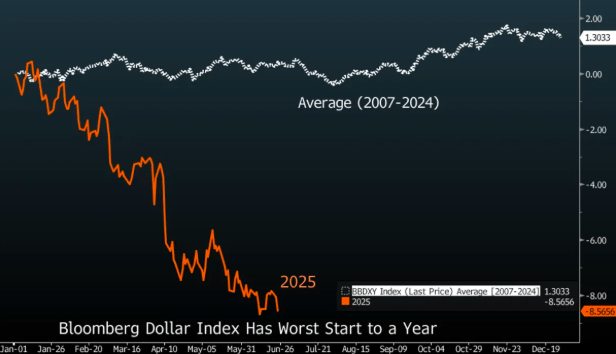
Group 1 - The Bloomberg Dollar Index has fallen over 8% year-to-date, while the ICE Dollar Index has seen a decline approaching 9%, marking the worst start in nearly 40 years [1] - Changes in interest rates are identified as the catalyst for the dollar's decline, with market expectations leaning towards a loosening cycle before 2026 despite the Federal Reserve's stance on maintaining higher rates for longer [3] - The increase in foreign exchange hedging ratios indicates that the future trajectory of the dollar will rely more on fundamentals rather than mere capital flows [4] Group 2 - Investors are shifting from traditional safe-haven assets like the dollar to derivatives for currency hedging, which has led to additional selling pressure on the dollar during settlement [3] - The potential for the dollar to further decline to the 101-102 index range exists if core inflation continues to fall and the Federal Reserve shifts its stance [4] - The focus for investors should transition from directional bets on the dollar to managing volatility, as the primary variables influencing dollar fluctuations have shifted from unilateral interest rate differentials to multidimensional risk pricing [4]
万腾外汇:黄金避险光环褪色?美联储观望与局势缓和下的市场变局
Sou Hu Cai Jing· 2025-06-25 09:59
以色列和伊朗宣布停火的消息,无疑是近期地缘政治局势中的重大转折点。此前,中东地区的紧张局势一 直是推动黄金价格上涨的重要因素之一。投资者在不确定性面前,往往将黄金视为避险资产的首选,从而 推动金价上升。然而,停火协议的达成,使得市场对地缘政治风险的担忧大幅缓解,投资者的风险偏好也 随之上升。他们开始将资金从黄金等避险资产中撤出,转而投向风险资产,如股票和部分大宗商品。这种 资金流向的变化,直接导致了黄金价格的下跌。 美联储观望态度:降息预期的降温 与此同时,美联储主席鲍威尔在周二国会听证会上的表态,也为黄金市场带来了新的变数。鲍威尔指出, 美联储需要更多时间来观察关税上调是否会推高通胀,然后才会考虑降息。这一表态暗示了美联储在短期 内可能不会急于采取降息行动,这与市场此前对降息的强烈预期形成了鲜明对比。 降息预期一直是支撑黄金价格的重要因素之一。较低的利率环境通常会降低持有黄金的机会成本,从而提 升黄金的吸引力。然而,鲍威尔的言论让市场意识到,降息并非板上钉钉,美联储可能会根据更多经济数 据和通胀表现来调整政策。这种不确定性使得投资者对黄金的持有意愿有所下降,进而加剧了金价的下 跌。 6月25日,现货黄金价格 ...
新骗局揭秘!外汇杀猪盘借壳“私募”搞基 MT4资产过亿都是空气
Sou Hu Cai Jing· 2025-06-25 07:12
Group 1 - The article highlights the emergence of fraudulent activities in the foreign exchange market, particularly involving a platform named CDG that targets inexperienced investors [3][20]. - A specific case is discussed where an individual named "徐小丽" claims to be a fund manager offering unrealistic annual returns of 18%, which raises red flags about the legitimacy of the investment opportunity [6][8]. - The fraudulent platform CDG is described as having no regulatory oversight, no legitimate trading software, and a very low risk score of 1.43, indicating a high-risk environment for investors [16][20]. Group 2 - The article details how investors are misled into believing they are investing in legitimate funds through a fake MT4 server, which is manipulated to show false profits [12][13]. - It is noted that the Shanghai Rongnuo Investment Management Co., Ltd., which was previously involved, has been officially dissolved, raising concerns about its connection to CDG and the potential for scams [14][18]. - The article emphasizes the importance of verifying the legitimacy of investment platforms and the necessity for investors to conduct thorough research before committing funds [20][23].