
地产

Search documents
收评:沪指涨近1%,金融板块集体拉升,PEEK材料概念爆发
Zheng Quan Shi Bao Wang· 2025-08-05 07:28
5日,沪指盘中强势拉升,尾盘涨近1%收复3600点;深证成指、创业板指亦上扬,场内约3900股飘红。 (文章来源:证券时报网) 盘面上看,保险、银行、汽车板块涨幅居前,煤炭、家电、券商、地产、酿酒、钢铁等板块均上扬, PEEK材料概念爆发,脑机接口、铜缆连接、热冷服务器概念等活跃。 截至收盘,沪指涨0.96%报3617.6点,深证成指涨0.59%报11106.96点,创业板指涨0.39%报2343.38点, 上证50指数涨0.77%,沪深北三市合计成交16161亿元。 华龙证券表示,当前市场总体环境有利,国内政策方向没有变化,使基本面预期向好,且稳定市场预期 明确,短期来看市场呈现的主要是内部的结构性调整造成的波动,调整企稳后将延续向上运行。一是科 技和先进制造等成长方向。二是"反内卷"政策叠加业绩改善方向。"反内卷"继续关注行情扩散方向,叠 加半年报业绩改善或景气延续方向可能是关注重点。三是内需政策发力方向。关注政策动向催化的行业 机会。 ...
红利港股ETF(159331)盘中飘红,高股息防御属性受关注
Mei Ri Jing Ji Xin Wen· 2025-08-05 05:35
Group 1 - The core viewpoint is that the Hong Kong Stock Connect high dividend sector has defensive allocation value in the current market environment, particularly favoring leading companies in vertical segments of the media industry [1] - Despite risks such as the underperformance of emerging IP commercialization, high dividend stocks still demonstrate attractive profitability stability and dividend advantages amid industry performance differentiation [1] - The Hong Kong Dividend ETF (159331) tracks the Hong Kong Stock Connect High Dividend Index (930914), which selects high dividend yield constituent stocks from eligible securities, focusing on value sectors like finance and real estate [1] Group 2 - The index aims to reflect the overall performance of Hong Kong Stock Connect targets under a high dividend strategy, providing investors with a stable dividend yield-oriented investment tool [1] - Investors without stock accounts can consider the Guotai Zhongzheng Hong Kong Stock Connect High Dividend Investment ETF Initiated Link A (022274) and Link C (022275) [1]
7月高频数据跟踪
LIANCHU SECURITIES· 2025-08-04 13:27
Production Side - As of the fourth week of July, the blast furnace operating rate was 83.48%, stable compared to the previous period and above last year's average[19] - The rebar operating rate increased to 43.95%, up 2.38 percentage points from the previous period, exceeding last year's average[19] - The cement mill operating rate recorded 36.95%, a slight decrease compared to the previous period[19] - The asphalt inventory saw a significant decline, indicating an acceleration in physical work volume in the infrastructure sector[7] Demand Side - In July, the real estate market remained weak, with the transaction area of commercial housing in 30 cities down by 27.43% month-on-month and 11.26% year-on-year[7] - The average daily sales of passenger cars were 53,006.50 units, reflecting a month-on-month decrease of 21.88%[8] - The total box office revenue for movies was 84,200.00 million yuan, showing a month-on-month increase of 99.53% but a year-on-year decline of 14.85%[8] Trade and Prices - The CCFI (China Containerized Freight Index) rose to 1,305.40, with a month-on-month growth of 2.19%[9] - The SCFI (Shanghai Containerized Freight Index) decreased to 1,684.07, reflecting a month-on-month decline of 16.42%[9] - The CPI showed a mild increase in consumer prices, while industrial product prices fluctuated, with PPI pressures from weak energy prices[9]
2025年8月金股组合:8月金股策略,布局新高
GUOTAI HAITONG SECURITIES· 2025-08-04 09:41
Group 1: Strategy Overview - The report emphasizes that the Chinese economy is undergoing a transformation, leading to a "transformation bull market" in the stock market, with expectations for new highs in the future [1][15][16] - Key investment themes include a focus on financials, growth sectors, and certain cyclical industries, as the market adjusts and gains confidence [1][2][3] Group 2: Key Investment Recommendations - The August stock selection includes: 1. Banking: China Merchants Bank 2. Non-bank: CICC and New China Life Insurance 3. Overseas Technology: Tencent Holdings and Kuaishou-W 4. Electronics: Cambricon Technologies, Chipone Technology, and Suzhou Tianmai 5. Computing: Dingjie Smart and Anheng Information 6. Machinery: Hengli Hydraulic and Mingzhi Electric 7. Military: AVIC Shenfei 8. Coal: Shaanxi Coal and Chemical Industry 9. Light Industry: Sun Paper 10. Agriculture: Muyuan Foods 11. Transportation: SF Express 12. Pharmaceuticals: MicroPort Medical 13. Real Estate: China Resources Mixc Lifestyle 14. Utilities: Huadian International Power [1][4][12] Group 3: Banking Sector Insights - The banking sector is expected to face revenue pressure but maintain positive net profit growth, with a gradual recovery in net interest margins anticipated [22][23] - China Merchants Bank is projected to benefit from economic recovery, with an upward revision of net profit growth forecasts for 2025-2027 [25][26][27] Group 4: Non-Banking Sector Insights - The impact of the new tax on bond interest income is expected to be limited for the non-banking sector, with continued optimism for growth in this area [30][32] - CICC is forecasted to see significant profit growth driven by active trading and investment recovery, with an increase in EPS estimates for 2025-2027 [33][34] Group 5: Technology Sector Insights - Major tech companies are increasing capital expenditures significantly, particularly in AI, indicating a robust growth trajectory for the sector [43][45] - Tencent is expected to leverage AI to enhance its core business, with revenue and profit projections being adjusted upwards for 2025-2027 [45][46][47]



关注红利港股ETF(159331)投资机会,防御属性适合中长期配置
Mei Ri Jing Ji Xin Wen· 2025-08-04 07:27
Group 1 - The core viewpoint is that high dividend-related industries in the Hong Kong stock market have medium to long-term absolute return potential, especially in a low interest and low growth environment similar to Japan's [1] - The current macroeconomic context is characterized by moderate growth and loose liquidity, making high dividend sectors in the Hong Kong stock market attractive for medium to long-term investment due to their stable cash flow and dividend characteristics [1] - The Hong Kong Dividend ETF (159331) tracks the Hong Kong Stock Connect High Dividend Index (930914), which selects listed companies with stable dividend characteristics and high dividend yields from the eligible stocks under the Stock Connect mechanism [1] Group 2 - The index primarily focuses on traditional sectors such as finance and real estate, aiming to reflect the overall performance of quality assets in the Hong Kong stock market under a high dividend strategy [1] - Investors without stock accounts can consider the Cathay CSI Hong Kong Stock Connect High Dividend Investment ETF Initiated Link A (022274) and Link C (022275) [1]
涨价预期或降温
Haitong Securities International· 2025-08-04 07:23
Consumption Trends - Consumer spending shows a divergence with weak goods consumption and strong service consumption, particularly in travel and cinema during the summer[1] - Automotive retail sales have slightly declined, while wholesale volumes have increased, indicating seasonal and promotional impacts on consumption[9] - Food prices continue to drop, with agricultural products seeing an expanding year-on-year decline, particularly affecting premium products like Moutai liquor[9] Investment Insights - As of August 2, 2025, the cumulative issuance of new special bonds reached CNY 2.8 trillion, marking the second-highest issuance pace since 2022, with July alone contributing CNY 616.94 billion[17] - New housing transactions in 30 cities have shown a seasonal rebound, but the year-on-year decline in average transaction area has widened from 14.8% to 15.4%[17] Price and Production Dynamics - Consumer prices are on a downward trend, with industrial prices also showing marginal declines, leading to a cooling of price increase expectations[36] - The Producer Price Index (PPI) has seen a slight decrease, with the South China price index dropping by 1.1% week-on-week, reflecting a shift in market supply and demand expectations[36] Import and Export Activity - Port operations have slowed due to typhoon impacts, with a year-on-year decline in the number of ships docking at ports[21] - Domestic export freight rates have decreased by 2.3% compared to the previous week, while import rates have slightly increased by 1.1%[21] Liquidity Conditions - Funding rates have decreased, with R007 down by 20.7 basis points and DR007 down by 22.8 basis points, indicating a trend towards a more accommodative liquidity environment[39] - The 10-year government bond yield has fallen by 2.7 basis points to 1.71%, reflecting easing pressures in the funding market[39]
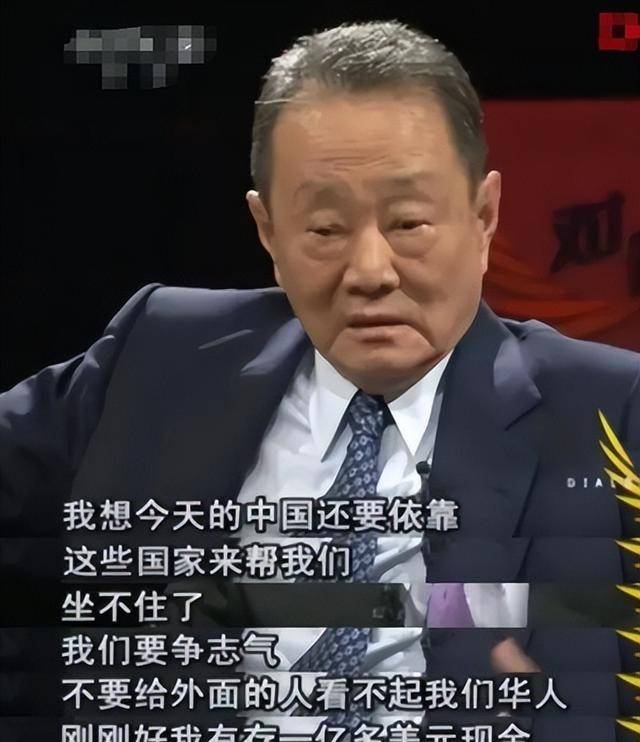
华人顶级富豪郭鹤年,如今101岁,千亿帝国接班难,仨儿难顶大梁
Sou Hu Cai Jing· 2025-08-04 06:21
Core Insights - Robert Kuok, a prominent Chinese businessman, was born on October 6, 1923, in Johor Bahru, Malaysia, and has built a vast business empire spanning sugar, hotels, real estate, and food products, including well-known brands like Shangri-La Hotels and Golden Dragon Fish Oil [1][3] Wealth and Status - As of 2024, Kuok's net worth is estimated at $11.5 billion, making him the richest person in Malaysia for 25 years and placing him among the top 100 billionaires globally [3][10] Succession Challenges - Despite his active involvement in the business at the age of 101, the succession plan for his empire remains unresolved, with his three sons unable to take the lead due to various issues, while a capable nephew is not a direct heir, complicating the situation further [3][12][14] Early Life and Education - Kuok was born into a family of Fujian immigrants and was influenced by his educated mother, who instilled values of integrity and ethics in business, shaping his future career [5][7] Business Ventures - In the 1950s, Kuok identified opportunities in the sugar industry, establishing Malaysia's first sugar factory and capturing 80% of the local market, which led to significant profits during market fluctuations [9] - He later expanded into various sectors, including mining, glass manufacturing, and real estate, and gained recognition as the "King of Sugar" [9][10] Hospitality Industry - Kuok opened the first Shangri-La Hotel in Singapore in the early 1970s, positioning it as a high-end brand that quickly gained global recognition, earning him the title "Hotel King" [10] Focus on China - Kuok's business interests shifted towards China, where he established Kerry Group and invested in multiple sectors, including hotels and real estate, demonstrating his deep connection to his ancestral roots [10][12] Ongoing Business Activities - Despite the unresolved succession issue, Kuok continues to explore new business opportunities, including investments in digital infrastructure and cloud computing in Southeast Asia, while also engaging in philanthropic efforts [16][18]

攻守兼备红利50组合周度收益跑至红利类基金产品约11%分位-20250804
Changjiang Securities· 2025-08-04 05:13
Quantitative Models and Construction Methods - **Model Name**: "Offense and Defense Dividend 50 Portfolio" **Model Construction Idea**: This model aims to enhance returns by selecting high-dividend stocks with a balance of growth and stability, outperforming the benchmark dividend indices[6][15] **Model Construction Process**: The portfolio is constructed by combining stocks with high dividend yields, growth potential, and low volatility. The selection process involves filtering stocks based on dividend-related factors and optimizing the portfolio to achieve a balance between growth and defensive characteristics[6][15] **Model Evaluation**: The model demonstrates strong performance, consistently outperforming the benchmark dividend indices and ranking in the top percentile among dividend-focused funds[6][21] - **Model Name**: "Central SOE High Dividend 30 Portfolio" **Model Construction Idea**: This model focuses on central state-owned enterprises (SOEs) with high dividend payouts, aiming to capture stable returns from these entities[15] **Model Construction Process**: The portfolio is constructed by selecting 30 central SOEs with the highest dividend yields. The selection criteria emphasize stability and consistent dividend payouts[15] **Model Evaluation**: The model shows stable performance, delivering excess returns over the benchmark dividend indices[15][21] - **Model Name**: "Electronic Sector Enhanced Portfolios" **Model Construction Idea**: These models aim to enhance returns within the electronic sector by focusing on high-growth sub-sectors and leading companies in mature sub-sectors[15][31] **Model Construction Process**: 1. **Balanced Allocation Enhanced Portfolio**: This portfolio is constructed by evenly allocating weights across various electronic sub-sectors to achieve diversification[15] 2. **Sector Leader Enhanced Portfolio**: This portfolio focuses on leading companies in mature sub-sectors, emphasizing their growth potential and market dominance[15][31] **Model Evaluation**: Both portfolios demonstrate positive returns, with the Sector Leader Enhanced Portfolio delivering higher excess returns relative to the electronic sector index[31] Model Backtesting Results - **Offense and Defense Dividend 50 Portfolio**: - Weekly excess return: ~1.41% over the CSI Dividend Total Return Index[6][21] - Year-to-date excess return: ~3.52% over the CSI Dividend Total Return Index[21] - Weekly performance percentile: ~11% among dividend-focused funds[6][21] - **Central SOE High Dividend 30 Portfolio**: - Weekly excess return: ~0.35% over the CSI Dividend Total Return Index[6][21] - **Electronic Sector Enhanced Portfolios**: - **Balanced Allocation Enhanced Portfolio**: Weekly excess return: ~0.89% over the electronic sector index[31] - **Sector Leader Enhanced Portfolio**: Weekly excess return: ~0.89% over the electronic sector index[31] Quantitative Factors and Construction Methods - **Factor Name**: Dividend Quality **Factor Construction Idea**: This factor evaluates the stability and sustainability of a company's dividend payouts[16][18] **Factor Construction Process**: The factor is calculated using metrics such as dividend payout ratio, historical dividend growth rate, and earnings stability. Companies with higher scores on these metrics are ranked higher[16][18] **Factor Evaluation**: The factor demonstrates strong predictive power for identifying high-performing dividend stocks[16][18] - **Factor Name**: Dividend Growth **Factor Construction Idea**: This factor focuses on the growth potential of a company's dividends over time[16][18] **Factor Construction Process**: The factor is derived from the historical growth rate of dividends and projected earnings growth. Companies with consistent and high dividend growth rates are ranked higher[16][18] **Factor Evaluation**: The factor shows significant excess returns compared to pure dividend yield factors[16][18] - **Factor Name**: Low Volatility Dividend **Factor Construction Idea**: This factor targets stocks with high dividend yields and low price volatility[16][18] **Factor Construction Process**: The factor is constructed by combining dividend yield with a volatility measure (e.g., standard deviation of returns). Stocks with high yields and low volatility are ranked higher[16][18] **Factor Evaluation**: The factor provides a defensive characteristic, outperforming during market downturns[16][18] Factor Backtesting Results - **Dividend Quality Factor**: - Weekly excess return: ~1.94% over the CSI Dividend Index[18] - **Dividend Growth Factor**: - Weekly excess return: ~0.92% over the CSI Dividend Index[18] - **Low Volatility Dividend Factor**: - Weekly excess return: ~0.69% over the CSI Dividend Index[18]
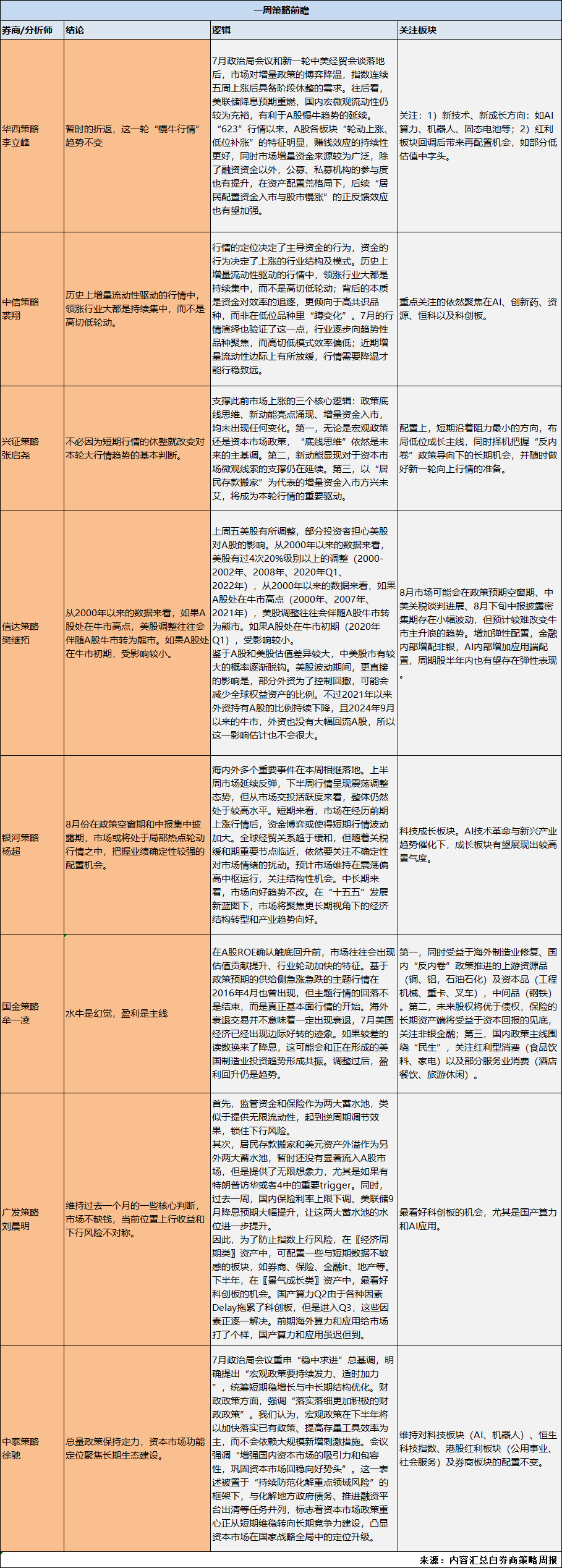
A股分析师前瞻:有阶段休整需求,但“慢牛行情”趋势不变
Xuan Gu Bao· 2025-08-03 13:47
Group 1 - The overall consensus among brokerage strategies indicates that the short-term index pullback is not a concern, and the "slow bull market" trend remains unchanged [1][3] - The three core logic supporting the previous market rally—policy bottom-line thinking, emergence of new growth drivers, and incremental capital inflow—have not changed [1][3] - The expectation of a Federal Reserve interest rate cut has reignited, and domestic macro and micro liquidity remains relatively abundant, which is favorable for the continuation of the A-share slow bull trend [1][3] Group 2 - In the context of economic cycle assets, it is advisable to allocate to sectors that are less sensitive to short-term data, such as brokerage, insurance, financial IT, and real estate [2][3] - The most promising opportunities in the second half of the year are seen in the Sci-Tech Innovation Board, particularly in domestic computing power, which faced delays in Q2 but is expected to recover in Q3 [2][3] - Historical data suggests that in liquidity-driven markets, leading sectors tend to be concentrated rather than rotating between high and low performers, indicating a preference for high consensus stocks [2][3] Group 3 - Concerns about the impact of U.S. stock market adjustments on A-shares are noted, with historical data indicating that A-shares are less affected if they are in the early stages of a bull market [4] - The market is expected to experience slight fluctuations during the policy expectation gap and the concentrated disclosure of mid-year reports in August, but the overall bullish trend is anticipated to remain intact [4][5] - The focus on structural opportunities is emphasized, with a long-term positive outlook on the market driven by economic structural transformation and industry trends [4][5] Group 4 - The macro policy is expected to continue to exert force, with an emphasis on implementing existing policies effectively rather than relying on large-scale new stimulus measures [5] - The capital market's role in the national strategic framework is being upgraded, focusing on long-term competitiveness and stability [5]
国内高频指标跟踪(2025年第30期):涨价预期或降温
GUOTAI HAITONG SECURITIES· 2025-08-03 07:57
Consumption Trends - Consumer spending shows a divergence with weak goods consumption and strong service consumption, particularly in travel and cinema during the summer[7] - Retail sales of automobiles have slightly declined, with wholesale volumes increasing marginally, indicating seasonal and promotional impacts[16] - Food prices continue to drop, with agricultural products seeing an expanding year-on-year decline[16] Investment Insights - As of August 2, 2025, the cumulative issuance of special bonds reached CNY 2.8 trillion, marking the highest issuance for the same period since 2020[22] - New housing transactions in 30 cities have shown a seasonal rebound, but the year-on-year decline in transaction area has widened from 14.8% to 15.4%[22] Import and Export Dynamics - Port operations have slowed due to typhoon impacts, with a year-on-year decline in the number of ships docking at ports[32] - Domestic export freight rates have decreased by 2.3%, while import rates have slightly increased by 1.1%[32] Production and Inventory - Overall production has shown marginal weakening, with coal consumption rising seasonally but still reflecting a year-on-year decline[36] - Inventory levels for coal at ports have slightly decreased, while cement and steel inventories have shown seasonal increases[39] Price Movements - Consumer prices continue to decline, with the iCPI showing a slight decrease in year-on-year growth, particularly in transportation and healthcare sectors[42] - Industrial prices are also experiencing a marginal decline, with the South China price index dropping by 1.1%[42] Liquidity Conditions - Funding rates have decreased, with R007 down by 20.7 basis points, indicating a trend towards a more accommodative liquidity environment[46] - The 10-year government bond yield has fallen to 1.71%, reflecting easing pressure in the funding market[46]