软件

Search documents
字节Seedance2.0引爆AI应用!软件板块强势反弹,三六零涨停!软件ETF汇添富(159590)大涨超3%!AI大模型"终结"软件行业?黄仁勋、机构发声
Sou Hu Cai Jing· 2026-02-09 06:52
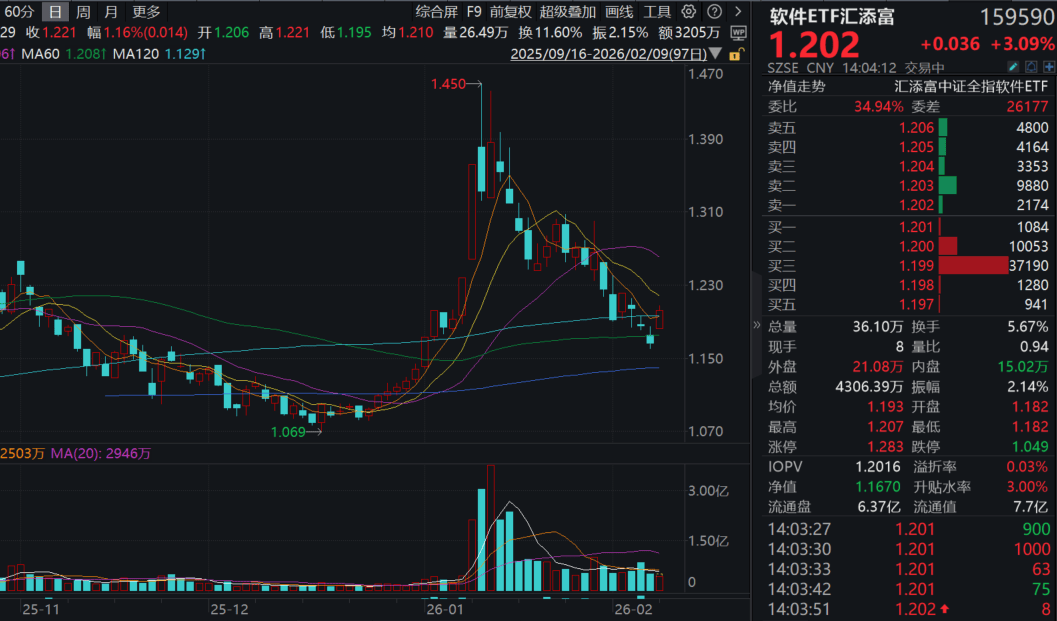
Group 1: Software ETF Performance - The software ETF Huatai (159590) saw most of its constituent stocks perform positively, with Dongfang Guoxin rising over 16%, Wanjing Technology increasing by over 11%, and 360 reaching the daily limit [2] - Key stocks and their performance include: - 360 (601360): 4.03% weight, 9.97% increase, trading volume of 4.363 billion - Keda Xunfei (002230): 12.40% weight, 2.72% increase, trading volume of 2.972 billion - Tonghuashun (300033): 7.02% weight, 3.54% increase, trading volume of 2.591 billion - Dongfang Guoxin (300166): 0.92% weight, 16.83% increase, trading volume of 2.201 billion - Wanjing Technology (300624): 1.18% weight, 11.57% increase, trading volume of 2.154 billion [3] Group 2: AI Video Generation Technology - ByteDance's AI video generation model, Seedance 2.0, has gained significant attention for its ability to create high-quality videos from text or images in under 60 seconds, featuring multi-scene narratives [4] - The model addresses key pain points in AI video generation, such as controllability and coherence, and is expected to catalyze a rebound in AI applications [5][6] - The technology is seen as a turning point for video generation, shifting the focus from technical capabilities to content quality and narrative value [7][8] Group 3: Market Sentiment and Future Outlook - Market sentiment is currently at a low point, but the introduction of Seedance 2.0 is expected to stimulate the AI application sector, particularly in cloud services and computing [5] - Analysts predict that the AI industry will see significant growth as the technology matures, with a focus on AI applications and the integration of AI agents into business processes [10][11] - The evolution of AI agents is anticipated to lead to structural changes in the industry, with increased demand for hardware and a shift in application entry points [12]





AI冲击波从软件业蔓延至债市:最大债主Ares、KKR股价重挫,违约率恐飙至13%
Hua Er Jie Jian Wen· 2026-02-09 06:21
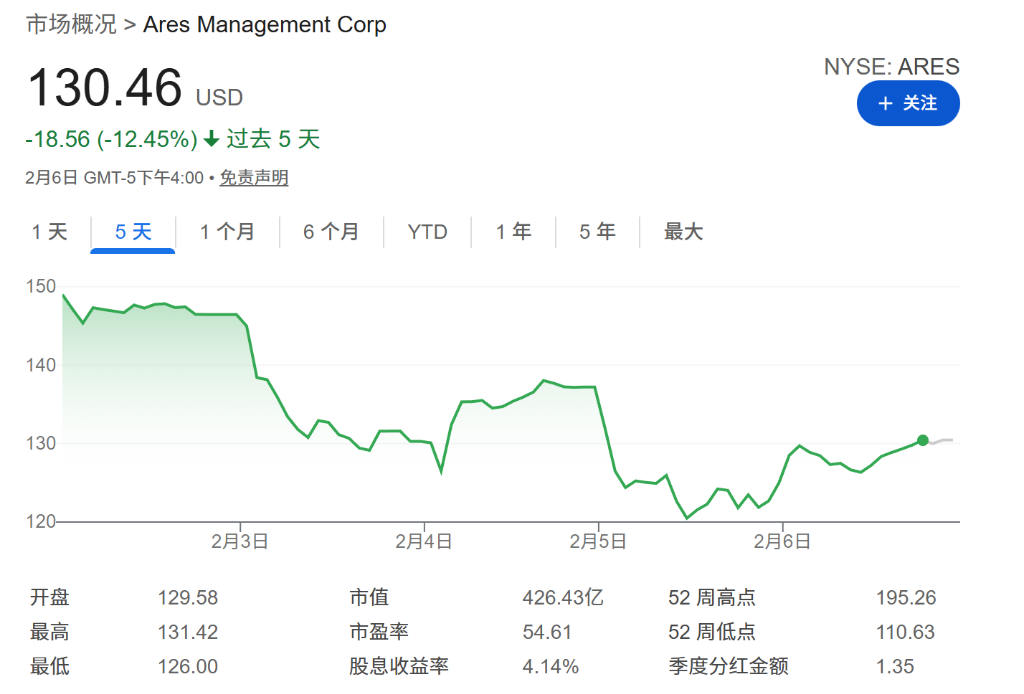
Core Insights - The disruptive wave of artificial intelligence (AI) technology is spreading from the software industry into the financial markets, creating unprecedented uncertainty in the private credit bond market, which is valued at approximately $3 trillion [1][12] - The release of a new AI tool by Anthropic has triggered a sell-off in software data supplier stocks, leading to significant declines in asset management companies heavily invested in private credit bonds [1][8] Group 1: Market Impact - The stock prices of major asset management firms with substantial private credit bond operations have experienced sharp declines, with Ares Management down over 12%, KKR down nearly 10%, Blue Owl Capital down over 8%, and TPG down about 7%, while the S&P 500 index only slightly decreased by approximately 0.1% during the same period [1][3] - Investors are increasingly uneasy about their exposure to the private credit bond market, particularly due to the software industry's significant concentration in this sector, which amplifies any disturbances [8][9] Group 2: Credit Quality Concerns - UBS has issued a stern warning that if the disruptive effects of AI accelerate beyond the adaptability of borrowing companies, the default rate in the U.S. private credit bond market could soar to 13% under aggressive scenarios, significantly higher than their estimates for leveraged loans (8%) and high-yield bonds (4%) [8][9] - The private credit bond market's heavy reliance on the software industry raises concerns about the quality of these assets, as any downturn in the software sector could lead to significant issues within investment portfolios [9][10] Group 3: Structural Risks - The structure of loans, particularly Payment-in-Kind (PIK) loans, exacerbates potential risks, as these loans allow borrowers to defer cash interest payments, which can become problematic if the borrower's financial situation deteriorates [10] - Moody's Analytics warns that the opacity of the private credit bond market complicates comprehensive risk assessment, highlighting the rapid growth of AI-related lending, rising leverage, and lack of transparency as significant warning signs [10][11] Group 4: Systemic Concerns - The market reassessment triggered by AI occurs against a backdrop of existing scrutiny of the private credit bond industry, which has long been criticized for high leverage and valuation opacity [12] - The private credit bond market, which has favored corporate software companies since 2020, must now prepare for the disruptive impacts driven by AI technology, prompting investors to reevaluate financing transactions that involve opaque, illiquid loans, especially those exposed to technological change risks [12]

中国AI软件前景值得期待,软件ETF(515230)涨超2%,资金抢筹,近20日资金净流入超33亿元
Mei Ri Jing Ji Xin Wen· 2026-02-09 05:29
Group 1 - The core viewpoint is that the recent release of AI plugin tools by Anthropic has raised concerns about the disruption of traditional software business models, leading to a sell-off in U.S. software stocks [1] - There is a fundamental doubt regarding the long-term growth logic and high profit margins of the software industry, particularly for SaaS, as general large models can perform core tasks at lower costs and more directly than specialized software [1] - The current volatility in the market should be understood as a profound structural adjustment rather than a complete collapse of the industry's fundamentals [1] Group 2 - Unlike the mature U.S. market, China's SaaS industry is still in its development phase, with ongoing digital transformation demands across various sectors providing significant growth opportunities for SaaS tools [1] - In China, AI technology is viewed more as an empowering tool to enhance efficiency and open new markets, rather than a direct disruption to existing business models [1] - The Chinese SaaS industry is expected to develop along a unique path that integrates AI, differing from the U.S. experience, and its prospects are promising [1]
每日投资策略-20260209
Zhao Yin Guo Ji· 2026-02-09 04:41
Macro Commentary - The report indicates a slowdown in China's economic growth in Q1, but improvements in deflation are noted, with policymakers signaling a focus on stabilizing real estate, promoting consumption, and countering "involution" [2] - The US economy is expected to rebound, with rental inflation declining, offsetting a rise in commodity inflation, leading to a stable dollar liquidity environment [2] - The report anticipates only one interest rate cut by the Federal Reserve in June this year, with a potential for a spring rebound in the stock market [2] Internet Sector - In January, high beta stocks benefitting from event-driven catalysts significantly outperformed the industry, aided by improved market risk appetite and liquidity [2] - Major Chinese internet companies are increasing market spending on AI applications targeting end-users, with 2026 identified as a critical year for capturing user engagement in the AI era [2] Stock Market Performance - The Hang Seng Index closed at 26,560, down 1.21% for the day but up 3.63% year-to-date, while the US markets showed a rebound with the Dow Jones up 2.47% [2] - The report highlights the performance of various indices, with the Hang Seng Financial Index down 1.89% and the Hang Seng Property Index up 17.49% year-to-date [3] Investment Strategy - A "barbell" investment strategy is recommended, focusing on companies with certain profit growth and those benefiting from AI [5] - Specific stocks to watch include Tencent, Alibaba, and Kuaishou for their AI-driven growth potential, and NetEase and Trip.com for their stable earnings visibility [5] Software and IT Services - The report expresses optimism for the software sector, expecting revenue growth to support valuations, while cautioning about the competitive pressures from AI model vendors [6] - Recommended stocks include Palo Alto Networks in the US and Kingdee in China, which are expected to benefit from AI-related revenue growth [6] Semiconductor Industry - The semiconductor sector is viewed positively, driven by AI demand, with structural shortages in memory products like HBM and server DRAM [7] - Recommended stocks include Zhongji Xuchuang and Northern Huachuang, which are expected to benefit from the ongoing demand for computing power [7] Technology Sector - The report anticipates a continued high demand for AI computing infrastructure and innovations in consumer electronics, with specific recommendations for companies like Luxshare Precision and BYD Electronics [8] Consumer Sector - The Hang Seng Consumer Index has risen 8% year-to-date, driven by high elasticity in discretionary consumption sectors [9] - The report highlights the potential for increased consumer spending during the Spring Festival, supported by government policies aimed at boosting consumption [10] Automotive Sector - January saw a slowdown in automotive sales, particularly in the new energy vehicle segment, but a recovery is expected post-Spring Festival [11] - Recommended stocks include Geely for its expanding new energy vehicle matrix and Xpeng for its potential to turn profitable [11] Pharmaceutical Sector - The report emphasizes the long-term trend of innovative drugs going global, with a focus on clinical progress and data validation for drugs already in international markets [12] - Recommended stocks include Innovent Biologics and CanSino Biologics, which are expected to benefit from the ongoing trend of drug commercialization [12] Capital Goods Sector - The report notes a positive outlook for the capital goods sector, particularly in construction machinery, driven by rising metal prices and increased mining capital expenditures [21] - Recommended stocks include SANY Heavy Industry and Zoomlion, which are expected to benefit from the ongoing demand for construction equipment [21] Real Estate and Property Management - The real estate sector is optimistic due to favorable policies, with the Hang Seng Property Index rising 15% year-to-date [19] - Recommended stocks include China Jinmao and Greentown China, which have shown significant price increases [19]
Private credit worries resurface in $3 trillion market as AI pressures software firms
CNBC· 2026-02-09 04:41
Core Viewpoint - The private credit markets are experiencing increased uncertainty due to the emergence of AI-driven tools that may disrupt traditional software business models, particularly affecting software companies that are significant borrowers in the private lending space [1][2]. Group 1: Impact of AI on Software Companies - AI tools developed by Anthropic are designed to perform complex tasks that many software companies currently charge for, raising concerns about the potential weakening of traditional software business models [2]. - The software sector, which has been a favored area for private credit lenders since 2020, is now facing pressure as AI adoption could accelerate faster than companies can adapt [5][7]. - Software companies account for approximately 17% of loans held by U.S. business development companies, making them a significant focus for private credit lenders [6]. Group 2: Market Reactions and Financial Implications - Shares of major asset managers with substantial private credit franchises have declined significantly, with Ares Management falling over 12%, Blue Owl Capital losing over 8%, and KKR declining almost 10% [3]. - UBS Group has warned that default rates in U.S. private credit could rise to 13% in an aggressive disruption scenario, which is notably higher than the projected stress for leveraged loans and high-yield bonds [7]. - The private credit industry, valued at $3 trillion, is facing concerns over leverage, opaque valuations, and the risk of isolated problems becoming systemic issues [9]. Group 3: Credit Risk and Future Outlook - The potential for credit risk varies among software and services sector borrowers, depending on their position relative to AI advancements [10]. - Payment-in-kind (PIK) loans, which allow borrowers to defer interest payments, are prevalent among software companies, posing risks if their financial situations deteriorate [11]. - Experts indicate that while the private credit industry may currently absorb losses, ongoing credit growth could lead to significant credit problems in the future [13].


德银:触及十年通道下沿后,美股科技股大反弹,回调结束了?
美股IPO· 2026-02-09 04:27
美股科技股超额收益,从10年通道的顶部一路跌至上周四收盘时的底部,随后在周五反弹。德银表示,周五的反弹或许标志着情绪的逆转,资金流向数 据也显示,极其拥挤的非科技板块交易已显露疲态,科技板块的资金流入正在回暖。 德意志银行在最新的研报中表示,这轮抛售的关键特征是:盈利预期实际上仍在上调,市场下跌完全由估值收缩驱动,而非基本面恶化。周五的反弹或 许标志着情绪的逆转。 与此同时,资金流向数据显示,极其拥挤的非科技板块交易已显露疲态,科技板块的资金流入正在回暖。 十年通道底部的反击 科技股的这次"触底反弹"并非偶然。报告指出,过去三个月,资金从大型科技股疯狂出逃,涌入其他板块,其导火索是2025年第三季度财报季——那时 市场首次看到了科技巨头之外盈利增长扩散的迹象。 资金流向的极端反转 然而,周五的反弹或许标志着情绪的逆转。德银表示: 大型成长股与科技股相对于标普500指数其余部分的表现, 从10月下旬位于其十年超额收益通道的顶部,一路跌至周四收盘时的底部,随后在周五反弹。 上周五美股报复性反弹,道指首破5万点,标普涨近2%,创去年5月以来最佳单日涨幅,英伟达大涨7%,这仅仅是死猫跳,还是新一轮上涨的号角? 这种剧 ...
Claude一个插件吓哭华尔街,软件公司集体暴跌,2万亿元一日蒸发
猿大侠· 2026-02-09 04:11
Core Viewpoint - The emergence of AI, particularly through Anthropic's new features, is perceived as a significant threat to the Software as a Service (SaaS) industry, leading to a dramatic sell-off in software stocks and a prevailing sentiment of "SaaS is dead" among investors [1][8][30]. Group 1: Market Reaction - The introduction of Anthropic's "plugins" and "silicon-based employees" resulted in a loss of approximately $285 billion in market value for Nasdaq [3]. - Following the initial drop, software stocks continued to decline, with the iShares expanded technology software industry ETF falling an additional 2% [6]. - The overall sentiment on Wall Street shifted to a state of panic, with many investors eager to exit their positions in software companies regardless of current prices [9][30]. Group 2: AI's Impact on SaaS - Anthropic's Claude Cowork can perform tasks traditionally handled by software, such as document drafting and legal compliance, significantly reducing the need for expensive SaaS solutions [12][16]. - The legal plugin introduced by Anthropic threatens the core functionalities of many legal software companies, which previously charged around $50,000 annually for their services [14][16]. - The competitive landscape is intensifying as AI tools like Claude Cowork are expected to disrupt various sectors, including finance, sales, and marketing, leading to widespread concerns about the viability of SaaS companies [25][22]. Group 3: Industry Perspectives - Analysts from Morgan Stanley highlighted that the introduction of AI capabilities in the legal sector would significantly increase competition, exacerbating the challenges faced by existing software companies [22]. - The perception that SaaS companies are merely intermediaries is growing, as AI technologies provide direct access to capabilities that were once reliant on software [40][41]. - Despite the current turmoil, some industry leaders argue that software will remain essential as a backend infrastructure, even if user interfaces evolve due to AI advancements [48].

马斯克捅刀子:创办微软≠懂科学,盖茨理科水平真不高
Sou Hu Cai Jing· 2026-02-09 02:17
科技圈再爆重磅言论!马斯克在最新访谈中公开对比尔·盖茨"捅刀子",直言这位微软创始人、全球顶 级科技富豪,科学素养与大众预期相去甚远。他直言:"人们总觉得,创办了微软这样世界级科技巨头 的比尔·盖茨,理应在科学领域十分出色,但亲身交流后我发现并非如此,他的理科水平并不高。"这番 直白评价瞬间引爆全网,成为全球科技与财经圈热议焦点。 这场公开交锋,并非临时起意的口舌之争,而是两人多年理念分歧与商业矛盾的集中爆发。从盖茨做空 特斯拉股票、双方在气候行动路径上各执一词,到AI发展、慈善模式的立场对立,两位科技界标杆人 物早已摩擦不断。马斯克推崇技术实证、工程落地,盖茨更侧重宏观规划与公益布局,底层逻辑的差 异,让这场关于"科学水平"的争论,更像两种科技价值观的正面碰撞。 言论发酵后,网友与行业人士争论不休。有人认为马斯克言辞犀利、直指要害,凸显工程派与商业派的 认知鸿沟;也有人觉得,盖茨的核心优势是商业格局与产业推动,不必用硬核理科标准苛求。无论立场 如何,这场顶流对话都折射出一个现实:科技行业既需要商业领袖的战略视野,也离不开技术极客的科 学深耕。两位传奇人物的交锋,也让外界重新思考:科技领袖的核心能力,究竟该偏 ...

市场缩量调整,聚焦攻防均衡丨周度量化观察
申万宏源证券上海北京西路营业部· 2026-02-09 02:10
Market Overview - This week, the A-share market experienced a comprehensive pullback, with the Shanghai Composite Index down by 1.27%, the CSI 300 down by 1.33%, and the ChiNext Index down by 3.28%. The average daily trading volume in the Shanghai and Shenzhen markets significantly decreased to around 2.3 trillion yuan [2][11][15]. - In the bond market, the overall performance was strong, supported by a stable funding environment maintained by the central bank. The January PMI data fell below the growth line, which is favorable for the bond market [3][31]. Equity Market - The decline in A-shares was primarily driven by a shift in expectations regarding the Federal Reserve's policy, which triggered a significant pullback in precious metals and led to profit-taking in popular sectors ahead of the Spring Festival. The nomination of hawkish candidate Waller as Fed Chair strengthened the dollar, suppressing risk appetite and dragging down cyclical stocks [6][9]. - The investment strategy emphasizes a balanced approach, advocating for low buying and avoiding high chasing. Long-term trends in sectors such as defense, resources, finance, and supply chains are highlighted as areas of potential growth [6][9]. Bond Market - The market is expected to remain volatile in the short term, with favorable factors including the central bank's support for the funding environment. However, the anticipated supply of government bonds poses a challenge. The recommendation is to focus on medium to short-term bond strategies rather than excessive speculation on long-term bonds [7][31]. Commodity Market - The gold market experienced significant volatility, with COMEX gold prices dropping sharply by 8.92% due to a combination of factors, including hawkish expectations from the Fed, profit-taking by bulls, and a sharp decline in silver prices [4][36]. - The short-term outlook for gold suggests potential fluctuations within the current range, with a focus on upcoming U.S. non-farm payroll data and Fed officials' statements. Long-term gold investment remains solid as a core asset [8][40]. Overseas Market - The U.S. economy remains strong, with favorable credit cycle expectations. However, the market is at a relatively high level, and factors such as unclear policy outlooks and declining risk appetite may lead to increased volatility. The AI industry trend is still ongoing, and traditional cycles are expected to recover [9][39].

重要信号!突然,集体大涨!美股小盘股,传出利好!
券商中国· 2026-02-09 01:34
美股市场风格转换要来了? 在近期市场剧烈震荡重创部分板块与资产之后,投资者正转向更便宜、规模更小的公司。 上周五,尽管标普500指数上涨1.78%,纳斯达克100指数反弹近2%,但反映美国小盘股市场表现的罗素2000小 盘股指数以3.6%的涨幅跑赢。"美股七巨头"中,部分个股并未参与此次反弹,亚马逊股价更是大跌超5%,谷 歌跌超2%,Meta也跌了1%。 美银首席投资策略师Michael Hartnett表示,科技巨头已不再是赢家,小盘股比科技股更值得押注。 小盘股强势反弹,罗素2000指数大涨 最近几周,随着投资者调整持仓,近年来表现最亮眼的某些市场领域正弥漫着警惕与避险情绪,而其他领域则 迎来资金流入。例如,旨在追踪工业公司的基准指数道琼斯工业平均指数上周五创下历史新高,而软件板块股 票当周市值却缩水1万亿美元。 上周五,反映美国小盘股市场表现的罗素2000指数大涨3.6%,万得美股小盘指数涨幅也达到3.42%,美股微盘 指数更是大涨超4%。 路透社指出,投资者纷纷押注,在科技股推动美国牛市多年后,涨势将扩散至工业、医疗保健和小盘股领域。 ProShares全球投资策略师Simeon Hyman表示:"我 ...