新材料

Search documents
新兴产业和未来产业“十五五”如何开局,工信部划出重点
2 1 Shi Ji Jing Ji Bao Dao· 2026-01-21 13:03
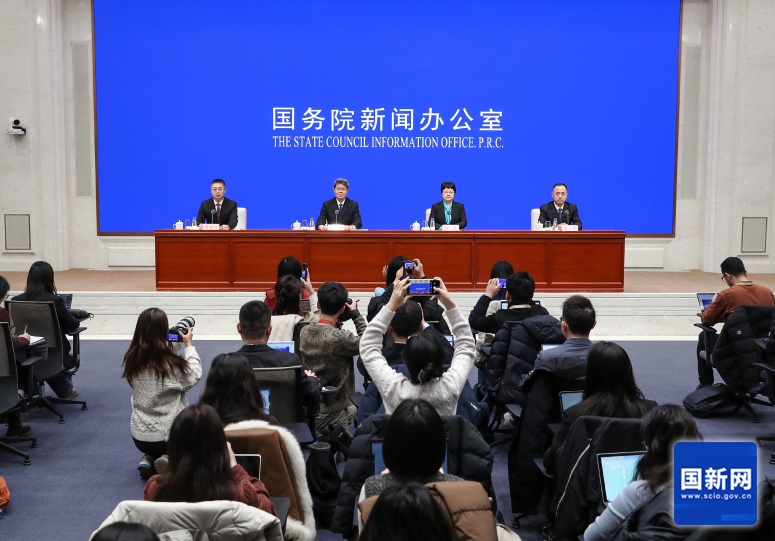
Core Viewpoint - The press conference highlighted China's industrial and information technology development goals for 2025, focusing on emerging industries and future technologies, with an emphasis on new materials, humanoid robotics, and 6G technology [1][4][8]. Emerging Industries - The Ministry of Industry and Information Technology (MIIT) aims to implement actions to develop and strengthen emerging industries, creating new momentum for growth [1][4]. - New materials were specifically mentioned as a key area, with a focus on advanced basic materials, strategic materials, and AI-integrated materials [1][6]. - By 2025, the industrial added value of key sectors like integrated circuits and electronic materials is expected to grow by 26.7% and 23.9% respectively [4]. Future Industries - The MIIT plans to promote future industries such as embodied intelligence and 6G technology, with significant investments in R&D and application ecosystems [1][7][10]. - The first phase of 6G technology trials has resulted in over 300 key technology reserves, with the second phase already initiated [10]. - Humanoid robotics is expected to drive the development of the embodied intelligence sector, with over 140 domestic companies and more than 330 humanoid robot products launched by 2025 [8][9]. Economic Contribution - The industrial and information sectors contributed over 40% to economic growth, with a manufacturing value-added growth of 5.9% year-on-year [4]. - The telecommunications business volume increased by 9.1%, indicating robust growth in the sector [4]. Investment and Innovation - The MIIT has facilitated over 55 billion yuan in new materials entering the market, supporting significant projects like the Shenzhou 21 manned spacecraft and C919 aircraft [6]. - The government is committed to enhancing the innovation capacity and development efficiency of the new materials industry through policy support and funding [6]. AI Development - By 2025, the number of AI companies in China is projected to exceed 6,000, with the core industry scale expected to surpass 1.2 trillion yuan [11]. - The launch of the national AI industry investment fund, with a scale of 60 billion yuan, aims to accelerate the development of AI technologies and applications [11][12]. Support for SMEs - The MIIT will optimize the business environment for small and medium-sized enterprises (SMEs) and implement measures to support their growth [13]. - A three-year action plan will be executed to cultivate specialized and innovative SMEs, enhancing their development mechanisms [13].

【投融资动态】中科可蓝天使+融资,融资额数千万人民币,投资方为金桥私募基金、丰原生物等
Sou Hu Cai Jing· 2026-01-21 11:32
Core Insights - Beijing Zhongke Kelan New Materials Technology Co., Ltd. has completed an angel round financing of several tens of millions of RMB, with participation from institutions such as Jinqiao Private Equity Fund, Fengyuan Biological, and Lingge Venture Capital [1] Company Overview - Zhongke Kelan was established in February 2024, with its core technology and team incubated from the National Engineering Research Center for Engineering and Ecological Plastics at the Chinese Academy of Sciences [1] - The company's flagship product is PDA (Polyesters Bio-Degradable in All Nature Environment), which is designed to meet national major demands and introduces a new technological route for achieving complete and controllable degradation of plastics under all natural conditions [1] Market Applications - The PDA technology can be widely applied in packaging upgrades for electronic information, daily chemicals, cosmetics, and medical fields, as well as in emerging market areas such as marine ranching, offshore operations, and 3D printing consumables [1]

智联招聘新报告:哪些行业就业好、工资高?
Xin Lang Cai Jing· 2026-01-21 11:18
Core Insights - The job market is experiencing structural changes driven by the development of new productive forces, with significant increases in demand for high-end equipment and modern service industries in Q4 2025 [1][2][4][6][7] Group 1: Job Market Trends - In Q4 2025, the average monthly salary for algorithm engineers is approximately 25,236 yuan, with job demand surging by 110% [2][4] - The demand for drone engineers has increased by nearly 60% year-on-year, with an average monthly salary of about 16,600 yuan [7] - The robotics industry has seen a 60% increase in demand for engineers, with specific roles like robot debugging engineers growing by 64.1% [4][5] Group 2: Sector-Specific Insights - The new generation of information technology is expanding rapidly, with job postings in artificial intelligence increasing by 19% and smart hardware by 11.5% [2][3] - The modern service industry, particularly online life services (O2O), has shown a remarkable growth rate of 62.7% in job postings [1] - The new materials sector has experienced a 28.1% increase in recruitment demand, with high polymer materials engineers earning an average salary of around 16,600 yuan [6] Group 3: Regional Demand - Beijing, Shenzhen, and Hangzhou are the top three cities for talent demand in the new generation of information technology, collectively accounting for over 20% of job postings [3] - Suzhou has emerged as the city with the highest demand for high-end equipment talent, followed by Shenzhen, Shanghai, Tianjin, and Wuxi [5] Group 4: Salary and Skill Requirements - The average monthly salary for robot algorithm positions is 24,426 yuan, with a year-on-year demand increase of 30.7% [2] - Positions in the aerospace sector, such as navigation algorithm engineers, have an average salary of approximately 26,000 yuan, reflecting high demand for skilled professionals [6][7] - The average salary for mechanical engineers and mechanical structure engineers is around 12,784 yuan and 13,729 yuan, respectively, indicating a trend of increasing quality in talent demand [5]
针对性化解供强需弱矛盾
Xin Lang Cai Jing· 2026-01-21 10:21
Economic Overview - The total economic output of China has reached a new milestone of 140 trillion yuan, with the manufacturing value added ranking first globally for 16 consecutive years, and the urbanization rate of the permanent resident population increasing by 0.89 percentage points compared to the previous year [2] Development Goals and Strategies - The National Development and Reform Commission (NDRC) summarized the past year's economic achievements, highlighting stable economic operation and enhanced resilience, with a focus on high-quality development [3] - Looking ahead to 2026, significant potential for growth is expected in consumption, investment, technology, and regional development [3] Technological and Industrial Advancements - New technologies, products, and scenarios are emerging, with sectors such as new energy, new materials, and aerospace poised for growth [3] - The NDRC is planning to advance a series of major high-tech industry projects during the 14th Five-Year Plan period [3] Supply and Demand Dynamics - The NDRC emphasized the need to address the prominent contradiction of strong supply and weak demand, focusing on achieving a dynamic balance and healthy circulation of supply and demand [4] - Key strategies include strengthening domestic circulation, enhancing the real economy, and promoting a unified national market [4] Policy Initiatives - The NDRC is set to develop a strategic implementation plan for expanding domestic demand from 2026 to 2030, aiming to leverage new demand to drive new supply [4] - Policies will focus on intelligent, green, and integrated development, fostering emerging and future industries [4] Consumer and Market Dynamics - Efforts to enhance consumer income are crucial for expanding domestic demand, with plans for actions to stabilize employment and increase urban and rural residents' income [5] - The NDRC is working on optimizing project conditions and standards to lower investment thresholds in equipment updates and improve the consumer goods replacement program [5] Price Stability and Inflation Control - Maintaining stable prices for essential goods is a key macroeconomic goal, with recent trends showing a rise in both the Consumer Price Index (CPI) and the Producer Price Index (PPI) [6] - The NDRC plans to implement more proactive fiscal policies and moderately loose monetary policies to promote reasonable price recovery [6][7]
我国已累计推动价值超550亿元新材料产品进入市场
Xin Hua Wang· 2026-01-21 09:13
Core Insights - The Ministry of Industry and Information Technology (MIIT) has significantly enhanced the development level and supply assurance capability of new materials, with over 55 billion yuan worth of new material products introduced to the market [1][2] Group 1: Policy and Initiatives - MIIT, in collaboration with relevant departments and local governments, is promoting the deep integration of new material technology innovation and industrial innovation [1] - Key breakthroughs have been achieved in critical materials through the implementation of national science and technology major projects and industrial foundation reconstruction projects [1] - The introduction of insurance compensation policies for first-time new materials aims to address market entry challenges and expand support for these materials [1] Group 2: Capacity Building - A comprehensive system of five key platforms covering the entire process of material research and development, pilot testing, production, testing, and application has been established [1] - Nearly 3,000 batches of new material application verification services and over 1.5 million testing and evaluation services have been provided [1] Group 3: Future Directions - MIIT plans to focus on advanced basic materials, key strategic materials, cutting-edge new materials, and the integration of artificial intelligence with materials to enhance innovation capabilities and development efficiency in the new materials industry [2]
山西华阳集团召开十五届三次职代会
Xin Hua Cai Jing· 2026-01-21 09:02
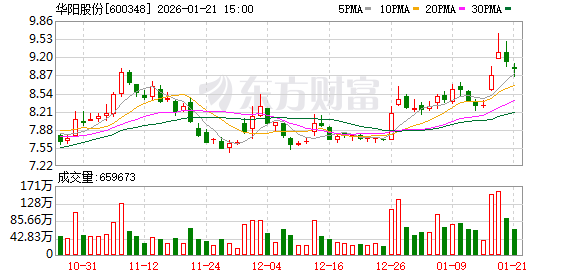
Core Viewpoint - Shanxi Huayang New Materials Group (Huayang Group) has achieved significant development results over the past year, focusing on production, transformation, and innovation while recognizing the long-term challenges of its transition [2] Group 1: Development Achievements - Huayang Group has emphasized the importance of maintaining a sense of urgency while also being patient in its development pace during the "15th Five-Year Plan" period, transitioning from a "dual-driven" to a "three-legged" approach [2] - The company has made notable progress in traditional industry upgrades and the cultivation of emerging industries [2] Group 2: Strategic Focus for "15th Five-Year Plan" - The company aims to strengthen its three main businesses while ensuring safety, enhancing efficiency, and expanding production capacity in traditional coal industries [3] - Huayang Group plans to develop the sodium-ion battery industry chain and high-performance carbon fiber industry, while also focusing on the aluminum industry chain integration [3] - The company will enhance its competitiveness in cost, technology, and market through internal improvements and innovation [3] Group 3: Goals and Work Plans for 2026 - The guiding ideology for 2026 includes focusing on coal, enhancing traditional coal advantages, and developing new energy materials [4][5] - Huayang Group will implement a strategy to enhance core functions and competitiveness, emphasizing intelligent, green, and integrated development [4] - The company has outlined five key areas for 2026: safety management, cost reduction and efficiency improvement, focus on main responsibilities, green development, and strong party leadership [5][6]

权威发布|一批“十五五”时期高技术产业标志性引领性重大工程正谋划推进
Ren Min Ri Bao· 2026-01-21 07:21
Group 1 - The core viewpoint emphasizes the importance of accelerating the integration of innovation chains, industrial chains, and talent chains to foster economic growth and enhance the role of domestic demand in driving the economy [2][3][4] - By 2025, the contribution rate of domestic demand to economic growth is expected to exceed 67%, with consumption contributing 52% [4] - The digital economy's added value is projected to reach 49 trillion yuan by 2025, accounting for approximately 35% of GDP, indicating significant market potential [2] Group 2 - China has 24 global top 100 innovation clusters, with the "Shenzhen-Hong Kong-Guangzhou" cluster ranked first globally, highlighting the country's strong innovation capabilities [3] - The government is focusing on creating a unified national market to enhance resource allocation, stimulate growth, and promote competition, which is crucial for domestic circulation [6][7] - The implementation of the "Two New" policy is expected to stabilize investment, expand consumption, and improve living standards, with over 3.6 billion people expected to benefit from consumption subsidies by 2025 [5]
跃升城市能级,济南发力“内涵式发展”
Qi Lu Wan Bao· 2026-01-21 06:17
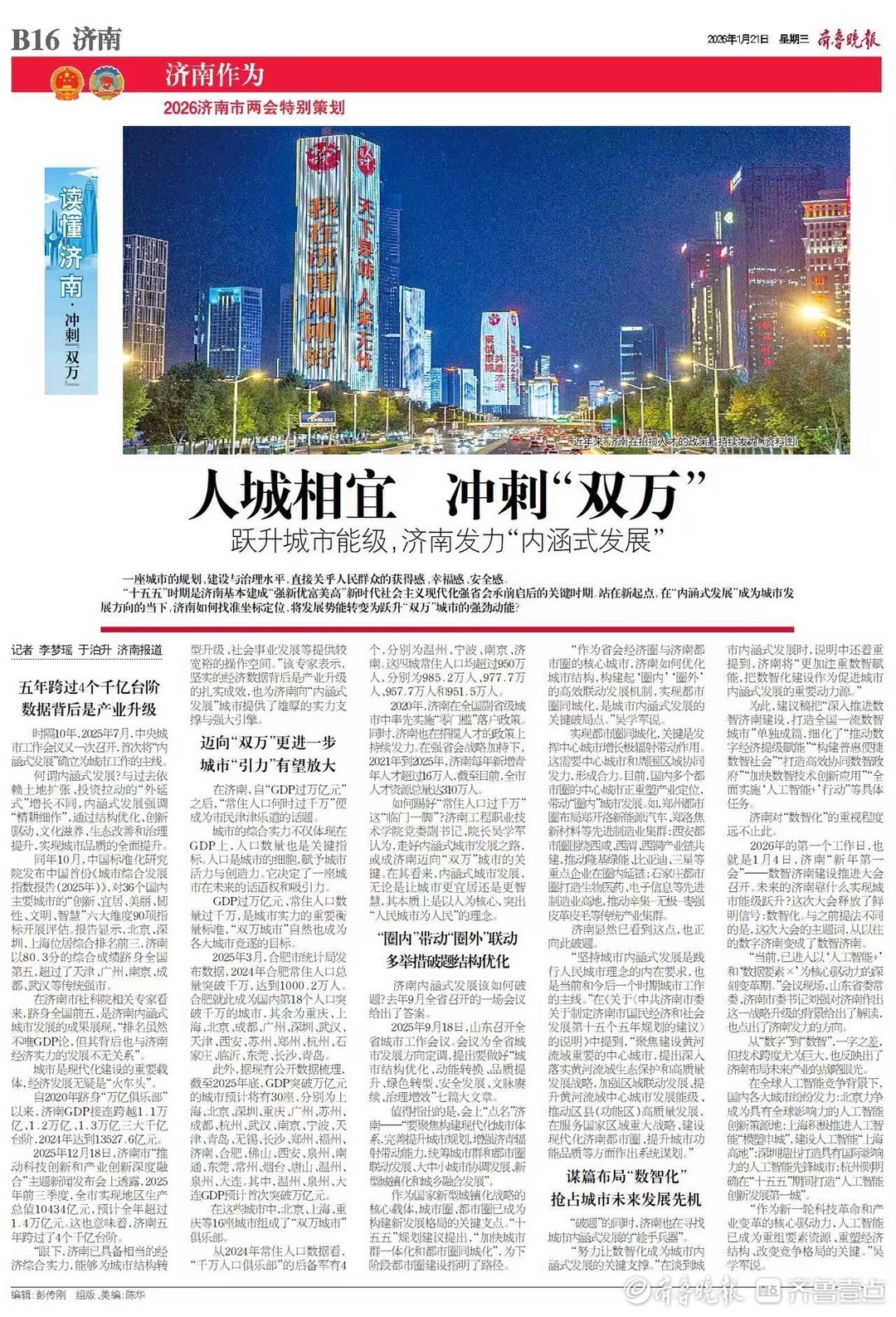
Core Viewpoint - The article emphasizes the importance of urban planning, construction, and governance in enhancing the people's sense of gain, happiness, and security, particularly in the context of Jinan's development during the "14th Five-Year Plan" period, focusing on "connotative development" as a key direction for urban growth [1][5]. Economic Development - Jinan's GDP has crossed significant milestones, moving from 1 trillion to 1.3 trillion yuan, with projections for 2024 to reach 1.35276 trillion yuan, indicating robust economic growth and industrial upgrades [6][16]. - The city has achieved a comprehensive score of 80.3 in the "Urban Comprehensive Development Index Report (2025)", ranking fifth nationally, surpassing traditional strong cities like Tianjin and Guangzhou [5][14]. Population Growth - The goal of Jinan is to surpass a permanent resident population of 10 million, which is seen as a critical indicator of urban strength alongside GDP [7][18]. - As of 2025, Jinan's population is reported to be approximately 951.5 million, positioning it among cities with populations exceeding 950 million, aiming to join the "double ten million" cities club [19]. Urban Development Strategy - The article outlines Jinan's focus on "connotative development," which emphasizes structural optimization, innovation, cultural enrichment, ecological improvement, and governance enhancement to elevate urban quality [5][14]. - A provincial meeting highlighted the need for Jinan to enhance its urban planning and improve its capacity for regional collaboration, aiming for a modern urban system and effective urban-rural integration [20][23]. Digital Transformation - Jinan is prioritizing "smart city" initiatives, transitioning from "digital" to "smart" development, with a focus on artificial intelligence and data-driven strategies to enhance urban capabilities [24][25]. - The city plans to implement specific tasks related to digital economy empowerment, creating a convenient smart society, and fostering efficient governance through technology [23][24].
新材料50ETF(159761)涨超1.1%,行业景气周期获关注
Mei Ri Jing Ji Xin Wen· 2026-01-21 06:14
Core Viewpoint - The new materials industry, particularly magnesium alloys, is experiencing significant growth due to technological advancements and increasing demand in sectors like electric vehicles and humanoid robots [1]. Group 1: Industry Trends - The magnesium-to-aluminum ratio has fallen below 1, making magnesium alloy casting products economically advantageous compared to aluminum alloys [1]. - Technological improvements in semi-solid forming equipment have led to the introduction of ultra-large equipment capable of over 3000 tons, enhancing the mechanical and corrosion properties of magnesium alloy products [1]. - The global demand for magnesium alloys in the automotive sector is projected to increase from 950,000 tons in 2024 to 5.12 million tons by 2030 [1]. Group 2: Market Applications - Major automotive manufacturers are accelerating the mass application of magnesium alloys in vehicle body and chassis components [1]. - Magnesium alloys are identified as ideal lightweight materials for humanoid robots, indicating potential for a second growth curve as the industry expands [1]. Group 3: Investment Vehicle - The New Materials 50 ETF (159761) tracks the New Materials Index (H30597), which includes companies engaged in the research, production, and sales of new materials, reflecting the overall performance and development trends of the new materials industry [1].
工信部:近期已启动第二阶段6G技术试验,AI已渗透领航级智能工厂70%以上业务场景
Hua Er Jie Jian Wen· 2026-01-21 06:07
Core Viewpoint - The press conference highlighted China's significant advancements in industrial and information technology development, with a focus on 5G and AI, aiming for high-quality growth and innovation by 2025 [1][6]. Group 1: 5G and 6G Development - China has established 4.838 million 5G base stations, covering all towns and 95% of administrative villages, with over 1.2 billion 5G users [3][50]. - The country holds 42% of the global share of essential 5G standard patents, and the first phase of 6G technology trials has been completed, with over 300 key technologies reserved [3][50]. Group 2: AI and Emerging Industries - By 2025, the core AI industry in China is expected to exceed 1.2 trillion yuan, with over 6,000 AI companies anticipated [5][6]. - AI applications have penetrated over 70% of business scenarios in leading smart factories, with more than 6,000 vertical models developed [8][28]. Group 3: Technological Innovations - Innovations in materials such as perovskite, permanent magnet materials, and power batteries are at an internationally advanced level, with significant advancements in quantum technology [4][22]. - The manufacturing sector has seen a 28% increase in industrial robot production and a 28.2% rise in new energy vehicle sales [17][23]. Group 4: Support for Future Industries - The Ministry of Industry and Information Technology (MIIT) plans to support local governments in developing future industries and increase investment from government funds [9][24]. - A focus on training and developing a workforce skilled in both AI and manufacturing is emphasized to address employment restructuring due to technological advancements [10][39]. Group 5: Small and Medium Enterprises (SMEs) - In 2025, the value added by industrial SMEs is projected to grow by 6.9%, with over 14,000 specialized and innovative SMEs cultivated [12][44]. - The MIIT will implement a "14th Five-Year Plan" to enhance the development environment for SMEs and ensure timely payments to them [45][46]. Group 6: Information Infrastructure - The construction of information infrastructure has been prioritized, with significant advancements in mobile and fixed networks, including 5G and gigabit optical networks [49][50]. - The MIIT aims to enhance the application of information infrastructure across various sectors, ensuring continuous upgrades and technological advancements [51].