
电信

Search documents
【涨知识】手续费企业所得税税前扣除知多少?
蓝色柳林财税室· 2025-10-09 01:35
欢迎扫描下方二维码关注: 申税小微有话说: 在企业日常经营中,手续费支出十分常见,小到银行转账手续费,大到中介服务佣金,这类支出能否在企业所得税税前扣除? 扣除限额多少?直接影响企业税务成本。 今天申税小微就结合最新政策,从" 常规行业扣除标准""特殊情形扣除规则""政策依据 "三方面,帮大家理清手续费税前扣除 的关键要点。 01 常规行业扣除标准(按行业分类) 扣除限额 :与合法中介机构/个人签订协议的, 按协议确认收入金额 的5%计算限额 , 超限额部分不得扣除。 举例 :某贸易公司委托中介促成1000万元合同,支付60万元手续费。扣除限额=1000×5%=50万元,超出的10万元无法税 前扣除。 注意 :需通过转账支付(委托个人除外), 现金支付不可扣除 ;发行股票支付的 承销手续费也不可扣除。 扣除限额: 按当年全部保费收入扣除退保金等后的18%计算限额, 超限额部分可结转以后年度扣除 (区别于一般企 业"当年不扣")。 举例 :某保险公司当年保费收入扣除退保金后余额5000万元,支付手续费950万元。扣除限额=5000×18%=900万元,超 出的50万元可结转次年扣除。 扣除 场景 :仅针对" 委 ...


爱尔兰电信行业贸易协会任命新主席和董事
Shang Wu Bu Wang Zhan· 2025-10-08 17:28
爱尔兰RTE新闻9月29日报道,爱尔兰电信行业协会 (TII)任命尼古拉·库克(Nicola Cooke)为其新 任董事长,并任命伊莲·凯瑞(Elaine Carey)为其新任理事会主席。TII是爱尔兰商业雇主协会(Ibec) 里代表电子通信的协会,成员包括宽带、广播、有线、固定、移动、卫星和无线互联网提供商,以及铁 塔公司、网络提供商和设备制造商,如Three、沃达丰、Sky和维珍传媒等大型行业参与者。过去八年, TII的会员公司已在爱尔兰通信基础设施上投资了约50亿欧元,并为当地创造24,000个就业机会。 (原标题:爱尔兰电信行业贸易协会任命新主席和董事) ...
WTO:AI商品提振全球贸易,今年北美进口将萎缩
Di Yi Cai Jing Zi Xun· 2025-10-07 13:40
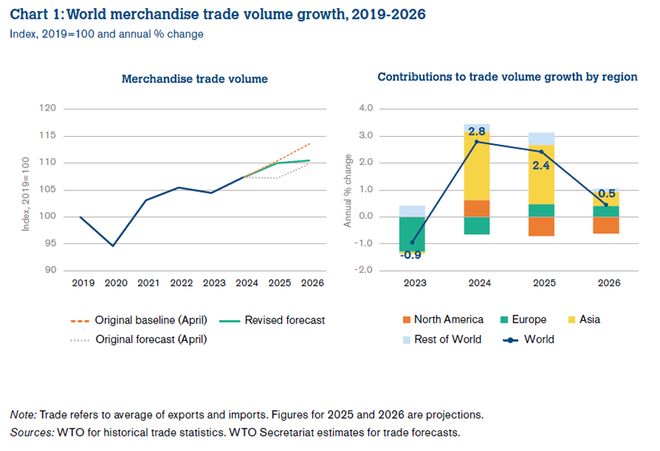
Core Insights - The WTO has revised its global trade growth forecast for 2025 upwards to 2.4%, driven by increased spending on AI-related products, a surge in North American imports before tariff hikes, and strong trade growth in other regions [1][5] - However, the forecast for 2026 has been significantly downgraded to 0.5%, indicating potential challenges ahead [1][5] Group 1: Trade Growth Drivers - In the first half of 2025, global merchandise trade volume is expected to grow by 4.9% year-on-year, with a 6% increase in current dollar terms following a 2% growth in 2024 [4] - Key drivers of this growth include early North American imports, favorable macroeconomic conditions such as deflation and supportive fiscal policies, and robust growth in emerging markets [4] - AI-related products, including semiconductors, servers, and telecommunications equipment, contributed nearly half of the overall trade growth, with a year-on-year value increase of 20% [4] Group 2: Trade Forecast Adjustments - The WTO anticipates that global merchandise trade growth will slow from 2.8% in 2024 to 2.4% in 2025 and further to 0.5% in 2026, reflecting the impact of higher tariffs and trade policy uncertainties [5] - The GDP growth forecast for 2025 is set at 2.7%, with a slight decrease to 2.6% in 2026 [5] - The WTO emphasizes that the main downside risks to this forecast include the spread of trade restrictions and policy uncertainties across more economies and sectors [5] Group 3: Regional Trade Performance - Asia and Africa are expected to achieve the fastest export growth in 2025, while North America is projected to experience a decline [6] - By 2026, export performance in North America and Europe is expected to improve, although all regions are anticipated to see a decline in import performance [6] Group 4: Impact on Services Trade - The WTO has downgraded its forecast for global commercial services trade due to indirect impacts from tariffs, with transportation and tourism sectors expected to see reduced growth rates [7] - The expected growth rate for transportation services in 2025 is 2.5%, down from 4.5% in 2024, while tourism is projected to grow by 3.1%, a decrease from 11% the previous year [7] - Digital services are expected to show slightly stronger growth, with a forecast of 6.1% compared to 5.7% in 2024 [7]
浙商国际10月港股策略:港股市场资金面环境进一步改善 看好相对景气的创新药等行业
Zhi Tong Cai Jing· 2025-10-07 09:42
Core Viewpoint - The Hong Kong stock market has shown a strong upward trend, with a continuous rise for five months, despite underlying economic weaknesses [1][2]. Market Performance Review - In September, the Hong Kong stock market experienced a slight decline at the beginning, followed by a sustained rebound due to favorable factors such as the U.S. interest rate cut and significant inflows from the south. The Hang Seng Index reached a peak of over 27,000 points [2]. - The monthly performance of major indices as of the end of September was as follows: Hang Seng Composite Index +8.11%, Hang Seng Index +7.09%, and Hang Seng Tech Index +13.95% [2]. Macro Environment Analysis - **Fundamentals**: Economic data in August showed further weakening, indicating that the domestic economy is still in a bottoming phase [3]. - **Policy**: The policy stance has become more proactive to support economic stability and growth [3]. - **Capital**: There has been a significant acceleration of southbound capital inflows, and the external funding environment has improved, leading to increased investment in Hong Kong stocks [3]. - **Sentiment**: The strong market performance has driven bullish sentiment, although concerns about the fundamentals remain [3]. Market Outlook and Strategy - The Hong Kong stock market's fundamentals remain weak, but the capital environment is improving, and there is strong short-term bullish sentiment. The market trend has entered a right-side phase, and a cautious optimism is maintained for the short to medium term [4]. - Preferred sectors for investment include automobiles, new consumption, innovative pharmaceuticals, and technology, which are relatively prosperous and benefit from policy support [4]. - Additionally, low-valuation state-owned enterprises with stable performance and dividends, as well as local Hong Kong banks, telecommunications, and utility stocks that benefit from the interest rate cut cycle, are also favored [4]. - Attention should be paid to potential impacts from the U.S.-China trade disputes, with a recommendation to avoid sectors and companies with significant exposure to U.S. business [4].
突发跳水,超16万人爆仓,什么情况?
Zheng Quan Shi Bao· 2025-10-07 07:56
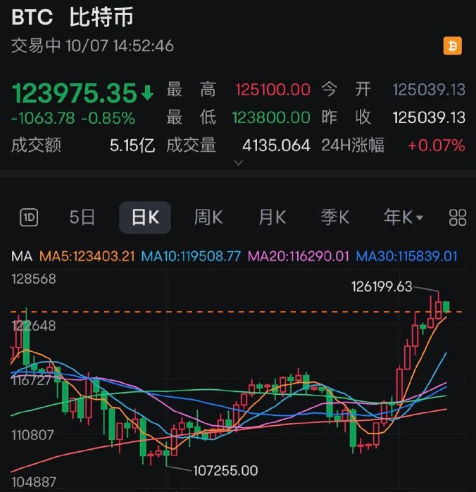
Group 1 - Bitcoin experienced a sudden drop of over 0.8%, falling below $124,000, while Ethereum and Avalanche also declined [1] - In the past 24 hours, over 160,000 individuals in the cryptocurrency market faced liquidation, with a total liquidation amount of $353 million [3][4] - Bitcoin had previously surged to around $126,199, driven by a weakening dollar and increased demand for assets like gold and Bitcoin as the Federal Reserve entered a rate-cutting phase [4][5] Group 2 - The recent surge in gold prices has raised concerns about a potential technical adjustment, as indicated by Bank of America analyst Paul Ciana, who noted signs of "exhaustion" in the upward momentum of gold prices nearing $4,000 per ounce [6] - Ciana suggested that the current price of gold is approximately 21% above its 200-day simple moving average, which historically indicates a higher likelihood of peak formation [6] - In the stock market, while major Asia-Pacific indices mostly closed higher, the Nikkei 225 index saw a slight increase of only 0.01% to close at 47,950.88 points after previously surpassing 48,500 points [7]
美股异动|美国电话电报股价跳水创三年新低业绩增长难挡市场忧虑
Xin Lang Cai Jing· 2025-10-06 22:45
Core Insights - The stock price of AT&T fell by 4.40% on October 6, reaching its lowest point since April 2025, raising concerns about the company's future development [1] - AT&T reported a revenue of $61.473 billion for the first half of fiscal year 2025, reflecting a year-over-year growth of 2.75%, while net profit increased by 24.06% to $9.553 billion, indicating strong performance [1] - The telecommunications industry is facing challenges due to rapid technological advancements, particularly the rollout of 5G, which pressures traditional business models [1] Company Performance - AT&T's revenue for the first half of 2025 was $61.473 billion, a 2.75% increase compared to the previous year [1] - The net profit for the same period reached $9.553 billion, marking a significant growth of 24.06% [1] - Despite positive financial results, the stock price decline suggests investor concerns regarding future prospects [1] Industry Trends - The telecommunications sector is experiencing rapid technological changes, particularly with the introduction of 5G technology, which poses challenges to existing business models [1] - Continuous investment is required for companies to maintain technological leadership and market competitiveness, which increases operational costs [1] - Global economic uncertainties may impact consumer and business spending, indirectly affecting company performance [1] Investor Considerations - Investors should closely monitor AT&T's future strategic initiatives, especially in response to technological changes and market demand shifts [2] - Attention to global economic data is crucial as it may have potential implications for the company's performance [2] - Long-term investment opportunities may arise based on the company's financial performance and industry trends, despite short-term stock price volatility [2]
每周投资策略-20251006
citic securities· 2025-10-06 13:37
Group 1: US Market Focus - The Federal Reserve is expected to lower interest rates two more times this year, with the next meetings on October and December [11][16][18] - Historical analysis shows that various asset classes have not reacted dramatically to US government shutdowns, indicating a potential for stability in the market [13][18] - Micron Technology (MU US) reported strong demand from data centers, with Q4 FY2025 earnings exceeding expectations, driven by growth in HBM business and a favorable DRAM market [19] - Meta Platforms (META US) unveiled a new AI glasses product line, enhancing its position in the AI and metaverse space, with a target price of $860 [19] Group 2: Singapore Market Focus - The Monetary Authority of Singapore (MAS) is set to restart easing measures in October, with expectations of a slowdown in GDP growth to 2.2% for the year [24][30] - Keppel Data Centre REIT is expanding in Japan with a recent acquisition worth SGD 707 million, expected to boost its distribution per unit (DPU) [36] - Singapore Telecommunications (ST SP) is focusing on digital infrastructure growth, with potential for significant earnings growth in FY2026 and beyond [36] Group 3: Vietnam Market Focus - Vietnam's GDP grew by 7.5% in the first half of 2025, driven by strong domestic consumption and investment, but is expected to slow down due to external trade uncertainties [43][46] - The Vietnamese central bank is likely to maintain a loose monetary policy in the short term, supporting economic growth through increased public investment [46] - Vietnam may be upgraded to FTSE's secondary emerging market status, potentially attracting around $1.1 billion in inflows if the upgrade occurs [49][50]


8月末澳门注册机动车同比上升0.8%
智通财经网· 2025-10-06 06:53
Group 1: Vehicle Registration and Traffic - As of the end of August 2025, the total number of registered vehicles in Macau reached 253,331, representing a year-on-year increase of 0.8% [1] - The cross-border vehicle flow increased by 23.3% year-on-year to 983,563 trips in August, with light vehicle flow rising by 25.5% to 932,912 trips [2] - The number of new registered vehicles in August decreased by 33.8% to 789, with electric vehicles accounting for 37.6% of new registrations [1][2] Group 2: Transportation and Shipping - The number of ferry services increased by 1.5% year-on-year to 6,857 trips in August, while commercial flights at Macau International Airport fell by 5.4% to 4,934 flights [1][2] - For the first eight months of the year, cross-border vehicle flow totaled 7,236,499 trips, up 23.0% year-on-year, while ferry services and commercial flights decreased by 2.0% and 4.5%, respectively [2] Group 3: Telecommunications and Internet Usage - The number of mobile phone users increased by 4.4% year-on-year to 1,499,914, with prepaid card users rising by 10.3% [3] - The number of internet subscribers grew by 1.7% to 781,346, while internet usage hours in August decreased by 1.8% to 150 million hours [3]
智通港股通资金流向统计(T+2)|10月6日
智通财经网· 2025-10-05 23:34
Key Points - On September 26, 2023, the top three stocks with net inflows from southbound funds were Alibaba-W (09988) with 34.60 billion, Yingfu Fund (02800) with 14.02 billion, and Tencent Holdings (00700) with 11.06 billion [1][2] - The top three stocks with net outflows were China Mobile (00941) with -6.35 billion, China Telecom (00728) with -3.59 billion, and China Construction Bank (00939) with -3.38 billion [1][2] - In terms of net inflow ratio, GX Hang Seng Technology (02837) led with 462.02%, followed by Green Power Environmental (01330) with 156.44%, and Anjuke Food (02648) with 127.61% [1][2] - The top three stocks with the highest net outflow ratios were Tianjin Chuangye Environmental Protection (01065) at -123.57%, China Telecom (00728) at -113.73%, and China Pacific Insurance (02328) at -110.28% [1][2] Net Inflow Rankings - The top ten stocks by net inflow included: - Alibaba-W (09988): 34.60 billion, 13.44% [2] - Yingfu Fund (02800): 14.02 billion, 9.22% [2] - Tencent Holdings (00700): 11.06 billion, 8.77% [2] - Xiaomi Group-W (01810): 11.00 billion, 4.71% [2] - Huahong Semiconductor (01347): 8.23 billion, 15.41% [2] - The top ten stocks by net outflow included: - China Mobile (00941): -6.35 billion, -61.43% [2] - China Telecom (00728): -3.59 billion, -113.73% [2] - China Construction Bank (00939): -3.38 billion, -18.39% [2] - China Pacific Insurance (02328): -2.86 billion, -110.28% [2] - China Petroleum & Chemical Corporation (00386): -2.16 billion, -51.00% [2] Net Inflow Ratio Rankings - The top three stocks by net inflow ratio were: - GX Hang Seng Technology (02837): 462.02%, 16.14 million [3] - Green Power Environmental (01330): 156.44%, 3.21 million [3] - Anjuke Food (02648): 127.61%, 1.14 million [3] - The top three stocks by net outflow ratio were: - Tianjin Chuangye Environmental Protection (01065): -123.57%, -2.42 million [3] - China Telecom (00728): -113.73%, -3.59 billion [3] - China Pacific Insurance (02328): -110.28%, -2.86 billion [3]





宣布与加拿大电信巨头贝尔合作 AST SpaceMobile(ASTS.US)涨超9%
Zhi Tong Cai Jing· 2025-10-02 15:13
Core Viewpoint - AST SpaceMobile's stock price increased by over 9% to $62.19 following the announcement of a partnership with Canadian telecom giant Bell to launch space-based mobile communication services using low Earth orbit satellites [1] Company Developments - Bell plans to collaborate with AST SpaceMobile next year to provide mobile communication services for remote and underserved areas [1] - A successful demonstration was conducted using AST SpaceMobile satellites to enable direct mobile voice calls on Bell's wireless network with standard, unmodified smartphones [1] - The demonstration also included video calls, broadband data transmission, SMS, and emergency alerts, utilizing Bell's low-frequency spectrum [1] Industry Impact - The space-based broadband technology is expected to bridge the coverage gap between Bell's terrestrial network and areas with complex geographical conditions, particularly in northern Canadian communities and remote coastal regions [1] - Bell's CTO, Mark McDonald, highlighted the significant potential of this technology for remote operations and monitoring in industries such as natural resources, energy, and environment [1]
