
贸易

Search documents
暴跌,黄金重大变局!
Sou Hu Cai Jing· 2025-10-21 10:05
Group 1: Gold Market - Gold prices surged over 2.5%, reaching a historical high of $4,381.29 before closing at $4,356.26 [1] - Following the surge, gold prices experienced a significant drop, falling below the $4,300 mark and hovering around $4,276 [1] Group 2: U.S. Government Shutdown - The U.S. government remains in a shutdown, now entering its 20th day, after the Senate failed to pass a funding bill [4] - The funding bill aimed to extend government funding until November 21 but did not meet the required 60 votes, receiving only 50 in favor [4] - The shutdown has led to approximately 1,400 employees at the National Nuclear Security Administration being placed on unpaid leave, marking the first such occurrence since the agency's establishment in 2000 [4] Group 3: U.S. Stock Market - U.S. stock indices rose significantly, with the Dow Jones up 1.12% to 46,706.58, the S&P 500 up 1.07% to 6,735.13, and the Nasdaq up 1.37% to 22,990.54 [2] - Market expectations are leaning towards a potential resolution of the government shutdown [2] Group 4: Federal Reserve Interest Rate Outlook - The probability of a 25 basis point rate cut by the Federal Reserve in October stands at 99.4%, with a 0.6% chance of maintaining current rates [5] - For December, the cumulative probability of a 50 basis point cut is 98.6% [5] Group 5: U.S.-China Trade Relations - President Trump has made multiple statements regarding trade negotiations with China, indicating a potential for both tariffs and agreements [7] - The market reacted positively to Trump's final statement expressing hope for China's prosperity, leading to gains in U.S. stock indices [7] Group 6: U.S.-India Trade Relations - President Trump has threatened to impose "huge tariffs" on Indian goods if India does not cease purchasing Russian oil, escalating tensions between the two nations [8] - An Indian official noted that trade-related differences between India and the U.S. have narrowed, with hopes for an agreement to reduce punitive tariffs [10] Group 7: Political Developments in Japan - On October 21, high-profile politician Takashi Saito was elected as Japan's first female Prime Minister, advocating for expansionary fiscal policies and increased defense spending [12] - The ruling Liberal Democratic Party has formed a new coalition with the Japan Innovation Party after the Komeito party exited the ruling alliance [14] Group 8: Ukraine Conflict - Ukrainian President Zelensky has rejected Russia's demands for a complete withdrawal of Ukrainian forces from the Donbas region, maintaining Ukraine's position in ongoing negotiations [15]


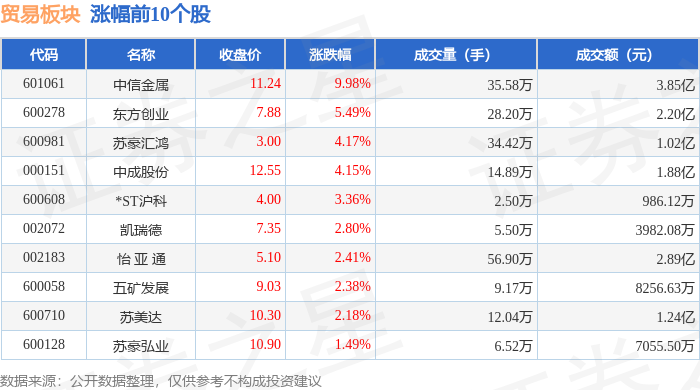
贸易板块10月21日涨2.98%,中信金属领涨,主力资金净流入1.69亿元
Zheng Xing Xing Ye Ri Bao· 2025-10-21 08:30
Market Performance - The trade sector increased by 2.98% on October 21, with CITIC Metal leading the gains [1] - The Shanghai Composite Index closed at 3916.33, up 1.36%, while the Shenzhen Component Index closed at 13077.32, up 2.06% [1] Individual Stock Performance - CITIC Metal (601061) closed at 11.24, rising by 9.98% with a trading volume of 355,800 shares and a transaction value of 3.85 billion [1] - Dongfang Chuangye (600278) closed at 7.88, up 5.49%, with a trading volume of 282,000 shares and a transaction value of 220 million [1] - Shisuo Huihong (600981) closed at 3.00, increasing by 4.17%, with a trading volume of 344,200 shares and a transaction value of 102 million [1] - Other notable stocks include Zhongcheng Co. (000151) up 4.15%, ST Hu Ke (600608) up 3.36%, and Kairuide (002072) up 2.80% [1] Capital Flow Analysis - The trade sector saw a net inflow of 169 million from institutional investors, while retail investors experienced a net outflow of 54.31 million [1] - CITIC Metal had a net inflow of 92.79 million from institutional investors, with retail investors showing a net outflow of 56.41 million [2] - Dongfang Chuangye had a net inflow of 35.32 million from institutional investors, while retail investors faced a net outflow of 24.52 million [2]





蓝皮书:中日贸易互补性依然显著,合作潜力巨大
Zhong Guo Xin Wen Wang· 2025-10-21 04:40
Group 1 - The core viewpoint of the blue paper indicates that the trade complementarity between China and Japan remains significant, with substantial cooperation potential [1] - In 2024, under the framework of the Regional Comprehensive Economic Partnership (RCEP), China-Japan economic cooperation is expected to deepen [1] - By 2025, despite challenges such as rising protectionism and slowing economic growth, there are opportunities for deeper cooperation in China-Japan economic relations [1] Group 2 - The blue paper suggests that both countries should enhance economic cooperation in the Asia-Pacific region and explore third-party market collaboration under the Belt and Road Initiative [1] - It emphasizes the need to release synergistic potential through structural complementarity, particularly in the silver economy, dual carbon goals, and digital economy sectors [1] - The report forecasts a slow recovery trend for the Japanese economy in 2024, with significant uncertainties persisting [1] Group 3 - Japan is actively focusing on the development of generative artificial intelligence (AI) and is accelerating its strategic layout in the generative AI industry structure [2] - While Japan has advantages in certain hardware areas like semiconductors, it faces shortcomings in cloud service capabilities and domestic model competitiveness [2] - The future requires Japan to find a balance between domestic substitution and international cooperation, particularly in seeking opportunities for technological collaboration with China to enhance its international competitiveness [2]
分红能力盘点:消费服务篇:自由现金流资产系列15
Huachuang Securities· 2025-10-21 01:13
Group 1: Stable Cash Flow Assets - Pharmaceutical commerce has a cash flow ratio of 55% in Q2 2025, indicating a stable cash flow generation capacity since 2021[11] - The hotel and catering industry shows a cash flow ratio of 49% in Q2 2025, with an average cash flow ratio of 50% from 2016 to 2024[18] - General retail has a cash flow ratio of 49% in Q2 2025, supported by reduced capital expenditures and inventory depletion[25] - Telecom operators maintain a cash flow ratio of 39% in Q2 2025, benefiting from stable demand and high user retention[32] Group 2: Improving Cash Flow Assets - The trade sector exhibits a cash flow ratio of 63% in Q2 2025, significantly improved due to reduced capital expenditures and inventory shrinkage[41] - The potential shareholder return rate for the trade sector is 7.1%, while the actual return is only 1.9%, indicating substantial room for dividend release[44] Group 3: Assets Under Pressure - The tourism and scenic area sector has a cash flow ratio of 21% in Q2 2025, with profitability still below pre-pandemic levels[51] - Professional services show a cash flow ratio of 13% in Q2 2025, with a significant decline in profitability due to weak demand[55] - Medical services have a cash flow ratio of 25% in Q2 2025, with profitability under pressure and limited dividend release potential[61] - The education sector has a cash flow ratio of 52% in Q2 2025, but profitability remains constrained post-regulatory changes[67] Group 4: High Expenditure Assets - The automotive services and IT services sectors are still in a high expenditure phase, with capital expenditures exceeding 1.5 in Q2 2025, indicating a new cycle of high spending driven by technological advancements[3]
国央企限制解除:提升企业治理效能
Sou Hu Cai Jing· 2025-10-20 23:29
Core Insights - Recent adjustments in corporate governance, particularly among state-owned enterprises, have garnered significant attention due to their impact on decision-making processes, talent incentives, and risk management [3][5][8] Group 1: Importance of Governance Adjustments - Effective corporate governance is essential for clarifying responsibilities, improving decision quality, and balancing stakeholder interests, especially for large and complex enterprises [3][5] - Optimized decision-making mechanisms allow companies to respond more swiftly to market changes by streamlining approval processes and enhancing decision-making transparency [3][5] Group 2: Talent Incentives - Enhanced talent incentive mechanisms are crucial for motivating employees, with companies adopting diverse approaches such as performance bonuses and career development pathways [3][6] - These measures focus not only on short-term performance but also on long-term value creation, aiding in attracting and retaining top talent [3][6] Group 3: Risk Management - A robust risk management system is vital for identifying, assessing, and managing various risks, with some companies establishing dedicated risk management committees and early warning mechanisms [5][6] - Successful risk management practices have enabled companies to avoid potential losses, as demonstrated by a trading company that implemented price monitoring and risk thresholds [6] Group 4: Supervision and Transparency - Strengthened supervision mechanisms, including internal audits and compliance management, ensure effective execution of corporate policies and processes [5] - Improved information transparency through timely and accurate disclosures enhances trust among stakeholders and supports informed decision-making [5] Group 5: Continuous Improvement - Corporate governance is an ongoing process that requires continuous adaptation to internal and external changes, emphasizing the need for companies to remain open to learning and adopting advanced management practices [8][9] - The integration of digital technologies, such as big data and AI, is expected to play a significant role in future governance developments, optimizing decision-making and enhancing corporate social responsibility [9] Group 6: Overall Trends - A clear trend towards more flexible, efficient, and transparent governance models is emerging, which not only improves individual company performance but also contributes to the overall health of the economic system [8][9]
江苏苏豪时尚集团股份有限公司关于召开2025年第三次临时股东会的通知
Shang Hai Zheng Quan Bao· 2025-10-20 20:02
Meeting Information - The third extraordinary general meeting of shareholders for 2025 will be held on November 6, 2025, at 14:30 [2] - The meeting will be conducted using a combination of on-site and online voting methods [2] - The location for the on-site meeting is Nanjing, Software Avenue, Building B, 1st Floor [2] Voting Procedures - Online voting will be conducted through the Shanghai Stock Exchange's shareholder meeting voting system, available from 9:15 to 15:00 on the day of the meeting [3] - Shareholders can vote via the trading system or the internet voting platform [7][8] - Shareholders holding multiple accounts can aggregate their voting rights across all accounts [7] Meeting Attendance - Shareholders registered with the China Securities Depository and Clearing Corporation Limited Shanghai Branch as of the close of trading on the registration date are eligible to attend [10] - The meeting will also include company directors, senior management, and appointed lawyers [10] Agenda Items - The meeting will review several proposals, including adjustments to the 2020 restricted stock incentive plan and the repurchase of certain restricted stocks [19][22] - The company plans to repurchase and cancel 2,051,900 shares of restricted stock due to unmet performance targets [22][39] - The company will also propose changes to its registered capital and amendments to its articles of association [47] Auditor Change - The company intends to appoint Zhongxinghua Certified Public Accountants as its auditor for the 2025 fiscal year, replacing Tianheng Certified Public Accountants [49] - The change is due to regulatory requirements regarding the tenure of auditing firms [50][61] - The proposed audit fees for 2025 are 1.36 million yuan, a decrease of 28.42% from the previous year [59] Legal Compliance - The company has ensured that all proposed actions comply with relevant laws and regulations, including the Company Law and the Securities Law [70]

高质量发展取得新的历史性成就——从“十四五”看中国答卷
Xin Hua She· 2025-10-20 15:49
Core Insights - The "14th Five-Year Plan" has achieved significant historical accomplishments, showcasing China's commitment to high-quality development and modernization [1][4][19] Economic Performance - China's GDP grew by 5.2% year-on-year in the first three quarters, demonstrating resilience against external pressures [2] - The total economic output is projected to reach approximately 140 trillion yuan by the end of the year, marking a significant increase during the "14th Five-Year Plan" period [5][10] - China's average economic growth rate during the first four years of the "14th Five-Year Plan" reached 5.5%, contributing around 30% to global economic growth [7] Technological Advancements - The successful procurement discussions for C919 aircraft by Asian Airlines and Cambodia's national airline highlight China's advancements in aviation technology [8] - The launch of the first domestically produced electromagnetic aircraft carrier and the operation of the world's first fourth-generation nuclear power plant underscore China's technological capabilities [9] Market Dynamics - The domestic market's contribution to economic growth is expected to average 86.8% from 2021 to 2024, with final consumption expenditure contributing 59.9%, an increase of 11.1 percentage points from the previous five-year period [10] - The reduction in energy consumption per unit of GDP by 11.6% over four years reflects a shift towards more sustainable economic practices [11] Reform and Opening Up - The reform of market access systems aims to eliminate hidden barriers and promote fair competition, with the negative list for market access reduced from 117 to 106 items [12][15] - China is committed to high-level opening up, removing restrictions on foreign investment in manufacturing and gradually expanding service sector openings [15] Social Development - The "14th Five-Year Plan" emphasizes improving people's livelihoods, with over 1.2 million new urban jobs created annually and a focus on reducing income disparities [18] - Key social indicators, such as preschool enrollment rates and life expectancy, have shown significant improvements, reflecting the government's commitment to enhancing the quality of life [18]
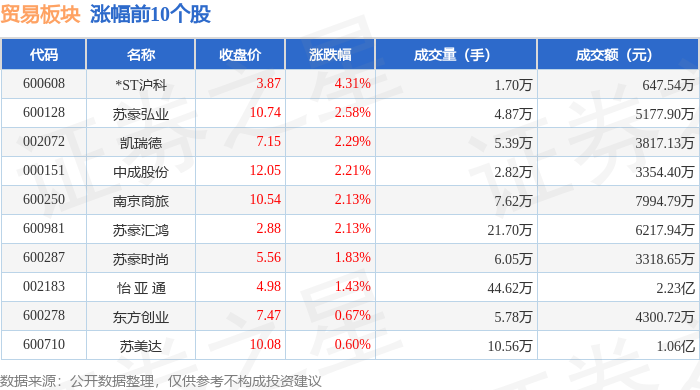
贸易板块10月20日涨1%,*ST沪科领涨,主力资金净流出580.26万元
Zheng Xing Xing Ye Ri Bao· 2025-10-20 08:27
Core Insights - The trade sector experienced a 1.0% increase on October 20, with *ST HuKe leading the gains [1] - The Shanghai Composite Index closed at 3863.89, up 0.63%, while the Shenzhen Component Index closed at 12813.21, up 0.98% [1] Trade Sector Performance - *ST HuKe closed at 3.87, with a rise of 4.31%, and a trading volume of 17,000 shares, amounting to 6.4754 million yuan [1] - Other notable performers included: - Shisuo 5Xiao at 10.74, up 2.58% [1] - XunRuiDe at 7.15, up 2.29% [1] - ZhongCheng at 12.05, up 2.21% [1] - Nanjing Shanglv at 10.54, up 2.13% [1] Capital Flow Analysis - The trade sector saw a net outflow of 580.26 million yuan from institutional investors, while retail investors contributed a net inflow of 4037.47 million yuan [2][3] - Specific stock capital flows included: - SuMeiDa with a net inflow of 577.92 million yuan from institutional investors [3] - Jiangsu Guotai with a net outflow of 532.64 million yuan from speculative funds [3] - *ST HuKe experienced a net outflow of 63.97 million yuan from speculative funds [3]


美国准备联合盟友力量,建立反制体系,可解西方稀土困局?
Sou Hu Cai Jing· 2025-10-20 03:41
Core Viewpoint - The article discusses the fluctuating stance of the Trump administration towards China, highlighting the conflicting messages regarding tariffs and negotiations, and the implications for global economic relations [1][3][11]. Group 1: Trump's Changing Attitude - Trump's approach to China has been inconsistent, oscillating between threats of increased tariffs and a willingness to engage in dialogue [3][4]. - The initial hardline stance included plans for higher tariffs and a refusal to negotiate, but this was quickly reversed to a more conciliatory tone [3][6]. Group 2: Secretary Mnuchin's Strategy - Treasury Secretary Mnuchin suggested that high tariffs may not be fully implemented and emphasized the importance of international cooperation to address challenges posed by China [6][11]. - He acknowledged the U.S.'s historical neglect of strategic resources like rare earths, which has led to dependency on China [6][12]. Group 3: Allies' Diverging Interests - European allies, while publicly supporting pressure on China, often diverge from U.S. policies, particularly regarding rare earths and trade relations [6][7]. - India and Southeast Asian countries exhibit caution in aligning with U.S. policies, preferring a neutral stance due to complex relationships with China [9][11]. Group 4: U.S. Strategic Dilemma - The frequent changes in U.S. policy indicate underlying pressures faced by the Trump administration in the global economic landscape [11][12]. - Despite attempts to leverage tariffs, the U.S. struggles to unilaterally reshape the global economic order, as interconnected supply chains limit the effectiveness of such measures [11][12]. Group 5: Global Economic Competition - The trade conflict between the U.S. and China represents a broader global economic competition, with potential tensions among allies as they balance their own interests against U.S. demands [12]. - China's resilience and adaptability in the face of external pressures suggest that it will continue to assert its influence in the evolving global economic landscape [12].
IMF发布最新世界经济展望报告预计—— 全球经济增速温和放缓
Jing Ji Ri Bao· 2025-10-19 22:08
Core Insights - The International Monetary Fund (IMF) report indicates that while the global economy showed resilience in the first half of the year, it is now experiencing signs of moderate slowdown, which is expected to persist long-term [1][2] - The report highlights that the initial strong economic activity was driven by short-term factors, and as these dissipate, global economic data is showing weakness [1][3] Economic Performance - In the first half of the year, global economic activities were robust, with inflation levels in the US and Asian economies being well-controlled [1] - The global economic growth rate is projected to decline from 3.6% at the end of 2024 to 2.6% at the end of this year, with forecasts of 3.2% in 2025 and 3.1% in 2026 [1][2] Risks and Challenges - The report identifies ongoing downward risks to the global economy, including policy uncertainty, rising protectionism, and restrictive immigration policies, which could negatively impact consumption and investment [3] - The potential volatility in the artificial intelligence sector poses a risk to economic growth, with possible repercussions for technology stocks and overall financial market stability [3] Policy Recommendations - Policymakers are urged to establish clear and transparent trade policies to reduce uncertainty and support investment, while modernizing trade rules to adapt to the digital age [4] - The report emphasizes the importance of fiscal sustainability and suggests that countries should implement structural reforms to enhance resilience and growth prospects [4]
