
金融

Search documents
中国新质造年度盛典在北京举行
Huan Qiu Wang· 2026-01-26 03:04
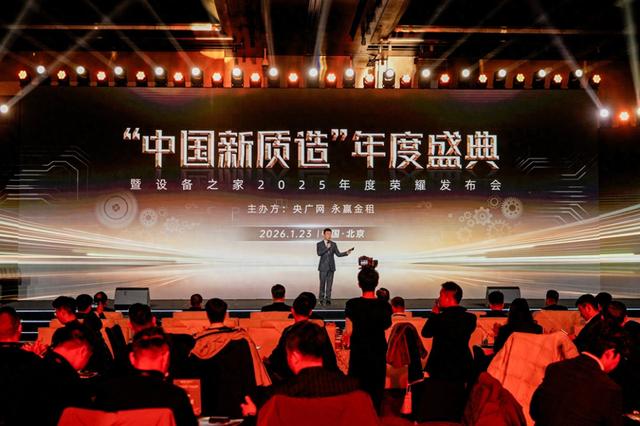
Core Viewpoint - The event "China New Quality Manufacturing Annual Ceremony and Equipment Home 2025 Annual Honor Release Conference" emphasizes the integration of technological and industrial innovation as a driving force for high-quality development in China's manufacturing sector [1][3]. Group 1: Event Overview - The ceremony gathered key stakeholders from government, industry, academia, research, finance, and media to establish industry benchmarks and foster ecological consensus [3]. - The event serves as a platform for showcasing the achievements of the "China New Quality Manufacturing" initiative and aims to promote high-quality development in the manufacturing sector [5]. Group 2: Key Insights from Speakers - Zhang Jun, Vice Secretary of the Party Committee of the Central Broadcasting Television General Station, highlighted that new quality productivity, centered on technological innovation, is crucial for transforming China's manufacturing from "large" to "strong" [5]. - Li Yizhong, President of the China Industrial Economy Federation, emphasized that the core of the "14th Five-Year Plan" is the application of artificial intelligence, which is essential for fostering new quality productivity and achieving technological self-reliance [6]. - Fu Wensheng, Vice President of Ningbo Bank, stated that finance is a vital support for "China New Quality Manufacturing," with the bank having served nearly 100,000 enterprises and supported the update of over 2 million pieces of equipment [8]. Group 3: Industry Trends and Innovations - Liu Weijie from Hisense Visual emphasized the shift in the display industry from scale growth to value growth, positioning Hisense as a model for "AI + manufacturing" [11]. - Yuan Feng, Vice President of BOE Technology Group, reiterated that self-controllable core technologies are the safety cornerstone of "China New Quality Manufacturing," focusing on technological innovation and industry upgrades [13]. - Discussions at the forums highlighted that AI has penetrated over 70% of manufacturing business scenarios, with companies like Hikvision showcasing solutions that enable autonomous decision-making in production processes [13]. Group 4: Future Initiatives - The Central Broadcasting Network announced the launch of new media projects for 2026, including short video programs that focus on enhancing life quality through smart home appliances and green building materials, as well as core industrial sectors [15][16].

基金经理投资笔记 | 锚定三重闭环,拥抱基本面慢牛
Sou Hu Cai Jing· 2026-01-26 03:04
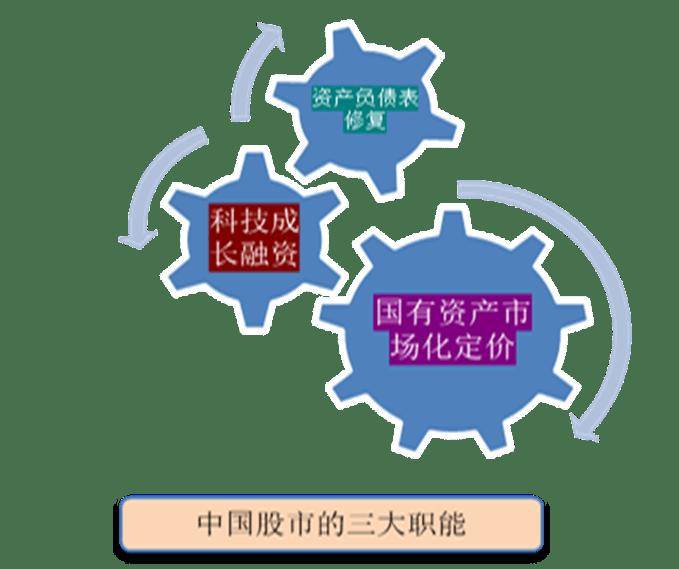
Group 1: Core Views - The narrative trading trend in the market has shown signs of fatigue, with a return to a fundamentals-driven slow bull market logic [1] - Regulatory measures on online information management aim to curb the risks associated with narrative trading, which can lead to significant market fluctuations [1] - The government's guidance for investors to shift from narrative trading to fundamentals trading is seen as a necessary response to market failures [1] Group 2: Positioning and Functions of the Stock Market - The Chinese stock market has evolved beyond a simple financing and trading platform, becoming a core hub connecting public welfare, industrial upgrades, and national strategy [2] - The core functions of the stock market can be summarized as "balance sheet repair, financing for technological growth, and market-based pricing of existing assets" [2] Group 3: Balance Sheet Repair Function - The health of household balance sheets directly influences consumption and economic resilience, with the stock market providing a means for wealth appreciation through a profit-driven slow bull market [3] - This function aims to ensure that financial market returns benefit households, thereby supporting the micro-foundation of common prosperity [3] Group 4: Financing for Technological Growth - The stock market plays a crucial role in providing long-term capital for strategic sectors such as hard technology and high-end manufacturing through market-based pricing and governance improvements [4] - This function embodies the principle of "finance serving the real economy," transforming capital into a long-term partner for innovation [4] Group 5: Market-Based Pricing of Existing Assets - The stock market's public pricing mechanism allows for the revaluation and circulation of existing assets, enhancing operational efficiency and governance structures [5] - This function emphasizes the market's decisive role in resource allocation, breaking away from traditional administrative valuations [5] Group 6: Current Functionality Assessment - As of early 2026, the A-share market shows an uneven performance in its three core functions, highlighting the need for government intervention to address market failures [8] - The asset balance sheet repair function has lagged, with household stock assets accounting for less than 10% of total wealth, compared to 20%-30% in developed countries [8] - The financing function for technological growth has been more robust, with over 1,200 hard technology companies raising more than 1.5 trillion yuan, but narrative trading still poses risks [8] - The market-based pricing function for state-owned assets faces challenges, with low valuations for state-owned enterprises indicating a lack of market recognition for existing asset values [9] Group 7: Historical Lessons from Market Volatility - Historical lessons indicate that the stock market must remain anchored to its core functions to avoid falling into cycles of policy-driven speculation and bubble bursts [11] - Past market booms have often led to significant wealth losses for households, emphasizing the unsustainability of trends detached from real economic support [11] Group 8: Government Intervention - Government intervention is deemed necessary to correct market failures, ensuring that the stock market continues to serve its three core functions effectively [13] - The government aims to protect household wealth, maintain industrial upgrades, and ensure the strategic value of state-owned assets through appropriate interventions [14] Group 9: Asset Allocation Insights - In the context of China's modernization, asset allocation should focus on the three core functions of the stock market, emphasizing long-term stable growth rather than short-term speculation [16] - Investors are encouraged to prioritize broad-based assets that can enhance wealth effects and support household balance sheet repair [17] - Strategic allocations should target hard technology and new productive forces, with a focus on companies with genuine technological barriers [17] - Attention should also be given to the revaluation opportunities of quality existing assets as market pricing mechanisms evolve [17]
撒哈拉以南非洲经济有望保持温和增长
Xin Lang Cai Jing· 2026-01-26 01:29
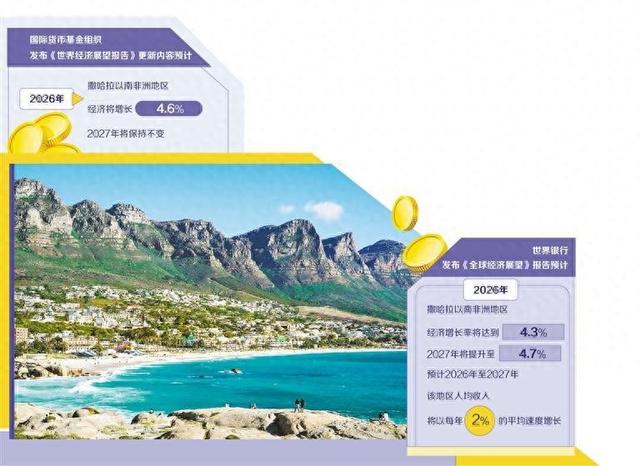
Core Insights - The economic growth in Sub-Saharan Africa is projected to remain moderate and above the global average, with various international economic organizations forecasting a growth rate of 4.6% in 2026, up from 4.4% in 2025 [3][4] - Major economies in the region, such as Nigeria and South Africa, are expected to show varying growth rates, with Nigeria at 4.4% and 4.1% for 2026 and 2027 respectively, while South Africa is projected at 1.4% and 1.5% for the same years [3] - The region's economic performance is supported by improved macroeconomic stability, increased investment, and a recovery in agriculture, despite facing challenges such as domestic security issues and geopolitical conflicts [5][7] Economic Forecasts - The International Monetary Fund (IMF) predicts that Sub-Saharan Africa's economic growth will accelerate to 4.6% in 2026, maintaining this rate into 2027, driven by macroeconomic stability and reforms [3] - The World Bank has adjusted its forecasts, expecting the region's growth to reach 4.3% in 2026 and 4.7% in 2027, bolstered by stronger investment and export performance [4] - The United Nations Conference on Trade and Development (UNCTAD) anticipates a slight increase in Africa's economic growth from 3.9% in 2025 to 4.0% in 2026, supported by improved macroeconomic stability and consumer demand [6] Positive Economic Indicators - Key economies like Nigeria and South Africa are experiencing positive trends such as reduced inflation and increased fiscal revenues, contributing to overall economic growth [5] - The region benefits from factors like stable electricity supply, recovery in agriculture, and expansion in the service sector, particularly in finance and information technology [5] - Improved financial conditions have allowed several economies, including Angola and Kenya, to regain access to international capital markets [5] Challenges and Risks - Economic growth in the region is still vulnerable to domestic security and geopolitical conflicts, which may hinder progress [7] - The anticipated growth rates are insufficient to make significant strides in reducing extreme poverty, particularly in conflict-affected areas [7] - A significant reduction in official development assistance (ODA) since 2024 has limited fiscal space for many countries, weakening their ability to withstand adverse shocks [7] - The region's economies remain heavily reliant on a limited number of export markets, particularly the United States, which poses risks to economic stability [7] - Employment generation remains a challenge, with growth not keeping pace with labor force increases, leading to limited job opportunities [7]
中信建投:坚守“科技+资源品”双主线
Ge Long Hui A P P· 2026-01-26 01:17
Core Viewpoint - The report from CITIC Securities indicates that while industrial production remains resilient and exports are growing rapidly, domestic demand indicators such as consumption and investment are still weak, highlighting a characteristic of "strong production versus weak demand" throughout the previous year [1] Economic Environment - The current macroeconomic environment shows similarities to the investment peak period of 2020-2021, with interbank interest rates at their lowest levels since 2020 [1] - The combination of weak macro demand and loose liquidity is expected to favor structural investment opportunities in certain sectors [1] Sector Insights - In the technology sector, AI semiconductors and new energy are identified as the core areas of current prosperity, with strong policy support for AI applications and accelerated commercialization [1] - The global capacity planning for space photovoltaics has exceeded expectations, and technological breakthroughs are opening up trillion-dollar markets [1] - The innovative drug sector is seeing value realization driven by business development transactions, clinical breakthroughs, and new drug approvals [1] Resource Sector - The non-ferrous metals industry has the highest forecasted performance improvement rate for 2025, with attention on the subsequent transmission of prosperity to the energy and machinery sectors [1] - As monetary easing continues, funds are expected to gradually shift from the financial system to the real economy, benefiting sectors such as non-ferrous metals, chemicals, machinery, and consumer goods [1] - Since December 2025, the South China Metal Index has risen by 12.5%, while the energy and industrial product indices have only increased by around 7%, suggesting better investment value in the current market [1]

证监会发布公募基金业绩比较基准指引!三分钟看完周末发生了什么
Sou Hu Cai Jing· 2026-01-26 01:00
商品市场方面,全球市场在地缘政治摩擦加剧的冲击下剧烈震荡。以黄金、白银为代表的贵金属成为了市场的焦点,其强劲的避险需求直接驱动了价格的 飙升。原油市场方面,除地缘局势外,哈萨克斯坦一直难以恢复全球最大油田之一的产量及北美极端寒潮天气引发美国天然气史诗级暴涨,推动油价宽幅 震荡走高。 (数据来源:wind,日期截至2026年1月23日,指数过往业绩不预示其未来表现,投资需谨慎) 01 市场回顾 | | | 全球大类资产本周表现 (2026/1/19-2026/1/23) | | | | | --- | --- | --- | --- | --- | --- | | 全球指数 | 涨跌幅 | A股领涨行业 | 涨跌幅 | 外汇 | 涨跌幅 | | 巴西IBOVESPA指数 | 8.53% | 建筑材料 | 9.23% | 澳元兑美元 | 3.19% | | 中证500 | 4.34% | 石油石化 | 7.71% | 欧元兑美元 | 1.97% | | 韩国综合指数 | 3.08% | 钢铁 | 7.31% | 美元兄港元 | 0.01% | | 科创50 | 2.62% | 基础化工 | 7.29% | 欧元兑 ...

“六箭齐发”彰显宏观调控创新
Sou Hu Cai Jing· 2026-01-25 23:11
Core Viewpoint - The Ministry of Finance, in collaboration with the central bank and other relevant departments, has launched a series of coordinated fiscal and financial policies aimed at boosting domestic demand as the main driver of economic growth, emphasizing the importance of policy and execution collaboration [2][3]. Group 1: Policy Innovation - A new package of policies has been introduced, including interest subsidies for loans to small and micro enterprises, a special guarantee plan for private investment, and a risk-sharing mechanism for private enterprise bond issuance, aimed at addressing financing difficulties and costs [3]. - The policies utilize a combination of tools such as loan interest subsidies and guarantees to support both indirect and direct financing, enhancing the effectiveness of fiscal and monetary policy collaboration [3]. Group 2: Policy Optimization - Among the six policies released, three focus on optimizing existing measures, including interest subsidies for equipment upgrades and personal consumption loans, which have proven effective in expanding domestic demand [4]. - The optimization includes extending implementation periods, broadening support areas, and increasing the number of participating banks, thereby enhancing the precision and effectiveness of existing policies [4]. Group 3: Policy Strength - The new policies demonstrate significant financial commitment, with a special guarantee plan for private investment amounting to 500 billion yuan, and increased loan limits for service sector entities and small enterprises, effectively reducing their financing costs [5]. - The interest subsidy for small and micro enterprises is set at 1.5% of the total loan amount for a maximum period of two years, with individual loan amounts reaching up to 50 million yuan, showcasing a proactive macroeconomic policy approach [5].

日元盘初大幅升值 日本股指料低开
Sou Hu Cai Jing· 2026-01-25 22:31
由于市场高度关注日本可能出手干预以阻止日元近期的下跌,日元兑美元汇率继续走强。日元兑美元汇 率在悉尼早盘交易中上涨0.7%,至154.58,延续了上周五的涨势。日本首相高市早苗警告称,如果汇率 出现异常波动,日本政府将采取行动,因此市场高度警惕日本政府可能采取干预措施——美国或许会罕 见地提供援助。美元也成为市场关注焦点,此前美元经历了自去年5月以来最糟糕的一周,推动全球货 币走强。此外,日本股指 期货预示着日本股市将下跌。Miller Tabak首席市场策略师Matt Maley表 示:"大多数支撑本国货币的举措只会导致长期利率进一步上升,因此,他们现在似乎进退两难。" ...
A股ESG强制披露“首考”进行时 投资者“阅卷”如何识金
Zhong Guo Zheng Quan Bao· 2026-01-25 21:58
Group 1 - The core focus of the articles is the increasing importance of ESG (Environmental, Social, and Governance) disclosures among listed companies in the A-share market, especially with the mandatory disclosure of sustainability reports starting in 2026 [1][2] - Investors are encouraged to develop effective methods for evaluating ESG reports to avoid "greenwashing" risks and to identify companies that are genuinely committed to sustainable practices [1][2] - The shift from voluntary to mandatory ESG reporting is expected to enhance the completeness and comparability of reports, particularly in environmental data such as greenhouse gas emissions [2][3] Group 2 - Key areas of focus for evaluating ESG management include the clarity of disclosure boundaries, the quality of data, and the establishment of reduction targets and pathways [3][4] - Governance and social indicators that reflect long-term development potential are often overlooked, yet they are crucial for assessing a company's ESG performance [4][5] - Industry-specific scoring checklists are recommended to identify material issues that have both substantive impact and financial significance [5][6] Group 3 - The credibility of ESG data is increasingly reliant on third-party verification, which is becoming more prevalent among major companies [6][7] - Investors should focus on the authority of verification agencies and the scope of the verification to assess the reliability of ESG reports [7][8] - High-quality verification can enhance a company's score in mainstream ESG ratings, although it is not a direct indicator of higher valuation [8][9] Group 4 - The quality of ESG reporting is expected to lead to valuation differentiation in the market, with companies that provide incomplete or low-quality disclosures facing potential valuation discounts [9][10] - The mandatory disclosure will likely foster structural investment opportunities, encouraging competition among companies in terms of efficiency metrics related to energy consumption and emissions [10][11] - Enhanced ESG data quality may lead to the creation of new ESG index products and investment tools, benefiting both passive and active investment strategies [10][11]
A股ESG强制披露“首考”进行时投资者“阅卷”如何识金
Zhong Guo Zheng Quan Bao· 2026-01-25 21:06
Core Insights - The article emphasizes the increasing importance of ESG (Environmental, Social, and Governance) disclosures among listed companies in the A-share market, particularly with the mandatory disclosure of sustainability reports starting in 2026 [1][2] - The shift from voluntary to mandatory ESG reporting is expected to enhance data transparency and comparability, leading to more accurate valuations and healthier market ecosystems [1][2] Group 1: ESG Reporting Changes - The transition to mandatory ESG reporting will transform the nature of disclosures from qualitative case studies to quantitative data-driven reports, improving completeness and comparability among companies [1][2] - Enhanced disclosure requirements will lead to more detailed reporting on environmental data, particularly greenhouse gas emissions, which is now considered financially significant [1][2] Group 2: Key Considerations for Investors - Investors are advised to focus on core chapters of ESG reports that align with the "double materiality" principle, including carbon emissions accounting and climate scenario analysis [2] - Key areas to scrutinize include the clarity of disclosure boundaries, the methods used for data calculation, and the presence of third-party verification [2] Group 3: Governance and Social Indicators - In addition to environmental data, governance and social indicators are crucial for assessing long-term corporate potential, including board diversity and employee welfare metrics [3] - Important social indicators include employee injury rates, mental health support usage, and labor rights compliance [3] Group 4: Industry-Specific ESG Metrics - Different industries require tailored ESG assessment criteria, with high-energy sectors focusing on climate change risks and resource management [4] - Continuous monitoring and validation of key performance indicators (KPIs) are essential for aligning with industry trends and ensuring reliable investment decisions [4] Group 5: Verification of ESG Data - The importance of third-party verification for enhancing the credibility of ESG reports is highlighted, with a growing trend in the coverage of ESG report verification among major indices [6] - Investors should evaluate the credibility of verification reports based on the authority of the verifying institutions and the scope of the verification [6][7] Group 6: Investment Opportunities - The quality of ESG reports is expected to create valuation differentiation, with companies that provide incomplete or low-quality disclosures facing potential valuation discounts [8] - The mandatory disclosure will also enhance investment opportunities in green technologies and sustainable practices, guiding capital towards low-carbon sectors [8][9] Group 7: ESG Product Innovation - Improved ESG disclosure quality is likely to lead to the development of new ESG index products, providing additional tools for passive investment and creating more alpha opportunities for active managers [9] - Institutional investors face challenges in managing and applying vast amounts of ESG data, necessitating the establishment of resilient ESG investment frameworks [9]
北京:完善民营小微企业融资支持协调机制
Zhong Guo Zheng Quan Bao· 2026-01-25 21:05
Economic Growth Targets - The GDP growth target for Beijing in 2026 is set at around 5% [1][2] - The projected GDP for 2025 is 5.2 trillion yuan, with a year-on-year growth of 5.4%, surpassing the national average by 0.4 percentage points [1] Investment and Project Development - Beijing aims to actively expand effective investment, promoting major projects with a total investment of no less than 200 billion yuan [1][3] - The report emphasizes optimizing investment structure, increasing investments in livelihood improvement and consumption upgrade [3] Key Economic Indicators - The expected growth for general public budget revenue is around 4% [2] - The urban unemployment rate is targeted to be controlled within 5% [2] - The average annual concentration of fine particulate matter is aimed to be around 29 micrograms per cubic meter [2] Focus on High-Tech Industries - The report highlights the implementation of the "Artificial Intelligence +" initiative and the establishment of a national AI application pilot base [3] - Future industry pilot zones will be developed to foster new growth points in 6G, quantum technology, and biomanufacturing [3] Financial Sector Development - Beijing will enhance its modern service industry, leveraging its role as a national financial management center [4] - Support will be provided for the Beijing Stock Exchange to strengthen financing services for small and medium-sized enterprises [4]