光模块

Search documents
科技金融释放四大红利
Ke Ji Ri Bao· 2025-12-04 01:00
Core Insights - The total issuance of technology innovation bonds in the market has reached approximately 1.5 trillion yuan, with funds accelerating towards technology innovation entities [1] - The establishment of an 800 billion yuan re-lending program for technology innovation and technological transformation by the Ministry of Science and Technology and the People's Bank of China aims to support over 120,000 technology-based SMEs [1] - The implementation of the "Innovation Points System" and specialized guarantee plans has led to positive outcomes in financial support for major national technology tasks and technology-based SMEs [1] Group 1: Technology Financial System Development - The establishment of a "Technology Board" in the bond market is a key focus for building a technology financial system that aligns with technological innovation, aiming to raise long-term, low-interest, and easily accessible bond funds [2] - Shenzhen has taken the lead in responding to the "Technology Board," issuing a total of 1 billion yuan in technology innovation bonds, primarily targeting cutting-edge fields such as artificial intelligence and biomedicine [2] - The "Investment-Insurance Linkage" model by Shenzhen High-tech Investment Group provides comprehensive services including equity, debt, and diversified financial tools to support startups and small enterprises [2] Group 2: Bond Issuance and Financial Products - Guangdong has issued 102 technology innovation bonds with a total issuance scale of 111.4 billion yuan, ranking second nationwide, with most funds directed towards technology innovation-related fields [3] - The bond market's "Technology Board" leverages its market-oriented advantages to continuously introduce specialized innovative products to support financing for technology-based enterprises [3] - A multi-layered and diversified technology financial service system is being developed to better meet the financing needs of technology-based enterprises at different stages [3] Group 3: Financial Support Mechanisms - The establishment of a coordinated mechanism for technology finance has improved the matching and precision of financial support for technology innovation [4] - A comprehensive financial service plan called "Mid-Stage Insurance and Financing" has been launched, providing 100 billion yuan in bank support and insurance guarantees for mid-stage projects over the next three years [4] - The "拨保贷投" mechanism provides full lifecycle funding support for mid-stage projects, covering various funding needs from project inception to maturity [5] Group 4: Innovation Points System - The "Innovation Points System" is being promoted nationwide to optimize evaluation indicators and provide precise profiles for technology-based SMEs [6] - In Handan, the "科创数智贷" product allows companies to secure loans based on their innovation points ranking, demonstrating the effectiveness of the innovation points system [7] - The upgraded "Innovation Points System 2.0" aims to convert a company's innovation potential into quantifiable credit for financial institutions, enhancing the accessibility and efficiency of technology financial services [8] Group 5: Knowledge Value Credit - Hubei has established a knowledge value credit evaluation model, allowing companies to secure financing based solely on intellectual property and talent value [9] - The "Knowledge Value Credit Loan" program has issued a total of 77.4 billion yuan, supporting 14,916 technology-based enterprises, breaking the traditional asset-backed financing model [11] - The establishment of a risk compensation fund and a scientific knowledge value credit evaluation system has enhanced banks' willingness to lend to technology-based enterprises [10][11]


抱紧英伟达谷歌“大腿”,680亿烟台首富“赢麻了”
投中网· 2025-12-03 09:30
以下文章来源于雷达Finance ,作者X编辑 市值一度冲破6000亿。 作者丨 丁禹 编辑丨 孟帅 来源丨 雷达Finance 市值一度冲破6000亿元大关、股价较年初大涨超3倍……借着AI的东风,中际旭创成为了资本市场 上的当红炸子鸡。 雷达财经注意到,在股价狂飙的同时,中际旭创的业绩表现同样十分亮眼。今年前三季度,公司营收 增长44.43%至250.05亿元,归母净利润同比更是大涨九成,增至71.32亿元。 而中际旭创这波市值狂飙的背后,除了公司自身业绩的强劲支撑,大客户谷歌近期斩获Meta数十亿 美元大单的消息,也被市场视为重要助推力。 雷达Finance . 遨游广袤的财富世界。 将投中网设为"星标⭐",第一时间收获最新推送 得益于公司业绩和股价的双丰收,身为中际旭创掌舵者的王伟修身家也水涨船高。 在《2025胡润百富榜》上,王伟修、王晓东父子以680亿元的身家位列榜单第73位,并荣膺烟台首 富(以居住地为标准),身家几乎是去年的3.5倍。 不过,中际旭创看似光鲜的表象背后,公司也面临存货规模增长、客户集中度较高等隐忧。与此同 时,AI行业的"泡沫论",也如达摩克利斯之剑般悬于中际旭创的头顶。 市值 ...

灵魂拷问:牛市还在不在?
Ge Long Hui· 2025-12-03 08:06
今天又超过4000家公司下跌,大跌的公司其实并不多,但最近的盘面,就是持续的阴跌,其难受程度,远不如4月给人一个痛快。 从10月至今,市场超过3000家公司是大跌的,涨10个点以上的公司1100家(10个点以内可以理解为震荡行情)。如果我们按10月至 今的区间最高价算到昨天收盘价,回撤10个点以上的公司有3300家,回撤超过15个点的有2049家,回撤超过20个点的有1024只。 所以,这段时间,虽然上证指数回撤并没有多少,但应该不少人的回撤是很大的。 如果配了港股,那会更加悲剧,因为就恒生科技指数来说,最高下来回撤了近20%,个股回撤2、30个点的一抓一大把,说港股一脚 已经踏入熊市,都不算过分的。 这就引出了一个灵魂问题:牛市到底还在不在? 我们从这波回撤的原因,当前的市场环境来讨论这个问题。 01 高位很高,低位不济 10月至今这波回撤,要说原因的话,我觉得就是8个字,高位很高,低位不济。 10月之前,创新药猛猛涨了一波,半导体猛猛涨了一波,AI猛猛涨了一波。这些方向的估值都非常高,如果没有更新的进展来打鸡 血,震荡消化估值是不可避免的。像光模块方向因为实不实又被美帝那边的进展打下鸡血,还有铜铝也加上了 ...
新华指数月度洞察:资本聚焦硬科技,产业链安全驱动出海
Xin Hua Cai Jing· 2025-12-03 05:47
Group 1 - Outbound capital is increasingly focused on "hard technology" and "industrial chain security," with significant investments flowing into areas like 6G and power batteries, where China has established global technological leadership and control over the supply chain [1][8] - The Xinhua Creative Research Long-term Index experienced a 5% decline at the end of November 2025, as funds shifted away from high-valuation sectors like semiconductors and photovoltaics, moving towards traditional cyclical sectors such as construction machinery that are directly related to current "stable growth" infrastructure investments [2][10] - The lithium battery electrolyte additive market is witnessing a surge in prices, driven by strong demand from the recovering new energy vehicle market, with leading companies like Tianqi Lithium signing long-term contracts for over 1.5 million tons of electrolyte, indicating high industry prosperity [3] Group 2 - China's shipbuilding industry is integrating into the global high-end value chain, with companies like Yaxing Anchor Chain benefiting from increased sales and investment returns, reflecting the overall rise of the Chinese shipbuilding sector [4][5] - The Chinese optical module industry is transitioning from scale expansion to technological leadership, with the market expected to grow from 60.6 billion yuan in 2024 to 67 billion yuan in 2025, driven by a significant increase in high-speed product offerings [6] - The current market dynamics show that funds are gravitating towards sectors with clear certainty, particularly in manufacturing, consumption, and electrical new energy, while emerging growth sectors face capital outflows due to valuation concerns [10]

资金两手抓,盘中加速涌入创业板人工智能ETF华夏(159381),自由现金流ETF(159201)连续18日获净申购
Ge Long Hui· 2025-12-03 03:25
Group 1 - A-shares experienced a significant drop of 280 billion with reduced trading volume, while technology and defensive sectors showed a contrasting performance today, with the CPO sector rising in the morning [1] - The AI ETF from the ChiNext market saw a peak increase of over 2% before turning negative, with a net subscription of 28 million shares during the day [1] - The free cash flow ETF also gained traction, with an increase of 0.59% and a net subscription of 14 million shares, reflecting a continuous inflow of funds since November 7, totaling 2.027 billion yuan over 18 days [1] Group 2 - Recent developments include Alibaba increasing its AI application efforts, ByteDance launching the Doubao mobile assistant, and DeepSeek releasing a new model with inference capabilities approaching GPT-5, indicating a rising demand for computing power as AI moves towards "inference + terminal" [2] - In the US market, Credo's performance exceeded expectations, leading to a 10% stock price increase, while Morgan Stanley raised Google's TPU production forecasts [3] - As the year-end approaches, market sentiment is shifting, with major banks halting large-denomination time deposits, increasing focus on cash flow and dividend strategies [3] Group 3 - The free cash flow ETF (159201) is noted for its low fee structure, with a current scale of 7.499 billion yuan, and includes major stocks like China National Offshore Oil Corporation and Gree Electric Appliances [4] - The ChiNext AI ETF (159381) has the highest CPO content and lowest fees among AI indices, with a slight decrease of 0.24%, featuring stocks such as Xinyiseng and Tianfu Communication [4]

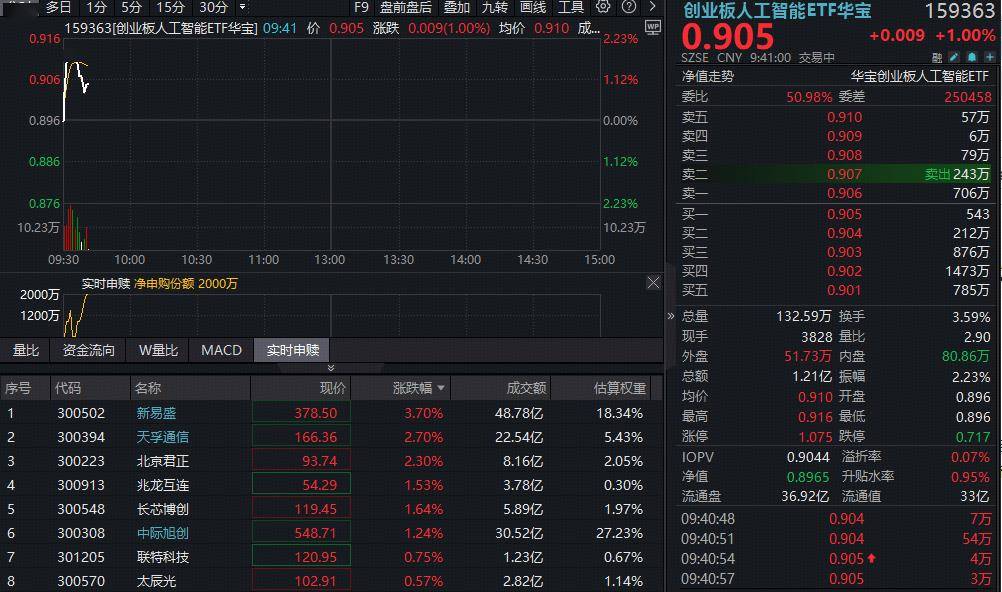
涨逾2%逼近历史高点!AI光模块火热,含“光”量超56%的创业板人工智能ETF(159363)量价齐升
Mei Ri Jing Ji Xin Wen· 2025-12-03 02:59
Core Viewpoint - The AI industry is experiencing a clear upward trend, with significant growth in the production of Google's TPU, indicating strong demand for computing power and AI applications [1][2]. Group 1: Market Activity - The optical module CPO and computing hardware continue to show strong activity, with New Yisheng rising over 4%, Tianfu Communication increasing over 3%, and Zhongji Xuchuang up over 1% [1]. - The AI-focused ETF (159363) saw its price rise over 2%, approaching its historical high since listing, with a real-time transaction volume exceeding 2.7 billion yuan, indicating a notable increase in trading activity [1]. Group 2: Supply Chain Insights - Morgan Stanley's latest research indicates a significant increase in Google's TPU production forecasts, with 2027 production estimates raised from approximately 3 million units to 5 million units (a 67% increase) and 2028 estimates from about 3.2 million units to 7 million units (a 120% increase) [1]. Group 3: Investment Recommendations - Huazhang Securities suggests that the AI industry's growth trend is clear, and the current short-term adjustment provides a good opportunity for future positioning, emphasizing the importance of computing power and AI applications [1]. - The first AI ETF on the ChiNext market (159363) and its corresponding off-market connection (023407) are recommended for investment, focusing on leading companies in the optical module sector, with over 56% of the ETF's holdings in optical modules [2].
通信ETF(515880)涨超1.3%,光模块占比超50%,海外云厂商资本开支屡创新高
Mei Ri Jing Ji Xin Wen· 2025-12-03 02:59
在海内外算力基础设施持续投入的背景下,光模块市场有望维持高景气度。通信ETF(515880)规 模同类第一,截至10月28日,通信ETF光模块占比达52%,服务器占比达22%,叠加光纤、铜连接等环 节,合计占比超81%,代表了海外算力的基本面底气。 相关机构表示,从财报数据及指引来看,一方面,海外云厂商的资本开支屡创新高,并对2026年的 投资口径保持乐观;另一方面,AI已成为云业务加速成长的核心驱动力,微软/谷歌/亚马逊/阿里的云业 务最新增速(YoY)达到40%/34%/20%+/34%,AI的商业闭环正在逐步形成。(提及具体公司仅为说明 行业观点,不构成投资建议) 根据中金公司预测,在头部科技企业加速部署自研AI ASIC集群的背景下,有望驱动光模块需求在 2026年继续维持高增长,其中对800G/1.6T的需求有望达到4000万/2000万只以上(25年预计分别为2000 万/100万)。 每日经济新闻 (责任编辑:董萍萍 ) 【免责声明】本文仅代表作者本人观点,与和讯网无关。和讯网站对文中陈述、观点判断保持中立,不对所包含内容 的准确性、可靠性或完整性提供任何明示或暗示的保证。请读者仅作参考,并请自 ...
AI驱动光模块,新易盛涨超4%逆市冲击七连涨!云计算ETF汇添富(159273)冲高回落再度吸金!海外算力大战持续火热,亚马逊重磅发布!
Sou Hu Cai Jing· 2025-12-03 02:47
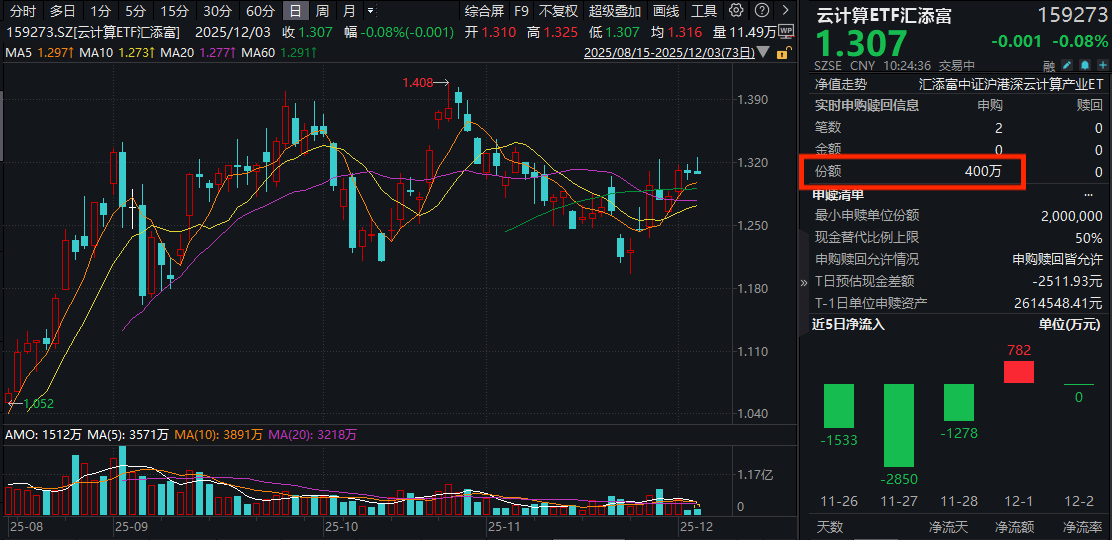
Core Insights - The cloud computing sector is experiencing fluctuations, with the Huatai Cloud Computing ETF (159273) seeing significant trading volume exceeding 15 million yuan and a net inflow of over 52 billion yuan [1][3]. Group 1: Cloud Computing Developments - Amazon Web Services (AWS) launched the next-generation AI training chip, Trainium 3, at the re:Invent conference, and announced plans for Trainium 4, aiming to compete with Nvidia and Google in the AI chip market [3]. - Morgan Stanley raised its forecast for Google's TPU production for 2027-2028, indicating a positive outlook for hardware suppliers related to optical modules [3]. - Domestic company DeepSeek released two official model versions, DeepSeek-V3.2 and DeepSeek-V3.2-Speciale, enhancing its AI offerings [3]. Group 2: Market Performance of Key Stocks - The majority of the index component stocks of the Huatai Cloud Computing ETF showed declines, with notable drops including Huasheng Tiancheng and Data Port, both down over 3%, while NewEase and Kehua Data saw increases of over 4% and nearly 1%, respectively [3][4]. Group 3: Optical Module Market Insights - According to招商证券, 2025 is expected to be a standout year for optical module suppliers with high AI business ratios, driven by significant revenue growth and profit margin expansion [5]. - Major cloud providers in the U.S. are projected to spend $230 billion on capital expenditures in 2024, a 55% year-on-year increase, with further investments expected to reach $367 billion in 2025 [5]. - The revenue growth rates for leading optical module manufacturers like Coherent, Zhongji Xuchuang, and NewEase are forecasted at 15%, 120%, and 175% respectively for 2024, with continued strong performance anticipated through 2026 [7]. Group 4: Supply Chain and Technology Trends - The optical module industry is facing supply chain challenges, particularly with EML chips, but advancements in silicon photonics technology are expected to alleviate some of these bottlenecks [8]. - By 2026, the share of silicon photonics is projected to exceed 50%, with significant growth in the shipment of 800G and 1.6T optical module products [8]. - Key suppliers like Lumentum and Coherent are planning substantial capacity expansions to meet the growing demand in the optical module market [9]. Group 5: AI Infrastructure and Applications - The launch of the Doubao mobile assistant by ZTE is part of a broader trend towards AI applications in mobile technology, with significant government support for AI integration across various sectors by 2027 [10][11]. - The demand for computing infrastructure is expected to accelerate due to the increasing deployment of AI applications, benefiting the related supply chain, including optical modules and edge computing solutions [11].

DeepSeek发布新模型!创业板50ETF(159949)涨0.48%,机构持续看好AI产业链投资机会
Xin Lang Cai Jing· 2025-12-03 02:33
Core Viewpoint - The news highlights the performance of the ChiNext 50 ETF (159949), which has shown a slight increase of 0.48% to 1.467 CNY, amidst a broader market fluctuation, indicating ongoing investor interest and activity in the growth sector [1][6]. Market Performance - As of 10:20 AM on December 3, the ChiNext 50 ETF (159949) was trading at 1.467 CNY, with a trading volume of 4.22 billion CNY and a turnover rate of 1.66% [1][6]. - The ETF has experienced a cumulative trading amount of 323.05 billion CNY over the last 20 trading days, averaging 16.15 billion CNY per day, and a total of 3,205.79 billion CNY over 222 trading days this year, averaging 14.44 billion CNY per day [7][10]. Top Holdings - The top ten holdings of the ChiNext 50 ETF (159949) include leading companies such as CATL, Zhongji Xuchuang, Dongfang Caifu, Xinyi Technology, Sungrow Power, Shenghong Technology, Huichuan Technology, Mindray, Yiwei Lithium Energy, and Tonghuashun [3][8]. Industry Insights - Longcheng Securities reports that the continuous implementation of AI applications will drive the acceleration of computing infrastructure, particularly in the AIDC industry chain, which includes optical modules, PCBs, and main equipment manufacturers, indicating a strong demand release and potential for performance and valuation growth [10]. - The report suggests that the demand for edge computing modules will steadily increase as AI applications continue to develop, transitioning from traditional data transmission modules to intelligent and computing modules [10]. Investment Recommendations - The ChiNext 50 ETF (159949) is presented as a convenient and efficient investment tool for investors looking to capitalize on the long-term growth of China's technology sector, with recommendations for dollar-cost averaging or phased investment strategies to mitigate short-term volatility [10].






ETF盘中资讯 | 光模块CPO反复活跃!新易盛冲击七连阳,含“光”量超56%的创业板人工智能ETF(159363)放量冲高逾2%
Sou Hu Cai Jing· 2025-12-03 02:04
Core Viewpoint - The market for AI-related hardware, particularly optical modules and computing power, is experiencing significant growth, driven by increased demand and production forecasts from major players like Google [1][3][4]. Group 1: Market Activity - Optical module CPO and related hardware continue to show strong performance, with companies like Xinyisheng and Tianfu Communication seeing stock increases of over 4% and 3% respectively [1]. - The AI ETF (159363) with over 56% optical module CPO content has seen a price increase of over 2%, indicating strong market interest and a potential breakout from its trading range [1]. Group 2: Industry Forecasts - Morgan Stanley's research indicates a significant upward revision in Google's TPU production forecasts, with expected increases from approximately 3 million units in 2027 to 5 million units, a 67% increase, and from 3.2 million units in 2028 to 7 million units, a 120% increase [2]. - Zhongtai Securities highlights Google's comprehensive technology ecosystem, which strengthens its competitive position in AI and drives ongoing capital investment growth [3]. Group 3: Investment Recommendations - The first AI ETF tracking the ChiNext AI Index is recommended for investment, focusing on leading optical module companies, with over 70% of its portfolio allocated to computing power and over 20% to AI applications [4]. - The optical module industry is expected to see a significant capacity release in Q1 2026, driven by leading manufacturers expanding production in mainland China and Thailand [3].